
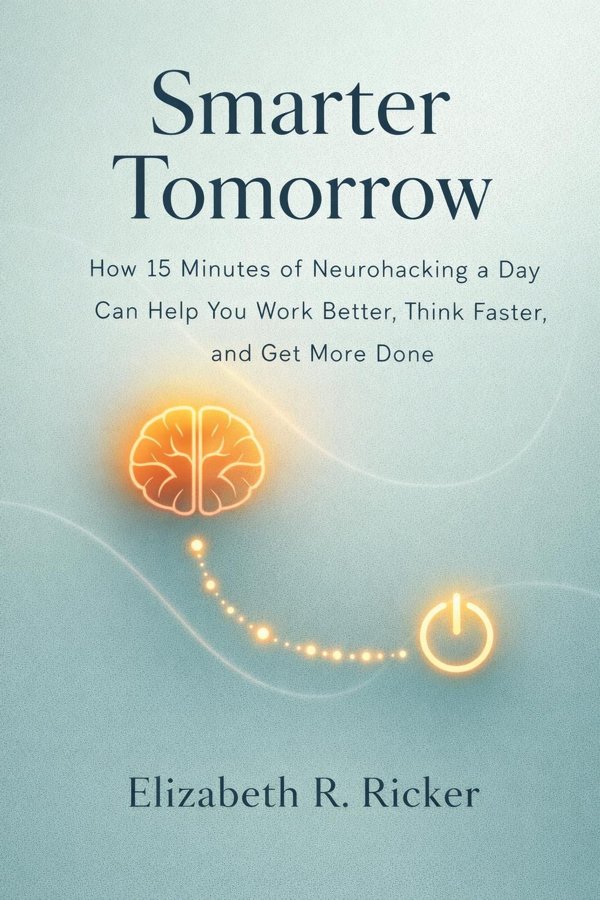
Smarter Tomorrow: How 15 Minutes of Neurohacking a Day Can Help You Work Better, Think Faster, and Get More Done: Summary & Key Insights
 10 min7 chaptersAudio available
What Is Smarter Tomorrow: How 15 Minutes of Neurohacking a Day Can Help You Work Better, Think Faster, and Get More Done About?
Smarter Tomorrow: How 15 Minutes of Neurohacking a Day Can Help You Work Better, Think Faster, and Get More Done by Elizabeth R. Ricker is a neuroscience book spanning 7 pages. Smarter Tomorrow es un libro de no ficción que explora cómo las técnicas de neurociencia y psicología pueden aplicarse para mejorar el rendimiento cognitivo y la productividad diaria. Elizabeth R. Ricker combina investigación científica con ejercicios prácticos de 'neurohacking' que ayudan a los lectores a optimizar su memoria, concentración y creatividad mediante hábitos sostenibles y autoexperimentación.
This FizzRead summary covers all 7 key chapters of Smarter Tomorrow: How 15 Minutes of Neurohacking a Day Can Help You Work Better, Think Faster, and Get More Done in approximately 10 minutes, distilling the most important ideas, arguments, and takeaways from Elizabeth R. Ricker's work. Also available as an audio summary and Key Quotes Podcast.
Smarter Tomorrow: How 15 Minutes of Neurohacking a Day Can Help You Work Better, Think Faster, and Get More Done
Smarter Tomorrow es un libro de no ficción que explora cómo las técnicas de neurociencia y psicología pueden aplicarse para mejorar el rendimiento cognitivo y la productividad diaria. Elizabeth R. Ricker combina investigación científica con ejercicios prácticos de 'neurohacking' que ayudan a los lectores a optimizar su memoria, concentración y creatividad mediante hábitos sostenibles y autoexperimentación.
Who Should Read Smarter Tomorrow: How 15 Minutes of Neurohacking a Day Can Help You Work Better, Think Faster, and Get More Done?
This book is perfect for anyone interested in neuroscience and looking to gain actionable insights in a short read. Whether you're a student, professional, or lifelong learner, the key ideas from Smarter Tomorrow: How 15 Minutes of Neurohacking a Day Can Help You Work Better, Think Faster, and Get More Done by Elizabeth R. Ricker will help you think differently.
- ✓Readers who enjoy neuroscience and want practical takeaways
- ✓Professionals looking to apply new ideas to their work and life
- ✓Anyone who wants the core insights of Smarter Tomorrow: How 15 Minutes of Neurohacking a Day Can Help You Work Better, Think Faster, and Get More Done in just 10 minutes
Want the full summary?
Get instant access to this book summary and 100K+ more with Fizz Moment.
Get Free SummaryAvailable on App Store • Free to download
Key Chapters
When I first encountered the concept of neuroplasticity as a young researcher, it revolutionized how I saw human potential. Neuroplasticity refers to the brain’s remarkable ability to rewire itself in response to new experiences, thoughts, and behaviors. Once thought to be static after adolescence, we now know the adult brain is malleable, constantly pruning and strengthening neural connections based on use.
This means that every time we intentionally focus, learn a skill, or adapt to a challenge, we’re literally reshaping our neural architecture. To me, that realization was both humbling and liberating. It meant that high cognitive performance isn’t a fixed trait—it’s trainable.
In this book, I draw on research ranging from meditation studies that show changes in the prefrontal cortex to experiments on cognitive training and brain stimulation. But what I find most persuasive is that change doesn’t require monumental time investment. Practiced consistently, even in small daily intervals, targeted cognitive challenges lead to measurable improvements in attention and working memory. Our objective is not to create short-term spikes of performance but to cultivate durable cognitive flexibility—the capacity to shift perspectives, learn rapidly, and stay adaptive in uncertain environments.
Neuroplasticity gives you the permission to start small and experiment boldly. Think of your brain as a muscle: it strengthens with intelligent stress and rests with recovery. By learning to work in deliberate cycles—focused practice followed by rest—you create the conditions for long-term adaptability. This foundational understanding is what underpins every technique in *Smarter Tomorrow*.
Through years of consulting and testing ideas on myself and others, I realized that cognitive improvement has to be measurable, structured, and enjoyable. That insight led me to develop the SMART framework—standing for Self-Experiments, Metrics, Analysis, Research, and Training. This framework is your compass for running scientifically informed self-experiments that fit your lifestyle.
First, the *Self-Experiments* stage invites curiosity. Instead of adopting fads or hacks blindly, you identify a specific question: for instance, how does short daily meditation affect your concentration under stress? From there, *Metrics* come into play. Measurement doesn’t have to be clinical or intimidating—a quick digital test of working memory, a journaling habit, or mood tracking can serve as quantifiable proxies.
Next is *Analysis*, the stage where data transforms into understanding. You examine trends, control for variables such as time of day or caffeine intake, and look for consistent effects. Engaging with *Research* keeps your experiments aligned with validated scientific findings, ensuring what you test has plausible biological or psychological mechanisms. Finally, *Training* consolidates what works: you incorporate successful interventions into regular practice.
This process makes self-improvement empirical rather than speculative. It also transforms setbacks into information. When a cognitive hack doesn’t yield the intended results, you don’t label it failure—you see it as a data point. SMART reframes the very way we learn about ourselves, turning curiosity into methodical progress.
+ 5 more chapters — available in the FizzRead app
All Chapters in Smarter Tomorrow: How 15 Minutes of Neurohacking a Day Can Help You Work Better, Think Faster, and Get More Done
About the Author
Elizabeth R. Ricker es neurocientífica, escritora y conferencista. Graduada de MIT y Harvard, ha trabajado en investigación cognitiva y en el desarrollo de programas de mejora cerebral. Su trabajo se centra en la intersección entre la neurociencia, la tecnología y el bienestar humano.
Get This Summary in Your Preferred Format
Read or listen to the Smarter Tomorrow: How 15 Minutes of Neurohacking a Day Can Help You Work Better, Think Faster, and Get More Done summary by Elizabeth R. Ricker anytime, anywhere. FizzRead offers multiple formats so you can learn on your terms — all free.
Available formats: App · Audio · PDF · EPUB — All included free with FizzRead
Download Smarter Tomorrow: How 15 Minutes of Neurohacking a Day Can Help You Work Better, Think Faster, and Get More Done PDF and EPUB Summary
Key Quotes from Smarter Tomorrow: How 15 Minutes of Neurohacking a Day Can Help You Work Better, Think Faster, and Get More Done
“When I first encountered the concept of neuroplasticity as a young researcher, it revolutionized how I saw human potential.”
“Through years of consulting and testing ideas on myself and others, I realized that cognitive improvement has to be measurable, structured, and enjoyable.”
Frequently Asked Questions about Smarter Tomorrow: How 15 Minutes of Neurohacking a Day Can Help You Work Better, Think Faster, and Get More Done
Smarter Tomorrow: How 15 Minutes of Neurohacking a Day Can Help You Work Better, Think Faster, and Get More Done by Elizabeth R. Ricker is a neuroscience book that explores key ideas across 7 chapters. Smarter Tomorrow es un libro de no ficción que explora cómo las técnicas de neurociencia y psicología pueden aplicarse para mejorar el rendimiento cognitivo y la productividad diaria. Elizabeth R. Ricker combina investigación científica con ejercicios prácticos de 'neurohacking' que ayudan a los lectores a optimizar su memoria, concentración y creatividad mediante hábitos sostenibles y autoexperimentación.
You Might Also Like
Anxious
Joseph LeDoux
10 min
Hallucinations
Oliver Sacks
10 min
The Biological Mind: How Brain, Body, and Environment Collaborate to Make Us Who We Are
Alan Jasanoff
10 min
The Feeling of Life Itself: Why Consciousness Is Widespread but Can't Be Computed
Christof Koch
10 min
The No-Nonsense Meditation Book
Steven Laureys
10 min
A General Theory of Love
Thomas Lewis, Fari Amini, Richard Lannon
10 minBrowse by Category
Ready to read Smarter Tomorrow: How 15 Minutes of Neurohacking a Day Can Help You Work Better, Think Faster, and Get More Done?
Get the full summary and 100K+ more books with Fizz Moment.