
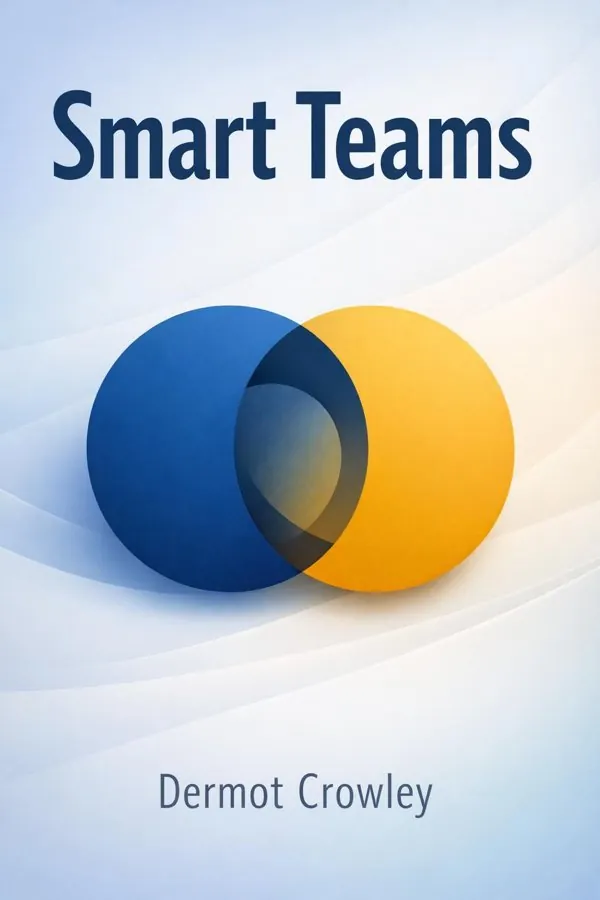
Smart Teams: How to Work Better Together: Summary & Key Insights
 10 min9 chaptersAudio available
Key Takeaways from Smart Teams: How to Work Better Together
The great irony of modern work is that the tools designed to help teams collaborate often make collaboration harder.
High-performing teams are rarely powered by charisma alone; they are powered by shared operating principles.
One of the most common causes of team stress is not too much work in absolute terms, but too many competing priorities at the same time.
Poor communication is rarely about lack of talking; more often, it is about lack of precision.
Strong teamwork is not built in a kickoff meeting; it is built in the repeated moments when people keep promises, raise issues early, and learn from what is not working.
What Is Smart Teams: How to Work Better Together About?
Smart Teams: How to Work Better Together by Dermot Crowley is a leadership book spanning 5 pages. Smart Teams: How to Work Better Together is a practical leadership and productivity book about a problem nearly every organization recognizes: talented people are working harder, communicating more, and using more tools than ever, yet many teams still feel overloaded, fragmented, and less effective than they should be. Dermot Crowley argues that better teamwork does not come from simply adding more meetings, more messages, or more urgency. It comes from building clear systems for how a team prioritizes, communicates, follows through, and improves together. Drawing on his work as a productivity expert and advisor to organizations, Crowley translates personal effectiveness principles into team-wide habits. He shows how clarity, focus, and accountability can become shared disciplines rather than individual aspirations. The result is a framework that helps teams reduce noise, manage competing demands, and collaborate with more intention. This book matters because modern work is increasingly interdependent. Most performance problems are no longer caused by isolated individual weakness, but by friction between people, tools, and priorities. Smart Teams offers leaders and team members a usable blueprint for creating calmer, faster, and more reliable ways of working together.
This FizzRead summary covers all 9 key chapters of Smart Teams: How to Work Better Together in approximately 10 minutes, distilling the most important ideas, arguments, and takeaways from Dermot Crowley's work. Also available as an audio summary and Key Quotes Podcast.
Smart Teams: How to Work Better Together
Smart Teams: How to Work Better Together is a practical leadership and productivity book about a problem nearly every organization recognizes: talented people are working harder, communicating more, and using more tools than ever, yet many teams still feel overloaded, fragmented, and less effective than they should be. Dermot Crowley argues that better teamwork does not come from simply adding more meetings, more messages, or more urgency. It comes from building clear systems for how a team prioritizes, communicates, follows through, and improves together.
Drawing on his work as a productivity expert and advisor to organizations, Crowley translates personal effectiveness principles into team-wide habits. He shows how clarity, focus, and accountability can become shared disciplines rather than individual aspirations. The result is a framework that helps teams reduce noise, manage competing demands, and collaborate with more intention.
This book matters because modern work is increasingly interdependent. Most performance problems are no longer caused by isolated individual weakness, but by friction between people, tools, and priorities. Smart Teams offers leaders and team members a usable blueprint for creating calmer, faster, and more reliable ways of working together.
Who Should Read Smart Teams: How to Work Better Together?
This book is perfect for anyone interested in leadership and looking to gain actionable insights in a short read. Whether you're a student, professional, or lifelong learner, the key ideas from Smart Teams: How to Work Better Together by Dermot Crowley will help you think differently.
- ✓Readers who enjoy leadership and want practical takeaways
- ✓Professionals looking to apply new ideas to their work and life
- ✓Anyone who wants the core insights of Smart Teams: How to Work Better Together in just 10 minutes
Want the full summary?
Get instant access to this book summary and 100K+ more with Fizz Moment.
Get Free SummaryAvailable on App Store • Free to download
Key Chapters
The great irony of modern work is that the tools designed to help teams collaborate often make collaboration harder. Email, chat platforms, shared documents, project boards, and video calls promise speed and connection, but without clear norms they create noise, interruption, and confusion. Crowley begins with this tension: most teams are not struggling because people are lazy or incapable; they are struggling because work is arriving from too many directions at once, with too little shared discipline for handling it.
In a hyperconnected environment, teams can mistake activity for progress. A day full of messages, meetings, and updates may feel productive while important work quietly stalls. People respond to what is loudest rather than what is most important. Priorities shift without being clarified. Ownership gets blurred. Team members spend energy managing inflow instead of delivering outcomes. As pressure rises, trust can also decline, because missed deadlines and patchy communication create frustration and blame.
Crowley frames this not as a technology problem but as a teamwork design problem. Healthy teams do not simply use communication tools; they agree on how to use them. They distinguish between urgent and important work, define who is responsible for what, and create shared expectations about response times, meeting purpose, and decision-making.
Imagine a marketing team launching a campaign. Requests come through email, chat, and hallway conversations. Designers receive conflicting feedback, managers assume someone else has approved copy, and campaign assets slip. The problem is not effort. The problem is unstructured coordination.
Actionable takeaway: audit your team’s current workflow and identify where work enters, how priorities are clarified, and where ownership becomes vague. Simplify those pressure points first.
High-performing teams are rarely powered by charisma alone; they are powered by shared operating principles. Crowley builds the book around a simple but powerful framework: clarity, focus, and accountability. While these ideas are often discussed at the individual level, his central contribution is showing how they become far more valuable when practiced collectively.
Clarity means the team knows what matters, what success looks like, who owns each deliverable, and how decisions are made. Without clarity, teams drift into assumptions and duplication. Focus means protecting attention so the team can make meaningful progress on the priorities that matter most. Without focus, important work gets buried under reactive tasks. Accountability means commitments are visible, tracked, and followed through. Without accountability, good intentions fade and deadlines become flexible in the worst way.
The strength of the framework lies in its simplicity. Teams often overcomplicate performance improvement by chasing sophisticated systems before they have mastered the basics. Crowley argues that if a team improves these three disciplines, many secondary problems begin to resolve. Meetings become shorter because expectations are clearer. Communication improves because people know when and how to engage. Workload pressure decreases because priorities are more explicit.
Consider a product team preparing a quarterly roadmap. Clarity defines the top objectives and decision owners. Focus limits the number of active initiatives. Accountability ensures each milestone has a named owner and review date. Instead of treating teamwork as an informal social process, the team treats it as a deliberate system.
Actionable takeaway: assess your team against the three pillars by asking, “Where do we lack clarity, where do we lose focus, and where do commitments fall through?” Start improving the weakest pillar first.
One of the most common causes of team stress is not too much work in absolute terms, but too many competing priorities at the same time. Crowley emphasizes that teams cannot perform at a high level if everything is treated as urgent. When priorities are unclear, people either chase the latest request or try to do everything at once. Both approaches create overload, poor quality, and hidden delays.
Alignment begins with visible priorities. Teams need a shared understanding of what the most important outcomes are right now, not just a long list of ongoing tasks. This means distinguishing strategic work from routine work, deciding what can wait, and acknowledging trade-offs openly. Leaders often damage team performance by saying everything matters equally. In reality, mature teams know that choosing one priority usually means giving less attention to another.
Crowley also highlights workload management as a team responsibility, not just a personal one. Individuals may have strong time-management habits, but if new work is constantly added without reviewing existing commitments, overload becomes inevitable. Effective teams regularly review capacity, reassign tasks when necessary, and stop pretending that invisible work has no cost.
A practical example is a client services team facing multiple deadlines in the same week. Instead of asking each person to “do their best,” the manager can convene a short planning session: What absolutely must be delivered? What can be deferred? Who has bandwidth? What dependencies could delay progress? This conversation turns stress into coordination.
Actionable takeaway: create a simple weekly team priority list with no more than three to five core outcomes, then review current workloads against those outcomes before accepting additional work.
Poor communication is rarely about lack of talking; more often, it is about lack of precision. Crowley argues that many teams communicate constantly but still fail to coordinate effectively because messages are vague, channels are misused, and commitments are not captured clearly. Teams become trapped in endless updates instead of meaningful progress.
Smart communication starts with intentionality. Different channels should serve different purposes. Quick chat messages may work for simple coordination, but major decisions need more durable documentation. Email may be useful for formal communication, but not for managing complex collaborative work that requires visibility and shared ownership. Meetings should exist to decide, align, or solve problems, not merely to report what could have been written.
Accountability then turns communication into execution. A discussion only matters if someone knows what happens next, who is responsible, and by when. Crowley encourages teams to stop ending meetings with general agreement and start ending them with explicit actions. The difference between “we should improve the onboarding process” and “Priya will draft a new onboarding checklist by Thursday for team review” is the difference between drift and delivery.
This approach also reduces interpersonal tension. When responsibilities are explicit, people are less likely to make assumptions or blame others unfairly. Accountability becomes a shared system rather than a personal confrontation.
Imagine a leadership team discussing a policy change. Without structure, everyone leaves with a different interpretation. With smart communication, the decision is summarized, actions are assigned, deadlines are agreed, and the follow-up point is scheduled.
Actionable takeaway: after every meeting or important discussion, document three things immediately: decisions made, actions assigned, and deadlines agreed.
Strong teamwork is not built in a kickoff meeting; it is built in the repeated moments when people keep promises, raise issues early, and learn from what is not working. Crowley stresses that collaboration is sustained by trust, and trust is sustained by consistency. Teams do not become effective simply because they like one another. They become effective because they create reliable ways of working that reduce friction and build confidence over time.
Trust grows when expectations are clear and behavior is dependable. If team members know that concerns can be raised safely, deadlines will be discussed honestly, and problems will be addressed without blame, collaboration deepens. If, instead, people hide overload, avoid difficult conversations, or quietly miss commitments, trust erodes even if relationships seem polite on the surface.
Continuous improvement is the discipline that keeps a team from slipping back into reactive habits. Crowley encourages regular reflection: What is helping us work well? Where are we losing time? Which meetings are useful? What recurring issues keep appearing? These questions help teams refine systems before frustration hardens into culture.
A simple example is a monthly team review. Rather than discussing only targets and outputs, the team also reviews process health. Are response-time expectations realistic? Is the project board accurate? Are handoffs between departments working? Small adjustments here can generate major gains in speed and morale.
Sustaining collaboration requires humility. Even successful teams must revisit their norms as workloads, people, and tools change. What worked last year may now create bottlenecks.
Actionable takeaway: build a short recurring team reflection into your calendar, and use it to improve one work habit, one communication habit, and one accountability habit every month.
Few workplace complaints are as universal as frustration with meetings. Crowley treats meetings not as a necessary evil, but as a critical test of team effectiveness. A smart team uses meetings to accelerate decisions, clarify priorities, and remove obstacles. A struggling team uses meetings to spread confusion, duplicate updates, and consume time that should have been spent doing the work.
The first principle is that meetings need a clear purpose. Is the meeting for decision-making, planning, problem-solving, or status review? If the purpose is unclear, the conversation will likely wander. The second principle is preparation. Teams often waste half a meeting explaining context that should have been shared in advance. The third is disciplined facilitation: keeping discussion on topic, ensuring the right voices are heard, and ending with documented outcomes.
Crowley also encourages leaders to challenge the default assumption that every issue needs a meeting. Some updates are better handled asynchronously. Some decisions require only a brief discussion among key stakeholders. The goal is not fewer meetings at any cost, but better meetings that are proportionate to the value they create.
For example, a weekly operations meeting can be redesigned around exceptions rather than routine reporting. Instead of everyone reciting updates, the team reviews key metrics in advance and spends the meeting addressing risks, bottlenecks, and decisions. This shift preserves time and increases value.
When meetings are designed well, they improve accountability because people leave knowing what matters. When they are designed poorly, they generate more messages, more follow-up, and more uncertainty.
Actionable takeaway: review your regular meetings and eliminate, shorten, or redesign any meeting that does not have a defined purpose, agenda, and action-based conclusion.
Teams rarely become smarter by accident. Leaders shape the climate in which collaboration either flourishes or deteriorates. Crowley makes it clear that leadership is not just about setting goals; it is about modeling the behaviors that make coordinated work possible. If leaders are unclear, reactive, and inconsistent, their teams will mirror those habits. If leaders demonstrate focus, structured communication, and follow-through, teams are more likely to adopt the same standards.
A crucial leadership task is creating clarity. This includes translating strategy into practical priorities, defining what success looks like, and making trade-offs visible. It also means shielding the team from unnecessary noise. Leaders who forward every request, escalate every concern, or constantly change direction may feel busy and responsive, but they destabilize the team’s ability to focus.
Leaders also set the tone for accountability. In healthy teams, accountability is not punitive. It is respectful, transparent, and expected. The leader follows up on commitments, addresses slippage early, and treats missed deadlines as signals to investigate rather than opportunities to shame.
Just as important is psychological safety. Crowley’s ideas imply that teams work better when people can admit overload, ask for clarification, and challenge assumptions without fear. Leaders who reward honesty and learning build resilience; leaders who punish bad news encourage silence and surprise.
For example, during a busy quarter, a department head might pause new initiatives, clarify the top three priorities, and invite staff to flag capacity issues early. That single move demonstrates focus, realism, and trust.
Actionable takeaway: as a leader, identify one behavior your team needs from you more consistently—clearer priorities, fewer interruptions, stronger follow-through, or more openness to feedback—and practice it visibly.
Teams often wait for major restructures, new software, or formal transformation programs to improve collaboration. Crowley’s message is more grounded: lasting change usually comes from small, repeatable habits. A team does not become effective through inspiration alone. It becomes effective by embedding better routines into everyday work.
These habits can be deceptively simple. Start meetings on time and finish with actions. Review priorities every week. Capture commitments in one place. Clarify ownership before work begins. Raise risks early instead of late. Respect attention by reducing unnecessary interruptions. Over time, these practices create a more predictable and lower-friction environment.
The power of habits lies in their compounding effect. A single well-run weekly planning session can prevent dozens of reactive messages. A clear decision log can stop recurring confusion. A short end-of-week review can reveal bottlenecks before they become crises. Because these improvements are practical and visible, they are easier to sustain than abstract calls to “collaborate better.”
Crowley’s approach is especially useful for teams that feel overwhelmed. Big change can feel unrealistic when people are already stretched. Small habits, however, can be introduced quickly and adjusted as the team learns what works. They build momentum and confidence.
For instance, a team might begin by introducing one shared rule: no task is considered assigned until it has an owner and due date in the team system. That single habit can transform accountability.
Actionable takeaway: choose one small team habit to implement this week, keep it simple, and repeat it consistently until it becomes part of how your team works.
All Chapters in Smart Teams: How to Work Better Together
About the Author
Dermot Crowley is an Australian productivity and leadership expert best known for helping organizations improve how people manage time, attention, and collaboration. He is the founder of Adapt Productivity, a consultancy focused on practical strategies for working smarter in fast-paced professional environments. Over the course of his career, Crowley has advised leaders, teams, and businesses on how to reduce overload, improve execution, and create better workplace habits. He is also the author of several books on personal and team effectiveness, with a particular strength in turning complex productivity challenges into clear, actionable systems. In Smart Teams, Crowley brings that expertise to collective performance, showing how teams can build clarity, focus, and accountability into their everyday ways of working.
Get This Summary in Your Preferred Format
Read or listen to the Smart Teams: How to Work Better Together summary by Dermot Crowley anytime, anywhere. FizzRead offers multiple formats so you can learn on your terms — all free.
Available formats: App · Audio · PDF · EPUB — All included free with FizzRead
Download Smart Teams: How to Work Better Together PDF and EPUB Summary
Key Quotes from Smart Teams: How to Work Better Together
“The great irony of modern work is that the tools designed to help teams collaborate often make collaboration harder.”
“High-performing teams are rarely powered by charisma alone; they are powered by shared operating principles.”
“One of the most common causes of team stress is not too much work in absolute terms, but too many competing priorities at the same time.”
“Poor communication is rarely about lack of talking; more often, it is about lack of precision.”
“Strong teamwork is not built in a kickoff meeting; it is built in the repeated moments when people keep promises, raise issues early, and learn from what is not working.”
Frequently Asked Questions about Smart Teams: How to Work Better Together
Smart Teams: How to Work Better Together by Dermot Crowley is a leadership book that explores key ideas across 9 chapters. Smart Teams: How to Work Better Together is a practical leadership and productivity book about a problem nearly every organization recognizes: talented people are working harder, communicating more, and using more tools than ever, yet many teams still feel overloaded, fragmented, and less effective than they should be. Dermot Crowley argues that better teamwork does not come from simply adding more meetings, more messages, or more urgency. It comes from building clear systems for how a team prioritizes, communicates, follows through, and improves together. Drawing on his work as a productivity expert and advisor to organizations, Crowley translates personal effectiveness principles into team-wide habits. He shows how clarity, focus, and accountability can become shared disciplines rather than individual aspirations. The result is a framework that helps teams reduce noise, manage competing demands, and collaborate with more intention. This book matters because modern work is increasingly interdependent. Most performance problems are no longer caused by isolated individual weakness, but by friction between people, tools, and priorities. Smart Teams offers leaders and team members a usable blueprint for creating calmer, faster, and more reliable ways of working together.
You Might Also Like

Extreme Ownership
Jocko Willink
10 min
Dare to Lead
Brene Brown
10 min
Leaders Eat Last
Simon Sinek
10 min
The 21 Irrefutable Laws of Leadership
John Maxwell
10 min
Start With Why
Simon Sinek
10 min
How to Lead When You're Not in Charge
Clay Scroggins
10 minBrowse by Category
Ready to read Smart Teams: How to Work Better Together?
Get the full summary and 100K+ more books with Fizz Moment.