
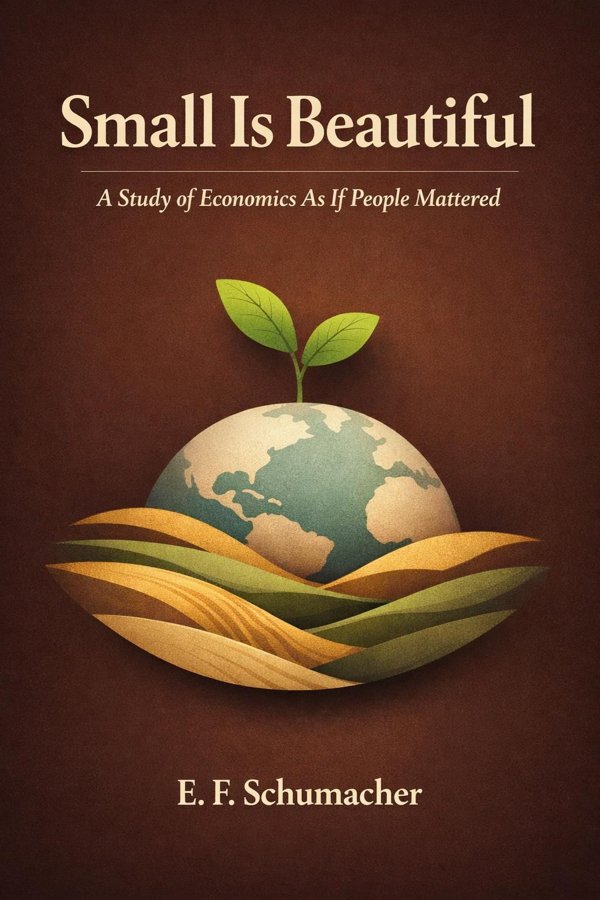
Small Is Beautiful: A Study of Economics As If People Mattered: Summary & Key Insights
 10 min5 chaptersAudio available
What Is Small Is Beautiful: A Study of Economics As If People Mattered About?
Small Is Beautiful: A Study of Economics As If People Mattered by E. F. Schumacher is a economics book spanning 5 pages. Small Is Beautiful: A Study of Economics As If People Mattered is a collection of essays by British economist E. F. Schumacher, first published in 1973. The book critiques modern economic systems focused on unlimited growth and advocates for a more human-centered and sustainable approach. Schumacher introduces the concept of 'economics as if people mattered,' emphasizing decentralization, appropriate technology, and ecological balance as foundations for a just and sustainable society.
This FizzRead summary covers all 5 key chapters of Small Is Beautiful: A Study of Economics As If People Mattered in approximately 10 minutes, distilling the most important ideas, arguments, and takeaways from E. F. Schumacher's work. Also available as an audio summary and Key Quotes Podcast.
Small Is Beautiful: A Study of Economics As If People Mattered
Small Is Beautiful: A Study of Economics As If People Mattered is a collection of essays by British economist E. F. Schumacher, first published in 1973. The book critiques modern economic systems focused on unlimited growth and advocates for a more human-centered and sustainable approach. Schumacher introduces the concept of 'economics as if people mattered,' emphasizing decentralization, appropriate technology, and ecological balance as foundations for a just and sustainable society.
Who Should Read Small Is Beautiful: A Study of Economics As If People Mattered?
This book is perfect for anyone interested in economics and looking to gain actionable insights in a short read. Whether you're a student, professional, or lifelong learner, the key ideas from Small Is Beautiful: A Study of Economics As If People Mattered by E. F. Schumacher will help you think differently.
- ✓Readers who enjoy economics and want practical takeaways
- ✓Professionals looking to apply new ideas to their work and life
- ✓Anyone who wants the core insights of Small Is Beautiful: A Study of Economics As If People Mattered in just 10 minutes
Want the full summary?
Get instant access to this book summary and 100K+ more with Fizz Moment.
Get Free SummaryAvailable on App Store • Free to download
Key Chapters
I began by examining the modern world’s faith in large-scale production. Industrialism, powered by fossil fuels and organized around gigantic enterprises, has delivered material abundance to a degree unimaginable in earlier ages. Yet the human and ecological costs of this triumph remain hidden beneath the ideology of growth. The ‘problem of production,’ I argue, is not merely a technical question of scarcity but a spiritual one. We are producing in ways that consume the very foundation of our existence — the finite resources of the earth. What kind of progress is it, if it destroys the soil, pollutes the water, and impoverishes the soul?
In the essay 'The Problem of Production,' I describe how modern economies treat resources as income, not capital. We believe we can indefinitely draw upon the earth’s wealth without accounting for depletion. This blindness stems from the belief that science and technology can always substitute for natural limits. But this faith in substitution is an illusion — there are no substitutes for soil fertility, clean air, or a stable climate. Real economics must begin from the recognition that we borrow from nature, and that every act of production carries a moral burden of stewardship.
From there, I turn to the idea of 'Peace and Permanence.' A civilization addicted to consumption can never know peace, for it must constantly conquer new frontiers of extraction and exploitation. Permanence — the ability to sustain a stable, balanced relationship between human beings and their environment — must therefore become the core criterion of economic success. The purpose of production should not be expansion for its own sake but the continuous renewal of life. This, I insist, is the only foundation upon which peace can rest.
All our wealth originates from the natural world, yet we behave as if nature’s bounty were infinite. In this part I seek to restore moral clarity to the question of resources. The depletion of fossil fuels and minerals, the loss of forests, the poisoning of soils — these are not isolated technical mishaps but signs that our economic logic is fatally flawed. To use resources as though they were freely replenishable is to commit an act of moral negligence against future generations.
In 'Buddhist Economics,' I contrast the Western view of consumption with an alternative grounded in wisdom and restraint. Where Western economics concerns itself with the multiplication of wants, Buddhist thought sees wealth in the purification of desire. Work, in the Buddhist sense, is not a necessary evil but an opportunity for self-realization and cooperation. Simplicity is not poverty, but freedom. When I visited Asia, I saw how economies built upon spiritual awareness — even amid material hardship — fostered a deeper contentment than many industrial societies could. The Buddhist path, by aiming at non-violence and inner peace, offers a model of economics that restores the soul to its rightful place.
The essay 'A Question of Size' follows naturally: scale determines not only efficiency but also morality. We often assume that bigger institutions promise greater productivity, yet bigness breeds complexity, alienation, and irresponsibility. Once enterprises grow beyond human comprehension, they lose their moral compass. A small enterprise, by contrast, remains embedded in the community it serves; its failures and successes are felt by identifiable people. By returning to the human scale, we can reclaim a sense of personal responsibility for our economic life.
+ 3 more chapters — available in the FizzRead app
All Chapters in Small Is Beautiful: A Study of Economics As If People Mattered
About the Author
Ernst Friedrich Schumacher (1911–1977) was a British economist and philosopher born in Germany. Known for his humanistic approach to economics, he worked as an economic advisor and wrote extensively on sustainable development and appropriate technology. His influential work, Small Is Beautiful, established him as a pioneer of ecological and alternative economic thought in the 20th century.
Get This Summary in Your Preferred Format
Read or listen to the Small Is Beautiful: A Study of Economics As If People Mattered summary by E. F. Schumacher anytime, anywhere. FizzRead offers multiple formats so you can learn on your terms — all free.
Available formats: App · Audio · PDF · EPUB — All included free with FizzRead
Download Small Is Beautiful: A Study of Economics As If People Mattered PDF and EPUB Summary
Key Quotes from Small Is Beautiful: A Study of Economics As If People Mattered
“I began by examining the modern world’s faith in large-scale production.”
“All our wealth originates from the natural world, yet we behave as if nature’s bounty were infinite.”
Frequently Asked Questions about Small Is Beautiful: A Study of Economics As If People Mattered
Small Is Beautiful: A Study of Economics As If People Mattered by E. F. Schumacher is a economics book that explores key ideas across 5 chapters. Small Is Beautiful: A Study of Economics As If People Mattered is a collection of essays by British economist E. F. Schumacher, first published in 1973. The book critiques modern economic systems focused on unlimited growth and advocates for a more human-centered and sustainable approach. Schumacher introduces the concept of 'economics as if people mattered,' emphasizing decentralization, appropriate technology, and ecological balance as foundations for a just and sustainable society.
You Might Also Like
Business Adventures
John Brooks
10 min
Nudge
Richard H. Thaler, Cass R. Sunstein
10 min
The Hitchhiker"s Guide to the Galaxy
Douglas Adams
10 minThe Muqaddimah
Ibn Khaldun
10 minThe Outsiders
William N. Thorndike
10 min
A Little History of Economics
Niall Kishtainy
10 minBrowse by Category
Ready to read Small Is Beautiful: A Study of Economics As If People Mattered?
Get the full summary and 100K+ more books with Fizz Moment.