
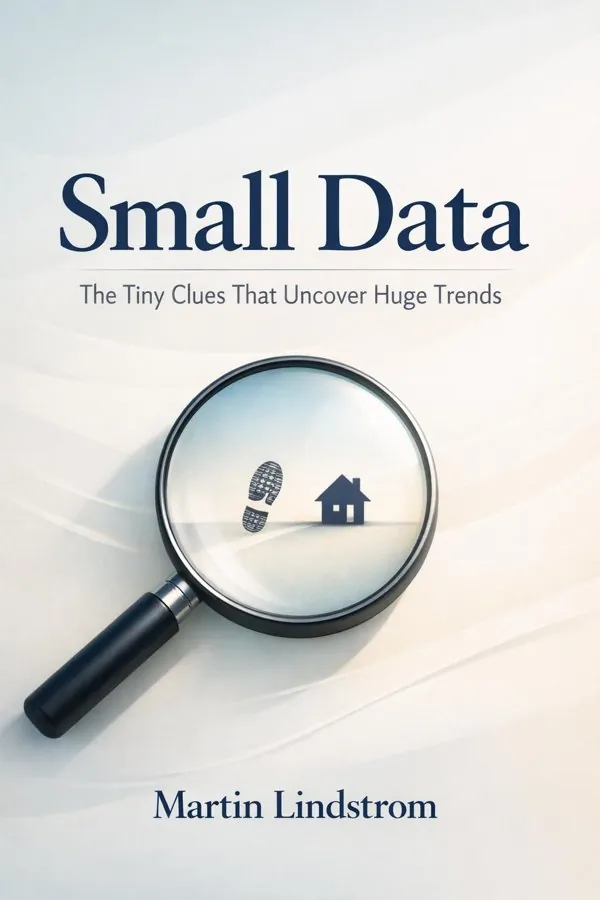
Small Data: The Tiny Clues That Uncover Huge Trends: Summary & Key Insights
 10 min10 chaptersAudio available
Key Takeaways from Small Data: The Tiny Clues That Uncover Huge Trends
The most valuable insight is often hiding in plain sight.
What people keep can reveal what they fear losing.
People do not just consume products; they perform identities through them.
Rapid change does not erase tradition; it makes the tension with tradition more visible.
Some of the strongest buying motives are hidden inside routines that seem purely practical.
What Is Small Data: The Tiny Clues That Uncover Huge Trends About?
Small Data: The Tiny Clues That Uncover Huge Trends by Martin Lindstrom is a marketing book spanning 10 pages. In a business world obsessed with dashboards, analytics, and machine learning, Martin Lindstrom makes a provocative argument: the biggest breakthroughs often come from the smallest observations. In Small Data, he shows that tiny, easily overlooked details in people’s homes, routines, language, and habits can reveal the emotional truths that drive buying behavior. A scuffed refrigerator door, a crowded shelf, a family ritual, or a child’s bedroom can say more about consumer desire than a spreadsheet full of clicks and conversions. Lindstrom’s method is grounded in global ethnographic fieldwork. Rather than relying only on surveys or large-scale data sets, he visits consumers where life actually happens and studies the contradictions between what people say and what they do. From Russia to Brazil, China to Germany, he uncovers how culture, memory, status, fear, and aspiration shape demand in ways that traditional market research often misses. The book matters because it gives marketers, founders, product teams, and innovators a practical way to generate sharper insights in crowded markets. Lindstrom, a renowned branding consultant and bestselling author, argues that to understand the future, you must first notice the intimate clues hidden in everyday life.
This FizzRead summary covers all 10 key chapters of Small Data: The Tiny Clues That Uncover Huge Trends in approximately 10 minutes, distilling the most important ideas, arguments, and takeaways from Martin Lindstrom's work. Also available as an audio summary and Key Quotes Podcast.
Small Data: The Tiny Clues That Uncover Huge Trends
In a business world obsessed with dashboards, analytics, and machine learning, Martin Lindstrom makes a provocative argument: the biggest breakthroughs often come from the smallest observations. In Small Data, he shows that tiny, easily overlooked details in people’s homes, routines, language, and habits can reveal the emotional truths that drive buying behavior. A scuffed refrigerator door, a crowded shelf, a family ritual, or a child’s bedroom can say more about consumer desire than a spreadsheet full of clicks and conversions.
Lindstrom’s method is grounded in global ethnographic fieldwork. Rather than relying only on surveys or large-scale data sets, he visits consumers where life actually happens and studies the contradictions between what people say and what they do. From Russia to Brazil, China to Germany, he uncovers how culture, memory, status, fear, and aspiration shape demand in ways that traditional market research often misses.
The book matters because it gives marketers, founders, product teams, and innovators a practical way to generate sharper insights in crowded markets. Lindstrom, a renowned branding consultant and bestselling author, argues that to understand the future, you must first notice the intimate clues hidden in everyday life.
Who Should Read Small Data: The Tiny Clues That Uncover Huge Trends?
This book is perfect for anyone interested in marketing and looking to gain actionable insights in a short read. Whether you're a student, professional, or lifelong learner, the key ideas from Small Data: The Tiny Clues That Uncover Huge Trends by Martin Lindstrom will help you think differently.
- ✓Readers who enjoy marketing and want practical takeaways
- ✓Professionals looking to apply new ideas to their work and life
- ✓Anyone who wants the core insights of Small Data: The Tiny Clues That Uncover Huge Trends in just 10 minutes
Want the full summary?
Get instant access to this book summary and 100K+ more with Fizz Moment.
Get Free SummaryAvailable on App Store • Free to download
Key Chapters
The most valuable insight is often hiding in plain sight. Lindstrom begins with a challenge to modern business thinking: big data is powerful, but it is not enough. Metrics can tell you what people clicked, bought, or searched for, yet they rarely explain the deeper emotional reason behind those actions. A chart may show a decline in loyalty or a spike in purchases, but it cannot easily reveal the anxieties, desires, rituals, or identity signals driving behavior.
This is where small data matters. Lindstrom uses an ethnographic lens, observing people in their natural environments rather than depending solely on formal interviews or digital traces. He looks at homes, kitchens, children’s rooms, family routines, and everyday objects. These details often expose contradictions. People may claim they value simplicity, yet surround themselves with symbols of status. They may say they are health-conscious, while their environment reveals comfort, nostalgia, and stress-driven habits.
For marketers, this means consumer truth is usually embedded in context. A person’s surroundings reveal how they actually live, not just how they wish to be seen. A start-up launching a new service, for example, might learn more by watching how customers improvise solutions at home than by asking them what features they want. The hidden workaround is often the real innovation opportunity.
Lindstrom’s core message is not that data is useless. It is that numbers need human interpretation. Big data points to patterns; small data explains them. When combined, they create more accurate and more humane business decisions.
Actionable takeaway: Spend time observing customers in real-life settings and look for mismatches between stated preferences and actual behavior. Those gaps often contain your best insight.
What people keep can reveal what they fear losing. In Lindstrom’s visits to Russian homes, he noticed a striking pattern: refrigerators stocked with expired food, crowded cupboards, and a strong tendency to save items for later. On the surface, this looked like clutter or inefficiency. But beneath it was a cultural logic shaped by history, uncertainty, and the lingering memory of scarcity.
These habits reflected more than practical thrift. They expressed a desire for control in a world that had often felt unstable. Preservation became emotional insurance. Keeping extra goods, holding onto old items, and resisting waste signaled security, self-protection, and preparedness. Consumers were not simply buying products; they were buying peace of mind.
For businesses, this kind of observation can transform strategy. A company entering a market like Russia might fail if it positions products around novelty alone. Consumers may respond better to messaging that emphasizes reliability, longevity, trust, and control. Packaging that suggests abundance, durability, or preparedness may resonate more strongly than sleek minimalism. Even loyalty programs or refill systems can be redesigned to support the emotional need for security.
The larger lesson is that behaviors that appear irrational are often emotionally coherent once viewed through cultural history. Lindstrom shows that a product strategy disconnected from those deep emotional patterns will miss the mark. Great marketers do not just decode purchase data; they decode the hidden emotional memory behind it.
Actionable takeaway: When studying a market, ask what forms of insecurity, scarcity, or instability might be shaping consumer habits, and adapt your brand message to address those emotional needs directly.
People do not just consume products; they perform identities through them. In Brazil, Lindstrom observed a culture in which aspiration, family visibility, and emotional display played a powerful role in daily life. Homes, possessions, and routines often reflected a desire not merely to live well, but to be seen living well. Consumption became a kind of social theater, where optimism, progress, and togetherness were constantly staged.
This did not mean the happiness was fake. Rather, Lindstrom suggests that public expressions of joy, beauty, and generosity are woven into how many Brazilians navigate social life. Products are often chosen for their ability to communicate warmth, aspiration, hospitality, and self-improvement. The emotional value of a purchase may lie as much in what it signals to others as in its functional usefulness.
For marketers, the implication is significant. In some cultures, a product’s social visibility matters more than its technical superiority. A kitchen appliance, beauty item, or smartphone can become a symbol of mobility, pride, or family care. Brands that focus only on product specifications may miss the deeper appeal. Campaigns that highlight celebration, shared experience, and uplifting transformation may outperform colder, feature-heavy messaging.
Lindstrom’s insight also helps explain why some products spread through communities quickly. If an item helps consumers project hope, achievement, or belonging, it becomes socially contagious. Design, packaging, and retail experience all matter because they shape the emotional performance around the product.
Actionable takeaway: Identify the identity your product allows customers to display in public or among family, and make that emotional and social payoff central to your branding.
Rapid change does not erase tradition; it makes the tension with tradition more visible. In China, Lindstrom found consumers navigating a complex psychological space between historical values and modern ambition. Families were often balancing respect for heritage, hierarchy, and collective norms with intense pressure toward achievement, advancement, and global modernity.
This creates a fertile but delicate environment for brands. Consumers may crave innovation and status, yet still respond strongly to symbols of continuity, trust, family honor, and cultural legitimacy. A brand that appears too foreign, disruptive, or rootless can feel emotionally shallow. At the same time, a brand that feels old-fashioned may fail to capture aspirational energy.
Lindstrom’s small data approach uncovers these subtleties through observation. Household arrangements, gift-giving rituals, educational pressure, and attitudes toward personal success all provide clues. A product may succeed not because it is new, but because it helps consumers reconcile old and new versions of themselves. For example, a technology brand might thrive by framing innovation as a way to strengthen family life or elevate the household, rather than as an act of rebellion against tradition.
The broader point is that modernization is rarely psychologically simple. Consumer decisions in fast-changing societies are often shaped by a negotiation between continuity and change. Marketers who understand this can craft offerings that feel both aspirational and culturally grounded.
Actionable takeaway: In fast-evolving markets, position your product as a bridge between tradition and progress, showing how it helps people modernize without losing identity or social legitimacy.
Some of the strongest buying motives are hidden inside routines that seem purely practical. In Germany, Lindstrom observed how order, quality, predictability, and nostalgia often carried emotional weight beyond simple efficiency. Structured homes, careful organization, and attachment to trusted objects suggested that reliability itself can function as a comfort system.
Consumers in such settings are not merely purchasing performance. They are also purchasing reassurance. A well-made product, a clear process, or a familiar brand can reduce cognitive strain and support a feeling of stability. Nostalgia also plays a role. Certain products act as emotional anchors, linking people to continuity, memory, and trust in a rapidly changing world.
This has direct marketing implications. Brands targeting consumers who value order and dependability should not underestimate the appeal of clarity, craftsmanship, and consistency. Overly flashy innovation may create suspicion rather than excitement. A product launch that emphasizes tested quality, intuitive design, and dependable service may be more persuasive than one built around novelty alone.
Lindstrom’s insight is that values such as precision and structure are not cold or impersonal. They often meet emotional needs. Even brand storytelling can reflect this by honoring heritage, process, and care. In many cases, trust is earned not through dramatic promises, but through calm proof that things will work as expected.
Actionable takeaway: If your audience values order and certainty, reduce friction in every customer touchpoint and position your brand as a source of dependable comfort, not just innovation.
Breakthrough ideas rarely appear as lightning bolts; they emerge from patterns in small, human details. One of Lindstrom’s most practical contributions is showing how to convert observation into business innovation. The process starts with collecting seemingly minor clues: habits, objects, workarounds, frustrations, sentimental attachments, repeated phrases, and environmental oddities. Individually, each clue may seem trivial. Together, they reveal a latent need.
Lindstrom often works like a detective. He searches for anomalies and contradictions, then links them into a narrative about unmet desire. If consumers modify a product, hide it, overprotect it, or use it in an unintended way, that behavior is not noise. It is evidence. Likewise, if households in different places display parallel rituals around safety, pride, or convenience, a broader trend may be forming.
The key is synthesis. Innovation does not come from copying what consumers explicitly ask for, because people often cannot verbalize what they need. It comes from interpreting the emotional logic behind their behavior. A company may discover a new packaging format by noticing how people store products in cramped spaces. A service business may create a new offering by observing the rituals customers invent to reduce anxiety. These are small clues with large commercial consequences.
Lindstrom reminds readers that successful innovation is not always about adding features. Often it is about removing friction, validating identity, or solving an emotional tension customers have normalized.
Actionable takeaway: Create an insight log of recurring customer behaviors, improvised fixes, and emotional cues, then ask what unmet need connects them. Build your next innovation around that hidden pattern.
Consumers may rationalize purchases with logic, but they are usually moved by emotion. Lindstrom argues that small data works because it captures the emotional layer of decision-making that surveys and dashboards often flatten. People do not buy only for utility. They buy to feel safer, more admired, more in control, more modern, more loving, or more complete.
This emotional core becomes visible through rituals and symbols. The arrangement of a family dining table may reveal a desire for closeness. A carefully protected handbag may represent hard-earned status. A child’s room may expose parental anxiety about success. None of these observations are random. They point toward emotional jobs that products and brands can fulfill.
Understanding this changes how businesses define value. A detergent may not simply clean clothes; it may preserve dignity. A car may not only provide transport; it may symbolize responsible parenthood or personal freedom. A digital app may not just save time; it may reduce stress and create a sense of mastery. The emotional meaning often determines loyalty more strongly than the functional benefit.
Lindstrom’s framework also helps explain why copycat products fail. Two offerings can have similar features, but the brand that better speaks to an emotional truth usually wins. Emotion shapes memory, identity, and trust, which is why small observations can produce such powerful strategic direction.
Actionable takeaway: For every product you market, identify the deeper feeling customers are actually buying, and ensure your messaging, design, and experience consistently reinforce that emotional promise.
Insight is not magic; it is a discipline of attention. A major theme in Small Data is that anyone can become better at spotting meaningful clues if they learn how to look. Lindstrom encourages a mindset of curiosity, patience, and interpretive thinking. Instead of rushing to confirm assumptions, he lingers over details that seem odd, repetitive, or emotionally charged.
This requires slowing down. In business settings, teams often seek quick answers from fast research tools. But small data depends on deep observation: noticing what is on the refrigerator, what has been repaired instead of replaced, what words people repeat, what objects are displayed proudly, and what remains hidden. It also requires asking why. Why is this item preserved? Why is that room arranged this way? Why does this habit persist despite inconvenience?
The skill improves with practice. Product managers can shadow customers. Retail teams can observe in-store behavior without immediately intervening. Founders can visit homes or workplaces. Researchers can pair interviews with contextual observation. Most importantly, teams should learn to suspend judgment. The goal is not to label behavior as irrational, but to decode the emotional and cultural meaning behind it.
Lindstrom’s approach is valuable because it democratizes insight generation. You do not need a billion data points to begin; you need sharp eyes, open ears, and a willingness to explore contradiction.
Actionable takeaway: Build a regular observation habit—visit customers, document odd behaviors and environments, and ask what emotional need each detail might reveal before drawing conclusions.
The danger of data is not that it is wrong, but that it can become incomplete when detached from human reality. Lindstrom closes with a broader critique of organizations that treat consumers as clusters of measurable transactions rather than full emotional beings. Big data can optimize targeting, pricing, and prediction, but it often misses meaning. It can tell you that an action happened, not always why it mattered.
This limitation becomes costly when businesses confuse correlation with understanding. A company may notice that certain users abandon a service after a specific step, but without context it may misdiagnose the cause. The issue might not be usability alone. It could be anxiety, mistrust, embarrassment, or a symbolic mismatch between the brand and the customer’s identity. These are small-data truths.
Lindstrom is not anti-technology. His argument is for balance. The best organizations integrate scale with empathy. They use analytics to find patterns and ethnographic observation to interpret them. They supplement performance metrics with immersion, stories, and sensory detail. This leads to better innovation, stronger branding, and more respectful engagement with customers.
In an era of automation and AI, this message feels even more relevant. The more businesses rely on systems, the more valuable human judgment becomes. Strategy improves when leaders remember that consumers are not abstract users but people shaped by memory, culture, ritual, and longing.
Actionable takeaway: Pair every major quantitative finding with direct customer observation or contextual interviews so your decisions are guided by both pattern recognition and human understanding.
All Chapters in Small Data: The Tiny Clues That Uncover Huge Trends
About the Author
Martin Lindstrom is a Danish author, branding consultant, and consumer behavior expert known for helping companies understand why people buy. Over the course of his career, he has advised many of the world’s leading brands and built a reputation for combining marketing strategy with deep psychological and cultural insight. Lindstrom became widely known through bestselling books such as Buyology, Brandwashed, and Small Data, which explore the hidden forces behind consumer decisions. He has been recognized internationally for his influence in business and marketing, including being named among the world’s influential thinkers by major media outlets. His work stands out for its blend of field observation, storytelling, and practical application, making complex consumer behavior understandable and useful for leaders, marketers, and entrepreneurs.
Get This Summary in Your Preferred Format
Read or listen to the Small Data: The Tiny Clues That Uncover Huge Trends summary by Martin Lindstrom anytime, anywhere. FizzRead offers multiple formats so you can learn on your terms — all free.
Available formats: App · Audio · PDF · EPUB — All included free with FizzRead
Download Small Data: The Tiny Clues That Uncover Huge Trends PDF and EPUB Summary
Key Quotes from Small Data: The Tiny Clues That Uncover Huge Trends
“The most valuable insight is often hiding in plain sight.”
“What people keep can reveal what they fear losing.”
“People do not just consume products; they perform identities through them.”
“Rapid change does not erase tradition; it makes the tension with tradition more visible.”
“Some of the strongest buying motives are hidden inside routines that seem purely practical.”
Frequently Asked Questions about Small Data: The Tiny Clues That Uncover Huge Trends
Small Data: The Tiny Clues That Uncover Huge Trends by Martin Lindstrom is a marketing book that explores key ideas across 10 chapters. In a business world obsessed with dashboards, analytics, and machine learning, Martin Lindstrom makes a provocative argument: the biggest breakthroughs often come from the smallest observations. In Small Data, he shows that tiny, easily overlooked details in people’s homes, routines, language, and habits can reveal the emotional truths that drive buying behavior. A scuffed refrigerator door, a crowded shelf, a family ritual, or a child’s bedroom can say more about consumer desire than a spreadsheet full of clicks and conversions. Lindstrom’s method is grounded in global ethnographic fieldwork. Rather than relying only on surveys or large-scale data sets, he visits consumers where life actually happens and studies the contradictions between what people say and what they do. From Russia to Brazil, China to Germany, he uncovers how culture, memory, status, fear, and aspiration shape demand in ways that traditional market research often misses. The book matters because it gives marketers, founders, product teams, and innovators a practical way to generate sharper insights in crowded markets. Lindstrom, a renowned branding consultant and bestselling author, argues that to understand the future, you must first notice the intimate clues hidden in everyday life.
More by Martin Lindstrom
You Might Also Like
Captivology: The Science of Capturing People's Attention
Ben Parr
10 min
Marketing 5.0: Technology for Humanity
Philip Kotler, Hermawan Kartajaya, Iwan Setiawan
10 min
Marketing Strategy
Paul Fifield
10 min
UnMarketing: Stop Marketing. Start Engaging.
Scott Stratten
10 min
$100M Leads: How to Get Strangers to Want to Buy Your Stuff
Alex Hormozi
10 min
80/20 Sales and Marketing: The Definitive Guide to Working Less and Making More
Perry Marshall
10 minBrowse by Category
Ready to read Small Data: The Tiny Clues That Uncover Huge Trends?
Get the full summary and 100K+ more books with Fizz Moment.