
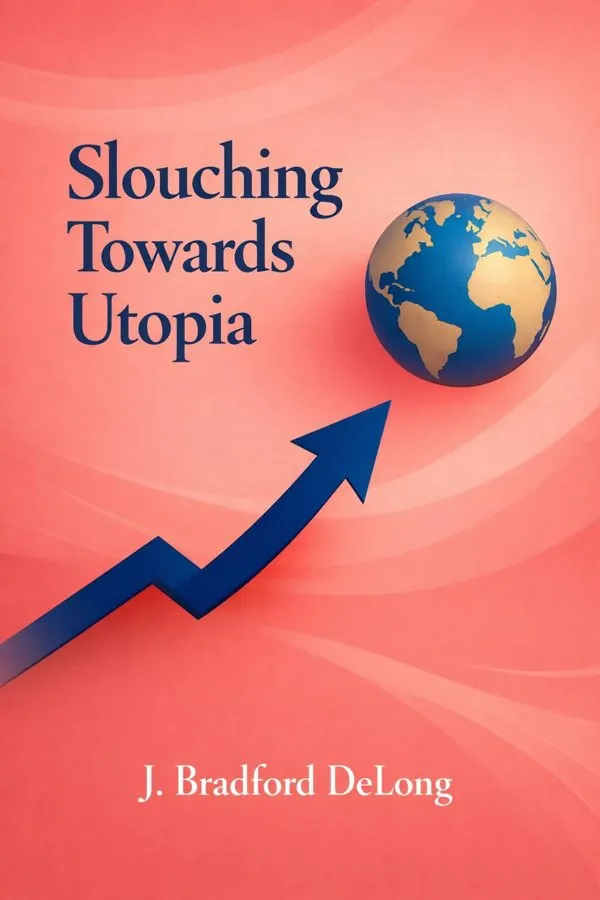
Slouching Towards Utopia: An Economic History of the Twentieth Century: Summary & Key Insights
 10 min11 chaptersAudio available
What Is Slouching Towards Utopia: An Economic History of the Twentieth Century About?
Slouching Towards Utopia: An Economic History of the Twentieth Century by J. Bradford DeLong is a economics book spanning 11 pages. This book offers a sweeping economic history of the twentieth century, exploring how technological progress, globalization, and political choices shaped prosperity and inequality. DeLong examines the forces that drove unprecedented growth from 1870 to 2010, while also analyzing the failures and crises that prevented humanity from achieving true utopia.
This FizzRead summary covers all 11 key chapters of Slouching Towards Utopia: An Economic History of the Twentieth Century in approximately 10 minutes, distilling the most important ideas, arguments, and takeaways from J. Bradford DeLong's work. Also available as an audio summary and Key Quotes Podcast.
Slouching Towards Utopia: An Economic History of the Twentieth Century
This book offers a sweeping economic history of the twentieth century, exploring how technological progress, globalization, and political choices shaped prosperity and inequality. DeLong examines the forces that drove unprecedented growth from 1870 to 2010, while also analyzing the failures and crises that prevented humanity from achieving true utopia.
Who Should Read Slouching Towards Utopia: An Economic History of the Twentieth Century?
This book is perfect for anyone interested in economics and looking to gain actionable insights in a short read. Whether you're a student, professional, or lifelong learner, the key ideas from Slouching Towards Utopia: An Economic History of the Twentieth Century by J. Bradford DeLong will help you think differently.
- ✓Readers who enjoy economics and want practical takeaways
- ✓Professionals looking to apply new ideas to their work and life
- ✓Anyone who wants the core insights of Slouching Towards Utopia: An Economic History of the Twentieth Century in just 10 minutes
Want the full summary?
Get instant access to this book summary and 100K+ more with Fizz Moment.
Get Free SummaryAvailable on App Store • Free to download
Key Chapters
Before 1870, the foundations of the modern economy had already been laid. The industrial revolution in Britain had demonstrated what sustained technological progress could do. But the diffusion of that progress across Europe, North America, and eventually the world required institutions, ideas, and a social order that could support investment, experimentation, and trade. That 'long nineteenth century' — from roughly 1770 to 1870 — was an age when liberal capitalism took shape. Property rights, contract law, and nascent democratic institutions gave entrepreneurs the freedom to take risks, while imperial expansion supplied resources and markets.
In this era, I see both triumph and tragedy. Triumph in the rise of productivity, literacy, and innovation; tragedy in the way the gains were captured. Industrialization concentrated wealth and labor in cities where conditions were often brutal. Yet from these contradictions emerged the intellectual seeds of modern economics — the idea that growth could be measured, influenced, and improved upon.
By the time we reach 1870, the world stood on the cusp of what I call the 'great acceleration.' The telegraph, the railroad, and steamships had already begun to shrink distances. Nations were increasingly interlinked by finance and trade. But crucially, humanity was entering a new phase where knowledge itself — scientific, managerial, and technological — would become the primary driver of prosperity. The old regime of limited progress was giving way to the modern world of compounding growth.
Between 1870 and 1914, the world witnessed a surge in creativity and connection unparalleled in any earlier era. Electricity, the internal combustion engine, chemical industries, the telephone — these were not incremental improvements but breakthroughs that reshaped how people lived and worked. I describe this period as the 'great acceleration' because it marks the moment when human productivity leapt ahead of biological constraints.
This was also a time when globalization as we now understand it truly emerged. Capital flowed from London to Buenos Aires, from Paris to Cairo. The costs of transport and communication plummeted, enabling goods, people, and ideas to circulate freely. Nations saw themselves as participants in a world economy and, for a time, it seemed as if the planet had discovered a self-reinforcing path to prosperity. Yet beneath the glitter ran deeper tensions — empires competing for resources, industrial powers struggling to absorb new technologies without destabilizing old hierarchies, and millions of workers displaced by change.
The global market expanded, but it did not unify humanity. It stratified it. Colonies supplied raw materials but received little of the benefits. Income inequality within industrialized nations soared. For all its wonders, this was an era where the wealth of nations was not the wealth of humankind. When the system finally met the political pressures of nationalism and war, it collapsed under its own contradictions.
+ 9 more chapters — available in the FizzRead app
All Chapters in Slouching Towards Utopia: An Economic History of the Twentieth Century
About the Author
J. Bradford DeLong is an American economist and professor at the University of California, Berkeley. He served as Deputy Assistant Secretary of the U.S. Treasury during the Clinton administration and is known for his work on macroeconomic history, growth, and policy analysis.
Get This Summary in Your Preferred Format
Read or listen to the Slouching Towards Utopia: An Economic History of the Twentieth Century summary by J. Bradford DeLong anytime, anywhere. FizzRead offers multiple formats so you can learn on your terms — all free.
Available formats: App · Audio · PDF · EPUB — All included free with FizzRead
Download Slouching Towards Utopia: An Economic History of the Twentieth Century PDF and EPUB Summary
Key Quotes from Slouching Towards Utopia: An Economic History of the Twentieth Century
“Before 1870, the foundations of the modern economy had already been laid.”
“Between 1870 and 1914, the world witnessed a surge in creativity and connection unparalleled in any earlier era.”
Frequently Asked Questions about Slouching Towards Utopia: An Economic History of the Twentieth Century
Slouching Towards Utopia: An Economic History of the Twentieth Century by J. Bradford DeLong is a economics book that explores key ideas across 11 chapters. This book offers a sweeping economic history of the twentieth century, exploring how technological progress, globalization, and political choices shaped prosperity and inequality. DeLong examines the forces that drove unprecedented growth from 1870 to 2010, while also analyzing the failures and crises that prevented humanity from achieving true utopia.
You Might Also Like

Business Adventures
John Brooks
10 min
Nudge
Richard H. Thaler, Cass R. Sunstein
10 min
The Hitchhiker"s Guide to the Galaxy
Douglas Adams
10 minThe Muqaddimah
Ibn Khaldun
10 minThe Outsiders
William N. Thorndike
10 min
A Little History of Economics
Niall Kishtainy
10 minBrowse by Category
Ready to read Slouching Towards Utopia: An Economic History of the Twentieth Century?
Get the full summary and 100K+ more books with Fizz Moment.