
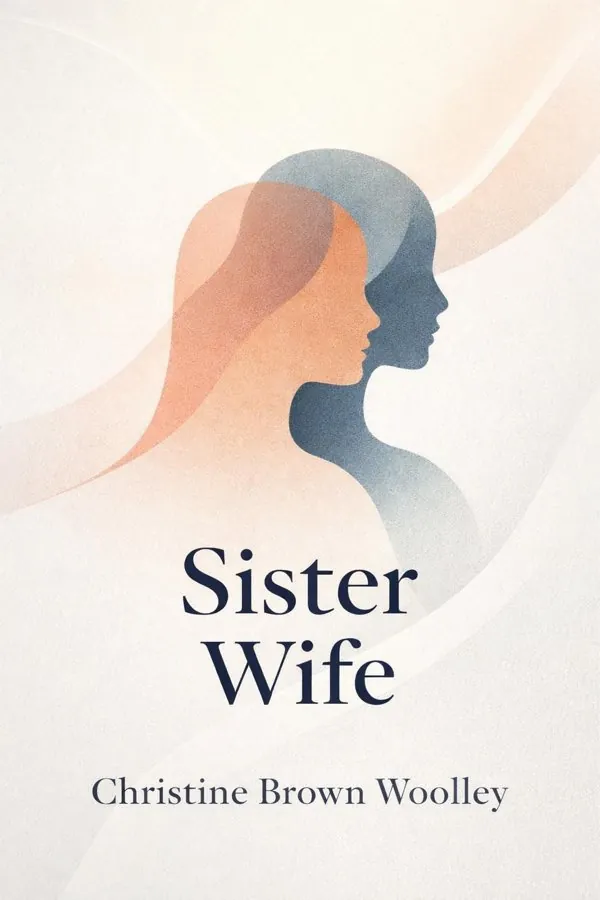
Sister Wife: Summary & Key Insights
 10 min8 chaptersAudio available
Key Takeaways from Sister Wife
A closed world often feels safest to the people who know nothing else.
Real change often begins not with rebellion, but with relationship.
When a future is assigned to you, even hope can feel like disobedience.
Leaving a restrictive life is rarely a clean act of liberation; it is usually a painful process of fragmentation and rebuilding.
Systems that glorify sacrifice often depend on women absorbing the greatest losses.
What Is Sister Wife About?
Sister Wife by Christine Brown Woolley is a bestsellers book spanning 4 pages. Sister Wife by Christine Brown Woolley is a contemporary novel that examines the hidden emotional architecture of plural marriage from the inside out. Rather than treating polygamist life as spectacle, the book centers on Celeste, a young woman raised in a tightly controlled religious community where obedience is praised, desire is disciplined, and a woman’s future is often decided long before she can name her own dreams. As Celeste begins to question the faith, family structures, and gender roles that have shaped her identity, the novel becomes a deeply human story about belonging, fear, loyalty, and the cost of freedom. What makes the book matter is its refusal to flatten people into stereotypes: Woolley shows how love, control, faith, and coercion can exist side by side. Her writing brings nuance to a subject often reduced to headlines, giving readers an intimate portrait of women navigating inherited belief and personal awakening. The result is a compelling, emotionally layered novel for readers interested in family, religion, women’s lives, and the difficult work of choosing oneself.
This FizzRead summary covers all 8 key chapters of Sister Wife in approximately 10 minutes, distilling the most important ideas, arguments, and takeaways from Christine Brown Woolley's work. Also available as an audio summary and Key Quotes Podcast.
Sister Wife
Sister Wife by Christine Brown Woolley is a contemporary novel that examines the hidden emotional architecture of plural marriage from the inside out. Rather than treating polygamist life as spectacle, the book centers on Celeste, a young woman raised in a tightly controlled religious community where obedience is praised, desire is disciplined, and a woman’s future is often decided long before she can name her own dreams. As Celeste begins to question the faith, family structures, and gender roles that have shaped her identity, the novel becomes a deeply human story about belonging, fear, loyalty, and the cost of freedom. What makes the book matter is its refusal to flatten people into stereotypes: Woolley shows how love, control, faith, and coercion can exist side by side. Her writing brings nuance to a subject often reduced to headlines, giving readers an intimate portrait of women navigating inherited belief and personal awakening. The result is a compelling, emotionally layered novel for readers interested in family, religion, women’s lives, and the difficult work of choosing oneself.
Who Should Read Sister Wife?
This book is perfect for anyone interested in bestsellers and looking to gain actionable insights in a short read. Whether you're a student, professional, or lifelong learner, the key ideas from Sister Wife by Christine Brown Woolley will help you think differently.
- ✓Readers who enjoy bestsellers and want practical takeaways
- ✓Professionals looking to apply new ideas to their work and life
- ✓Anyone who wants the core insights of Sister Wife in just 10 minutes
Want the full summary?
Get instant access to this book summary and 100K+ more with Fizz Moment.
Get Free SummaryAvailable on App Store • Free to download
Key Chapters
A closed world often feels safest to the people who know nothing else. At the beginning of Sister Wife, Celeste lives inside a structure that gives every part of life a predetermined meaning: authority flows downward from male leadership, women are measured by obedience and sacrifice, and family life is organized around the logic of plural marriage. Her home is crowded with mothers, siblings, duties, and expectations, yet beneath that abundance is a rigid system that leaves little room for personal choice. Woolley captures how such environments function not only through rules, but through repetition, ritual, and moral language. The system endures because it offers certainty. It tells its members who they are, what God expects, and what kind of future is honorable.
This matters because harmful systems rarely present themselves as harmful from within. They often appear as order, safety, tradition, and divine purpose. Celeste has been taught to interpret discomfort as weakness and questions as temptation. That inner conditioning is one of the novel’s most important insights: control becomes powerful when people learn to monitor themselves.
Readers can apply this idea beyond the novel. Any family, workplace, or community can normalize unequal power by calling it loyalty, discipline, or values. A useful question is: Which parts of my life are chosen, and which have simply been inherited without examination?
Actionable takeaway: Identify one belief or routine you have always accepted as “normal,” and ask who benefits from it, who is limited by it, and whether it still aligns with your values.
Real change often begins not with rebellion, but with relationship. Celeste’s world starts to shift when she meets Taviana, a girl from outside the compound whose presence introduces an entirely different vocabulary for life. Taviana is not idealized; she carries scars, uncertainty, and her own complicated past. Yet that complexity is exactly what makes her transformative. Through friendship, Celeste sees that there are ways of living not governed by the expectations she has internalized. Taviana becomes a mirror and a window at once: she reflects Celeste’s longing back to her, while also offering a glimpse of a broader world.
Woolley shows that outside influence does not have to arrive as a dramatic rescue. Sometimes it comes through ordinary conversations, small acts of trust, or the unsettling discovery that another person sees your life differently than you do. Friendship destabilizes certainty because it makes comparison possible. Celeste begins to notice that what she has been taught to call righteousness may also look like confinement. She learns that freedom can be frightening, messy, and imperfect, but still worth imagining.
This idea applies widely. People often reconsider limiting beliefs because someone enters their life who lives by different assumptions. A supportive friend, mentor, teacher, or colleague can make alternatives feel real rather than abstract. Exposure alone is not enough; what matters is emotionally safe contact with someone who expands your sense of possibility.
Actionable takeaway: Seek one conversation with someone whose life experience differs greatly from yours, and listen for what their perspective reveals about the assumptions you rarely question.
When a future is assigned to you, even hope can feel like disobedience. One of the novel’s central tensions is Celeste’s growing awareness that her life path has effectively been chosen in advance. In her community, marriage is not merely a personal milestone; it is a spiritual obligation tied to family duty, female worth, and salvation. The expectation that she may become a sister wife is framed as sacred destiny, not negotiable preference. Woolley explores how this burden operates psychologically. Celeste is not simply afraid of a specific marriage arrangement; she is afraid of betraying everyone she loves, disappointing God, and stepping into a moral universe she has been taught to fear.
This is what makes the novel powerful: it understands that coercion is often most effective when wrapped in love, responsibility, and eternal meaning. Celeste’s conflict is not between obvious evil and obvious freedom. It is between fidelity to her upbringing and loyalty to her emerging self. The pressure of destiny can silence desire by convincing people they are selfish for wanting agency.
In everyday life, many people encounter softer versions of this dynamic. Families may expect certain careers, communities may impose gender roles, and cultural traditions may define what success should look like. The challenge is learning to distinguish guidance from control, and sacrifice from self-erasure.
Actionable takeaway: Write down one major expectation others have for your future, then ask yourself three questions: Do I want this? Why do they want this for me? What would I choose if fear were not the deciding factor?
Leaving a restrictive life is rarely a clean act of liberation; it is usually a painful process of fragmentation and rebuilding. In Sister Wife, Celeste’s movement toward independence is not presented as a triumphant, uncomplicated escape. Woolley understands that breaking away from a controlling community often means losing not only rules, but relationships, identity, language, and the emotional map that once made life legible. Celeste’s struggle includes guilt, confusion, grief, and practical vulnerability. Freedom is not delivered as a finished state. It must be learned.
That nuance is essential. Many stories of self-liberation focus on the moment of departure, but Woolley pays attention to what comes after: the instability of choice, the disorientation of new environments, and the challenge of trusting one’s own judgment after years of being told what to think. Celeste must discover who she is without the scripts that once defined her. That kind of growth can feel lonely because old certainties fall away before new confidence appears.
Readers can see in this an important truth about change in general. Whether leaving a religion, a relationship, a job, or a family role, the hardest part may not be deciding to go. It may be tolerating the emotional aftermath while a new self takes shape. Support systems, patience, and practical planning matter as much as courage.
Actionable takeaway: If you are considering a major life change, create a two-part plan: one list for what you are leaving, and another for what you will need to build—emotionally, financially, socially, and practically—to sustain your next chapter.
Belief becomes dangerous when it cannot be questioned without punishment. Sister Wife treats faith with more complexity than a simple critique of religion. Woolley portrays spiritual belief as a genuine source of meaning, identity, and emotional structure for many characters. Celeste is not raised in a vacuum of cruelty; she is raised in a worldview that explains suffering, promises purpose, and anchors family life in sacred language. That is why her doubts are so destabilizing. To question the community is also to question God, morality, eternity, and the people she loves most.
The novel’s strength lies in showing how faith can be both sincere and controlling. Religious ideas can comfort the vulnerable, but they can also be used to sanctify hierarchy and suppress dissent. Celeste’s inner conflict is not solved by instantly abandoning spirituality. Instead, she has to learn the difference between faith as living conviction and faith as institutional obedience. That distinction is one of the book’s deepest contributions.
In practical terms, this theme invites readers to examine any belief system with both respect and honesty. Healthy faith traditions make room for conscience, curiosity, and accountability. Unhealthy ones demand silence, fear, and submission. The issue is not whether people believe, but whether belief leaves room for human dignity and moral reflection.
Actionable takeaway: Take one core belief you hold—religious or otherwise—and test it with this question: Does this belief make me more compassionate, honest, and free, or does it mainly keep me afraid of asking difficult questions?
A person cannot choose a life until they learn to recognize what they want. Much of Celeste’s journey is not about dramatic action at first, but about inner language. She has been trained to mute desire, distrust instinct, and frame personal longing as selfishness. In that environment, self-knowledge becomes an act of resistance. Woolley carefully traces how Celeste starts to notice her own responses—to beauty, fear, affection, unfairness, and possibility. These moments may seem small, but they are foundational. Before she can decide anything, she must first believe that her inner life has moral significance.
This theme speaks to anyone who has grown up in a highly prescriptive environment. When your role is defined for you, you may become skilled at pleasing others while losing contact with your own preferences. Reclaiming identity then starts with seemingly simple questions: What do I enjoy? What kind of future feels alive to me? What relationships feel mutual rather than obligatory? Naming desire does not solve every problem, but it interrupts the illusion that your only purpose is to fulfill expectations.
Woolley shows that identity is not discovered all at once. It emerges through attention, reflection, and experience. Celeste’s growth depends on honoring feelings she was taught to dismiss. That makes the novel not only a story of escape, but of self-recognition.
Actionable takeaway: Spend ten minutes writing uncensored answers to three prompts: I feel most like myself when…, I feel smallest when…, and if no one judged me, I would want…. Review your answers for clues about what your life may be asking for.
Independence is not sustained by bravery alone; it also depends on resources, relationships, and realistic preparation. A subtle but important lesson in Sister Wife is that freedom becomes possible not just because Celeste wants a different life, but because pathways begin to open around her. Emotional encouragement, information, practical help, and human connection all matter. Woolley avoids the myth of the solitary hero. Even deeply personal transformations are shaped by who believes you, who shelters you, who tells you the truth, and who helps you imagine survival beyond the old system.
This is especially relevant for readers who think change should happen quickly once someone “sees the truth.” In reality, people stay in restrictive environments for many reasons: dependency, fear, isolation, shame, lack of money, concern for siblings, and uncertainty about what comes next. Celeste’s hesitation is not weakness. It is evidence of how power works. Leaving requires not just desire, but enough stability to endure the consequences.
The broader application is clear. Whether someone is leaving a harmful relationship, a manipulative organization, or a stifling identity, support networks increase the odds of lasting change. Practical freedom comes from combining inner resolve with external scaffolding.
Actionable takeaway: If you are helping someone make a difficult transition, ask not only “What do you want?” but also “What do you need in order to act safely?” Then identify one concrete form of support—transportation, information, money, housing, or emotional check-ins—you can provide or help them find.
All Chapters in Sister Wife
About the Author
Christine Brown Woolley is an American author recognized for fiction that explores the intersection of family, faith, gender, and personal identity. Her work often focuses on women living within demanding social or religious structures, and she is especially skilled at depicting the emotional nuance of loyalty, doubt, and self-discovery. Rather than relying on sensationalism, Woolley writes with empathy and psychological depth, illuminating how belief systems shape intimate relationships and life choices. In Sister Wife, she brings those strengths to a story about plural marriage, autonomy, and the difficult path toward freedom. Her writing appeals to readers who value character-centered narratives, morally complex situations, and thoughtful examinations of how individuals negotiate the expectations placed upon them by family, culture, and tradition.
Get This Summary in Your Preferred Format
Read or listen to the Sister Wife summary by Christine Brown Woolley anytime, anywhere. FizzRead offers multiple formats so you can learn on your terms — all free.
Available formats: App · Audio · PDF · EPUB — All included free with FizzRead
Download Sister Wife PDF and EPUB Summary
Key Quotes from Sister Wife
“A closed world often feels safest to the people who know nothing else.”
“Real change often begins not with rebellion, but with relationship.”
“When a future is assigned to you, even hope can feel like disobedience.”
“Leaving a restrictive life is rarely a clean act of liberation; it is usually a painful process of fragmentation and rebuilding.”
“Systems that glorify sacrifice often depend on women absorbing the greatest losses.”
Frequently Asked Questions about Sister Wife
Sister Wife by Christine Brown Woolley is a bestsellers book that explores key ideas across 8 chapters. Sister Wife by Christine Brown Woolley is a contemporary novel that examines the hidden emotional architecture of plural marriage from the inside out. Rather than treating polygamist life as spectacle, the book centers on Celeste, a young woman raised in a tightly controlled religious community where obedience is praised, desire is disciplined, and a woman’s future is often decided long before she can name her own dreams. As Celeste begins to question the faith, family structures, and gender roles that have shaped her identity, the novel becomes a deeply human story about belonging, fear, loyalty, and the cost of freedom. What makes the book matter is its refusal to flatten people into stereotypes: Woolley shows how love, control, faith, and coercion can exist side by side. Her writing brings nuance to a subject often reduced to headlines, giving readers an intimate portrait of women navigating inherited belief and personal awakening. The result is a compelling, emotionally layered novel for readers interested in family, religion, women’s lives, and the difficult work of choosing oneself.
You Might Also Like

The Godfather
Mario Puzo
10 min
The Handmaid's Tale
Margaret Atwood
10 min
The Hunger Games
Suzanne Collins
10 min
The Nightingale
Kristin Hannah
10 min
The Seven Husbands of Evelyn Hugo
Taylor Jenkins Reid
10 min
Backwater Justice
Fern Michaels
10 minBrowse by Category
Ready to read Sister Wife?
Get the full summary and 100K+ more books with Fizz Moment.