
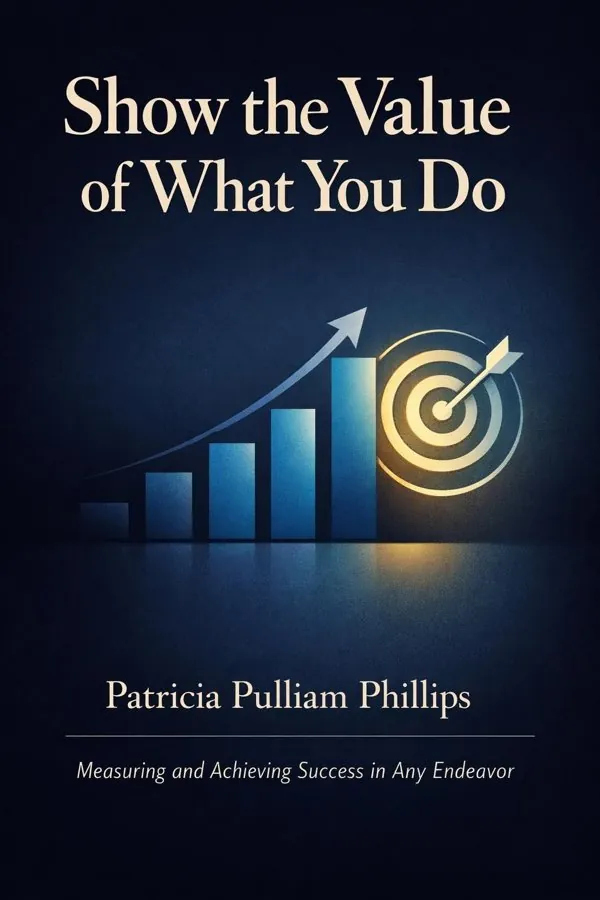
Show the Value of What You Do: Measuring and Achieving Success in Any Endeavor: Summary & Key Insights
 10 min9 chaptersAudio available
Key Takeaways from Show the Value of What You Do: Measuring and Achieving Success in Any Endeavor
A hard truth runs through modern professional life: if people cannot see the value of your work, they may act as if that value does not exist.
Measurement becomes far more useful when it is systematic.
Many initiatives fail to prove their worth for a simple reason: nobody defined success clearly enough at the beginning.
Evidence is only persuasive when it fits the question being asked.
One of the biggest objections to evaluation is also one of the most legitimate: how can you be sure your initiative caused the results?
What Is Show the Value of What You Do: Measuring and Achieving Success in Any Endeavor About?
Show the Value of What You Do: Measuring and Achieving Success in Any Endeavor by Patricia Pulliam Phillips is a leadership book spanning 9 pages. In a world where budgets are scrutinized, projects are compared, and every function is expected to prove its impact, doing good work is no longer enough. In Show the Value of What You Do, Patricia Pulliam Phillips offers a practical system for answering one of the most important professional questions: how do you demonstrate that your efforts truly matter? Rather than relying on vague claims, personal conviction, or anecdotal success stories, the book shows readers how to connect actions to measurable outcomes and communicate those outcomes in language decision-makers respect. At the center of the book is the ROI Methodology, a disciplined approach for defining objectives, gathering data, isolating the effects of an initiative, converting results into meaningful business terms, and using evidence to make better decisions. Phillips writes with unusual authority. As CEO of ROI Institute and one of the world’s leading experts on measurement, accountability, and evaluation, she has helped organizations across industries quantify the value of programs that are often difficult to assess. This book matters because it turns evaluation from a bureaucratic exercise into a strategic tool for credibility, improvement, and influence.
This FizzRead summary covers all 9 key chapters of Show the Value of What You Do: Measuring and Achieving Success in Any Endeavor in approximately 10 minutes, distilling the most important ideas, arguments, and takeaways from Patricia Pulliam Phillips's work. Also available as an audio summary and Key Quotes Podcast.
Show the Value of What You Do: Measuring and Achieving Success in Any Endeavor
In a world where budgets are scrutinized, projects are compared, and every function is expected to prove its impact, doing good work is no longer enough. In Show the Value of What You Do, Patricia Pulliam Phillips offers a practical system for answering one of the most important professional questions: how do you demonstrate that your efforts truly matter? Rather than relying on vague claims, personal conviction, or anecdotal success stories, the book shows readers how to connect actions to measurable outcomes and communicate those outcomes in language decision-makers respect.
At the center of the book is the ROI Methodology, a disciplined approach for defining objectives, gathering data, isolating the effects of an initiative, converting results into meaningful business terms, and using evidence to make better decisions. Phillips writes with unusual authority. As CEO of ROI Institute and one of the world’s leading experts on measurement, accountability, and evaluation, she has helped organizations across industries quantify the value of programs that are often difficult to assess. This book matters because it turns evaluation from a bureaucratic exercise into a strategic tool for credibility, improvement, and influence.
Who Should Read Show the Value of What You Do: Measuring and Achieving Success in Any Endeavor?
This book is perfect for anyone interested in leadership and looking to gain actionable insights in a short read. Whether you're a student, professional, or lifelong learner, the key ideas from Show the Value of What You Do: Measuring and Achieving Success in Any Endeavor by Patricia Pulliam Phillips will help you think differently.
- ✓Readers who enjoy leadership and want practical takeaways
- ✓Professionals looking to apply new ideas to their work and life
- ✓Anyone who wants the core insights of Show the Value of What You Do: Measuring and Achieving Success in Any Endeavor in just 10 minutes
Want the full summary?
Get instant access to this book summary and 100K+ more with Fizz Moment.
Get Free SummaryAvailable on App Store • Free to download
Key Chapters
A hard truth runs through modern professional life: if people cannot see the value of your work, they may act as if that value does not exist. Phillips begins with the idea that effort, expertise, and good intentions are important, but they are not sufficient in environments shaped by competition, limited resources, and rising expectations. Leaders, clients, funders, and executives increasingly want evidence. They want to know what changed, what improved, what problems were solved, and whether the investment was worthwhile.
This does not mean every worthy activity can be reduced to a simplistic number. It means professionals must learn to make impact visible. A training manager should be able to show whether employees gained skills and used them. A nonprofit leader should be able to show whether a program improved lives. A department head should be able to show whether a new initiative saved time, reduced errors, increased satisfaction, or supported strategic goals. When value is not documented, decisions get driven by assumptions, politics, and the loudest voice in the room.
Phillips reframes measurement as an act of stewardship rather than self-promotion. Showing value helps protect resources, improve future performance, and build trust with stakeholders. It also changes how work is designed. Once teams know they will need to demonstrate outcomes, they become more focused about setting goals, managing execution, and tracking progress from the start.
The practical implication is simple but powerful: stop describing your work only by activities completed. Instead, ask what changed because the work happened. Actionable takeaway: list your three most important responsibilities and define one measurable result that would prove each one creates meaningful value.
Measurement becomes far more useful when it is systematic. Phillips places the ROI Methodology at the center of the book because it gives professionals a structured process for moving from activity to evidence. The methodology is not merely a finance tool for calculating profit. It is a broader framework that helps people define expectations, collect the right data, analyze outcomes, and communicate results in a way stakeholders can understand and compare.
A major strength of the model is that it creates a common language across functions. Human resources, learning and development, operations, government agencies, healthcare teams, and nonprofit organizations often struggle to explain their contributions because they use different metrics and different standards of proof. The ROI Methodology organizes evaluation into levels, from reaction and learning through application, impact, and ultimately return on investment. This layered approach allows professionals to show both immediate effects and deeper organizational results.
For example, a leadership development program can be evaluated step by step. Participants may report that the program was relevant. Tests may show learning occurred. Follow-up observation may show managers using new coaching techniques. Business metrics may show lower turnover and higher team productivity. Monetary analysis may estimate whether the financial gains exceeded program costs. Each level adds clarity.
Phillips emphasizes that the methodology is flexible enough for nearly any endeavor because its core question is universal: what results did this initiative produce, and how do we know? The process disciplines thinking before, during, and after implementation.
Actionable takeaway: choose one current project and map it across the ROI levels, from participant response to ultimate organizational impact, so you can identify what evidence you should start collecting now.
Many initiatives fail to prove their worth for a simple reason: nobody defined success clearly enough at the beginning. Phillips stresses that evaluation should not be an afterthought added when leaders suddenly ask for justification. It should begin in the planning stage, when goals, expectations, and measures are still being shaped. If you do not know what success looks like, you will struggle to recognize it, measure it, or explain it later.
Defining success means aligning an initiative with organizational goals and stakeholder priorities. A project may be well designed and competently executed yet still appear unimportant if its outcomes are disconnected from what decision-makers care about. For this reason, Phillips encourages readers to begin by asking: what business or mission need is this effort intended to address? Is the aim higher sales, lower costs, fewer accidents, faster service, stronger compliance, improved patient outcomes, better retention, or enhanced community impact?
Once that connection is made, objectives can be written with precision. Instead of saying a training program will “improve leadership,” state that it aims to reduce team turnover by a certain percentage, increase employee engagement scores, or improve project delivery rates. Instead of saying a public initiative will “help residents,” specify target outcomes such as increased job placement, reduced recidivism, or better school attendance.
This front-end clarity also improves execution. Teams can focus resources on what matters most and avoid collecting irrelevant data. Clear expectations create accountability because everyone knows the desired result and the indicators that will signal progress.
Actionable takeaway: before launching your next initiative, write one statement that links it to a strategic goal, then define two or three measurable outcomes that would show success in concrete terms.
Evidence is only persuasive when it fits the question being asked. Phillips explains that data collection should be driven by purpose, not by habit or convenience. Too many organizations gather information that is easy to capture rather than information that actually demonstrates results. Attendance, participation, and satisfaction are useful, but they do not by themselves prove impact. To show value, the data must match the claim.
The book encourages a disciplined approach to selecting measures across different levels of outcomes. If you claim a program improved knowledge, use assessments that show learning. If you claim people changed behavior, collect evidence of application on the job. If you claim organizational performance improved, track operational or business indicators such as error rates, productivity, quality, customer satisfaction, or cost savings. Data can come from surveys, interviews, tests, observations, existing records, performance dashboards, and follow-up studies.
Phillips also recognizes that data collection must be practical. Not every project requires a complex research design. The goal is credible evidence, not perfection. A school leader might combine teacher feedback, student performance trends, and classroom observations. A hospital administrator might use patient wait times, safety incident reports, and staff compliance records. A sales trainer might compare post-training behaviors with revenue trends and manager observations.
What matters most is planning data collection early, assigning responsibility for it, and ensuring methods are consistent. A weak measurement process often results not from lack of intelligence but from lack of discipline. If data are gathered too late or inconsistently, conclusions become fragile.
Actionable takeaway: review your current metrics and ask of each one, “What claim does this support?” Remove vanity metrics and add at least one measure that captures actual behavior change or organizational impact.
One of the biggest objections to evaluation is also one of the most legitimate: how can you be sure your initiative caused the results? Phillips tackles this challenge directly by focusing on isolating the effects of a program, project, or intervention. In real organizations, outcomes are influenced by many variables at once: market conditions, seasonality, leadership changes, incentives, staffing shifts, technology upgrades, and external events. If you ignore these factors, your claims may sound inflated and lose credibility.
The answer is not to abandon measurement. It is to use reasonable methods for estimating contribution. Phillips presents isolation as a practical process, not an impossible scientific standard. Techniques can include control groups, trend-line analysis, forecasting models, participant estimates, supervisor estimates, expert input, or comparisons with previous performance. The best method depends on the situation, available data, and the importance of the decision.
Imagine a customer service initiative that coincides with a major software upgrade. If customer satisfaction rises, the improvement may have resulted from both better staff training and better technology. By asking supervisors and analysts to estimate the proportion attributable to training, comparing trained versus untrained teams, or reviewing historical performance patterns, the organization can make a more defensible judgment.
This step matters because it builds trust. Stakeholders are more likely to believe your conclusions when you openly acknowledge complexity instead of claiming total credit. Isolation also improves learning. It helps teams understand which components truly drive results and which may be less influential than assumed.
Actionable takeaway: when reporting any positive result, include one sentence explaining how you estimated your initiative’s specific contribution rather than presenting the full outcome as if it came from a single cause.
Not every benefit can or should be reduced to money, but financial language often determines which initiatives survive. Phillips argues that converting selected outcomes into monetary values is one of the most effective ways to communicate value to executives and funders. Financial translation does not replace mission-based or human outcomes; it complements them by showing the economic significance of change.
The key is to identify outcomes that can reasonably be valued. Reduced turnover can be tied to hiring and onboarding costs. Faster cycle times can be linked to labor efficiency or increased capacity. Lower error rates can be associated with rework reduction, warranty claims, or compliance costs avoided. Higher sales obviously produce direct revenue gains. Even in public or nonprofit settings, savings from prevention, efficiency, and risk reduction can often be estimated.
Once benefits are converted to money, they can be compared with the total cost of the initiative. ROI is typically calculated as net benefits divided by costs, expressed as a percentage. If a program produces $300,000 in benefits and costs $100,000, the net benefit is $200,000 and the ROI is 200 percent. This figure gives leaders a familiar benchmark when prioritizing investments.
Phillips is careful to avoid overselling. Some outcomes are intangible, such as confidence, morale, reputation, or trust. These should still be reported, even if they are not monetized. The goal is not forced precision but informed judgment. Financial estimates should be conservative, transparent, and based on credible assumptions.
Actionable takeaway: select one outcome from your work that has a plausible economic value, estimate its monetary impact using a conservative method, and compare that benefit to the total cost of producing it.
Data become valuable only when they influence action. Phillips emphasizes that communication is not the final decorative stage of evaluation; it is the bridge between evidence and decision-making. Many professionals collect useful information but present it in a way that overwhelms audiences, buries the key message, or fails to connect results to the concerns of stakeholders. A strong report does more than document activity. It helps people decide what to continue, expand, revise, or stop.
Effective communication begins with audience awareness. Senior executives usually want concise findings tied to strategic priorities, risks, costs, and business outcomes. Program managers may need diagnostic detail about what worked, what did not, and why. Frontline staff may need practical feedback that helps them improve implementation. The same data can be framed differently depending on who will use it.
Phillips encourages readers to tell a clear results story: what problem existed, what solution was implemented, what evidence was collected, what changed, how the effects were isolated, what value was created, and what should happen next. Visual summaries, trend charts, ROI calculations, and short case examples can make findings more persuasive than dense tables alone. Credibility also grows when reports include limitations and lessons learned rather than only favorable outcomes.
For instance, a manager presenting a mentoring program to leadership might summarize reductions in attrition, estimated savings, participant application rates, and recommendations for scaling. That kind of focused reporting turns measurement into leverage.
Actionable takeaway: rewrite your next performance report around three executive questions: What changed, why does it matter, and what decision should be made because of these results?
Sustainable measurement is not a one-time project; it is a cultural habit. Phillips argues that organizations create far more value when accountability is woven into how work is planned, managed, and reviewed. In such environments, people do not wait defensively until budget season to justify themselves. They routinely define expected outcomes, monitor progress, and use evidence to improve performance.
A culture of measurement starts with leadership behavior. When leaders ask thoughtful questions about outcomes, reward evidence-based decisions, and provide resources for evaluation, teams take accountability seriously. When leaders tolerate vague goals and celebrate effort without examining results, measurement becomes superficial. Phillips therefore links value demonstration to broader management discipline.
Processes also matter. Teams need templates, agreed definitions, reporting schedules, and realistic standards for evidence. They need to know which metrics are strategic, who owns them, how often they are reviewed, and what actions follow when performance deviates from expectations. Training may be required so managers can interpret data responsibly rather than treating every number as absolute truth.
In practice, this could mean a nonprofit integrating outcome indicators into program design meetings, a corporate function including ROI thinking in project approval, or a government agency requiring post-implementation reviews tied to public goals. Over time, the mindset shifts from “prove your value when challenged” to “design for value from the beginning.”
The payoff is significant: better decisions, greater credibility, stronger learning loops, and more efficient use of resources. Accountability, when healthy, is empowering rather than punitive.
Actionable takeaway: introduce one recurring review process in your team where initiatives are discussed in terms of objectives, measures, results, and next-step improvements instead of only tasks completed.
The deepest purpose of showing value is not self-defense. It is improvement. Phillips closes the loop by showing that measurement is most powerful when it becomes a tool for learning, adaptation, and sustained success. Once professionals begin tracking outcomes, isolating effects, and analyzing what creates value, they gain the ability to refine their work with greater precision.
This matters because even strong initiatives can weaken over time. Conditions change, audiences shift, and what once worked may become less effective. Without measurement, underperformance can remain hidden behind good intentions and familiar routines. With measurement, teams can spot patterns early. They can identify which participant groups benefit most, which delivery methods generate better application, where costs exceed benefits, and which assumptions need revising.
Consider a company running a recurring onboarding program. Initial results may show strong learning but limited impact on retention. Further analysis might reveal that new hires understand the content but lack manager support in the first ninety days. The solution is not necessarily to cancel the program but to redesign surrounding processes. Likewise, a community program may discover that one service component drives most of the outcomes while another consumes resources without much effect.
Phillips also addresses the emotional barrier to continuous improvement: fear of unfavorable findings. Mature organizations understand that imperfect results are not failures if they lead to smarter decisions. Honest evaluation protects credibility and prevents the costly continuation of ineffective practices.
Actionable takeaway: after every major initiative, conduct a brief after-action review asking what outcomes were achieved, what evidence supports them, what limited results, and what one change would most improve the next cycle.
All Chapters in Show the Value of What You Do: Measuring and Achieving Success in Any Endeavor
About the Author
Patricia Pulliam Phillips, Ph.D., is a globally recognized expert in measurement, evaluation, accountability, and return on investment. She serves as CEO of ROI Institute, Inc., where she has helped organizations across business, government, education, and nonprofit sectors build practical systems for demonstrating the value of programs and initiatives. Phillips has authored and coauthored numerous books and articles on ROI methodology, performance improvement, and impact measurement. Her work is known for bridging the gap between rigorous evaluation and real-world managerial use. Rather than treating measurement as a technical exercise for specialists alone, she has made it accessible to leaders and practitioners who need to prove results, improve decisions, and strengthen credibility. Her influence has made her one of the most trusted voices in outcome-based accountability.
Get This Summary in Your Preferred Format
Read or listen to the Show the Value of What You Do: Measuring and Achieving Success in Any Endeavor summary by Patricia Pulliam Phillips anytime, anywhere. FizzRead offers multiple formats so you can learn on your terms — all free.
Available formats: App · Audio · PDF · EPUB — All included free with FizzRead
Download Show the Value of What You Do: Measuring and Achieving Success in Any Endeavor PDF and EPUB Summary
Key Quotes from Show the Value of What You Do: Measuring and Achieving Success in Any Endeavor
“A hard truth runs through modern professional life: if people cannot see the value of your work, they may act as if that value does not exist.”
“Measurement becomes far more useful when it is systematic.”
“Many initiatives fail to prove their worth for a simple reason: nobody defined success clearly enough at the beginning.”
“Evidence is only persuasive when it fits the question being asked.”
“One of the biggest objections to evaluation is also one of the most legitimate: how can you be sure your initiative caused the results?”
Frequently Asked Questions about Show the Value of What You Do: Measuring and Achieving Success in Any Endeavor
Show the Value of What You Do: Measuring and Achieving Success in Any Endeavor by Patricia Pulliam Phillips is a leadership book that explores key ideas across 9 chapters. In a world where budgets are scrutinized, projects are compared, and every function is expected to prove its impact, doing good work is no longer enough. In Show the Value of What You Do, Patricia Pulliam Phillips offers a practical system for answering one of the most important professional questions: how do you demonstrate that your efforts truly matter? Rather than relying on vague claims, personal conviction, or anecdotal success stories, the book shows readers how to connect actions to measurable outcomes and communicate those outcomes in language decision-makers respect. At the center of the book is the ROI Methodology, a disciplined approach for defining objectives, gathering data, isolating the effects of an initiative, converting results into meaningful business terms, and using evidence to make better decisions. Phillips writes with unusual authority. As CEO of ROI Institute and one of the world’s leading experts on measurement, accountability, and evaluation, she has helped organizations across industries quantify the value of programs that are often difficult to assess. This book matters because it turns evaluation from a bureaucratic exercise into a strategic tool for credibility, improvement, and influence.
You Might Also Like

Extreme Ownership
Jocko Willink
10 min
Dare to Lead
Brene Brown
10 min
Leaders Eat Last
Simon Sinek
10 min
The 21 Irrefutable Laws of Leadership
John Maxwell
10 min
Start With Why
Simon Sinek
10 min
How to Lead When You're Not in Charge
Clay Scroggins
10 minBrowse by Category
Ready to read Show the Value of What You Do: Measuring and Achieving Success in Any Endeavor?
Get the full summary and 100K+ more books with Fizz Moment.