
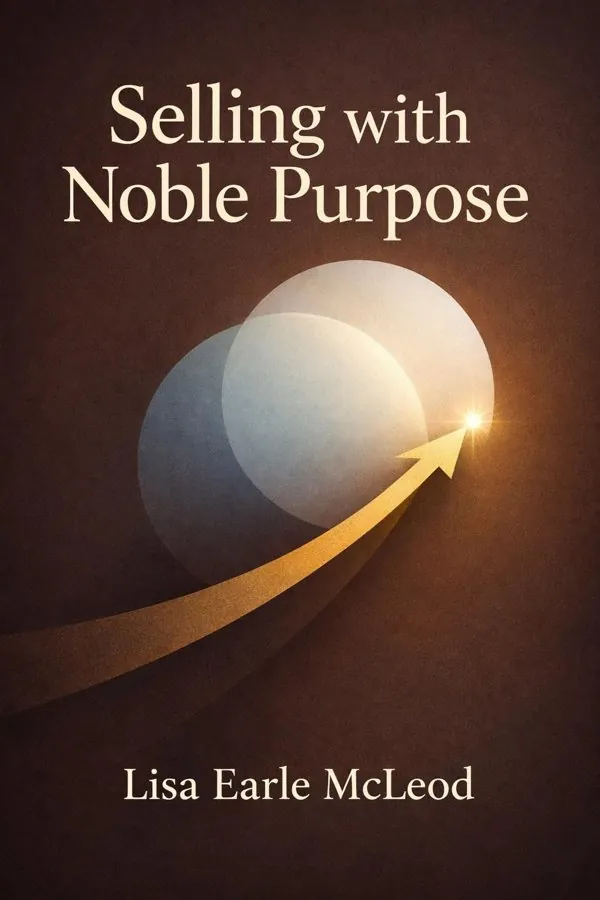
Selling with Noble Purpose: How to Drive Revenue and Do Work That Makes You Proud: Summary & Key Insights
 10 min9 chaptersAudio available
Key Takeaways from Selling with Noble Purpose: How to Drive Revenue and Do Work That Makes You Proud
The biggest shift in sales performance often begins with a change in motive.
Many leaders assume purpose is inspirational but hard to quantify.
Customers do not become loyal because they were pressured effectively; they become loyal because they believe a seller understands them and is committed to their success.
Purpose becomes powerful only when it is concrete enough to guide daily action.
A noble purpose cannot survive as a poster on the wall while leaders manage by pressure alone.
What Is Selling with Noble Purpose: How to Drive Revenue and Do Work That Makes You Proud About?
Selling with Noble Purpose: How to Drive Revenue and Do Work That Makes You Proud by Lisa Earle McLeod is a leadership book spanning 7 pages. Selling is often portrayed as a numbers game driven by quotas, pressure, and persuasion. Lisa Earle McLeod challenges that view with a far more powerful idea: the best salespeople do not simply chase revenue, they focus on making a meaningful difference in customers’ lives. In Selling with Noble Purpose, she argues that when individuals and organizations define success around customer impact rather than internal targets alone, they actually sell more, build stronger trust, and create work cultures people feel proud to belong to. This book matters because it reframes sales from a transactional function into a value-creating discipline. McLeod combines research, consulting experience, and vivid case studies to show that purpose is not a soft slogan or branding exercise. It is a measurable driver of performance, loyalty, resilience, and differentiation. Her insights speak not only to salespeople, but also to leaders responsible for culture, strategy, and growth. For anyone tired of manipulative sales tactics or disengaged teams, Selling with Noble Purpose offers a practical and inspiring roadmap for generating revenue while serving customers in a way that feels both ethical and effective.
This FizzRead summary covers all 9 key chapters of Selling with Noble Purpose: How to Drive Revenue and Do Work That Makes You Proud in approximately 10 minutes, distilling the most important ideas, arguments, and takeaways from Lisa Earle McLeod's work. Also available as an audio summary and Key Quotes Podcast.
Selling with Noble Purpose: How to Drive Revenue and Do Work That Makes You Proud
Selling is often portrayed as a numbers game driven by quotas, pressure, and persuasion. Lisa Earle McLeod challenges that view with a far more powerful idea: the best salespeople do not simply chase revenue, they focus on making a meaningful difference in customers’ lives. In Selling with Noble Purpose, she argues that when individuals and organizations define success around customer impact rather than internal targets alone, they actually sell more, build stronger trust, and create work cultures people feel proud to belong to.
This book matters because it reframes sales from a transactional function into a value-creating discipline. McLeod combines research, consulting experience, and vivid case studies to show that purpose is not a soft slogan or branding exercise. It is a measurable driver of performance, loyalty, resilience, and differentiation. Her insights speak not only to salespeople, but also to leaders responsible for culture, strategy, and growth. For anyone tired of manipulative sales tactics or disengaged teams, Selling with Noble Purpose offers a practical and inspiring roadmap for generating revenue while serving customers in a way that feels both ethical and effective.
Who Should Read Selling with Noble Purpose: How to Drive Revenue and Do Work That Makes You Proud?
This book is perfect for anyone interested in leadership and looking to gain actionable insights in a short read. Whether you're a student, professional, or lifelong learner, the key ideas from Selling with Noble Purpose: How to Drive Revenue and Do Work That Makes You Proud by Lisa Earle McLeod will help you think differently.
- ✓Readers who enjoy leadership and want practical takeaways
- ✓Professionals looking to apply new ideas to their work and life
- ✓Anyone who wants the core insights of Selling with Noble Purpose: How to Drive Revenue and Do Work That Makes You Proud in just 10 minutes
Want the full summary?
Get instant access to this book summary and 100K+ more with Fizz Moment.
Get Free SummaryAvailable on App Store • Free to download
Key Chapters
The biggest shift in sales performance often begins with a change in motive. McLeod’s central insight is that salespeople perform at a higher level when they see their work as helping customers succeed rather than merely closing deals. Traditional sales culture tends to emphasize quotas, rankings, incentives, and pressure. Those factors can create short bursts of action, but they rarely sustain excellence. Purpose, by contrast, gives people an emotional reason to care deeply, persist through setbacks, and approach customers with authenticity.
When salespeople are focused only on their own targets, customers can sense it. Conversations become self-serving, and trust erodes. But when a salesperson genuinely wants to improve a client’s business, health, financial stability, or daily work, the tone changes. They listen more carefully, ask better questions, and recommend solutions more responsibly. That creates stronger relationships and often leads to larger and longer-lasting business.
Imagine two account managers selling workplace software. One pushes for the fastest possible signature to hit a monthly number. The other seeks to understand how the client’s employees struggle with coordination, delays, and frustration. The second seller is more likely to tailor the solution, identify implementation risks, and create a positive outcome. That customer is also more likely to renew, expand, and refer others.
McLeod’s point is not that compensation and results stop mattering. Rather, purpose gives those goals a healthier foundation. It channels ambition into service and turns selling into a profession people can respect.
Actionable takeaway: Ask yourself and your team one question every day: “How will what we sell improve the customer’s world?”
Many leaders assume purpose is inspirational but hard to quantify. McLeod argues the opposite: noble purpose produces measurable business results. Through her research and consulting work, she found that high-performing sales organizations consistently talk about customer impact differently from low-performing ones. The strongest teams do not merely describe what they sell; they describe the difference their offering makes.
This matters because language reveals attention. Teams obsessed with internal metrics tend to frame success around market share, commissions, and quarterly wins. Top performers, while fully aware of financial targets, remain anchored in how they help customers reduce risk, grow revenue, save time, improve safety, or achieve important goals. That mindset influences behavior at every level, from prospecting and messaging to negotiation and account management.
Purpose also improves resilience. A team driven only by numbers may become discouraged after rejection or market disruption. A team that believes its work matters is more likely to persist, innovate, and adapt. Purpose acts as emotional fuel. It reminds people that they are not just selling products; they are solving meaningful problems.
Consider a medical device company. A sales team focused only on volume may become transactional, pushing inventory. A team focused on helping doctors improve patient outcomes will likely invest more in training, clinical understanding, and long-term support. The result is often deeper trust and stronger growth.
McLeod’s evidence supports a practical conclusion: purpose is not separate from profit. It is one of profit’s drivers when it guides behavior consistently.
Actionable takeaway: Review your team’s language in meetings and emails. If most conversations are about internal targets rather than customer outcomes, your culture needs recalibration.
Customers do not become loyal because they were pressured effectively; they become loyal because they believe a seller understands them and is committed to their success. McLeod shows that noble purpose changes the psychology of the sales relationship by replacing persuasion-first behavior with empathy-first behavior. Trust grows when customers sense that the seller is trying to create value, not merely extract it.
This shift is especially important in markets where buyers are skeptical, overloaded with options, or wary of being manipulated. When salespeople approach conversations with genuine curiosity, they ask different questions. Instead of rushing to pitch features, they explore the customer’s real frustrations, constraints, fears, and aspirations. That leads to solutions that fit better and to recommendations that customers can believe.
Trust also depends on candor. A purpose-driven salesperson is more willing to say, “This is not the right fit,” or “You may not need our premium package.” Ironically, this honesty often increases credibility and future business. Customers remember when someone prioritized their interest over a quick sale.
For example, a financial advisor operating with noble purpose would not simply push high-commission products. They would spend time understanding the client’s family responsibilities, risk tolerance, long-term goals, and anxieties about money. By aligning recommendations with actual needs, the advisor builds a durable relationship rather than a one-time transaction.
McLeod’s broader lesson is that customer loyalty is emotional before it is contractual. Purpose improves the quality of human interaction, and that improves the quality of business outcomes.
Actionable takeaway: In your next sales conversation, spend more time diagnosing the customer’s situation than describing your solution.
Purpose becomes powerful only when it is concrete enough to guide daily action. McLeod warns against vague mission statements that sound inspirational but do little to change behavior. A true noble purpose is not a generic promise to be excellent, innovative, or customer-centric. It is a clear articulation of how your work improves customers’ lives in a meaningful way.
Specificity matters because sales teams need a practical compass, not just an uplifting slogan. “We help manufacturers reduce costly downtime so workers can do their jobs safely and efficiently” is far more useful than “We deliver world-class industrial solutions.” The first statement helps people identify which customer problems matter, how to frame value, and what tradeoffs to make. The second is too broad to shape conduct.
Discovering a noble purpose requires leaders to ask deeper questions. What burden do we remove? What progress do we enable? What human problem sits beneath the transaction? For a logistics company, the purpose may not simply be moving packages but helping businesses keep promises to their customers. For an education technology provider, it may be enabling teachers to spend more time teaching and less time on administrative work.
Once defined, noble purpose should be memorable and emotionally resonant. Salespeople must be able to say it naturally, believe it sincerely, and connect it to real customer stories. If they cannot, the statement is probably too abstract.
McLeod emphasizes that the right purpose is discovered through customer truth, not invented by branding alone.
Actionable takeaway: Rewrite your company’s purpose in one sentence that explains exactly how customers are better off because you exist.
A noble purpose cannot survive as a poster on the wall while leaders manage by pressure alone. McLeod makes clear that leadership behavior determines whether purpose becomes a living standard or an empty slogan. Employees watch what leaders praise, measure, repeat, and reward. If managers talk about customer impact but celebrate only short-term numbers, the true message is obvious.
Purpose-driven leadership starts with how leaders communicate. They consistently connect targets to customer value. They tell stories about clients whose lives or businesses improved. They ask in pipeline reviews not only “Will this close?” but also “What problem are we solving?” This kind of messaging teaches teams that results matter and that the way results are achieved matters too.
Coaching is equally important. Managers should help salespeople think through customer outcomes, not just tactics for overcoming objections. A purpose-led coach might ask, “What would success look like for the customer six months after implementation?” That question broadens the salesperson’s perspective beyond the signature.
Hiring and promotion also shape culture. Leaders who want noble purpose must select people who show empathy, curiosity, integrity, and a desire to help others, not just aggressive competitiveness. Likewise, top performers who damage trust or mistreat customers should not be held up as heroes simply because they produce revenue.
McLeod’s point is straightforward: culture follows leadership. Noble purpose becomes real when leaders operationalize it through language, decisions, and discipline.
Actionable takeaway: In your next team meeting, share one customer-impact story and link it explicitly to the behaviors you want repeated.
Purpose only changes outcomes when it is translated into systems, habits, and routines. McLeod stresses that noble purpose should shape the entire sales process, not just kickoff speeches or annual strategy documents. The organizations that benefit most are the ones that weave purpose into how they prospect, qualify, present, negotiate, onboard, and renew.
For instance, prospecting becomes more effective when outreach focuses on the problems you are equipped to solve rather than on generic claims about your product. Qualification improves when sellers assess whether they can truly create value, not just whether a buyer has budget. Presentations become stronger when they are organized around the customer’s desired results rather than a feature dump. Even negotiations change when both parties are discussing outcomes and implementation instead of only price.
Purpose should also influence internal collaboration. Marketing can equip sales with customer stories and impact-focused messaging. Product teams can use frontline insights to refine offerings around real-world needs. Customer success teams can reinforce the promise made during the sale. In this way, noble purpose becomes a cross-functional operating principle, not a departmental idea.
A practical example is a B2B service firm that redesigns its proposal templates around business outcomes, expected gains, risk mitigation, and customer implementation plans. That structure signals seriousness and customer focus from the outset.
McLeod’s message is that purpose must be built into workflows to become sustainable. Inspiration starts the process; disciplined execution secures the result.
Actionable takeaway: Audit one stage of your sales process this week and redesign it to emphasize customer outcomes over seller convenience.
One of the biggest obstacles to noble purpose is not strategy but skepticism. McLeod acknowledges that many salespeople and leaders have seen lofty mission statements used as public relations gloss while everyday behavior remains unchanged. As a result, they may view purpose initiatives as soft, naive, or manipulative. Overcoming that resistance requires more than speeches; it requires proof, consistency, and honesty.
Cynicism often shows up in familiar ways. Some people say, “At the end of the day, sales is about numbers.” Others fear that focusing on customer welfare will make teams less competitive. McLeod counters that noble purpose does not replace accountability. It improves the quality of performance by giving salespeople a better reason to excel. The point is not to become passive or sentimental. The point is to compete by creating genuine value.
Leaders can reduce resistance by showing how purpose changes actual decisions. If a company turns down bad-fit business, improves customer onboarding, redesigns incentives, or publicly recognizes people who did the right thing for a client, employees begin to believe the message. Trust in the initiative grows when purpose has consequences.
Measurement also matters. Organizations should track customer retention, referrals, implementation success, engagement scores, and stories of meaningful impact alongside revenue metrics. That creates a more complete picture of performance.
McLeod suggests that resistance softens when people see noble purpose not as moral decoration but as a practical discipline that improves trust, pride, and results.
Actionable takeaway: Identify one cynical objection in your culture and answer it with a concrete example of purpose improving both customer outcomes and business performance.
In crowded markets, products, pricing, and features are often easy for competitors to copy. McLeod argues that noble purpose creates a harder-to-replicate advantage: a culture that consistently delivers value in a way customers can feel. Differentiation is not only about what you sell, but about how deeply you understand customers and how seriously you take their success.
This matters because buyers increasingly compare more than technical specifications. They evaluate responsiveness, trustworthiness, insight, and alignment. A purpose-driven sales organization stands out by demonstrating that it understands the customer’s world and is prepared to serve it. That distinction is especially powerful in industries where solutions look similar on paper.
For example, two consulting firms may offer comparable capabilities. The first talks mostly about methodology and credentials. The second frames its work around helping clients reduce organizational friction, build stronger leaders, and create sustainable performance. If that purpose is reflected in discovery, proposal design, and post-sale follow-through, the customer experiences a meaningful difference.
Purpose also supports premium positioning. When customers believe you are invested in results rather than transactions, they become less likely to choose solely on price. They see your offering as a relationship and an outcome, not just a commodity.
McLeod’s insight is strategic: noble purpose is not merely internal motivation. It becomes externally visible through behavior, messaging, and customer experience, which makes it a powerful competitive asset.
Actionable takeaway: Define one way your team can make its customer commitment visible before, during, and after the sale so buyers experience your purpose directly.
Revenue matters, but pride in one’s work is what makes success feel worthwhile. McLeod highlights a deeply human benefit of noble purpose: it allows salespeople to see themselves as contributors rather than persuaders-for-hire. That shift can transform morale, engagement, and long-term commitment, especially in a profession that often struggles with burnout and negative stereotypes.
When people believe their efforts matter, they bring more emotional energy to the job. They handle setbacks better because rejection no longer feels like a verdict on personal worth; it is part of the process of finding the right fit where they can help. Purpose also reduces the internal conflict many sellers feel when they are asked to push aggressively without clear value. Instead of rationalizing behavior, they can feel aligned with it.
This has implications for retention and team culture. Employees are more likely to stay in organizations where they feel their work has dignity and impact. Teams built around shared purpose also collaborate more naturally because they are united by a common mission, not just individual incentives.
Consider a salesperson in elder-care services. If the role is framed only as filling beds, motivation may erode quickly. If it is framed as helping families find safety, support, and peace of mind during difficult transitions, the work becomes more emotionally meaningful and often more effective.
McLeod’s broader argument is that noble purpose creates a win on two levels: stronger business performance and a stronger sense of personal integrity.
Actionable takeaway: Ask each team member to share one real example of how your product or service improved a customer’s life, then use those stories to reinforce pride and purpose.
All Chapters in Selling with Noble Purpose: How to Drive Revenue and Do Work That Makes You Proud
About the Author
Lisa Earle McLeod is a sales leadership consultant, keynote speaker, and author best known for her work on purpose-driven business performance. She has spent years advising Fortune 500 companies and other organizations on how to improve results by helping teams connect their work to meaningful customer impact. Her research and consulting focus on the idea that salespeople and leaders perform better when they are motivated by service and contribution rather than by metrics alone. McLeod has become a respected voice in both leadership and sales because she combines practical business insight with a strong ethical framework. Through her speaking, writing, and advisory work, she has helped organizations rethink selling as a profession rooted in trust, value creation, and pride in making a difference.
Get This Summary in Your Preferred Format
Read or listen to the Selling with Noble Purpose: How to Drive Revenue and Do Work That Makes You Proud summary by Lisa Earle McLeod anytime, anywhere. FizzRead offers multiple formats so you can learn on your terms — all free.
Available formats: App · Audio · PDF · EPUB — All included free with FizzRead
Download Selling with Noble Purpose: How to Drive Revenue and Do Work That Makes You Proud PDF and EPUB Summary
Key Quotes from Selling with Noble Purpose: How to Drive Revenue and Do Work That Makes You Proud
“The biggest shift in sales performance often begins with a change in motive.”
“Many leaders assume purpose is inspirational but hard to quantify.”
“Customers do not become loyal because they were pressured effectively; they become loyal because they believe a seller understands them and is committed to their success.”
“Purpose becomes powerful only when it is concrete enough to guide daily action.”
“A noble purpose cannot survive as a poster on the wall while leaders manage by pressure alone.”
Frequently Asked Questions about Selling with Noble Purpose: How to Drive Revenue and Do Work That Makes You Proud
Selling with Noble Purpose: How to Drive Revenue and Do Work That Makes You Proud by Lisa Earle McLeod is a leadership book that explores key ideas across 9 chapters. Selling is often portrayed as a numbers game driven by quotas, pressure, and persuasion. Lisa Earle McLeod challenges that view with a far more powerful idea: the best salespeople do not simply chase revenue, they focus on making a meaningful difference in customers’ lives. In Selling with Noble Purpose, she argues that when individuals and organizations define success around customer impact rather than internal targets alone, they actually sell more, build stronger trust, and create work cultures people feel proud to belong to. This book matters because it reframes sales from a transactional function into a value-creating discipline. McLeod combines research, consulting experience, and vivid case studies to show that purpose is not a soft slogan or branding exercise. It is a measurable driver of performance, loyalty, resilience, and differentiation. Her insights speak not only to salespeople, but also to leaders responsible for culture, strategy, and growth. For anyone tired of manipulative sales tactics or disengaged teams, Selling with Noble Purpose offers a practical and inspiring roadmap for generating revenue while serving customers in a way that feels both ethical and effective.
You Might Also Like

Extreme Ownership
Jocko Willink
10 min
Dare to Lead
Brene Brown
10 min
Leaders Eat Last
Simon Sinek
10 min
The 21 Irrefutable Laws of Leadership
John Maxwell
10 min
Start With Why
Simon Sinek
10 min
How to Lead When You're Not in Charge
Clay Scroggins
10 minBrowse by Category
Ready to read Selling with Noble Purpose: How to Drive Revenue and Do Work That Makes You Proud?
Get the full summary and 100K+ more books with Fizz Moment.