
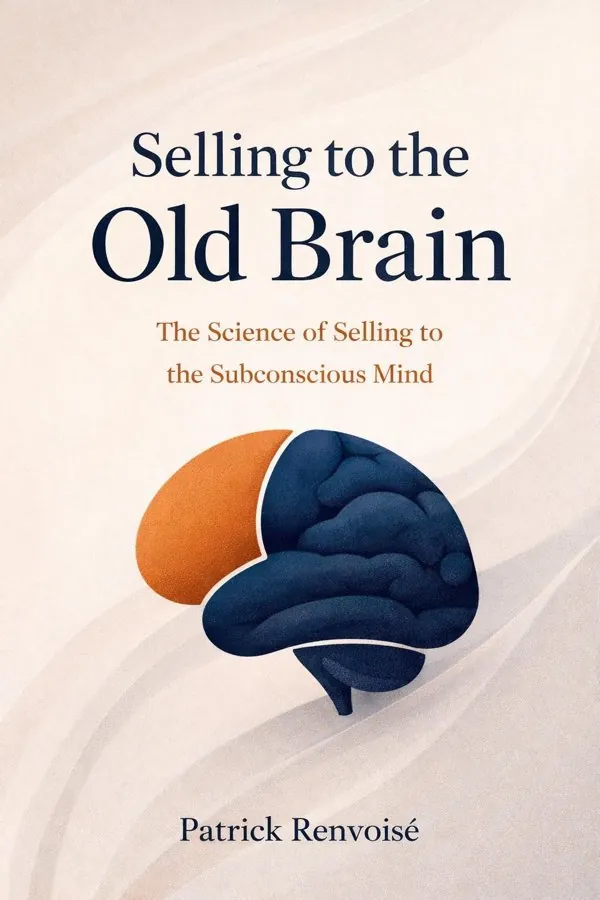
Selling to the Old Brain: The Science of Selling to the Subconscious Mind: Summary & Key Insights
 10 min6 chaptersAudio available
What Is Selling to the Old Brain: The Science of Selling to the Subconscious Mind About?
Selling to the Old Brain: The Science of Selling to the Subconscious Mind by Patrick Renvoisé is a marketing book spanning 6 pages. This book explores how neuroscience and psychology can be applied to sales and marketing by focusing on the 'old brain'—the part of the human brain responsible for instinctive decision-making. Renvoisé explains how understanding subconscious triggers can help sales professionals craft more persuasive messages and close deals more effectively.
This FizzRead summary covers all 6 key chapters of Selling to the Old Brain: The Science of Selling to the Subconscious Mind in approximately 10 minutes, distilling the most important ideas, arguments, and takeaways from Patrick Renvoisé's work. Also available as an audio summary and Key Quotes Podcast.
Selling to the Old Brain: The Science of Selling to the Subconscious Mind
This book explores how neuroscience and psychology can be applied to sales and marketing by focusing on the 'old brain'—the part of the human brain responsible for instinctive decision-making. Renvoisé explains how understanding subconscious triggers can help sales professionals craft more persuasive messages and close deals more effectively.
Who Should Read Selling to the Old Brain: The Science of Selling to the Subconscious Mind?
This book is perfect for anyone interested in marketing and looking to gain actionable insights in a short read. Whether you're a student, professional, or lifelong learner, the key ideas from Selling to the Old Brain: The Science of Selling to the Subconscious Mind by Patrick Renvoisé will help you think differently.
- ✓Readers who enjoy marketing and want practical takeaways
- ✓Professionals looking to apply new ideas to their work and life
- ✓Anyone who wants the core insights of Selling to the Old Brain: The Science of Selling to the Subconscious Mind in just 10 minutes
Want the full summary?
Get instant access to this book summary and 100K+ more with Fizz Moment.
Get Free SummaryAvailable on App Store • Free to download
Key Chapters
At the heart of persuasion lies a discovery both humbling and empowering: it’s not the logical mind that rules our decisions, but the primal, subconscious one. The old brain is the part of our mind that evolved millions of years ago when survival was our only goal. It doesn’t weigh pros and cons—it acts. It’s self-centered, emotional, and responds only to what feels immediate and crucial.
When I began studying neuromarketing and the way decisions unfold, I realized that most sales messages were targeting the wrong recipient. They appealed to the new brain—the rational mind—with data, features, and technical specifications. Yet the new brain doesn’t decide; it only rationalizes. The customer may listen, analyze, even agree intellectually, but unless the old brain decides, there is no action.
The old brain responds to cues of fear, contrast, and reward—the simple survival calculus: Will this help me avoid pain? Will it help me gain pleasure or safety? All purchasing choices, stripped of modern context, follow this instinct. When your message resonates at that level, it becomes undeniable, because you are communicating where decisions actually happen.
The key, then, is to understand the old brain’s six triggers—the stimuli that activate its attention. Each represents a fundamental human bias born of evolutionary necessity. Self-centeredness ensures we focus on what benefits us personally. Contrast helps us detect changes in our environment quickly, vital for survival. Tangible input makes messages real; the old brain distrusts abstraction. The bias toward beginnings and ends ensures we remember what matters most. Visual stimuli dominate auditory or textual input, because sight was our first defense. And emotional engagement locks a message into memory and action.
By mastering these six stimuli, we learn not to manipulate but to communicate in the language the old brain understands. It’s about removing noise, reaching clarity, and triggering the deeply human responses that precede all choices.
If we trace the anatomy of a failing sales pitch, we often find it perfectly logical—but lifeless. The seller may have spent hours crafting rational arguments about quality, price, and performance, yet the listener feels nothing. That’s because logic appeals to the new brain, which analyzes but does not act. The old brain, meanwhile, sleeps through data-heavy presentations, waiting for something that feels relevant to its survival.
I learned through years of observation that the most persuasive messages are not those that inform, but those that transform how the listener feels. The problem is that most marketing material is written for internal comfort—for showing how clever or comprehensive we are—not for the biological decision-maker in the customer.
You can tell when you’re targeting the wrong part of the brain: your prospect nods politely, asks for more data, but never reaches the buying moment. To awaken the old brain, you must frame your message in primal terms—pain and gain. It needs to feel visceral, concrete, and centered around the listener, not the product.
Whenever data replaces story or empathy with slides, you are signaling to the rational mind that analysis is welcome—but to the old brain, the signal is noise. The right approach is simplicity. Speak to survival and emotion. Build contrast between pain and relief, between what is and what could be, and between danger and safety. Above all, make the listener’s life, not your product’s features, the hero of the narrative.
This is why understanding neuroscience isn’t just an academic pursuit—it’s the foundation of effective communication. To sell to humans, you must sell to their instincts.
+ 4 more chapters — available in the FizzRead app
All Chapters in Selling to the Old Brain: The Science of Selling to the Subconscious Mind
About the Author
Patrick Renvoisé is a French-born marketing expert and co-founder of SalesBrain, a neuromarketing agency. He is known for pioneering the application of neuroscience to marketing and sales strategies, helping organizations understand how the brain influences buying decisions.
Get This Summary in Your Preferred Format
Read or listen to the Selling to the Old Brain: The Science of Selling to the Subconscious Mind summary by Patrick Renvoisé anytime, anywhere. FizzRead offers multiple formats so you can learn on your terms — all free.
Available formats: App · Audio · PDF · EPUB — All included free with FizzRead
Download Selling to the Old Brain: The Science of Selling to the Subconscious Mind PDF and EPUB Summary
Key Quotes from Selling to the Old Brain: The Science of Selling to the Subconscious Mind
“At the heart of persuasion lies a discovery both humbling and empowering: it’s not the logical mind that rules our decisions, but the primal, subconscious one.”
“If we trace the anatomy of a failing sales pitch, we often find it perfectly logical—but lifeless.”
Frequently Asked Questions about Selling to the Old Brain: The Science of Selling to the Subconscious Mind
Selling to the Old Brain: The Science of Selling to the Subconscious Mind by Patrick Renvoisé is a marketing book that explores key ideas across 6 chapters. This book explores how neuroscience and psychology can be applied to sales and marketing by focusing on the 'old brain'—the part of the human brain responsible for instinctive decision-making. Renvoisé explains how understanding subconscious triggers can help sales professionals craft more persuasive messages and close deals more effectively.
You Might Also Like
Captivology: The Science of Capturing People's Attention
Ben Parr
10 min
Marketing 5.0: Technology for Humanity
Philip Kotler, Hermawan Kartajaya, Iwan Setiawan
10 min
Marketing Strategy
Paul Fifield
10 min
UnMarketing: Stop Marketing. Start Engaging.
Scott Stratten
10 min
$100M Leads: How to Get Strangers to Want to Buy Your Stuff
Alex Hormozi
10 min
80/20 Sales and Marketing: The Definitive Guide to Working Less and Making More
Perry Marshall
10 minBrowse by Category
Ready to read Selling to the Old Brain: The Science of Selling to the Subconscious Mind?
Get the full summary and 100K+ more books with Fizz Moment.