
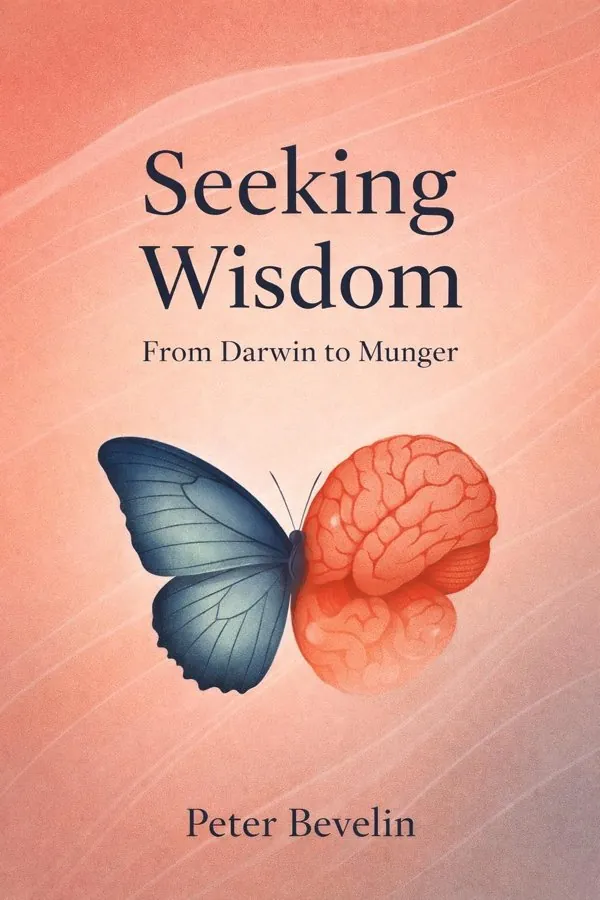
Seeking Wisdom: From Darwin to Munger: Summary & Key Insights
 10 min10 chaptersAudio available
Key Takeaways from Seeking Wisdom: From Darwin to Munger
Great thinking often begins not with brilliance, but with the willingness to notice what contradicts us.
The most dangerous mistakes are often the ones that feel right in the moment.
We like to think of ourselves as rational decision-makers, but much of our behavior is rooted in biology.
Living through events does not automatically make us wiser.
A single way of seeing the world is a recipe for error.
What Is Seeking Wisdom: From Darwin to Munger About?
Seeking Wisdom: From Darwin to Munger by Peter Bevelin is a mindset book spanning 11 pages. Seeking Wisdom: From Darwin to Munger is a practical guide to clearer thinking in a world full of noise, emotion, and avoidable mistakes. Peter Bevelin brings together lessons from Charles Darwin, Charlie Munger, Warren Buffett, and a wide range of thinkers in psychology, biology, philosophy, and decision theory to answer a deceptively simple question: why do smart people make poor decisions so often? His answer is that human judgment is shaped by predictable mental biases, flawed incentives, limited memory, and emotional impulses. But these weaknesses can be managed if we learn to think more carefully and more broadly. What makes this book so valuable is its multidisciplinary approach. Rather than offering quick productivity tips or simplistic life hacks, Bevelin shows how enduring wisdom comes from understanding reality as it is: uncertain, probabilistic, and often counterintuitive. He draws authority not from grand personal claims but from synthesizing the best ideas of exceptional thinkers and applying them to everyday life, business, investing, and self-improvement. The result is a timeless manual for anyone who wants fewer foolish errors and better long-term decisions.
This FizzRead summary covers all 10 key chapters of Seeking Wisdom: From Darwin to Munger in approximately 10 minutes, distilling the most important ideas, arguments, and takeaways from Peter Bevelin's work. Also available as an audio summary and Key Quotes Podcast.
Seeking Wisdom: From Darwin to Munger
Seeking Wisdom: From Darwin to Munger is a practical guide to clearer thinking in a world full of noise, emotion, and avoidable mistakes. Peter Bevelin brings together lessons from Charles Darwin, Charlie Munger, Warren Buffett, and a wide range of thinkers in psychology, biology, philosophy, and decision theory to answer a deceptively simple question: why do smart people make poor decisions so often? His answer is that human judgment is shaped by predictable mental biases, flawed incentives, limited memory, and emotional impulses. But these weaknesses can be managed if we learn to think more carefully and more broadly.
What makes this book so valuable is its multidisciplinary approach. Rather than offering quick productivity tips or simplistic life hacks, Bevelin shows how enduring wisdom comes from understanding reality as it is: uncertain, probabilistic, and often counterintuitive. He draws authority not from grand personal claims but from synthesizing the best ideas of exceptional thinkers and applying them to everyday life, business, investing, and self-improvement. The result is a timeless manual for anyone who wants fewer foolish errors and better long-term decisions.
Who Should Read Seeking Wisdom: From Darwin to Munger?
This book is perfect for anyone interested in mindset and looking to gain actionable insights in a short read. Whether you're a student, professional, or lifelong learner, the key ideas from Seeking Wisdom: From Darwin to Munger by Peter Bevelin will help you think differently.
- ✓Readers who enjoy mindset and want practical takeaways
- ✓Professionals looking to apply new ideas to their work and life
- ✓Anyone who wants the core insights of Seeking Wisdom: From Darwin to Munger in just 10 minutes
Want the full summary?
Get instant access to this book summary and 100K+ more with Fizz Moment.
Get Free SummaryAvailable on App Store • Free to download
Key Chapters
Great thinking often begins not with brilliance, but with the willingness to notice what contradicts us. Peter Bevelin presents Charles Darwin as a model of intellectual character because Darwin did something rare: he trained himself to pay special attention to facts that challenged his own conclusions. Instead of defending his first ideas, he built habits that protected him from self-deception. He recorded disconfirming evidence quickly, revisited uncomfortable questions, and resisted the natural human tendency to remember only what supported his theory.
This matters because most bad decisions are not caused by lack of intelligence. They are caused by selective perception. We see what we expect, interpret events in our favor, and quietly ignore signals that suggest we are wrong. Darwin’s greatness came from treating doubt as a tool rather than a threat. That mindset is useful far beyond science. In business, a leader can ask what evidence would prove a strategy is failing. In investing, a person can write down the reasons for buying an asset and track what would invalidate the thesis. In relationships, we can question our own assumptions before judging others.
Darwin also reminds us that deep understanding comes from patient observation, not instant opinion. The world is complicated, and reality rarely bends to our preferences. Careful thinkers build systems that make truth easier to see.
Actionable takeaway: Create a “disconfirming evidence” habit. For every important belief or decision, write down at least three reasons you might be wrong and review them before acting.
The most dangerous mistakes are often the ones that feel right in the moment. A central theme in Seeking Wisdom is the psychology of misjudgment: the systematic ways human beings distort reality. Bevelin draws heavily on behavioral psychology and Charlie Munger’s famous catalogue of biases to show that our minds are not designed for objective reasoning. We are vulnerable to confirmation bias, social proof, overconfidence, loss aversion, contrast effects, authority influence, and many other mental shortcuts that can mislead us.
These errors are powerful because they usually operate automatically. A person may believe they are making an independent decision while actually responding to framing, group pressure, or emotional reward. For example, consumers may buy an overpriced item because it is placed next to something even more expensive. Investors may follow a bubble because everyone around them appears confident. Managers may cling to a failed project because they have already invested time and money in it.
Bevelin’s point is not that people are hopelessly irrational. It is that wisdom starts with humility about how easily we can be fooled. Once we accept that our minds have built-in vulnerabilities, we can create defenses. Checklists, second opinions, written reasoning, cooling-off periods, and pre-commitment rules all reduce the odds of error.
Actionable takeaway: Before any major choice, ask: What bias is most likely affecting me here—social proof, overconfidence, loss aversion, or commitment bias—and what process can I use to offset it?
We like to think of ourselves as rational decision-makers, but much of our behavior is rooted in biology. Bevelin emphasizes that human nature cannot be understood apart from evolution. Many of our instincts once helped our ancestors survive, yet those same instincts can now produce poor decisions in modern environments. We react strongly to status, scarcity, immediate rewards, tribal loyalty, and threats because our brains were built for survival, not perfect reasoning.
This evolutionary lens explains why certain mistakes are so persistent. We are drawn to short-term pleasure over long-term benefit, even when we know better. We imitate group behavior because belonging historically improved survival. We fear losses more than we value equal gains because caution helped avoid fatal outcomes. None of this means we are prisoners of instinct, but it does mean that self-improvement requires understanding the machinery beneath our thoughts.
In practical life, this perspective is liberating. If you procrastinate, overspend, overeat, or overreact, the answer is not just to “try harder.” It may be to redesign your environment. Remove temptations. Use default options. Limit exposure to manipulative cues. Build systems that make good behavior easier than bad behavior. A person trying to save money, for example, can automate transfers so discipline is less dependent on willpower.
Actionable takeaway: Stop relying on motivation alone. Identify one recurring bad decision in your life and redesign the environment around it so your biology is less likely to hijack your judgment.
Living through events does not automatically make us wiser. Bevelin argues that experience is useful only when it is interpreted correctly, and that is harder than it sounds. Human beings are poor at learning from feedback when outcomes are noisy, delayed, or partly due to luck. We often draw strong conclusions from small samples, confuse good outcomes with good decisions, and fail to separate skill from chance.
This is especially important in fields like investing, business, medicine, and personal relationships, where the result of a decision may not reveal whether the decision process was sound. A reckless investor can seem brilliant during a rising market. A poor hiring decision may look successful for months before hidden problems emerge. A lucky guess can reinforce bad habits if the outcome happens to turn out well.
Bevelin encourages readers to study not just what happened, but why it happened. That means reviewing decisions based on process rather than result. What information was available at the time? What assumptions were made? What alternatives were ignored? What role did randomness play? This approach builds genuine learning instead of false confidence.
A useful practical method is the decision journal. By recording your reasoning before outcomes are known, you can later compare what you expected with what actually happened. Over time, patterns emerge: perhaps you are too optimistic, too reactive, or too easily influenced by recent events.
Actionable takeaway: Start keeping a decision journal for important choices so you can evaluate the quality of your thinking separately from the luck of the outcome.
A single way of seeing the world is a recipe for error. One of the book’s most influential ideas is that better judgment comes from using multiple mental models drawn from different disciplines. A mental model is a framework for understanding how something works: incentives from economics, feedback loops from systems thinking, adaptation from biology, probability from mathematics, or inversion from logic. The more models you have, the less likely you are to misread reality through a narrow lens.
Bevelin, following Charlie Munger, argues that many mistakes happen because people rely too heavily on one specialized perspective. To a person who knows only finance, every problem may look like a pricing issue. To someone trained only in psychology, every problem may seem motivational. But real-world problems are usually interconnected. A failed company strategy may involve incentives, competition, human bias, poor communication, and delayed feedback all at once.
Mental models help us ask better questions. What are the second-order consequences? Where are the bottlenecks? What happens if this trend reverses? Am I confusing correlation with causation? In daily life, this can improve everything from career decisions to parenting to negotiations. For example, understanding opportunity cost can sharpen time management, while understanding regression to the mean can prevent overreaction to short-term performance.
Actionable takeaway: Build your own latticework of models. Each week, learn one idea from a different field and practice applying it to a real decision you face.
If you want to understand behavior, follow the incentives. Bevelin stresses that people do not respond only to stated goals or moral principles; they respond to rewards, punishments, status signals, and institutional pressures. This is one of the simplest and most powerful explanations for why individuals and organizations behave in surprising ways. Often, what looks like incompetence or hypocrisy is really a predictable response to incentives.
A salesperson paid only on volume may push products that are bad for customers. A manager rewarded for short-term metrics may sacrifice long-term resilience. A student graded solely on test performance may optimize for memorization rather than learning. In each case, behavior follows the structure of rewards. Good intentions are often overwhelmed by a bad system.
The lesson is not merely to distrust others. It is also to examine the incentives shaping your own actions. Are you rewarding yourself for busyness instead of meaningful progress? Are workplace metrics causing you to focus on what is measurable rather than what matters? In families, teams, and companies, the most effective leaders design incentives that align with long-term outcomes.
This idea also helps explain why advice often fails. Telling people what they should do matters less than arranging conditions that make the desired action more attractive and the harmful action less appealing.
Actionable takeaway: For any recurring problem involving people, ask: What incentives are in play here? Then adjust the reward structure so the behavior you want becomes the easiest or most beneficial option.
The world rarely offers guaranteed answers, yet people constantly act as if certainty were available. Bevelin argues that wise judgment depends on probabilistic thinking: estimating likelihoods, updating beliefs with new evidence, and accepting that outcomes come in ranges rather than absolutes. This mindset is essential because many of life’s biggest decisions involve uncertainty, incomplete information, and changing conditions.
Probabilistic thinking counters several common errors. It reduces overconfidence by replacing “I know” with “I think this is likely.” It improves forecasting by encouraging base rates and historical comparisons. It also helps people avoid all-or-nothing reasoning. A business idea does not need to be certain to be worth pursuing; it may simply offer favorable odds relative to the downside. Likewise, a warning sign does not prove disaster, but it may increase the probability enough to justify caution.
In investing, this means judging expected value rather than chasing stories. In medicine, it means understanding risks and trade-offs rather than demanding impossible certainty. In personal life, it means planning for contingencies instead of assuming best-case outcomes. Someone considering a job change, for example, can map likely scenarios, downside risks, and potential upside rather than relying on intuition alone.
The practical challenge is emotional. People crave confidence. But false certainty is expensive, while calibrated uncertainty is useful.
Actionable takeaway: Replace categorical predictions with probability estimates. For important choices, write down the top three possible outcomes and the rough likelihood of each, then update your view as new evidence appears.
One of the book’s most refreshing ideas is that success often comes less from being exceptionally smart than from consistently avoiding obvious mistakes. Bevelin echoes Munger’s inversion-based wisdom: instead of asking only how to win, ask how to lose. Many disasters are predictable. People damage their finances through leverage they do not understand, ruin relationships through ego and impulsive anger, and sabotage careers by neglecting preparation, integrity, and patience.
This negative approach is powerful because the world is full of unforced errors. We overcomplicate solutions when a simple rule would do. We chase exciting opportunities without checking basic risks. We confuse activity with progress. In many fields, staying out of trouble creates an enormous advantage. An investor who avoids catastrophic losses does not need heroic returns. A manager who avoids toxic hires and misaligned incentives may outperform someone with more dazzling strategy but poorer judgment.
Avoiding foolishness also means respecting our limitations. Tired, hungry, emotionally charged, rushed, or socially pressured people make worse choices. Wise systems account for that. Pilots use checklists. Surgeons use protocols. Good organizations create barriers against predictable human error.
This mindset is practical because it does not require genius. It requires realism, humility, and discipline. Remove the biggest mistakes, and many good outcomes become much more likely.
Actionable takeaway: Make a personal “foolishness checklist” of five mistakes that repeatedly hurt you—such as rushing decisions, arguing when emotional, or ignoring incentives—and review it before major actions.
Reality does not respect academic boundaries. That is why Bevelin places so much emphasis on multidisciplinary learning. He argues that durable wisdom comes from combining insights from biology, psychology, economics, mathematics, history, and philosophy rather than staying confined within a single specialty. Complex problems demand broad understanding because their causes are rarely isolated.
A company’s failure, for instance, may involve human bias, poor incentive design, weak capital allocation, competitive dynamics, and mistaken assumptions about customer behavior. A health decision may involve biology, statistics, habit formation, and social environment. If you use only one discipline, you may find part of the truth but miss the rest.
This is also why reading widely can improve practical judgment. History reveals recurring patterns in human behavior. Mathematics disciplines thinking about scale and probability. Philosophy sharpens logic and ethics. Biology teaches adaptation and constraints. Psychology explains misperception and motivation. The more these ideas connect, the more robust your reasoning becomes.
For professionals, this has major advantages. A generalist with strong mental models can often outperform a narrow expert when facing ambiguous, real-world situations. Not because they know more facts, but because they can synthesize causes and consequences more effectively.
Actionable takeaway: Design a learning plan that spans multiple fields. If you mainly read within your profession, add one book or lecture each month from a discipline that challenges your usual way of thinking.
Good intentions are unreliable, but good systems are durable. In the end, Seeking Wisdom is not just a book about ideas; it is a book about building processes that improve judgment over time. Bevelin shows that wise decision-making in practice depends on routines, preparation, feedback, and self-correction. Since human beings are biased, emotional, and inconsistent, we need structures that make better thinking more likely.
These structures can be simple. Use checklists before expensive purchases. Sleep on emotionally charged decisions. Seek independent views before committing to a plan. Break complex problems into smaller parts. Define what success and failure would look like in advance. Review decisions after the fact without blaming or self-flattery. Over time, these habits compound into sounder judgment.
Continuous improvement is central here. Wisdom is not a fixed trait possessed by a few gifted people. It is an iterative process of noticing mistakes, refining models, and adapting behavior. This is one reason the book remains so practical: it does not promise perfection. It encourages readers to become slightly less wrong, more often. In real life, that is a huge advantage.
The best decision-makers are not those who never err. They are those who learn faster, remain open to revision, and build environments where clear thinking can survive stress and uncertainty.
Actionable takeaway: Choose one repeatable decision in your life—such as spending, hiring, planning, or investing—and build a simple system around it with a checklist, written criteria, and a review process.
All Chapters in Seeking Wisdom: From Darwin to Munger
About the Author
Peter Bevelin is a Swedish author known for writing about rational thinking, decision-making, and the mental models that shape human judgment. He is especially admired for translating the ideas of Charles Darwin, Charlie Munger, Warren Buffett, and other great thinkers into practical lessons for everyday life and business. Rather than promoting flashy theories, Bevelin focuses on timeless principles from psychology, biology, economics, mathematics, and philosophy. His work emphasizes how people can reduce avoidable mistakes by understanding bias, incentives, probability, and human nature. Through books such as Seeking Wisdom, he has earned a reputation as a thoughtful synthesizer of multidisciplinary knowledge. His writing appeals strongly to investors, entrepreneurs, and lifelong learners who want to think more clearly and make better long-term decisions.
Get This Summary in Your Preferred Format
Read or listen to the Seeking Wisdom: From Darwin to Munger summary by Peter Bevelin anytime, anywhere. FizzRead offers multiple formats so you can learn on your terms — all free.
Available formats: App · Audio · PDF · EPUB — All included free with FizzRead
Download Seeking Wisdom: From Darwin to Munger PDF and EPUB Summary
Key Quotes from Seeking Wisdom: From Darwin to Munger
“Great thinking often begins not with brilliance, but with the willingness to notice what contradicts us.”
“The most dangerous mistakes are often the ones that feel right in the moment.”
“We like to think of ourselves as rational decision-makers, but much of our behavior is rooted in biology.”
“Living through events does not automatically make us wiser.”
“A single way of seeing the world is a recipe for error.”
Frequently Asked Questions about Seeking Wisdom: From Darwin to Munger
Seeking Wisdom: From Darwin to Munger by Peter Bevelin is a mindset book that explores key ideas across 10 chapters. Seeking Wisdom: From Darwin to Munger is a practical guide to clearer thinking in a world full of noise, emotion, and avoidable mistakes. Peter Bevelin brings together lessons from Charles Darwin, Charlie Munger, Warren Buffett, and a wide range of thinkers in psychology, biology, philosophy, and decision theory to answer a deceptively simple question: why do smart people make poor decisions so often? His answer is that human judgment is shaped by predictable mental biases, flawed incentives, limited memory, and emotional impulses. But these weaknesses can be managed if we learn to think more carefully and more broadly. What makes this book so valuable is its multidisciplinary approach. Rather than offering quick productivity tips or simplistic life hacks, Bevelin shows how enduring wisdom comes from understanding reality as it is: uncertain, probabilistic, and often counterintuitive. He draws authority not from grand personal claims but from synthesizing the best ideas of exceptional thinkers and applying them to everyday life, business, investing, and self-improvement. The result is a timeless manual for anyone who wants fewer foolish errors and better long-term decisions.
You Might Also Like



Browse by Category
Ready to read Seeking Wisdom: From Darwin to Munger?
Get the full summary and 100K+ more books with Fizz Moment.