
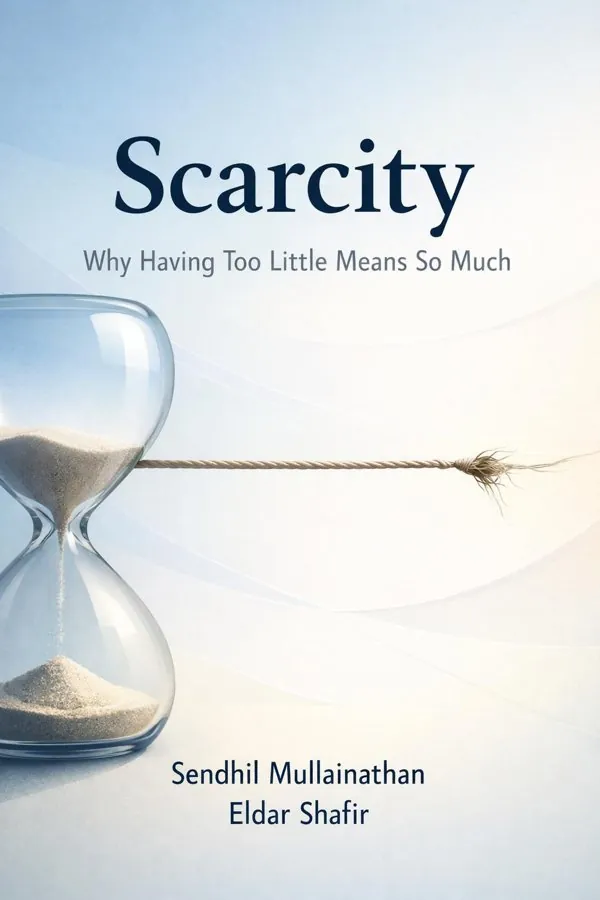
Scarcity: Why Having Too Little Means So Much: Summary & Key Insights
by Sendhil Mullainathan, Eldar Shafir
 10 min4 chaptersAudio available
What Is Scarcity: Why Having Too Little Means So Much About?
Scarcity: Why Having Too Little Means So Much by Sendhil Mullainathan, Eldar Shafir is a economics book spanning 4 pages. This book explores the psychology and economics of scarcity, examining how having too little—whether of time, money, or other resources—shapes our thinking, decision-making, and behavior. The authors argue that scarcity captures the mind, narrowing focus and leading to both beneficial and detrimental effects. Drawing on research in behavioral economics and cognitive science, they reveal how scarcity can create cycles of poverty, stress, and inefficiency, and propose ways to design policies and systems that mitigate its negative impacts.
This FizzRead summary covers all 4 key chapters of Scarcity: Why Having Too Little Means So Much in approximately 10 minutes, distilling the most important ideas, arguments, and takeaways from Sendhil Mullainathan, Eldar Shafir's work. Also available as an audio summary and Key Quotes Podcast.
Scarcity: Why Having Too Little Means So Much
This book explores the psychology and economics of scarcity, examining how having too little—whether of time, money, or other resources—shapes our thinking, decision-making, and behavior. The authors argue that scarcity captures the mind, narrowing focus and leading to both beneficial and detrimental effects. Drawing on research in behavioral economics and cognitive science, they reveal how scarcity can create cycles of poverty, stress, and inefficiency, and propose ways to design policies and systems that mitigate its negative impacts.
Who Should Read Scarcity: Why Having Too Little Means So Much?
This book is perfect for anyone interested in economics and looking to gain actionable insights in a short read. Whether you're a student, professional, or lifelong learner, the key ideas from Scarcity: Why Having Too Little Means So Much by Sendhil Mullainathan, Eldar Shafir will help you think differently.
- ✓Readers who enjoy economics and want practical takeaways
- ✓Professionals looking to apply new ideas to their work and life
- ✓Anyone who wants the core insights of Scarcity: Why Having Too Little Means So Much in just 10 minutes
Want the full summary?
Get instant access to this book summary and 100K+ more with Fizz Moment.
Get Free SummaryAvailable on App Store • Free to download
Key Chapters
When we speak of scarcity, we do not simply mean having less; we mean the feeling of not having enough. Scarcity exists when there is a gap between what we want and what we have, and that gap captures the mind’s attention irresistibly. In our research, we found that scarcity pulls focus toward whatever is lacking—money, time, food—and organizes thinking around that deficit. This intense focus can sometimes feel productive, even energizing. Imagine being close to a deadline—the clarity you feel, the sense of urgency, the surge of concentration. That is a form of scarcity. But beneath that temporary boost lies a hidden cost: the narrowing of cognition we call *tunneling*.
Tunneling is the mind’s natural response to shortage. When the brain detects scarcity, it reallocates attention narrowly toward the pressing need inside the tunnel. This means that urgent matters dominate thought, while distant goals—those outside the tunnel—fade away. For the poor, that tunnel may be filled with worries about rent or debt. For someone busy, the tunnel holds tasks waiting to be finished. Once inside the tunnel, everything outside looks less real, less important. That tunnel explains why even intelligent, motivated people under scarcity make choices that worsen their situation. A farmer anticipating next season’s harvest may neglect basic upkeep today because the immediate shortage feels more pressing. A parent managing bills may take a painful payday loan because the tunnel demands doing something now, even if the long-term consequences are severe.
As researchers, we were fascinated to see this pattern across different domains. Scarcities differ—money, time, food—but the psychology is strikingly similar. Scarcity reduces cognitive bandwidth. We measured bandwidth empirically—in experiments on poverty and attention—and found that the mental load of scarcity can effectively lower IQ scores by several points because the mind’s capacity is partially consumed. This is not evidence of lesser ability, but of resource diversion. Just as a computer slows when too many programs run, the human mind slows when scarcity runs in the background.
When we understand scarcity as a bandwidth problem, we see that poor decisions often arise not from laziness or lack of willpower but from lack of cognitive slack. This insight should change how we view poverty, productivity, and self-control. The scarcity of money robs the poor not only of options but of bandwidth. The scarcity of time robs the busy not only of relaxation but of foresight. Recognizing this dynamic is the first step toward compassion and effective design.
One of the most striking findings from our research is how scarcity imposes a *bandwidth tax*. Think of bandwidth as your mental capacity—the sum of attention, memory, and cognitive control available to you. When scarcity occupies part of that bandwidth, less remains for everything else. This tax is not optional; it is automatic. You cannot decide not to worry about where your next meal will come from or how you will pay for medical bills. Scarcity captures attention involuntarily, and that attention drain has consequences.
We saw this vividly in our field studies with farmers in India. Before the harvest, when money was tight, the same farmers performed worse on cognitive tests than they did after harvest, when money was abundant. Nothing else about them had changed—their intelligence, motivation, and health remained constant. What changed was their mental bandwidth: before harvest, poverty filled their minds. This experiment showed that scarcity itself, not personality or background, causes measurable cognitive load.
This bandwidth tax explains the paradox of poverty and poor decision-making. Under scarcity, people may make choices that appear irrational—taking high-interest loans, failing to plan ahead—but those decisions arise from the logic of tunneling. When the tunnel presses everything into urgency, the future becomes a luxury. The cycle begins when scarcity leads to mistakes, which deepen scarcity, creating feedback loops. The poor stay poor not just because of external conditions but because scarcity perpetuates itself through the mind.
Scarcity does not have to involve money alone. The same principles apply to time. When you are time-poor—packed deadlines, unending tasks—you experience cognitive narrowing. You focus on urgent items and neglect long-term planning. A manager chasing deadlines may ignore strategic goals; a parent rushing between duties may neglect health. This time scarcity creates similar loops—neglected relationships or postponed rest, which in turn create more stress and less time.
The bandwidth tax matters for policy as much as it does for individual behavior. Programs designed to help the poor often assume full cognitive bandwidth—complex forms, rigid schedules—but those under scarcity are already mentally taxed. Good intentions fail because interventions ignore the cognitive reality of scarcity. By treating lack of bandwidth as part of poverty itself, we can design policy that helps rather than hinders: simplifying processes, automating savings, building slack into schedules. To break the cycle, we must design for the mind under scarcity.
+ 2 more chapters — available in the FizzRead app
All Chapters in Scarcity: Why Having Too Little Means So Much
About the Authors
Sendhil Mullainathan is a professor of computation and behavioral science at the University of Chicago Booth School of Business, known for his work in behavioral economics and development economics. Eldar Shafir is a professor of psychology and public affairs at Princeton University, specializing in cognitive science and decision-making under uncertainty.
Get This Summary in Your Preferred Format
Read or listen to the Scarcity: Why Having Too Little Means So Much summary by Sendhil Mullainathan, Eldar Shafir anytime, anywhere. FizzRead offers multiple formats so you can learn on your terms — all free.
Available formats: App · Audio · PDF · EPUB — All included free with FizzRead
Download Scarcity: Why Having Too Little Means So Much PDF and EPUB Summary
Key Quotes from Scarcity: Why Having Too Little Means So Much
“When we speak of scarcity, we do not simply mean having less; we mean the feeling of not having enough.”
“One of the most striking findings from our research is how scarcity imposes a *bandwidth tax*.”
Frequently Asked Questions about Scarcity: Why Having Too Little Means So Much
Scarcity: Why Having Too Little Means So Much by Sendhil Mullainathan, Eldar Shafir is a economics book that explores key ideas across 4 chapters. This book explores the psychology and economics of scarcity, examining how having too little—whether of time, money, or other resources—shapes our thinking, decision-making, and behavior. The authors argue that scarcity captures the mind, narrowing focus and leading to both beneficial and detrimental effects. Drawing on research in behavioral economics and cognitive science, they reveal how scarcity can create cycles of poverty, stress, and inefficiency, and propose ways to design policies and systems that mitigate its negative impacts.
You Might Also Like

Business Adventures
John Brooks
10 min
Nudge
Richard H. Thaler, Cass R. Sunstein
10 min
The Hitchhiker"s Guide to the Galaxy
Douglas Adams
10 minThe Muqaddimah
Ibn Khaldun
10 minThe Outsiders
William N. Thorndike
10 min
A Little History of Economics
Niall Kishtainy
10 minBrowse by Category
Ready to read Scarcity: Why Having Too Little Means So Much?
Get the full summary and 100K+ more books with Fizz Moment.