
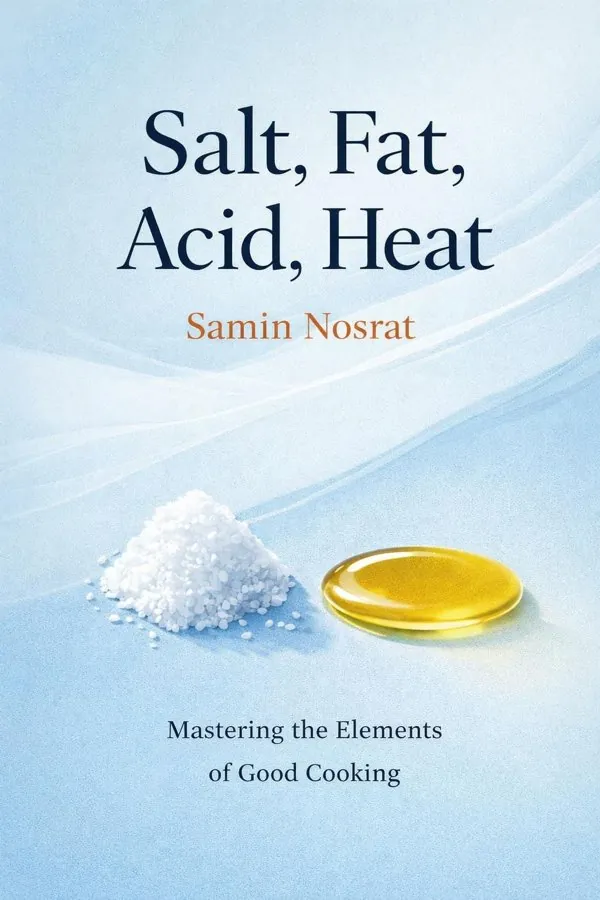
Salt, Fat, Acid, Heat: Mastering the Elements of Good Cooking: Summary & Key Insights
by Samin Nosrat
 10 min8 chaptersAudio available
Key Takeaways from Salt, Fat, Acid, Heat: Mastering the Elements of Good Cooking
The most surprising truth in cooking is that salt does not simply make food salty; it makes food taste more like itself.
If salt wakes up flavor, fat gives it body, depth, and allure.
Many mediocre dishes fail not because they lack salt or fat, but because they lack acid.
Cooking is not simply warming food; it is changing it.
The four elements matter individually, but Nosrat’s central insight is that memorable cooking comes from their interaction.
What Is Salt, Fat, Acid, Heat: Mastering the Elements of Good Cooking About?
Salt, Fat, Acid, Heat: Mastering the Elements of Good Cooking by Samin Nosrat is a cooking book spanning 7 pages. What if becoming a better cook had less to do with memorizing recipes and more to do with understanding a few timeless principles? In Salt, Fat, Acid, Heat, chef and teacher Samin Nosrat argues that great cooking becomes far more accessible once you learn the four essential elements that shape flavor and texture. Rather than overwhelming readers with rigid formulas, she shows how salt enhances flavor, fat delivers richness, acid creates balance, and heat transforms ingredients. What makes this book so powerful is its blend of kitchen science, practical guidance, and human warmth. Nosrat writes not as a distant expert but as a generous mentor who wants readers to trust their senses and cook with confidence. Drawing on years of professional kitchen experience, teaching, and food writing, she translates chef-level knowledge into lessons that home cooks can actually use. The result is more than a cookbook. It is a framework for thinking, tasting, and improvising. Whether you are a beginner who fears underseasoning or an experienced cook looking to sharpen intuition, this book helps you move from following recipes to truly understanding food.
This FizzRead summary covers all 8 key chapters of Salt, Fat, Acid, Heat: Mastering the Elements of Good Cooking in approximately 10 minutes, distilling the most important ideas, arguments, and takeaways from Samin Nosrat's work. Also available as an audio summary and Key Quotes Podcast.
Salt, Fat, Acid, Heat: Mastering the Elements of Good Cooking
What if becoming a better cook had less to do with memorizing recipes and more to do with understanding a few timeless principles? In Salt, Fat, Acid, Heat, chef and teacher Samin Nosrat argues that great cooking becomes far more accessible once you learn the four essential elements that shape flavor and texture. Rather than overwhelming readers with rigid formulas, she shows how salt enhances flavor, fat delivers richness, acid creates balance, and heat transforms ingredients.
What makes this book so powerful is its blend of kitchen science, practical guidance, and human warmth. Nosrat writes not as a distant expert but as a generous mentor who wants readers to trust their senses and cook with confidence. Drawing on years of professional kitchen experience, teaching, and food writing, she translates chef-level knowledge into lessons that home cooks can actually use.
The result is more than a cookbook. It is a framework for thinking, tasting, and improvising. Whether you are a beginner who fears underseasoning or an experienced cook looking to sharpen intuition, this book helps you move from following recipes to truly understanding food.
Who Should Read Salt, Fat, Acid, Heat: Mastering the Elements of Good Cooking?
This book is perfect for anyone interested in cooking and looking to gain actionable insights in a short read. Whether you're a student, professional, or lifelong learner, the key ideas from Salt, Fat, Acid, Heat: Mastering the Elements of Good Cooking by Samin Nosrat will help you think differently.
- ✓Readers who enjoy cooking and want practical takeaways
- ✓Professionals looking to apply new ideas to their work and life
- ✓Anyone who wants the core insights of Salt, Fat, Acid, Heat: Mastering the Elements of Good Cooking in just 10 minutes
Want the full summary?
Get instant access to this book summary and 100K+ more with Fizz Moment.
Get Free SummaryAvailable on App Store • Free to download
Key Chapters
The most surprising truth in cooking is that salt does not simply make food salty; it makes food taste more like itself. A tomato becomes more tomato-like, a roast chicken more deeply savory, and even a piece of fruit more vivid when seasoned properly. That is why Samin Nosrat places salt first. It is the foundation of flavor, the element that unlocks the natural character of ingredients.
Nosrat explains that salting is not a last-minute sprinkle but a process that should happen at the right moment and in the right amount. Salt can penetrate food over time, seasoning it throughout rather than leaving flavor only on the surface. That is why pasta water should be well salted, meat benefits from dry brining, and vegetables improve when seasoned early enough for the salt to dissolve and distribute. She also emphasizes that different salts behave differently. Kosher salt, table salt, and flaky sea salt vary in density and texture, so cooks must learn how each one feels and tastes.
Practical experience matters more than perfect measurement. Roast a tray of vegetables and compare one underseasoned batch to one seasoned assertively. Cook beans without salt and then with salt. Taste soup before and after adding a pinch. These simple exercises reveal how salt sharpens sweetness, balances bitterness, and gives food definition.
The deeper lesson is that seasoning is a conscious act of attention. You cannot outsource it entirely to a recipe because ingredients differ, and your palate must guide the final decision. Actionable takeaway: season in layers, taste repeatedly, and train yourself to notice the moment when food comes alive rather than merely becoming salty.
If salt wakes up flavor, fat gives it body, depth, and allure. One of Nosrat’s most valuable insights is that fat is not an indulgent extra; it is a structural element of good cooking. Fat transports aromas, softens textures, creates tenderness, and delivers the luxurious mouthfeel that makes food satisfying. Without enough fat, a dish can taste thin or harsh even when it is properly salted.
Different fats contribute different qualities. Butter adds sweetness and dairy richness; olive oil can bring fruitiness and bitterness; animal fats offer savory depth; coconut milk lends creaminess and aroma. Choosing a fat is therefore both a technical and aesthetic decision. In a vinaigrette, oil rounds out the sharpness of vinegar. In pastry, cold butter creates flakiness. In braising, fat carries the flavors of spices and aromatics into every bite. In frying, hot oil creates crisp, golden surfaces that contrast with moist interiors.
Nosrat also highlights how fat influences temperature and texture. A drizzle of olive oil can help vegetables roast more evenly, while marbling in meat protects it from drying out. Even simple dishes illustrate the point: bread and olive oil, rice with butter, yogurt with a slick of fragrant oil. These foods feel complete because fat fills out the experience.
Yet the goal is not to add fat mindlessly. Too much can make food heavy, greasy, or dull. The cook’s job is balance. Ask what kind of richness a dish needs, not merely whether it needs more. Actionable takeaway: when food tastes flat or severe, consider whether it needs a better or more thoughtfully chosen fat to carry flavor and improve texture.
Many mediocre dishes fail not because they lack salt or fat, but because they lack acid. Nosrat treats acid as the element that brings focus and life to food. It cuts through richness, balances sweetness, tempers bitterness, and keeps flavors from feeling muddy or dull. A squeeze of lemon, a splash of vinegar, a spoonful of yogurt, or a handful of pickled onions can completely change a dish’s energy.
Acid works by creating contrast. Think of a rich braise finished with a little red wine vinegar, or buttery fish served with lemon. The acid does not erase richness; it makes richness more enjoyable by preventing palate fatigue. The same principle explains why tomatoes brighten a stew, buttermilk lifts a cake, and sour cream makes baked potatoes taste more complete. In salads, acid gives shape to greens and helps dressings taste clean rather than oily.
Nosrat encourages cooks to think of acid as a balancing tool rather than a fixed ingredient. Different acids contribute different personalities. Lemon tastes fresh and sunny, lime sharper and more aromatic, vinegar more assertive, tamarind deeper and fruitier. Choosing among them changes the emotional tone of a dish. The same bowl of beans can feel Mediterranean with lemon, Latin American with lime, or Southern with a vinegar finish.
One of the easiest ways to improve everyday cooking is to ask, just before serving, whether a dish needs brightness. Soup, roasted vegetables, grilled meat, lentils, and pasta often benefit from a final acidic touch. Actionable takeaway: keep several acids in your kitchen and make it a habit to taste food at the end of cooking to see whether a small amount of acid would sharpen and balance it.
Cooking is not simply warming food; it is changing it. Nosrat presents heat as the force that transforms raw ingredients into something tender, crisp, caramelized, or deeply savory. It affects moisture, structure, color, and aroma. Understanding heat means understanding why a chicken skin browns, why onions soften and sweeten, why bread forms a crust, and why an overcooked steak turns dry.
Different types of heat create different outcomes. Gentle heat coaxes custards into silkiness and braises into tenderness. Intense dry heat creates browning and crispness in roasting, searing, and grilling. Moist heat, as in steaming or poaching, preserves delicacy. The cook’s responsibility is to match method to ingredient and desired result. A tough cut of meat may need long, slow cooking, while a fillet of fish benefits from brief, careful heat. A potato can be creamy when boiled, fluffy when baked, or crisp when fried.
Nosrat also teaches that heat is inseparable from timing and attention. A pan that is too cool steams instead of sears. An overcrowded tray of vegetables roasts poorly because trapped moisture prevents browning. Letting food rest after cooking allows juices to redistribute and texture to settle. Even the order of operations matters: preheating, drying surfaces, and giving food enough space can dramatically improve results.
The bigger idea is confidence through observation. Watch for color, aroma, sound, and feel rather than relying only on the clock. Listen for a lively sizzle, notice when a crust forms, and learn the visual cues of doneness. Actionable takeaway: treat heat as a tool for controlling transformation, and before cooking, decide whether your ingredient needs gentleness, intensity, moisture, or dryness to become its best self.
The four elements matter individually, but Nosrat’s central insight is that memorable cooking comes from their interaction. A dish is rarely improved by focusing on just one dimension. Instead, the cook must sense how salt, fat, acid, and heat support or correct one another. Too much richness may call for acid. Harsh acidity may need fat. Flatness may need salt. Dryness may be a heat problem. Great cooking is often the art of diagnosing imbalance.
Consider a simple tomato sauce. Salt brings out the tomato’s flavor, olive oil gives it body, a gentle simmer develops sweetness, and a little acidity keeps it lively. Or think of fried chicken: seasoning is essential, fat helps create tenderness and flavor, acid in a marinade can affect texture and brightness, and heat determines whether the crust becomes crisp or greasy. Every successful dish is a system.
This way of thinking frees cooks from dependency on recipes. Instead of asking, “What step did I miss?” you begin to ask, “What is this dish lacking?” That shift is transformative because it builds judgment. If a soup tastes dull, maybe it needs salt, but maybe it also needs lemon or more gentle simmering to concentrate flavor. If roasted vegetables seem heavy, perhaps a yogurt sauce or vinaigrette would complete them.
Nosrat’s framework is empowering precisely because it is flexible. It works for scrambled eggs, braised beans, grilled fish, salad dressing, cake, and stew. Once you understand the elements, you can adapt to any cuisine or situation. Actionable takeaway: when a dish feels off, troubleshoot using the four elements one by one and adjust the weakest link instead of blindly adding random ingredients.
One of the book’s most liberating messages is that recipes do not make great cooks; tasting does. Nosrat urges readers to move beyond passive obedience and develop an active relationship with food through repeated sensory attention. A good cook is constantly gathering information: tasting broth before serving, touching dough to judge texture, smelling onions to know when they are ready, and looking for visual cues that reveal doneness.
This emphasis on tasting builds intuition. Over time, you begin to notice patterns. Beans taste fuller after enough salt has penetrated. A stew often needs acid at the end, not just at the beginning. Cookie dough changes as butter warms. Greens collapse differently depending on heat. These observations cannot be fully absorbed from text alone; they emerge through practice. That is why Nosrat wants readers to be present in the kitchen rather than trapped by fear of mistakes.
Practical habits can accelerate learning. Taste components separately and then together. Taste a vinaigrette before dressing the salad. Taste the pasta water. Taste vegetables before and after roasting. Compare undercooked, properly cooked, and overcooked versions of the same ingredient. Keep notes if useful, but most importantly, slow down enough to register what you are perceiving.
This approach also changes your emotional relationship with cooking. Mistakes become information, not failure. Oversalted soup teaches correction; bland rice teaches confidence; scorched nuts teach attentiveness. Intuition is built from these moments. Actionable takeaway: make tasting a deliberate ritual at every stage of cooking, because the fastest path to skill is learning to trust and refine your own senses.
A recipe can tell you what to do, but it cannot fully teach you why it works. Nosrat’s book stands out because it prioritizes technique and understanding over rote repetition. The point is not to reproduce one perfect roast chicken or salad dressing. The point is to grasp the principles behind them so you can cook dozens of variations with confidence.
This distinction matters because real kitchens are full of unpredictability. Vegetables vary in size and sweetness. Ovens run hot or cold. Ingredients are substituted. Guests arrive late. If all you know is a script, any change can throw you off. But if you understand emulsion, seasoning, browning, tenderness, and balance, you can adapt. You can make a dressing without measuring every drop. You can roast whatever vegetables are in season. You can rescue a sauce that split or brighten a braise that tastes heavy.
Nosrat often frames cooking as a form of literacy. Once you can read the signals of ingredients and methods, you are no longer trapped by instructions. You become capable of improvisation. This is especially useful for home cooks who want to shop more flexibly, reduce waste, and cook according to appetite rather than strict plans. A fridge of leftovers becomes opportunity rather than confusion.
The beauty of technique-based learning is that it compounds. Mastering one well-seasoned roast chicken teaches lessons about salting, drying, fat, heat, and resting that transfer to turkey, duck, potatoes, and even cauliflower. Actionable takeaway: when following any recipe, ask what core technique or principle it is teaching, and focus on learning that lesson rather than merely finishing the dish.
All Chapters in Salt, Fat, Acid, Heat: Mastering the Elements of Good Cooking
About the Author
Samin Nosrat is an American chef, teacher, and food writer celebrated for translating professional cooking knowledge into clear, encouraging lessons for home cooks. She began her culinary career in restaurant kitchens, where she developed the practical understanding that later shaped her teaching philosophy. Nosrat became widely known for her writing in major publications, especially The New York Times Magazine, where she combined food storytelling with approachable instruction. Her breakthrough book, Salt, Fat, Acid, Heat, earned acclaim for rethinking the cookbook as a guide to culinary principles rather than mere recipes. She later brought those ideas to an even wider audience through the Netflix series of the same name. Nosrat is admired for her warmth, curiosity, and ability to make cooking feel both joyful and deeply understandable.
Get This Summary in Your Preferred Format
Read or listen to the Salt, Fat, Acid, Heat: Mastering the Elements of Good Cooking summary by Samin Nosrat anytime, anywhere. FizzRead offers multiple formats so you can learn on your terms — all free.
Available formats: App · Audio · PDF · EPUB — All included free with FizzRead
Download Salt, Fat, Acid, Heat: Mastering the Elements of Good Cooking PDF and EPUB Summary
Key Quotes from Salt, Fat, Acid, Heat: Mastering the Elements of Good Cooking
“The most surprising truth in cooking is that salt does not simply make food salty; it makes food taste more like itself.”
“If salt wakes up flavor, fat gives it body, depth, and allure.”
“Many mediocre dishes fail not because they lack salt or fat, but because they lack acid.”
“Cooking is not simply warming food; it is changing it.”
“The four elements matter individually, but Nosrat’s central insight is that memorable cooking comes from their interaction.”
Frequently Asked Questions about Salt, Fat, Acid, Heat: Mastering the Elements of Good Cooking
Salt, Fat, Acid, Heat: Mastering the Elements of Good Cooking by Samin Nosrat is a cooking book that explores key ideas across 8 chapters. What if becoming a better cook had less to do with memorizing recipes and more to do with understanding a few timeless principles? In Salt, Fat, Acid, Heat, chef and teacher Samin Nosrat argues that great cooking becomes far more accessible once you learn the four essential elements that shape flavor and texture. Rather than overwhelming readers with rigid formulas, she shows how salt enhances flavor, fat delivers richness, acid creates balance, and heat transforms ingredients. What makes this book so powerful is its blend of kitchen science, practical guidance, and human warmth. Nosrat writes not as a distant expert but as a generous mentor who wants readers to trust their senses and cook with confidence. Drawing on years of professional kitchen experience, teaching, and food writing, she translates chef-level knowledge into lessons that home cooks can actually use. The result is more than a cookbook. It is a framework for thinking, tasting, and improvising. Whether you are a beginner who fears underseasoning or an experienced cook looking to sharpen intuition, this book helps you move from following recipes to truly understanding food.
You Might Also Like
The Bread Baker's Apprentice: Mastering the Art of Extraordinary Bread
Peter Reinhart
10 min
Flour Water Salt Yeast: The Fundamentals of Artisan Bread and Pizza
Ken Forkish
10 min
Go-To Dinners: A Barefoot Contessa Cookbook
Ina Garten
10 min
Martha: The Cookbook
Martha Stewart
10 min
Sally's Baking 101
Sally McKenney
10 min
Sweet & Salty!: The Perfect Balance of Opposites in 75 Irresistible Recipes
King Arthur Baking Company
10 minBrowse by Category
Ready to read Salt, Fat, Acid, Heat: Mastering the Elements of Good Cooking?
Get the full summary and 100K+ more books with Fizz Moment.