
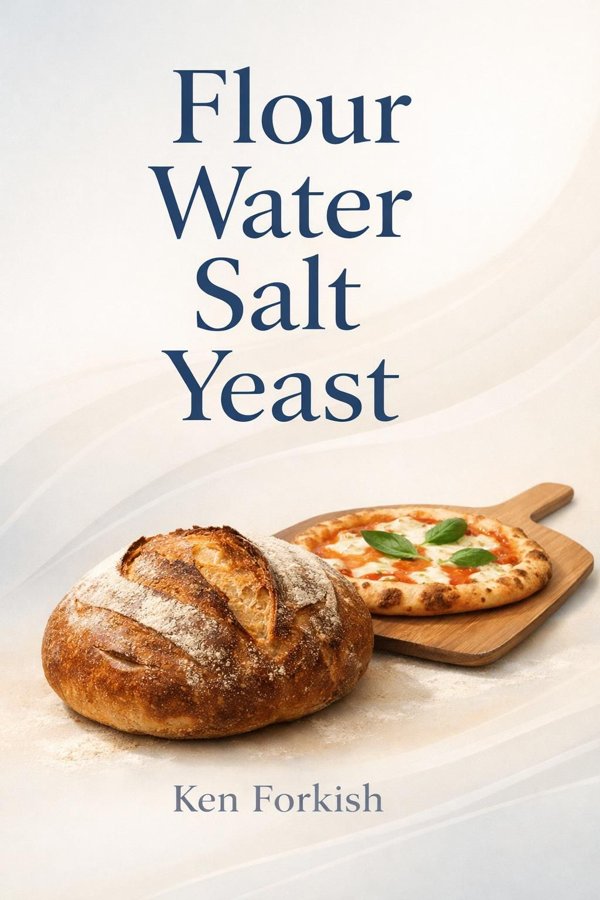
Flour Water Salt Yeast: The Fundamentals of Artisan Bread and Pizza: Summary & Key Insights
by Ken Forkish
 10 min7 chaptersAudio available
What Is Flour Water Salt Yeast: The Fundamentals of Artisan Bread and Pizza About?
Flour Water Salt Yeast: The Fundamentals of Artisan Bread and Pizza by Ken Forkish is a cooking book spanning 7 pages. Flour Water Salt Yeast es una guía completa para hornear pan y pizza artesanal en casa. Ken Forkish, panadero y propietario de Ken’s Artisan Bakery en Portland, enseña los principios fundamentales de la panificación: cómo combinar harina, agua, sal y levadura para crear panes de masa madre y pizzas de calidad profesional. El libro ofrece recetas detalladas, técnicas paso a paso y explicaciones sobre la fermentación, el amasado y el horneado, adaptadas tanto para principiantes como para panaderos experimentados.
This FizzRead summary covers all 7 key chapters of Flour Water Salt Yeast: The Fundamentals of Artisan Bread and Pizza in approximately 10 minutes, distilling the most important ideas, arguments, and takeaways from Ken Forkish's work. Also available as an audio summary and Key Quotes Podcast.
Flour Water Salt Yeast: The Fundamentals of Artisan Bread and Pizza
Flour Water Salt Yeast es una guía completa para hornear pan y pizza artesanal en casa. Ken Forkish, panadero y propietario de Ken’s Artisan Bakery en Portland, enseña los principios fundamentales de la panificación: cómo combinar harina, agua, sal y levadura para crear panes de masa madre y pizzas de calidad profesional. El libro ofrece recetas detalladas, técnicas paso a paso y explicaciones sobre la fermentación, el amasado y el horneado, adaptadas tanto para principiantes como para panaderos experimentados.
Who Should Read Flour Water Salt Yeast: The Fundamentals of Artisan Bread and Pizza?
This book is perfect for anyone interested in cooking and looking to gain actionable insights in a short read. Whether you're a student, professional, or lifelong learner, the key ideas from Flour Water Salt Yeast: The Fundamentals of Artisan Bread and Pizza by Ken Forkish will help you think differently.
- ✓Readers who enjoy cooking and want practical takeaways
- ✓Professionals looking to apply new ideas to their work and life
- ✓Anyone who wants the core insights of Flour Water Salt Yeast: The Fundamentals of Artisan Bread and Pizza in just 10 minutes
Want the full summary?
Get instant access to this book summary and 100K+ more with Fizz Moment.
Get Free SummaryAvailable on App Store • Free to download
Key Chapters
At the core of every great bread or pizza lie just four elements: flour, water, salt, and yeast. But their simplicity conceals tremendous complexity. The multitude of breads around the world are all variations on how we balance and manage these four.
Flour is your backbone, the structure-builder. I often reach for unbleached, unbromated bread flour because its protein strength supports long fermentation and open crumb structures. In the home bakery, understanding flour’s properties elevates everything. High-protein flour encourages chew and elasticity, while lower-protein flour, such as all-purpose, can soften the crumb or make pizza doughs more supple. Learning how to read your flour and interpret its response to hydration allows you to guide the dough rather than fight it.
Water, though seemingly trivial, is the great mediator of all reactions. The hydration level you select governs your dough’s behavior, from tight, sturdy batards to soft, extensible ciabattas. High-hydration doughs create open holes and moist crumbs—symbols of modern artisan style—but they insist that you learn to handle stickiness and mastering folds rather than heavy kneading.
Salt doesn’t merely season. It tightens gluten networks, moderates fermentation, and deepens flavor. Many new bakers forget that salt is a foundation of balance, not an afterthought. Yeast, finally, is the living engine. Whether you use commercial instant yeast or cultivate a wild starter, yeast transforms a dense mass of flour into something alive—rising, stretching, and developing nuance over time. Natural levains bring acidity and aroma impossible to imitate; commercial yeast obeys your timing but sacrifices a little mystery.
When you choose to bake with awareness of these four ingredients, you no longer see bread as a recipe but as a living system. The moment you introduce time and temperature—your next essential variables—you begin directing fermentation instead of chasing results.
Baking is time sculpted by temperature. If flour, water, salt, and yeast are matter, time and temperature are the energy shaping them. Mastering them is the true threshold of artisan baking.
Fermentation, both bulk and final, is not only about gas production. It’s flavor fermentation. When you slow down yeast activity through cooler temperatures or longer resting periods, enzymes unlock sugars, bacteria introduce lactic and acetic acids, and suddenly your bread sings—a rich tang, a caramelized hue, a perfume of grain memory. Many bakers think the refrigerator is a mere storage device; I see it as the most precise fermentation control tool you own. An overnight retard in the fridge can transform a good dough into an exceptional one.
Temperature isn’t uniform across your kitchen either. A warm counter may spike yeast activity, while a winter room introduces languor that lengthens bulk fermentation by hours. As a baker, your task is to respond, not to impose. I show you in this book how to read dough temperature, how to touch it and feel its readiness, to know when gluten networks have reached elasticity and when air pockets are evenly distributed. Your hands learn to see.
Time teaches humility. When I first started Ken’s Artisan Bakery, I battled the schedule: I wanted perfection on my timeline. Bread refused. It demanded that I listen. That is the paradox of craft: your mastery grows in proportion to your patience.
Applying this principle at home, you can align baking with your life. Through scheduling models—weekend loaves with long overnight proofing or weekday quick yeasted breads—you learn to weave fermentation into your daily rhythm instead of resisting it. Bread doesn’t interrupt your life; it enhances it, marking time with fragrance.
+ 5 more chapters — available in the FizzRead app
All Chapters in Flour Water Salt Yeast: The Fundamentals of Artisan Bread and Pizza
About the Author
Ken Forkish es un panadero y autor estadounidense, fundador de Ken’s Artisan Bakery y Ken’s Artisan Pizza en Portland, Oregón. Reconocido por su enfoque artesanal y su dedicación a la calidad, Forkish ha recibido múltiples premios por su contribución a la panadería contemporánea y es considerado una autoridad en el arte del pan de masa madre.
Get This Summary in Your Preferred Format
Read or listen to the Flour Water Salt Yeast: The Fundamentals of Artisan Bread and Pizza summary by Ken Forkish anytime, anywhere. FizzRead offers multiple formats so you can learn on your terms — all free.
Available formats: App · Audio · PDF · EPUB — All included free with FizzRead
Download Flour Water Salt Yeast: The Fundamentals of Artisan Bread and Pizza PDF and EPUB Summary
Key Quotes from Flour Water Salt Yeast: The Fundamentals of Artisan Bread and Pizza
“At the core of every great bread or pizza lie just four elements: flour, water, salt, and yeast.”
“If flour, water, salt, and yeast are matter, time and temperature are the energy shaping them.”
Frequently Asked Questions about Flour Water Salt Yeast: The Fundamentals of Artisan Bread and Pizza
Flour Water Salt Yeast: The Fundamentals of Artisan Bread and Pizza by Ken Forkish is a cooking book that explores key ideas across 7 chapters. Flour Water Salt Yeast es una guía completa para hornear pan y pizza artesanal en casa. Ken Forkish, panadero y propietario de Ken’s Artisan Bakery en Portland, enseña los principios fundamentales de la panificación: cómo combinar harina, agua, sal y levadura para crear panes de masa madre y pizzas de calidad profesional. El libro ofrece recetas detalladas, técnicas paso a paso y explicaciones sobre la fermentación, el amasado y el horneado, adaptadas tanto para principiantes como para panaderos experimentados.
You Might Also Like
The Bread Baker's Apprentice: Mastering the Art of Extraordinary Bread
Peter Reinhart
10 min
Go-To Dinners: A Barefoot Contessa Cookbook
Ina Garten
10 min
Martha: The Cookbook
Martha Stewart
10 min
Sally's Baking 101
Sally McKenney
10 min
Salt, Fat, Acid, Heat: Mastering the Elements of Good Cooking
Samin Nosrat
10 min
Sweet & Salty!: The Perfect Balance of Opposites in 75 Irresistible Recipes
King Arthur Baking Company
10 minBrowse by Category
Ready to read Flour Water Salt Yeast: The Fundamentals of Artisan Bread and Pizza?
Get the full summary and 100K+ more books with Fizz Moment.