
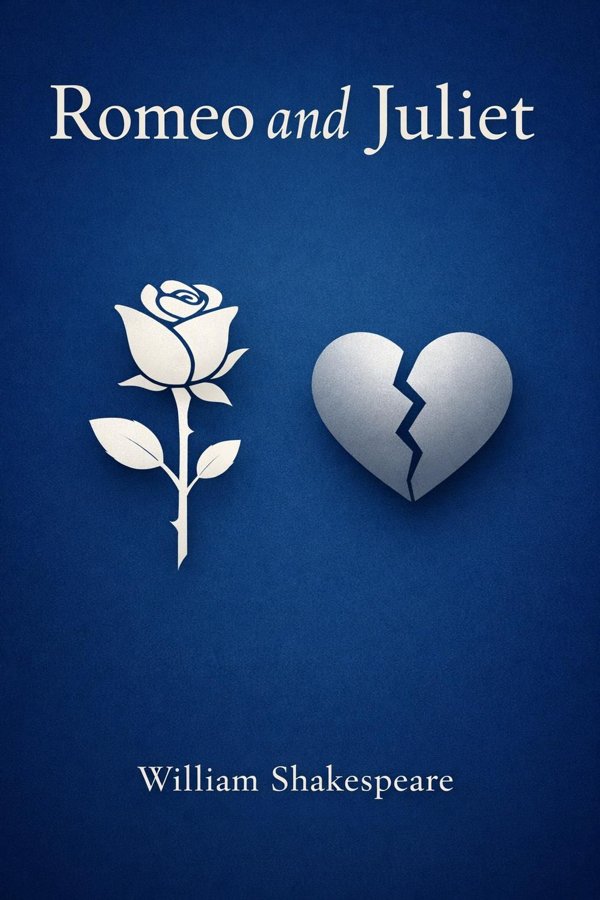
Romeo and Juliet: Summary & Key Insights
 10 min9 chaptersAudio available
Key Takeaways from Romeo and Juliet
Before Romeo and Juliet ever meet, Verona is already broken.
Some encounters feel instantaneous because they bypass logic and strike identity itself.
What begins as privacy soon becomes secrecy, and secrecy changes the moral weight of love.
Speed is one of the play’s hidden engines.
One sword fight can destroy an entire future.
What Is Romeo and Juliet About?
Romeo and Juliet by William Shakespeare is a classics book spanning 5 pages. Romeo and Juliet is far more than a love story gone wrong. In William Shakespeare’s most famous tragedy, two teenagers from rival families fall intensely, instantly, and disastrously in love, only to discover that private devotion cannot easily survive inside a public world shaped by violence, pride, and inherited hatred. Set in Verona, the play moves with astonishing speed: a street fight becomes a secret romance, a wedding becomes a feud, and youthful hope collapses into irreversible loss. What makes the play endure is not only its emotion, but its insight into how families, social pressure, impulsive decisions, and failed communication can turn love into catastrophe. Shakespeare writes with unmatched dramatic power, combining lyrical poetry with psychological precision. He understands the ecstasy of first love, the arrogance of youth, the blindness of anger, and the cruel timing by which lives are changed forever. Romeo and Juliet still matters because it asks timeless questions: How much of our lives do we choose? How much is inherited? And what happens when the older generation’s conflicts become the younger generation’s fate?
This FizzRead summary covers all 9 key chapters of Romeo and Juliet in approximately 10 minutes, distilling the most important ideas, arguments, and takeaways from William Shakespeare's work. Also available as an audio summary and Key Quotes Podcast.
Romeo and Juliet
Romeo and Juliet is far more than a love story gone wrong. In William Shakespeare’s most famous tragedy, two teenagers from rival families fall intensely, instantly, and disastrously in love, only to discover that private devotion cannot easily survive inside a public world shaped by violence, pride, and inherited hatred. Set in Verona, the play moves with astonishing speed: a street fight becomes a secret romance, a wedding becomes a feud, and youthful hope collapses into irreversible loss. What makes the play endure is not only its emotion, but its insight into how families, social pressure, impulsive decisions, and failed communication can turn love into catastrophe. Shakespeare writes with unmatched dramatic power, combining lyrical poetry with psychological precision. He understands the ecstasy of first love, the arrogance of youth, the blindness of anger, and the cruel timing by which lives are changed forever. Romeo and Juliet still matters because it asks timeless questions: How much of our lives do we choose? How much is inherited? And what happens when the older generation’s conflicts become the younger generation’s fate?
Who Should Read Romeo and Juliet?
This book is perfect for anyone interested in classics and looking to gain actionable insights in a short read. Whether you're a student, professional, or lifelong learner, the key ideas from Romeo and Juliet by William Shakespeare will help you think differently.
- ✓Readers who enjoy classics and want practical takeaways
- ✓Professionals looking to apply new ideas to their work and life
- ✓Anyone who wants the core insights of Romeo and Juliet in just 10 minutes
Want the full summary?
Get instant access to this book summary and 100K+ more with Fizz Moment.
Get Free SummaryAvailable on App Store • Free to download
Key Chapters
Before Romeo and Juliet ever meet, Verona is already broken. Shakespeare opens the play not with romance, but with a street brawl, reminding us that hatred is the true atmosphere of the story. The feud between the Montagues and Capulets is so old that no one even seems to remember its original cause. That is precisely the point: destructive conflict can outlive reason. People inherit anger they did not create, then defend it as if it were honor. In Verona, family identity dictates behavior, loyalty, and even danger in public spaces. The Prince’s warning shows that private grudges have become a civic problem.
This matters because the lovers’ tragedy is not caused by love alone. It is caused by love trying to exist inside a culture already organized around hostility. Romeo cannot simply visit Juliet openly. Juliet cannot speak freely to her parents. Tybalt interprets Romeo’s presence as insult. Mercutio treats conflict like sport. Everyone lives inside a system where reputation and retaliation carry more weight than peace.
The play remains practical because feuds are not limited to noble houses. Modern versions appear in family estrangements, political tribalism, workplace factions, and social media hostility. People often defend positions not because they are right, but because backing down feels like betrayal. When conflict becomes identity, even innocent relationships become casualties.
Shakespeare’s insight is sobering: unresolved collective hatred creates private suffering. If communities do not interrupt cycles of resentment, the young inherit consequences they never chose. Actionable takeaway: identify one inherited conflict in your life, and ask whether you are preserving it out of conviction, habit, or fear.
Some encounters feel instantaneous because they bypass logic and strike identity itself. At the Capulets’ masquerade ball, Romeo and Juliet meet under the cover of masks, danger, and celebration. This setting matters. In a world of disguise, they speak with unusual honesty. Romeo, who begins the play brooding over Rosaline, suddenly discovers a deeper and more mutual form of love. Juliet, equally struck, responds not as a passive ideal but as an intelligent partner in verbal and emotional exchange. Their first shared sonnet turns attraction into spiritual recognition.
Yet Shakespeare does not present love at first sight as simple fantasy. He shows its splendor and its risk. The lovers experience an emotional certainty that feels sacred, but they form this bond in an environment where they know almost nothing practical about one another’s world beyond the force of connection. That tension is crucial. Intense feeling may reveal truth, but it does not remove the need for wisdom, timing, or consequence.
In modern life, people still experience sudden affinity: a conversation that alters a career, a friendship that forms instantly, a romantic connection that seems fated. Such moments can be real and transformative. But the play asks us to distinguish emotional authenticity from emotional sufficiency. Feeling deeply is not the same as understanding fully.
The ball scene also reveals one of Shakespeare’s central themes: moments of beauty often occur under threat. The tenderness of the meeting is heightened because danger surrounds it. Actionable takeaway: honor powerful first impressions, but before making life-altering decisions, pair emotional intensity with deliberate reflection.
What begins as privacy soon becomes secrecy, and secrecy changes the moral weight of love. After the balcony scene, Romeo and Juliet commit themselves to one another with breathtaking sincerity. Their secret marriage, arranged through Friar Laurence and aided by the Nurse, is driven by hope. Friar Laurence believes the union may reconcile the feuding houses. Juliet sees in Romeo a path beyond inherited identity. Romeo thinks love can transform the world around him. In emotional terms, they are not wrong. But strategically, they are dangerously isolated.
Shakespeare shows that hidden commitments create pressure. Every lie told to preserve the truth of their love produces new vulnerability. Because the marriage is concealed, Juliet cannot invoke it when her father demands that she marry Paris. Because Romeo’s bond to Juliet is secret, Tybalt misreads his refusal to fight as dishonor. Because only a few adults know the truth, the lovers depend on a fragile chain of intermediaries.
Secrecy often begins as protection. People hide relationships, ambitions, beliefs, or struggles because they fear judgment, punishment, or misunderstanding. Sometimes privacy is wise. But when major life decisions exist entirely in the shadows, they become harder to defend, explain, and sustain. Hidden realities can leave people without support precisely when they need it most.
This key idea makes Romeo and Juliet more than a romance; it becomes a study in communication failure. Love is genuine, but it is forced underground, and underground things struggle to breathe. Shakespeare suggests that even noble intentions can be damaged by concealment. Actionable takeaway: if something important in your life must remain hidden, ask what support system, clarity, or honest conversation is missing—and whether secrecy is protecting you or trapping you.
Speed is one of the play’s hidden engines. Romeo and Juliet meet, declare love, marry, separate, and die within a matter of days. Shakespeare compresses time to show how youth experiences emotion: intensely, absolutely, and urgently. Romeo swings from despair over Rosaline to ecstatic devotion to Juliet. Juliet moves from obedient daughter to decisive rebel with remarkable courage. Their passion is not false because it is fast, but it is vulnerable because it has no time to mature.
The adults around them are not models of patience either. Capulet changes suddenly from indulgent father to authoritarian force. Tybalt’s temper ignites instantly. Mercutio escalates conflict for pride and performance. Friar Laurence, though wiser than most, still agrees to a high-risk plan with astonishing speed. Shakespeare therefore presents haste as a social disease, not merely a youthful flaw.
In practical terms, the play teaches that emotional urgency can distort scale. When feelings become overwhelming, every delay seems unbearable and every obstacle absolute. This can happen in romance, business, friendship, or family conflict. A rushed message, impulsive resignation, secret commitment, or retaliatory act may feel necessary in the moment and disastrous in hindsight.
At the same time, Shakespeare does not mock youthful intensity. He honors its sincerity. What he critiques is the absence of structures strong enough to guide it. Passion needs form. Desire needs patience. Courage needs counsel.
The tragedy reminds us that when people act at the speed of emotion, consequences often arrive before understanding does. Actionable takeaway: when a decision feels too urgent to delay, create a pause anyway—one conversation, one night, or one trusted second opinion can change the outcome.
One sword fight can destroy an entire future. The turning point of Romeo and Juliet is not the secret marriage, but the violent confrontation that leaves Mercutio and Tybalt dead and Romeo banished. Romeo tries, briefly, to reject the feud because Tybalt is now his kinsman by marriage. But because that bond is hidden, his refusal appears cowardly. Mercutio intervenes, is killed, and Romeo, overcome by guilt and rage, kills Tybalt. In a single sequence, the possibility of reconciliation collapses.
Shakespeare is ruthless in showing how violence narrows human options. Once blood is spilled, grief hardens into judgment, law enters with punishment, and personal agency shrinks. Romeo is not executed, but banishment functions as a living death. Juliet is left alone between marital loyalty and family expectation. What had been a daring love story becomes a struggle against consequences already in motion.
The play’s insight remains painfully modern. Acts of aggression rarely stay contained. A public humiliation becomes estrangement. A retaliatory email becomes a career problem. One reckless confrontation can damage trust, safety, and future possibilities for everyone involved. Violence also includes verbal and emotional forms: contempt, threat, intimidation, and humiliation can reshape relationships as decisively as physical force.
Shakespeare’s brilliance lies in showing that violence often emerges from wounded pride disguised as honor. Characters think they are defending dignity, but they are really serving destruction. Love cannot flourish where escalation is admired.
Actionable takeaway: when conflict begins to revolve around proving strength rather than solving the problem, step back immediately. Refusing escalation is not weakness; it may be the only way to protect what still can be saved.
Romeo and Juliet are young, but the tragedy is not simply a warning about reckless teenagers. It is also an indictment of the adults who should have protected them and did not. Lord and Lady Capulet value obedience and status over Juliet’s inner life. The Montagues seem affectionate yet largely ineffective. The Nurse loves Juliet sincerely but offers inconsistent guidance, eventually urging her to marry Paris despite Juliet’s existing marriage. Friar Laurence is compassionate and intelligent, but his plans rely on secrecy, timing, and chance instead of durable responsibility.
Shakespeare suggests that young people become desperate when authority figures are either rigid or unreliable. Juliet cannot confide safely in her parents. Romeo lacks stable direction. Even the adults who mean well fail to create an environment where truth can be spoken without disaster. That failure pushes the lovers toward improvisation.
This dynamic is broadly applicable. In families, schools, workplaces, and communities, people in positions of power often underestimate how much their emotional climate matters. If authority is controlling, dismissive, or unpredictable, honesty goes underground. Then leaders are shocked when crises emerge that no one reported earlier.
The play invites readers to ask not only whether Romeo and Juliet were impulsive, but why they had so few trustworthy paths available. Adult failure here is not always malicious; sometimes it is blindness, ego, distraction, or overconfidence. But the outcome is the same: the vulnerable are forced to carry risks they should not bear alone.
Actionable takeaway: if someone younger or less powerful depends on you, make it easier for them to tell you the truth before they are in danger, not after a situation has become unmanageable.
Romeo and Juliet is often called a story of fate, and Shakespeare certainly frames it that way. The Prologue names the lovers “star-crossed,” and characters repeatedly speak in terms of fortune, omens, and destiny. Yet fate in this play does not erase human choice. Instead, it operates through ordinary errors, timing failures, and avoidable misjudgments. Romeo decides to attend the Capulet feast. Friar Laurence agrees to marry the lovers. Mercutio provokes combat. Capulet accelerates Juliet’s wedding to Paris. The crucial letter fails to reach Romeo. Fate feels powerful because human systems are fragile.
This is one of Shakespeare’s deepest achievements. He captures the experience of looking backward on tragedy and seeing both inevitability and contingency at once. It seems destined because so many things aligned toward disaster. But each step also involved a decision that might have gone differently.
In real life, people often invoke fate when outcomes exceed understanding: an accident, a breakup, a lost opportunity, a chain of mistimed events. Sometimes this language helps us bear uncertainty. But the play warns against using fate to avoid responsibility. Destiny may frame the story, but character still writes the scenes.
Practically, this means we should respect chance while strengthening the systems that reduce preventable harm. Confirm messages. Create backups. Clarify assumptions. Do not build critical plans on a single point of failure. Friar Laurence’s scheme collapses not because love is false, but because it depends on perfect execution in an imperfect world.
Actionable takeaway: when something truly matters, do not rely on hope alone—build redundancy, verify communication, and plan for what can go wrong.
In Romeo and Juliet, people do not simply speak; they become who they are through speech. Shakespeare uses language to chart emotional and moral change. Romeo begins with artificial, highly stylized complaints about Rosaline, sounding more in love with the idea of love than with another person. When he meets Juliet, his language becomes more alive, mutual, and reverent. Juliet’s speech evolves even more dramatically. She moves from dutiful daughterly responses to bold, precise, intellectually agile expressions of desire, fear, and resolve. Their language creates intimacy before the world recognizes their bond.
At the same time, Shakespeare contrasts the lovers’ lyricism with the sharp wit and aggression of other characters. Mercutio’s language dazzles but also destabilizes; it turns seriousness into performance. Tybalt’s speech burns with insult and challenge. Capulet’s language shifts from affectionate management to authoritarian command. Through these verbal differences, the play reveals value systems: tenderness, pride, cynicism, loyalty, and control all have distinct rhythms.
This matters beyond literature because language remains one of the clearest indicators of inner life. The words people choose reveal whether they are posturing, connecting, escalating, evading, or reflecting. In relationships, a change in tone often signals a deeper shift before actions do.
Reading Shakespeare closely also teaches practical attentiveness. Instead of hearing words as surface, we can listen for assumptions beneath them: Does someone speak to dominate, to protect, to impress, or to understand? The tragedy intensifies partly because too many characters are fluent in reaction and too few in honest, patient dialogue.
Actionable takeaway: pay attention not only to what you say in difficult moments, but to the kind of self your language is creating—defensive, compassionate, impulsive, or wise.
The most bitter lesson in Romeo and Juliet is that peace arrives only after irreparable loss. When Romeo and Juliet die, the feud that dominated Verona finally breaks. The Montagues and Capulets, confronted with the bodies of their children, recognize the cost of their hatred and promise reconciliation. Shakespeare gives the audience resolution, but not relief. The ending is structured to feel morally clarifying and emotionally devastating at the same time.
This late reconciliation reveals a painful truth about human behavior: people often change only when denial becomes impossible. As long as conflict feels abstract, symbolic, or manageable, they preserve it. Only catastrophe forces perspective. The houses do not end their feud because they suddenly become generous; they end it because the logic of hostility has consumed what they love most.
The play therefore functions as both tragedy and warning. It asks whether wisdom must always arrive after damage. In families, organizations, and societies, people frequently wait too long to apologize, compromise, or intervene. They assume there will be another chance, another conversation, another season in which repair will be easier. Shakespeare insists that delay has a cost.
Yet the ending is not entirely hopeless. The lovers’ deaths expose truth and create the possibility of a better order. Their private devotion succeeds where public authority failed: it reveals the humanity hidden beneath inherited roles. That does not undo the tragedy, but it gives it meaning.
Actionable takeaway: do not wait for a crisis to make conflict seem unimportant. If pride is blocking reconciliation with someone who matters, take one concrete step toward repair while repair is still possible.
All Chapters in Romeo and Juliet
About the Author
William Shakespeare (1564–1616) was an English playwright, poet, and actor whose work transformed world literature. Born in Stratford-upon-Avon, he later became a central figure in London’s theatrical life as a member of the Lord Chamberlain’s Men, later known as the King’s Men. Shakespeare wrote across genres, producing tragedies, comedies, histories, and sonnets of extraordinary range and influence. His most celebrated works include Hamlet, Macbeth, Othello, King Lear, A Midsummer Night’s Dream, and Romeo and Juliet. What sets Shakespeare apart is his unmatched command of language and his penetrating understanding of ambition, love, jealousy, power, grief, and desire. More than four centuries after his death, his plays remain widely read, performed, adapted, and studied throughout the world.
Get This Summary in Your Preferred Format
Read or listen to the Romeo and Juliet summary by William Shakespeare anytime, anywhere. FizzRead offers multiple formats so you can learn on your terms — all free.
Available formats: App · Audio · PDF · EPUB — All included free with FizzRead
Download Romeo and Juliet PDF and EPUB Summary
Key Quotes from Romeo and Juliet
“Before Romeo and Juliet ever meet, Verona is already broken.”
“Some encounters feel instantaneous because they bypass logic and strike identity itself.”
“What begins as privacy soon becomes secrecy, and secrecy changes the moral weight of love.”
“Speed is one of the play’s hidden engines.”
“One sword fight can destroy an entire future.”
Frequently Asked Questions about Romeo and Juliet
Romeo and Juliet by William Shakespeare is a classics book that explores key ideas across 9 chapters. Romeo and Juliet is far more than a love story gone wrong. In William Shakespeare’s most famous tragedy, two teenagers from rival families fall intensely, instantly, and disastrously in love, only to discover that private devotion cannot easily survive inside a public world shaped by violence, pride, and inherited hatred. Set in Verona, the play moves with astonishing speed: a street fight becomes a secret romance, a wedding becomes a feud, and youthful hope collapses into irreversible loss. What makes the play endure is not only its emotion, but its insight into how families, social pressure, impulsive decisions, and failed communication can turn love into catastrophe. Shakespeare writes with unmatched dramatic power, combining lyrical poetry with psychological precision. He understands the ecstasy of first love, the arrogance of youth, the blindness of anger, and the cruel timing by which lives are changed forever. Romeo and Juliet still matters because it asks timeless questions: How much of our lives do we choose? How much is inherited? And what happens when the older generation’s conflicts become the younger generation’s fate?
More by William Shakespeare


You Might Also Like





Browse by Category
Ready to read Romeo and Juliet?
Get the full summary and 100K+ more books with Fizz Moment.