
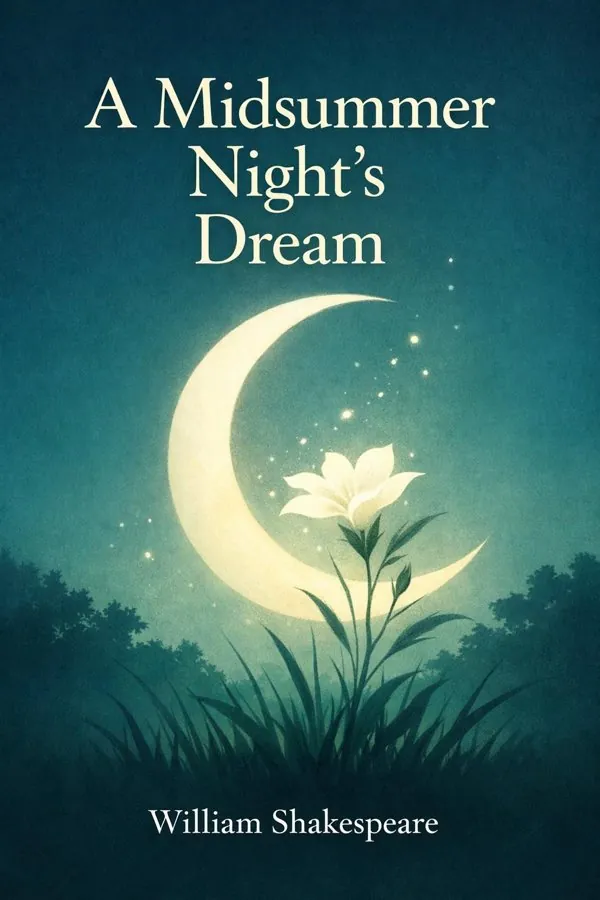
A Midsummer Night's Dream: Summary & Key Insights
 10 min9 chaptersAudio available
Key Takeaways from A Midsummer Night's Dream
One of the play's most enduring insights is that love can make intelligent people behave irrationally.
A powerful idea at the heart of the play is that imagination does not merely decorate reality; it actively shapes how people experience it.
Few conflicts are more timeless than the struggle between social authority and individual desire, and Shakespeare makes that tension central to the play.
Yet Shakespeare suggests that disorder can become a strange pathway to insight.
Shakespeare's comedy works because laughter lowers defenses and allows difficult truths to be seen more clearly.
What Is A Midsummer Night's Dream About?
A Midsummer Night's Dream by William Shakespeare is a classics book. A Midsummer Night's Dream is one of William Shakespeare's most dazzling comedies, a play where love turns irrational, identity becomes unstable, and the boundary between reality and fantasy seems to disappear overnight. Set between the ordered world of Athens and the enchanted confusion of a nearby forest, the story follows young lovers fleeing authority, amateur actors preparing a performance, and a community of fairies whose interference throws everyone into comic disorder. What begins as a romantic conflict becomes a rich exploration of desire, imagination, transformation, and the strange logic of the human heart. The play matters because it remains endlessly relevant. Shakespeare shows how people misread themselves and one another, how social expectations collide with private longing, and how art can turn confusion into meaning. Beneath the wit, magic, and theatrical brilliance lies a sharp understanding of emotion and power. Shakespeare's authority comes not only from his status as the most influential playwright in English, but from his unmatched ability to capture human contradictions with poetry, humor, and psychological insight. This comedy still feels fresh because it understands that love, like dreams, rarely follows reason.
This FizzRead summary covers all 9 key chapters of A Midsummer Night's Dream in approximately 10 minutes, distilling the most important ideas, arguments, and takeaways from William Shakespeare's work. Also available as an audio summary and Key Quotes Podcast.
A Midsummer Night's Dream
A Midsummer Night's Dream is one of William Shakespeare's most dazzling comedies, a play where love turns irrational, identity becomes unstable, and the boundary between reality and fantasy seems to disappear overnight. Set between the ordered world of Athens and the enchanted confusion of a nearby forest, the story follows young lovers fleeing authority, amateur actors preparing a performance, and a community of fairies whose interference throws everyone into comic disorder. What begins as a romantic conflict becomes a rich exploration of desire, imagination, transformation, and the strange logic of the human heart.
The play matters because it remains endlessly relevant. Shakespeare shows how people misread themselves and one another, how social expectations collide with private longing, and how art can turn confusion into meaning. Beneath the wit, magic, and theatrical brilliance lies a sharp understanding of emotion and power. Shakespeare's authority comes not only from his status as the most influential playwright in English, but from his unmatched ability to capture human contradictions with poetry, humor, and psychological insight. This comedy still feels fresh because it understands that love, like dreams, rarely follows reason.
Who Should Read A Midsummer Night's Dream?
This book is perfect for anyone interested in classics and looking to gain actionable insights in a short read. Whether you're a student, professional, or lifelong learner, the key ideas from A Midsummer Night's Dream by William Shakespeare will help you think differently.
- ✓Readers who enjoy classics and want practical takeaways
- ✓Professionals looking to apply new ideas to their work and life
- ✓Anyone who wants the core insights of A Midsummer Night's Dream in just 10 minutes
Want the full summary?
Get instant access to this book summary and 100K+ more with Fizz Moment.
Get Free SummaryAvailable on App Store • Free to download
Key Chapters
One of the play's most enduring insights is that love can make intelligent people behave irrationally. In A Midsummer Night's Dream, Shakespeare presents affection not as a stable, noble force, but as something volatile, impulsive, and deeply vulnerable to illusion. Hermia loves Lysander, Demetrius pursues Hermia, Helena chases Demetrius, and then magic abruptly scrambles all of these attachments. The result is comic chaos, but the comedy reveals a serious truth: human desire is not always governed by fairness, consistency, or common sense.
Shakespeare dramatizes this idea through the famous love potion applied by the fairy Puck. Once characters begin loving the wrong person, their emotional certainty changes instantly, exposing how fragile romantic confidence can be. Helena, who has long been rejected, cannot believe that sudden devotion from two men is real. Hermia, once secure in Lysander's love, is thrown into confusion and pain. The play suggests that love feels absolute when we are inside it, even when it is temporary, distorted, or based on appearances.
This idea remains practical far beyond literature. In modern life, people often mistake intensity for compatibility, attention for commitment, or attraction for understanding. Relationships can become distorted by jealousy, insecurity, social pressure, or fantasy. Shakespeare does not ask us to distrust love entirely; rather, he invites us to recognize its unpredictability and to approach it with humility.
A useful application is to pause before treating every emotion as permanent truth. In conflict, ask what is actually happening beneath your reaction. Are you responding to reality, or to wounded pride, fear, or assumption? Love gains depth when it is examined rather than romanticized.
Actionable takeaway: when emotions feel overwhelming, slow down and test your perceptions before acting on them.
A powerful idea at the heart of the play is that imagination does not merely decorate reality; it actively shapes how people experience it. Shakespeare fills A Midsummer Night's Dream with transformations, dreams, mistaken identities, and theatrical performances to show that perception is never neutral. Characters enter the forest with one understanding of themselves and emerge with another, as if imagination has rearranged the world around them.
The enchanted woods operate like a physical version of the mind, a place where hidden wishes and fears become visible. There, ordinary rules dissolve. A man can fall in love at first sight because of a potion. A weaver can be given a donkey's head and become the object of a fairy queen's adoration. These events are absurd, yet they reveal something psychologically true: people often live according to stories they tell themselves. If those stories shift, their reality shifts too.
This is especially clear in the closing movement of the play, when Theseus questions whether the night's events were real or simply imagined. Shakespeare refuses to draw a hard line between dream and fact, suggesting that emotional experience matters even when its source is uncertain. Art, memory, desire, and fantasy all influence how life is understood.
In practical terms, this matters because people constantly interpret events through expectation and narrative. A workplace setback can become proof of failure or an invitation to grow. A difficult conversation can be seen as rejection or as honesty. Imagination can mislead, but it can also liberate.
The challenge is to use imagination consciously. Instead of letting fear invent the worst possible meaning, use creativity to envision wiser responses and broader possibilities. The stories you repeat internally become the lens through which you act.
Actionable takeaway: examine the narrative you are assigning to your situation, and choose one that is both truthful and constructive.
At first glance, the confusion in A Midsummer Night's Dream seems purely comic: people chase the wrong partners, insults replace devotion, and nearly every character misunderstands what is happening. Yet Shakespeare suggests that disorder can become a strange pathway to insight. The night in the forest is disruptive, embarrassing, and painful, but it also exposes truths that the structured world of Athens keeps hidden.
Before entering the woods, the lovers are already trapped in emotional imbalance. Helena's self-worth depends on Demetrius's approval. Hermia's happiness is threatened by legal coercion. Lysander and Demetrius are both entangled in rivalry and desire. The magical confusion intensifies these tensions until they can no longer remain concealed. Shakespeare's point is not that turmoil is pleasant, but that disruption often reveals underlying problems more clearly than routine does.
The same pattern appears in many areas of life. A failed plan can uncover weak assumptions. A conflict in friendship can expose unmet expectations. A chaotic transition, such as moving cities or changing careers, may force a person to rethink values they had never examined. What feels like breakdown can become diagnosis.
Importantly, the play does not glorify confusion for its own sake. Harmony returns only after the chaos has run its course and the enchantments are corrected. But the restored order is not identical to the old one. It is more honest, more aligned with genuine pairings, and more spacious in its understanding of human desire.
The practical lesson is to resist the urge to treat every period of uncertainty as failure. Confusion may be signaling that your assumptions, attachments, or structures need revision. Instead of demanding immediate certainty, ask what the disorder is teaching you.
Actionable takeaway: when life feels chaotic, write down what the disruption is revealing about your needs, relationships, or beliefs.
Shakespeare's comedy works because laughter lowers defenses and allows difficult truths to be seen more clearly. A Midsummer Night's Dream is playful, absurd, and full of verbal wit, but beneath the delight lies a careful examination of vanity, insecurity, power, and longing. The humor is not a distraction from meaning; it is the method through which meaning becomes accessible.
Consider the mechanicals, the group of amateur actors preparing the tragedy of Pyramus and Thisbe. Their rehearsals are clumsy and self-important, and their final performance is hilariously awkward. Yet Shakespeare treats them with more than mockery. They reveal the vulnerability of ordinary people who want to create art, be taken seriously, and participate in something larger than themselves. Their incompetence is funny, but their aspiration is recognizable.
Likewise, the romantic chaos among the lovers is comic because it exaggerates emotional instability, jealousy, and self-dramatization. Audiences laugh at the lovers' intensity because they recognize those tendencies in themselves. Comedy turns self-knowledge into something bearable.
This has practical value. People are often more willing to confront flaws when those flaws are presented with humor rather than accusation. A team can discuss communication failures more honestly if defensiveness is softened. Families can address recurring patterns through gentle wit that opens conversation. Even personal reflection becomes easier when one can acknowledge, with some amusement, how dramatic or mistaken one has been.
Shakespeare demonstrates that seriousness need not always arrive in solemn form. Humor can illuminate ego, reveal blind spots, and create room for empathy. The goal is not to trivialize pain, but to approach human weakness with honesty and grace.
Actionable takeaway: use humor thoughtfully to reflect on mistakes, making truth easier to face without losing compassion.
The enchanted forest in A Midsummer Night's Dream is more than a setting; it functions as a symbolic landscape of the unconscious. Once characters leave Athens, with its laws, hierarchy, and public order, they enter a realm where hidden impulses rise to the surface. Desires intensify, identities blur, and suppressed emotions become impossible to ignore. Shakespeare turns the natural world into a theater of the mind.
This contrast between city and forest is crucial. Athens represents social structure, reason, and civilization. The forest represents instinct, imagination, unpredictability, and transformation. In that space, the characters are stripped of the certainties that defined them. Their loves are tested, their rivalries distorted, and their self-images shaken. The forest does not create their emotions from nothing; it amplifies what was already present.
Shakespeare also links the natural and emotional worlds through the quarrel between Oberon and Titania. Their conflict disrupts the seasons and disturbs the environment, suggesting that disorder in relationships can ripple outward into the wider world. Human and cosmic balance are intertwined.
This symbolic forest remains relevant because everyone has inner spaces that operate beyond neat logic. Dreams, impulses, fears, and unresolved conflicts influence decisions even when they are not consciously acknowledged. Times of solitude, travel, grief, or transition often function like Shakespeare's forest, pulling people out of routine and confronting them with parts of themselves they usually avoid.
The practical application is to treat periods of emotional strangeness as invitations to reflection rather than mere inconvenience. What recurring reactions are trying to tell you? What desire or fear emerges when structure falls away? Insight often begins where certainty ends.
Actionable takeaway: create regular moments away from routine to notice what thoughts and feelings surface when external noise is reduced.
One of Shakespeare's most sophisticated ideas in the play is that art can gather disorder, pain, absurdity, and error into a form that people can share and understand. This is why the mechanicals matter so much. Their performance of Pyramus and Thisbe is intentionally ridiculous, yet it reflects the very themes the larger play explores: forbidden love, miscommunication, theatrical illusion, and the thin line between tragedy and comedy.
By placing a play within the play, Shakespeare reminds audiences that theater itself is a kind of dream, an agreed-upon illusion that reveals truth. The artisans are poor performers, but their effort shows how deeply human beings need narrative and performance to process experience. They want to make meaning, impress others, and participate in communal celebration. Their art is imperfect, but it still brings people together.
This insight extends beyond the stage. Art helps individuals interpret experiences that might otherwise remain chaotic. A journal entry can organize grief. A song can express what ordinary conversation cannot. A film or novel can help someone see their own life differently. Creative expression does not erase confusion, but it can contain it, frame it, and make it discussable.
Shakespeare also suggests that audiences play an active role in this process. The imagination of the viewer completes the artwork. In other words, meaning is collaborative. Art offers a structure, and people bring their own memories, emotions, and interpretations to it.
In practical life, this means creative engagement is not optional decoration but a real tool for understanding. When emotions feel tangled, making something, however simple, can reveal patterns words alone do not capture.
Actionable takeaway: use a creative form—writing, drawing, music, or storytelling—to process one confusing experience and see what new meaning emerges.
A Midsummer Night's Dream repeatedly shows that identity is less fixed than people assume. Characters change their affections, shift their confidence, misread one another, and awaken from the night altered by what they have experienced. Even Bottom, transformed outwardly with an ass's head, embodies the play's fascination with the instability of the self. Shakespeare suggests that human beings are always more mutable than they appear.
This idea can feel unsettling because people often prefer to think of themselves as consistent and coherent. Yet the play points out that circumstances, influence, and emotion can quickly rearrange behavior. The lovers who swear devotion one moment become hostile the next. Titania, dignified fairy queen, is reduced to enchanted infatuation. These transformations are exaggerated for comic effect, but they highlight a real truth: identity includes performance, vulnerability, and adaptation.
The encouraging side of this insight is that change is not merely loss of self; it can also be growth. By the end of the play, relationships are reordered and tensions resolved. The characters do not return exactly as they were. They have passed through bewilderment and emerged into a more workable harmony. Transformation, though awkward, has made new alignment possible.
In everyday life, this matters whenever people cling too tightly to old versions of themselves. Someone may continue in an unsuitable role because they fear change. A relationship may stagnate because its participants are committed to outdated assumptions. Personal growth often requires tolerating temporary uncertainty while a new self is taking shape.
Shakespeare's comedy invites flexibility. To mature, people must allow identity to be revised by experience rather than defended at all costs.
Actionable takeaway: notice one outdated label or self-story you are carrying, and experiment with a version of yourself that better fits who you are now.
The title itself points to a central insight: dreams may be unreal in a literal sense, yet they can disclose genuine emotional truths. By the end of A Midsummer Night's Dream, the events in the forest feel dreamlike, and several characters struggle to explain what happened. Shakespeare leaves room for ambiguity, but he makes clear that whether or not the experience can be rationally verified, it has changed the people who lived through it.
Dreams in the play symbolize the unstable territory between conscious control and hidden desire. They allow Shakespeare to explore what logic normally suppresses: jealousy, erotic confusion, fear of rejection, and the longing to be seen and chosen. The dream framework gives permission for exaggeration, but that exaggeration brings emotional reality into sharper focus.
Bottom's reaction is especially telling. After his bizarre encounter with Titania, he describes it as a dream beyond explanation, one too strange to be put into ordinary language. This moment captures a familiar human experience: sometimes the most significant events are difficult to explain because they operate at the level of feeling, symbol, or intuition rather than clear logic.
In practical life, this suggests value in attending to experiences that are hard to categorize. A recurring dream, a strong emotional reaction, or a vivid imaginative episode may not be factual guidance, but it can point toward unresolved concerns or important desires. Reflection helps convert vague impressions into self-knowledge.
The lesson is not to abandon reason, but to recognize that truth arrives through more than rational analysis alone. Emotional insight often begins in what seems strange, fleeting, or dreamlike.
Actionable takeaway: pay attention to emotionally charged images, dreams, or intuitions, and ask what truth about your inner life they may be revealing.
All Chapters in A Midsummer Night's Dream
About the Author
William Shakespeare was an English playwright, poet, and actor born in 1564 in Stratford-upon-Avon. He is widely considered the most influential writer in English literature. Over the course of his career, he wrote around 39 plays, along with 154 sonnets and several long poems. His works span comedy, tragedy, history, and romance, and include enduring masterpieces such as Hamlet, King Lear, Macbeth, Othello, and A Midsummer Night's Dream. Shakespeare was closely associated with the Lord Chamberlain's Men, later known as the King's Men, one of the most prominent acting companies in London. His writing is renowned for its poetic brilliance, psychological depth, and extraordinary insight into human nature. More than four centuries after his death in 1616, his works continue to shape literature, theater, and culture worldwide.
Get This Summary in Your Preferred Format
Read or listen to the A Midsummer Night's Dream summary by William Shakespeare anytime, anywhere. FizzRead offers multiple formats so you can learn on your terms — all free.
Available formats: App · Audio · PDF · EPUB — All included free with FizzRead
Download A Midsummer Night's Dream PDF and EPUB Summary
Key Quotes from A Midsummer Night's Dream
“One of the play's most enduring insights is that love can make intelligent people behave irrationally.”
“A powerful idea at the heart of the play is that imagination does not merely decorate reality; it actively shapes how people experience it.”
“Few conflicts are more timeless than the struggle between social authority and individual desire, and Shakespeare makes that tension central to the play.”
“At first glance, the confusion in A Midsummer Night's Dream seems purely comic: people chase the wrong partners, insults replace devotion, and nearly every character misunderstands what is happening.”
“Shakespeare's comedy works because laughter lowers defenses and allows difficult truths to be seen more clearly.”
Frequently Asked Questions about A Midsummer Night's Dream
A Midsummer Night's Dream by William Shakespeare is a classics book that explores key ideas across 9 chapters. A Midsummer Night's Dream is one of William Shakespeare's most dazzling comedies, a play where love turns irrational, identity becomes unstable, and the boundary between reality and fantasy seems to disappear overnight. Set between the ordered world of Athens and the enchanted confusion of a nearby forest, the story follows young lovers fleeing authority, amateur actors preparing a performance, and a community of fairies whose interference throws everyone into comic disorder. What begins as a romantic conflict becomes a rich exploration of desire, imagination, transformation, and the strange logic of the human heart. The play matters because it remains endlessly relevant. Shakespeare shows how people misread themselves and one another, how social expectations collide with private longing, and how art can turn confusion into meaning. Beneath the wit, magic, and theatrical brilliance lies a sharp understanding of emotion and power. Shakespeare's authority comes not only from his status as the most influential playwright in English, but from his unmatched ability to capture human contradictions with poetry, humor, and psychological insight. This comedy still feels fresh because it understands that love, like dreams, rarely follows reason.
More by William Shakespeare



You Might Also Like






Browse by Category
Ready to read A Midsummer Night's Dream?
Get the full summary and 100K+ more books with Fizz Moment.