
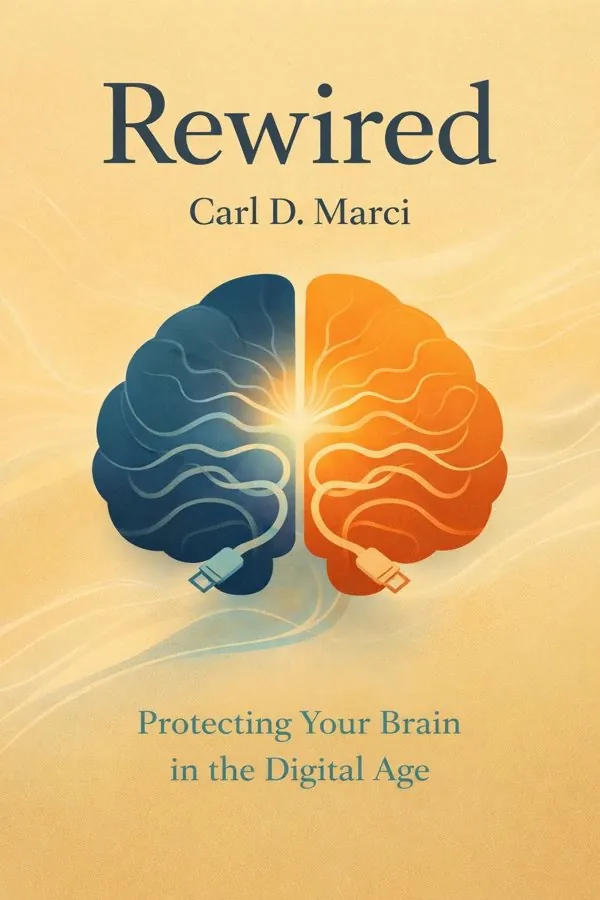
Rewired: Protecting Your Brain in the Digital Age: Summary & Key Insights
 10 min12 chaptersAudio available
What Is Rewired: Protecting Your Brain in the Digital Age About?
Rewired: Protecting Your Brain in the Digital Age by Carl D. Marci is a neuroscience book spanning 12 pages. Rewired explores how constant digital connectivity reshapes the human brain, behavior, and relationships. Drawing on neuroscience and psychology, Carl D. Marci examines the cognitive and emotional consequences of technology use and offers strategies to maintain mental health and meaningful human connection in the digital era.
This FizzRead summary covers all 12 key chapters of Rewired: Protecting Your Brain in the Digital Age in approximately 10 minutes, distilling the most important ideas, arguments, and takeaways from Carl D. Marci's work. Also available as an audio summary and Key Quotes Podcast.
Rewired: Protecting Your Brain in the Digital Age
Rewired explores how constant digital connectivity reshapes the human brain, behavior, and relationships. Drawing on neuroscience and psychology, Carl D. Marci examines the cognitive and emotional consequences of technology use and offers strategies to maintain mental health and meaningful human connection in the digital era.
Who Should Read Rewired: Protecting Your Brain in the Digital Age?
This book is perfect for anyone interested in neuroscience and looking to gain actionable insights in a short read. Whether you're a student, professional, or lifelong learner, the key ideas from Rewired: Protecting Your Brain in the Digital Age by Carl D. Marci will help you think differently.
- ✓Readers who enjoy neuroscience and want practical takeaways
- ✓Professionals looking to apply new ideas to their work and life
- ✓Anyone who wants the core insights of Rewired: Protecting Your Brain in the Digital Age in just 10 minutes
Want the full summary?
Get instant access to this book summary and 100K+ more with Fizz Moment.
Get Free SummaryAvailable on App Store • Free to download
Key Chapters
Human brains are social organs, wired from birth to connect, cooperate, and synchronize. When I speak of a 'connected brain,' I don’t just mean one that uses Wi-Fi—I mean a brain whose neural networks are constantly adapting to new forms of connection. The prefrontal cortex, the amygdala, and the reward centers of the striatum were shaped for physical encounters and shared realities. Yet our modern lives now consist largely of virtual interactions mediated by screens. This persistent digital engagement reorganizes those same circuits.
Every ping or alert activates the brain’s dopamine system, creating cycles of anticipation and reward. These rapid fluctuations reinforce habits of constant checking and scrolling. Over time, the default mode network—responsible for introspection and empathy—can become less active, replaced by a reactive, externally-oriented state. This doesn’t mean technology damages the brain irreversibly, but it does suggest that our inner lives are being reconfigured toward stimulus-driven attention rather than calm reflection.
In my clinical work, I’ve seen how these neural shifts manifest emotionally. Patients describe feeling connected yet lonely, stimulated yet exhausted. Their nervous systems oscillate between hyperarousal and depletion. Neuroscience helps explain this: chronic connectivity keeps the brain’s stress systems activated. The cortisol surges once reserved for survival situations are now triggered by email alerts or online exchanges. To protect your brain, the first step is recognizing that connectivity has a physiological cost. Awareness opens the door to restoration—to the deliberate cultivation of quiet moments and face-to-face bonds that allow the brain to recalibrate.
Attention is the currency of the digital world, and our brains are the marketplace. Every platform that vies for your focus does so by exploiting neural mechanisms that evolved to detect novelty and potential threat. When you try to multitask—switching between emails, texts, and tasks—you are not actually doing many things at once; your brain is toggling rapidly, paying a steep cognitive tax with each switch.
Functional MRI studies show that divided attention weakens activity in the hippocampus, impairing our ability to consolidate memory. The more we fragment our focus, the less deeply we think. Even worse, multitasking generates an illusion of efficiency. You feel busy, even accomplished, yet the quality of thought diminishes. In my own practice, high-performing professionals often describe mental fatigue without understanding its neurological roots: their attentional networks are overworked and under-recovered.
True productivity stems from intentional focus. The prefrontal cortex thrives under sustained attention; the mind feels grounded, and creativity flourishes. Reclaiming attention requires creating spaces for monotasking—reading a single book chapter, listening wholly to a conversation, or simply allowing moments of silence. These habits allow neuroplasticity to work in your favor, strengthening circuits for sustained thought rather than fragmented distraction.
+ 10 more chapters — available in the FizzRead app
All Chapters in Rewired: Protecting Your Brain in the Digital Age
About the Author
Carl D. Marci, M.D., is a psychiatrist and neuroscientist known for his research on empathy, media, and technology’s impact on the brain. He has served as Chief Psychiatrist at Massachusetts General Hospital and as a faculty member at Harvard Medical School.
Get This Summary in Your Preferred Format
Read or listen to the Rewired: Protecting Your Brain in the Digital Age summary by Carl D. Marci anytime, anywhere. FizzRead offers multiple formats so you can learn on your terms — all free.
Available formats: App · Audio · PDF · EPUB — All included free with FizzRead
Download Rewired: Protecting Your Brain in the Digital Age PDF and EPUB Summary
Key Quotes from Rewired: Protecting Your Brain in the Digital Age
“Human brains are social organs, wired from birth to connect, cooperate, and synchronize.”
“Attention is the currency of the digital world, and our brains are the marketplace.”
Frequently Asked Questions about Rewired: Protecting Your Brain in the Digital Age
Rewired: Protecting Your Brain in the Digital Age by Carl D. Marci is a neuroscience book that explores key ideas across 12 chapters. Rewired explores how constant digital connectivity reshapes the human brain, behavior, and relationships. Drawing on neuroscience and psychology, Carl D. Marci examines the cognitive and emotional consequences of technology use and offers strategies to maintain mental health and meaningful human connection in the digital era.
You Might Also Like

Anxious
Joseph LeDoux
10 min
Hallucinations
Oliver Sacks
10 min
The Biological Mind: How Brain, Body, and Environment Collaborate to Make Us Who We Are
Alan Jasanoff
10 min
The Feeling of Life Itself: Why Consciousness Is Widespread but Can't Be Computed
Christof Koch
10 min
The No-Nonsense Meditation Book
Steven Laureys
10 min
A General Theory of Love
Thomas Lewis, Fari Amini, Richard Lannon
10 minBrowse by Category
Ready to read Rewired: Protecting Your Brain in the Digital Age?
Get the full summary and 100K+ more books with Fizz Moment.