
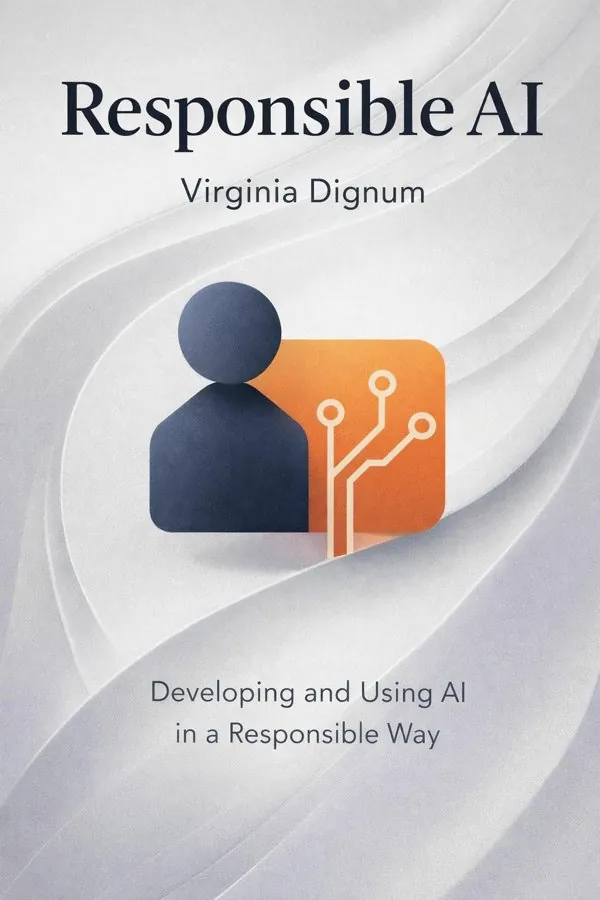
Responsible AI: Developing and Using AI in a Responsible Way: Summary & Key Insights
 10 min6 chaptersAudio available
What Is Responsible AI: Developing and Using AI in a Responsible Way About?
Responsible AI: Developing and Using AI in a Responsible Way by Virginia Dignum is a ai_ml book spanning 6 pages. Responsible AI explores how artificial intelligence systems can be designed, developed, and deployed in ways that are ethical, transparent, and aligned with human values. The book provides frameworks for accountability, fairness, and trustworthiness in AI, addressing both technical and societal aspects of responsible AI governance.
This FizzRead summary covers all 6 key chapters of Responsible AI: Developing and Using AI in a Responsible Way in approximately 10 minutes, distilling the most important ideas, arguments, and takeaways from Virginia Dignum's work. Also available as an audio summary and Key Quotes Podcast.
Responsible AI: Developing and Using AI in a Responsible Way
Responsible AI explores how artificial intelligence systems can be designed, developed, and deployed in ways that are ethical, transparent, and aligned with human values. The book provides frameworks for accountability, fairness, and trustworthiness in AI, addressing both technical and societal aspects of responsible AI governance.
Who Should Read Responsible AI: Developing and Using AI in a Responsible Way?
This book is perfect for anyone interested in ai_ml and looking to gain actionable insights in a short read. Whether you're a student, professional, or lifelong learner, the key ideas from Responsible AI: Developing and Using AI in a Responsible Way by Virginia Dignum will help you think differently.
- ✓Readers who enjoy ai_ml and want practical takeaways
- ✓Professionals looking to apply new ideas to their work and life
- ✓Anyone who wants the core insights of Responsible AI: Developing and Using AI in a Responsible Way in just 10 minutes
Want the full summary?
Get instant access to this book summary and 100K+ more with Fizz Moment.
Get Free SummaryAvailable on App Store • Free to download
Key Chapters
Our conversation about responsibility must begin with history, because the ethical dilemmas of AI didn’t appear overnight. From the earliest dreams of artificial reasoning, thinkers have contended with questions of autonomy and control. The myth of the Golem, the automata of ancient Greece, and later the cybernetic ambitions of the twentieth century all reflected humanity’s fascination — and fear — with creating life from logic.
The rise of digital computing in the mid-twentieth century gave the concept of artificial intelligence form and momentum. Initially, discussions focused on technical capability: could machines really *think*? By the 1980s and 1990s, a second wave of consideration began to ask *how* these systems might be used in society. As machine learning matured, we found ourselves no longer asking if machines could learn, but whether their learning processes could be trusted to produce fair and accountable outcomes.
Today, automated decision systems operate in domains such as healthcare, criminal justice, and finance — areas where outcomes carry profound moral significance. Ethical issues have evolved from questions of theoretical possibility to urgent matters of social justice. AI’s decisions are embedded within networks of power, data, and institutional choice. When we ask about responsibility, we are therefore asking how to design systems that acknowledge and mitigate these power dynamics.
The historical trajectory of AI reveals an important truth: ethics is not external to technology. Every stage of AI development has mirrored cultural expectations of intelligence and autonomy. Understanding this helps us approach responsibility not merely as a regulatory or moral imposition, but as an intrinsic element of innovation itself.
The concept of responsibility in AI, as I describe it, rests on three interrelated dimensions. Accountability refers to the ability to trace the origins and consequences of an AI system’s decisions. Transparency means that decisions should be explainable — not hidden behind the opacity of algorithms. Fairness ensures that the system operates without bias and with respect for human differences.
Responsibility requires both moral and technical interpretation. A developer must be accountable for how an algorithm affects users; an organization must be accountable for the societal outcomes of deploying that system. Responsibility is not an attribute of the machine; it is a relational quality that binds creators, operators, and affected individuals.
Transparency, likewise, is not simply about opening black boxes. It is about offering comprehensible explanations to diverse audiences — policymakers, engineers, and citizens alike. For a system to be truly transparent, its design must include clear documentation, accessible reasoning, and mechanisms by which users can question its outputs.
Fairness is perhaps the most complex of these dimensions. Algorithms learn from historical data, which often encodes social inequities. Correcting this requires active engagement with the data and the values that shape it. Fairness is not achieved by flattening differences but by designing systems that respect them. In practice, this means interdisciplinary collaboration among technologists, ethicists, and sociologists who together define what “fair” means in context.
Through this triad — accountability, transparency, fairness — responsibility becomes measurable, operational, and human-centered. These are the principles that anchor the rest of our exploration.
+ 4 more chapters — available in the FizzRead app
All Chapters in Responsible AI: Developing and Using AI in a Responsible Way
About the Author
Virginia Dignum is a professor of Responsible Artificial Intelligence at Umeå University in Sweden. Her research focuses on the ethical and social implications of AI, and she has contributed extensively to international policy discussions on AI governance and ethics.
Get This Summary in Your Preferred Format
Read or listen to the Responsible AI: Developing and Using AI in a Responsible Way summary by Virginia Dignum anytime, anywhere. FizzRead offers multiple formats so you can learn on your terms — all free.
Available formats: App · Audio · PDF · EPUB — All included free with FizzRead
Download Responsible AI: Developing and Using AI in a Responsible Way PDF and EPUB Summary
Key Quotes from Responsible AI: Developing and Using AI in a Responsible Way
“Our conversation about responsibility must begin with history, because the ethical dilemmas of AI didn’t appear overnight.”
“The concept of responsibility in AI, as I describe it, rests on three interrelated dimensions.”
Frequently Asked Questions about Responsible AI: Developing and Using AI in a Responsible Way
Responsible AI: Developing and Using AI in a Responsible Way by Virginia Dignum is a ai_ml book that explores key ideas across 6 chapters. Responsible AI explores how artificial intelligence systems can be designed, developed, and deployed in ways that are ethical, transparent, and aligned with human values. The book provides frameworks for accountability, fairness, and trustworthiness in AI, addressing both technical and societal aspects of responsible AI governance.
You Might Also Like

Life 3.0
Max Tegmark
10 min
Superintelligence
Nick Bostrom
10 min
TensorFlow in Action
Thushan Ganegedara
10 min
AI Made Simple: A Beginner’s Guide to Generative AI, ChatGPT, and the Future of Work
Rajeev Kapur
10 min
AI Snake Oil
Arvind Narayanan, Sayash Kapoor
10 min
AI Superpowers: China, Silicon Valley, and the New World Order
Kai-Fu Lee
10 minBrowse by Category
Ready to read Responsible AI: Developing and Using AI in a Responsible Way?
Get the full summary and 100K+ more books with Fizz Moment.