
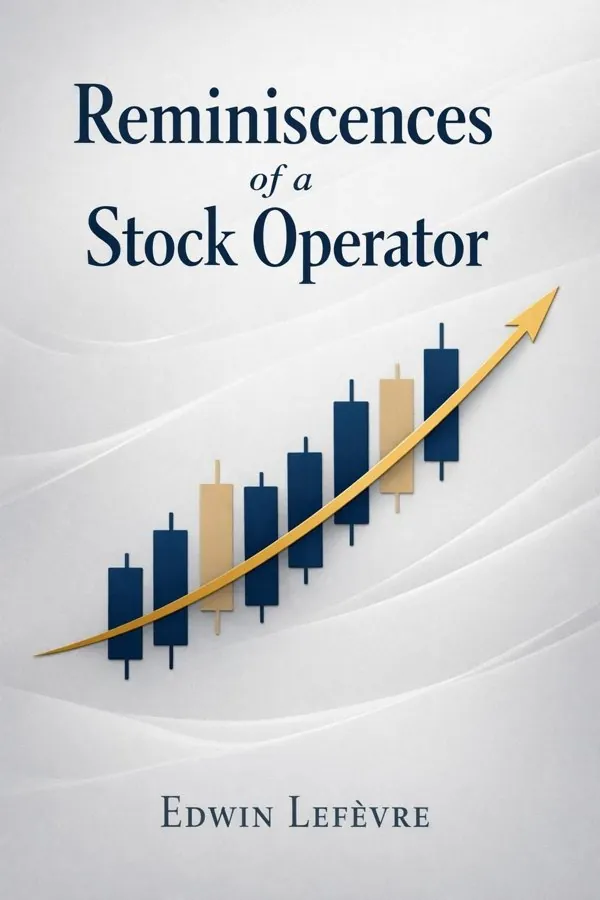
Reminiscences of a Stock Operator: Summary & Key Insights
 10 min9 chaptersAudio available
Key Takeaways from Reminiscences of a Stock Operator
Great speculators often begin not with money, but with curiosity.
An edge in one environment can fail completely in another.
The market rarely destroys people with ignorance alone; it more often destroys them through repeated violations of what they already know.
Prices move on numbers, but markets move on people.
The hardest thing in speculation is often not buying or selling, but waiting.
What Is Reminiscences of a Stock Operator About?
Reminiscences of a Stock Operator by Edwin Lefèvre is a finance book spanning 5 pages. Few books about markets have endured like Reminiscences of a Stock Operator because it is not really a book about stocks alone. It is a book about judgment, timing, conviction, self-deception, greed, fear, and the painful cost of learning in public. Written by Edwin Lefèvre and inspired by the life of legendary speculator Jesse Livermore, the story follows Larry Livingston from his early days in bucket shops to the high-stakes arena of Wall Street, where fortunes are made and lost on nerve as much as intelligence. What makes the book timeless is its deep understanding of trader psychology: the market changes in appearance, but human behavior does not. Lefèvre, a journalist and keen observer of finance, captures the emotional rhythm of speculation with unusual clarity, turning market lessons into vivid, memorable scenes. For modern readers, the book remains essential because it teaches that success in markets is rarely about finding a secret formula. It is about discipline, patience, risk control, and the ability to think independently when crowds are euphoric or terrified.
This FizzRead summary covers all 9 key chapters of Reminiscences of a Stock Operator in approximately 10 minutes, distilling the most important ideas, arguments, and takeaways from Edwin Lefèvre's work. Also available as an audio summary and Key Quotes Podcast.
Reminiscences of a Stock Operator
Few books about markets have endured like Reminiscences of a Stock Operator because it is not really a book about stocks alone. It is a book about judgment, timing, conviction, self-deception, greed, fear, and the painful cost of learning in public. Written by Edwin Lefèvre and inspired by the life of legendary speculator Jesse Livermore, the story follows Larry Livingston from his early days in bucket shops to the high-stakes arena of Wall Street, where fortunes are made and lost on nerve as much as intelligence. What makes the book timeless is its deep understanding of trader psychology: the market changes in appearance, but human behavior does not. Lefèvre, a journalist and keen observer of finance, captures the emotional rhythm of speculation with unusual clarity, turning market lessons into vivid, memorable scenes. For modern readers, the book remains essential because it teaches that success in markets is rarely about finding a secret formula. It is about discipline, patience, risk control, and the ability to think independently when crowds are euphoric or terrified.
Who Should Read Reminiscences of a Stock Operator?
This book is perfect for anyone interested in finance and looking to gain actionable insights in a short read. Whether you're a student, professional, or lifelong learner, the key ideas from Reminiscences of a Stock Operator by Edwin Lefèvre will help you think differently.
- ✓Readers who enjoy finance and want practical takeaways
- ✓Professionals looking to apply new ideas to their work and life
- ✓Anyone who wants the core insights of Reminiscences of a Stock Operator in just 10 minutes
Want the full summary?
Get instant access to this book summary and 100K+ more with Fizz Moment.
Get Free SummaryAvailable on App Store • Free to download
Key Chapters
Great speculators often begin not with money, but with curiosity. Larry Livingston’s earliest edge was not wealth, connections, or formal training. It was a fascination with price movement itself. As a quotation boy in bucket shops, he developed an unusual habit: he watched numbers long enough to notice recurring behavior. While others saw random fluctuations, he saw tendencies, rhythms, and the traces of human emotion translated into prices. This early stage matters because it shows that successful speculation begins with observation before action.
Bucket shops were imperfect, often corrupt environments where customers bet on stock movements without actually buying securities. Yet for Livingston, they became a laboratory. The stakes were small, the lessons immediate, and the feedback brutally honest. He learned that prices often move in patterns shaped by expectation, momentum, and crowd behavior. More importantly, he learned the difference between guessing and reading the tape. He was not always right, but he was beginning to understand that markets reward those who pay attention to behavior rather than opinion.
For modern readers, the lesson is to treat early market experience as tuition, not as a stage for ego. A new trader does not need to master everything at once. It is far more valuable to study how assets behave around news, trend changes, earnings, or volatility spikes. Keep a trading journal. Review your assumptions. Notice what actually moves prices instead of what should move them in theory.
Actionable takeaway: before risking serious capital, spend time becoming a student of market behavior. Build your edge through careful observation, pattern recognition, and disciplined note-taking.
An edge in one environment can fail completely in another. When Livingston moved from bucket shops to Wall Street, he discovered a painful truth: knowing market direction is not enough if you do not understand execution, liquidity, timing, and the structure of the game you are playing. In bucket shops, his quick reading of price changes gave him an advantage. In the real market, larger forces mattered. Orders influenced prices, brokers mattered, operators defended positions, and market moves took longer to unfold.
This transition is one of the book’s most useful lessons. Many traders assume a profitable tactic automatically scales from paper trading to live markets, from small caps to index futures, or from calm markets to volatile ones. Livingston learned otherwise. He often acted too early, took profits too quickly, or underestimated the market’s ability to move against him before eventually proving him right. The problem was not always analysis. Often, it was adaptation.
His journey shows that markets are ecosystems. A strategy that works in a fast, manipulated, lightly capitalized setting may fail in a deeper, more complex one. Likewise, modern investors may succeed in bull markets but struggle when conditions change. A momentum strategy may collapse in a range-bound market. Long-term investing principles may not translate into short-term speculation.
Actionable takeaway: define the exact market environment your strategy fits. Test whether your edge depends on volatility, trend strength, liquidity, time horizon, or position size, and adapt before the market forces you to.
The market rarely destroys people with ignorance alone; it more often destroys them through repeated violations of what they already know. Livingston’s failures are as important as his triumphs because they reveal the gap between understanding and discipline. He repeatedly learns lessons about overtrading, acting on tips, averaging down, and abandoning patience, only to discover that knowledge without emotional control has little value.
One of the book’s central truths is that losses can be educational if they are examined honestly. Livingston does not portray himself as infallible. He makes expensive mistakes, and those mistakes expose the psychological weak points that every trader has: impatience, hope, pride, the need to be right, and the temptation to recover quickly after a setback. He learns that a small loss can be a useful signal, but a large loss often reflects stubbornness. The market gives little sympathy to those who confuse conviction with ego.
This idea remains deeply practical. Traders today may know they should cut losses, size positions properly, and avoid revenge trading. Yet after three losing trades in a row, many increase size or break rules in an attempt to earn back what was lost. Investors do similar things when they hold collapsing positions because selling would force them to admit error.
Actionable takeaway: review every meaningful loss and identify the true cause. Was it the market, or was it your process, position size, timing, or emotional state? Turn each loss into a written rule so the same tuition is paid only once.
Prices move on numbers, but markets move on people. One reason Reminiscences of a Stock Operator remains relevant is its insistence that speculation is fundamentally psychological. Livingston learns that fear, greed, hope, envy, and crowd imitation are more persistent than any specific market structure. Technology changes, regulations change, and financial instruments evolve, but human beings continue to chase rising prices, panic near bottoms, and search for certainty where none exists.
This insight gives the book its timeless quality. A trader who understands earnings models but ignores psychology will still be surprised by irrational rallies, vicious squeezes, and mass delusion. Livingston recognizes that crowds become most dangerous when they feel safest. Bull markets create confidence that looks like intelligence. Bear markets create despair that looks like realism. The challenge is to think independently while still respecting what the tape is saying.
In practical terms, this means watching sentiment as carefully as fundamentals. If everyone is certain a stock can only rise, the risk may be increasing, not decreasing. If panic is universal, forced selling may be near exhaustion. This does not mean reflexively taking the opposite side of the crowd. It means understanding that emotional extremes often distort judgment and create opportunity.
Actionable takeaway: add a psychological layer to your analysis. Ask not only what an asset is worth or where it is trending, but also how the crowd feels, who is trapped, and what emotional story the market is currently telling.
The hardest thing in speculation is often not buying or selling, but waiting. One of Livingston’s most famous lessons is that the real money is made in the big swing, not in constant trading. He learns that being right about the broad direction of a move matters far more than reacting to every small fluctuation. Many traders can identify trends, but few can hold through normal corrections without talking themselves out of the position.
This idea cuts against the impulse to feel productive. Frequent action creates the illusion of control, yet it often leads to commissions, emotional fatigue, and inconsistent decisions. Livingston discovers that once a market confirms his thesis, patience becomes a competitive advantage. A bull market does not end because prices pause for a day. A bear move does not vanish because of one sharp rally. Traders often sabotage themselves by taking tiny profits while allowing losses to run, or by exiting sound positions simply because they are uncomfortable.
Modern investors can apply this in different ways. A trend follower must let winners develop rather than micro-manage every candle. A long-term investor must distinguish between a broken thesis and normal volatility. Even outside finance, the principle holds: compounding usually rewards disciplined staying power more than restless activity.
Actionable takeaway: before entering any position, decide what kind of move you are trying to capture. If the thesis is long-term, avoid making short-term noise the reason you exit. Let time work for you when your thesis remains intact.
Nothing is more dangerous than acting with confidence you did not earn. Throughout the book, Livingston repeatedly shows the weakness of tips, insider whispers, and borrowed opinions. Even when a tip is correct, it can still be useless if the timing is wrong, the position size is reckless, or the trader lacks the conviction to hold or exit properly. Information without independent judgment becomes a trap.
This lesson is especially important because tips appeal to emotion. They offer the fantasy of certainty, of shortcutting the slow work of analysis and experience. But Livingston learns that a position based on someone else’s conviction will collapse the moment the market moves against him. Because the idea is not truly his, he cannot manage it rationally. He does not know why he is in, when he is wrong, or how long he should stay.
Today, tips arrive faster than ever through social media, chat groups, television pundits, newsletters, and online influencers. The format has changed, but the danger has not. Buying a stock because it is trending online or because a famous investor mentioned it is not a strategy. It is outsourcing thought while keeping all the risk.
Actionable takeaway: never enter a position unless you can explain, in your own words, the thesis, the risk, the invalidation point, and the expected time horizon. If you cannot do that, you are trading someone else’s idea with your own money.
In markets, survival is not a defensive concept; it is the foundation of future success. Livingston’s career rises and falls dramatically, and one recurring lesson is that preserving capital matters more than proving brilliance. A trader who survives mistakes can recover, learn, and exploit the next great opportunity. A trader who overextends during a bad stretch may be right later but still end up ruined.
The book does not present risk management as dry arithmetic. It presents it as a moral discipline against excess. Livingston sees how dangerous it is to average down simply because a position is lower, to trade too large after a winning streak, or to stay exposed when market conditions become uncertain. He learns that markets can remain irrational longer than pride can remain solvent. The first responsibility is not to maximize every move, but to stay in the game.
For modern readers, this means position sizing, stop-loss discipline, diversification when appropriate, and respect for leverage. It also means knowing when not to trade. Opportunity cost is real, but catastrophic loss is far worse. Risk management often feels frustrating because it limits upside in the short term. Yet it creates durability, and durability is what allows compounding.
Actionable takeaway: set a maximum acceptable loss before every trade or investment. Decide position size based on what you can afford to lose, not on how strongly you feel. Strong opinions should never override risk limits.
Many people enter markets believing someone powerful is always in control. Livingston’s experience offers a more nuanced truth. Operators, pools, and insiders can influence prices for a time, but they cannot permanently overpower the broader forces of supply, demand, sentiment, and economic reality. Manipulation exists, yet even manipulators must eventually confront the market itself.
This is one of the more sophisticated lessons in the book. Livingston understands that powerful interests can create misleading moves, force squeezes, or stage campaigns that attract public participation. But he also sees that these efforts have limits. If a stock is fundamentally weak and the market environment is hostile, artificial support eventually fails. If a trend has broad force behind it, attempts to resist it become expensive. The operator who ignores the larger current gets swept away just like anyone else.
The modern parallel is clear. Investors often blame hedge funds, central banks, high-frequency traders, or institutions for every move they do not understand. Sometimes large players do shape short-term behavior. But blaming manipulation can become an excuse for ignoring evidence. The better question is whether price action confirms or rejects your thesis.
Actionable takeaway: respect the possibility of temporary distortion, but do not build your process around conspiracy. Focus on what price, volume, trend, and macro conditions are actually telling you. In the end, reality tends to defeat manufactured narratives.
The best market operators combine confidence in their method with humility before uncertainty. Livingston’s journey shows that speculation punishes both arrogance and passivity. To win, he must think independently rather than follow the herd, yet he must also remain flexible enough to admit when the market disproves him. This balance is rare, and it is perhaps the deepest personal lesson in the book.
Independence matters because consensus is often most persuasive at exactly the wrong time. When everyone agrees, much of the move may already be over. Livingston learns to trust his reading of the market instead of public opinion. But humility matters because conviction can harden into stubbornness. The market does not reward intelligence in the abstract. It rewards alignment with reality. Being early, overconfident, or emotionally attached can be as costly as being uninformed.
This lesson applies beyond trading. Investors, entrepreneurs, and decision-makers of all kinds must form original judgments while remaining open to disconfirming evidence. The strongest performers are not those who never change their minds. They are those who change their minds quickly when facts change, without letting ego interfere.
Actionable takeaway: build a decision process that includes both independent thinking and explicit invalidation criteria. Know why you believe what you believe, and know in advance what evidence would prove you wrong. Confidence should guide action, but humility should govern risk.
All Chapters in Reminiscences of a Stock Operator
About the Author
Edwin Lefèvre (1871–1943) was an American journalist, novelist, and diplomat whose writing helped define early financial literature. Born in Colombia to American parents and educated in the United States, he built his career as a reporter and author with a strong interest in Wall Street, business, and public life. Lefèvre became known for his ability to translate complex financial activity into vivid, human stories, focusing less on formulas and more on the motives, fears, and ambitions driving market behavior. His most famous work, Reminiscences of a Stock Operator, drew heavily from the life of legendary trader Jesse Livermore and remains one of the most influential books ever written about speculation. Lefèvre’s enduring strength was his ability to show that finance is, above all, a drama of human psychology.
Get This Summary in Your Preferred Format
Read or listen to the Reminiscences of a Stock Operator summary by Edwin Lefèvre anytime, anywhere. FizzRead offers multiple formats so you can learn on your terms — all free.
Available formats: App · Audio · PDF · EPUB — All included free with FizzRead
Download Reminiscences of a Stock Operator PDF and EPUB Summary
Key Quotes from Reminiscences of a Stock Operator
“Great speculators often begin not with money, but with curiosity.”
“An edge in one environment can fail completely in another.”
“The market rarely destroys people with ignorance alone; it more often destroys them through repeated violations of what they already know.”
“Prices move on numbers, but markets move on people.”
“The hardest thing in speculation is often not buying or selling, but waiting.”
Frequently Asked Questions about Reminiscences of a Stock Operator
Reminiscences of a Stock Operator by Edwin Lefèvre is a finance book that explores key ideas across 9 chapters. Few books about markets have endured like Reminiscences of a Stock Operator because it is not really a book about stocks alone. It is a book about judgment, timing, conviction, self-deception, greed, fear, and the painful cost of learning in public. Written by Edwin Lefèvre and inspired by the life of legendary speculator Jesse Livermore, the story follows Larry Livingston from his early days in bucket shops to the high-stakes arena of Wall Street, where fortunes are made and lost on nerve as much as intelligence. What makes the book timeless is its deep understanding of trader psychology: the market changes in appearance, but human behavior does not. Lefèvre, a journalist and keen observer of finance, captures the emotional rhythm of speculation with unusual clarity, turning market lessons into vivid, memorable scenes. For modern readers, the book remains essential because it teaches that success in markets is rarely about finding a secret formula. It is about discipline, patience, risk control, and the ability to think independently when crowds are euphoric or terrified.
You Might Also Like




Browse by Category
Ready to read Reminiscences of a Stock Operator?
Get the full summary and 100K+ more books with Fizz Moment.