
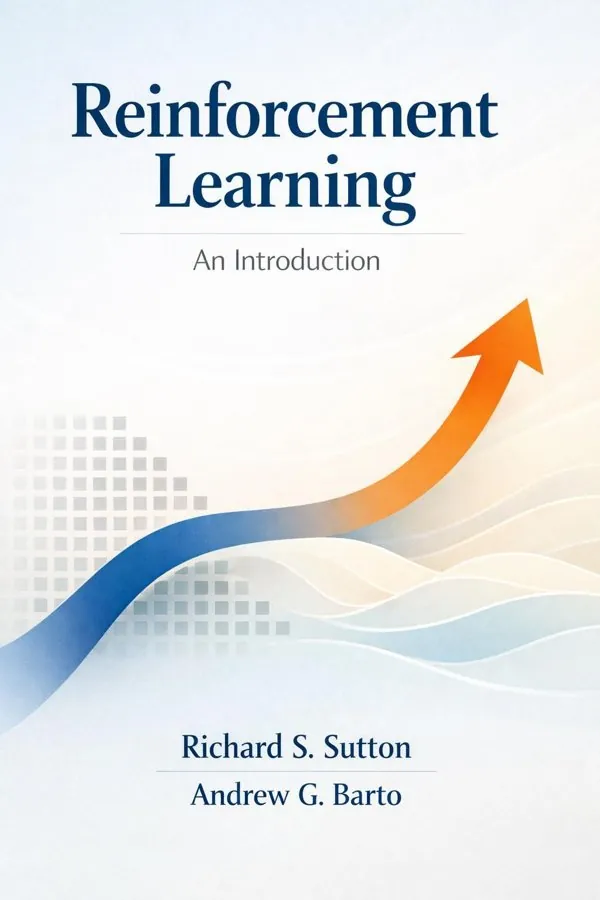
Reinforcement Learning: An Introduction: Summary & Key Insights
by Richard S. Sutton, Andrew G. Barto
 10 min5 chaptersAudio available
What Is Reinforcement Learning: An Introduction About?
Reinforcement Learning: An Introduction by Richard S. Sutton, Andrew G. Barto is a ai_ml book spanning 5 pages. This foundational textbook provides a comprehensive introduction to reinforcement learning, a branch of machine learning concerned with how agents can learn to make decisions through interaction with their environment. It covers key concepts such as Markov decision processes, dynamic programming, Monte Carlo methods, temporal-difference learning, and policy gradient techniques. The book is widely used in academia and industry as a standard reference for understanding the theoretical and practical aspects of reinforcement learning.
This FizzRead summary covers all 5 key chapters of Reinforcement Learning: An Introduction in approximately 10 minutes, distilling the most important ideas, arguments, and takeaways from Richard S. Sutton, Andrew G. Barto's work. Also available as an audio summary and Key Quotes Podcast.
Reinforcement Learning: An Introduction
This foundational textbook provides a comprehensive introduction to reinforcement learning, a branch of machine learning concerned with how agents can learn to make decisions through interaction with their environment. It covers key concepts such as Markov decision processes, dynamic programming, Monte Carlo methods, temporal-difference learning, and policy gradient techniques. The book is widely used in academia and industry as a standard reference for understanding the theoretical and practical aspects of reinforcement learning.
Who Should Read Reinforcement Learning: An Introduction?
This book is perfect for anyone interested in ai_ml and looking to gain actionable insights in a short read. Whether you're a student, professional, or lifelong learner, the key ideas from Reinforcement Learning: An Introduction by Richard S. Sutton, Andrew G. Barto will help you think differently.
- ✓Readers who enjoy ai_ml and want practical takeaways
- ✓Professionals looking to apply new ideas to their work and life
- ✓Anyone who wants the core insights of Reinforcement Learning: An Introduction in just 10 minutes
Want the full summary?
Get instant access to this book summary and 100K+ more with Fizz Moment.
Get Free SummaryAvailable on App Store • Free to download
Key Chapters
It always starts with the formulation. Every learning problem in reinforcement learning must be grounded in the interplay between the agent and the environment. This is captured neatly through the Markov Decision Process (MDP)—a mathematical model that binds states, actions, transitions, rewards, and policies in a seamless dynamic loop.
In an MDP, at each time step, the agent observes a state, selects an action, receives a reward, and transitions to a new state. The reward signals the immediate consequence of the agent’s action, while the transition function captures the environment’s stochastic nature. Crucially, the agent aims not for short-term gratification but for cumulative reward maximization, represented through expected returns.
Policies lie at the heart of MDPs. A policy defines the agent’s behavior—a mapping from states to probabilities of selecting actions. Determining or improving this policy is the essence of RL. When the model of the environment is known, classic methods in dynamic programming emerge; when it is unknown, learning becomes the centerpiece.
This formalism offers more than notation—it provides a lens into autonomy. It connects control problems, game strategies, and adaptive behaviors under a single theoretical umbrella. The elegance of the MDP formulation lies in its generality: whether a robot exploring terrain or software adjusting pricing strategies, each operates through this loop of observation, choice, and reward.
Dynamic Programming (DP) is where reinforcement learning finds its computational heartbeat for problems with known models. When transitions and rewards are fully specified, we can exploit mathematical precision to compute optimal policies through iterative refinement.
Policy evaluation calculates the value of a policy—the expected return from each state if that policy is followed. Policy improvement leverages those values to produce a better policy. These two steps, alternated repeatedly, yield what we call policy iteration. Alternatively, value iteration compresses this process into a unified update mechanism that drives values directly to optimality.
Beyond the equations, dynamic programming establishes a fundamental intuition: learning is iteration. Each evaluation, each improvement reflects a gradual honing of performance, approaching optimal behavior through recursive self-consistency. Even though DP assumes full knowledge, it prepares the conceptual ground for later methods that operate under uncertainty.
This technique connects generations of research—from Richard Bellman’s principle of optimality to today’s neural approximators. It reminds us that every reinforcement learner, human or machine, relies on dynamic programming principles at its core: refining beliefs, adjusting actions, and converging upon greater efficiency through cycles of feedback.
+ 3 more chapters — available in the FizzRead app
All Chapters in Reinforcement Learning: An Introduction
About the Authors
Richard S. Sutton is a Canadian computer scientist known for his pioneering work in reinforcement learning and artificial intelligence. He is a professor at the University of Alberta and a researcher at DeepMind. Andrew G. Barto is an American computer scientist and professor emeritus at the University of Massachusetts Amherst, recognized for his contributions to machine learning and computational neuroscience.
Get This Summary in Your Preferred Format
Read or listen to the Reinforcement Learning: An Introduction summary by Richard S. Sutton, Andrew G. Barto anytime, anywhere. FizzRead offers multiple formats so you can learn on your terms — all free.
Available formats: App · Audio · PDF · EPUB — All included free with FizzRead
Download Reinforcement Learning: An Introduction PDF and EPUB Summary
Key Quotes from Reinforcement Learning: An Introduction
“Every learning problem in reinforcement learning must be grounded in the interplay between the agent and the environment.”
“Dynamic Programming (DP) is where reinforcement learning finds its computational heartbeat for problems with known models.”
Frequently Asked Questions about Reinforcement Learning: An Introduction
Reinforcement Learning: An Introduction by Richard S. Sutton, Andrew G. Barto is a ai_ml book that explores key ideas across 5 chapters. This foundational textbook provides a comprehensive introduction to reinforcement learning, a branch of machine learning concerned with how agents can learn to make decisions through interaction with their environment. It covers key concepts such as Markov decision processes, dynamic programming, Monte Carlo methods, temporal-difference learning, and policy gradient techniques. The book is widely used in academia and industry as a standard reference for understanding the theoretical and practical aspects of reinforcement learning.
You Might Also Like
Life 3.0
Max Tegmark
10 min
Superintelligence
Nick Bostrom
10 min
TensorFlow in Action
Thushan Ganegedara
10 min
AI Made Simple: A Beginner’s Guide to Generative AI, ChatGPT, and the Future of Work
Rajeev Kapur
10 min
AI Snake Oil
Arvind Narayanan, Sayash Kapoor
10 min
AI Superpowers: China, Silicon Valley, and the New World Order
Kai-Fu Lee
10 minBrowse by Category
Ready to read Reinforcement Learning: An Introduction?
Get the full summary and 100K+ more books with Fizz Moment.