
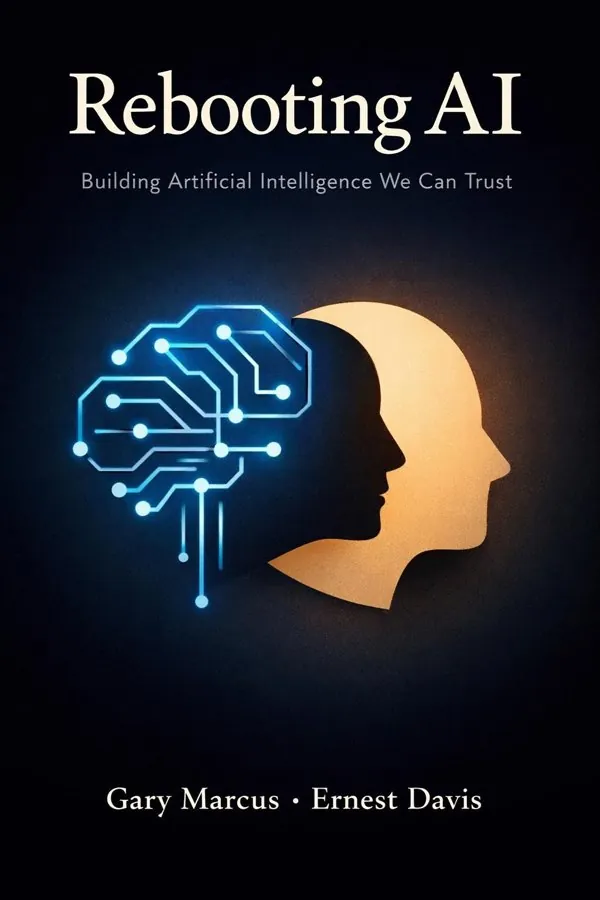
Rebooting AI: Building Artificial Intelligence We Can Trust: Summary & Key Insights
 10 min9 chaptersAudio available
What Is Rebooting AI: Building Artificial Intelligence We Can Trust About?
Rebooting AI: Building Artificial Intelligence We Can Trust by Gary Marcus, Ernest Davis is a ai_ml book spanning 9 pages. Rebooting AI: Building Artificial Intelligence We Can Trust es una obra que examina críticamente el estado actual de la inteligencia artificial. Los autores, Gary Marcus y Ernest Davis, argumentan que la IA moderna, basada principalmente en el aprendizaje profundo, carece de comprensión y razonamiento genuinos. Proponen un enfoque más equilibrado que combine el aprendizaje automático con la cognición humana y la comprensión del sentido común, para construir sistemas de IA más confiables y responsables.
This FizzRead summary covers all 9 key chapters of Rebooting AI: Building Artificial Intelligence We Can Trust in approximately 10 minutes, distilling the most important ideas, arguments, and takeaways from Gary Marcus, Ernest Davis's work. Also available as an audio summary and Key Quotes Podcast.
Rebooting AI: Building Artificial Intelligence We Can Trust
Rebooting AI: Building Artificial Intelligence We Can Trust es una obra que examina críticamente el estado actual de la inteligencia artificial. Los autores, Gary Marcus y Ernest Davis, argumentan que la IA moderna, basada principalmente en el aprendizaje profundo, carece de comprensión y razonamiento genuinos. Proponen un enfoque más equilibrado que combine el aprendizaje automático con la cognición humana y la comprensión del sentido común, para construir sistemas de IA más confiables y responsables.
Who Should Read Rebooting AI: Building Artificial Intelligence We Can Trust?
This book is perfect for anyone interested in ai_ml and looking to gain actionable insights in a short read. Whether you're a student, professional, or lifelong learner, the key ideas from Rebooting AI: Building Artificial Intelligence We Can Trust by Gary Marcus, Ernest Davis will help you think differently.
- ✓Readers who enjoy ai_ml and want practical takeaways
- ✓Professionals looking to apply new ideas to their work and life
- ✓Anyone who wants the core insights of Rebooting AI: Building Artificial Intelligence We Can Trust in just 10 minutes
Want the full summary?
Get instant access to this book summary and 100K+ more with Fizz Moment.
Get Free SummaryAvailable on App Store • Free to download
Key Chapters
Artificial intelligence did not begin with neural networks or with the mountains of data we now take for granted. In its infancy, the field was driven by a very different dream — one grounded in logic, symbols, and understanding. The early pioneers of AI, from Newell and Simon to Minsky and McCarthy, sought to capture intelligence as a process of reasoning. Their systems, often limited in computational power, aimed to encode rules and represent knowledge explicitly. This approach, known as symbolic AI or 'Good Old-Fashioned AI', brought us systems that could play chess, prove theorems, and even converse in rudimentary ways. Yet, these early models struggled with flexibility. They lacked the ability to learn from raw data, an ability natural to humans.
Then came the era of machine learning and, more recently, deep learning. Fueled by immense datasets and processing power, neural networks began to outperform symbolic systems in recognition tasks. The allure was irresistible — rather than crafting intricate rules, one could now let the system 'learn' directly from examples. It was a paradigm shift that propelled AI into mainstream success. But in that success lay a trap. The community, intoxicated by data-driven triumphs, started to equate correlation with understanding. In the process, the rich tradition of symbolic reasoning and knowledge representation was largely dismissed.
In *Rebooting AI*, we argue for synthesis, not replacement. The symbolic era gave us insights into structure and representation; the deep learning era contributed scalability and adaptability. To truly move forward, we must unite these strengths rather than pit them against each other.
Deep learning excels when the environment is constrained and the patterns are consistent. A convolutional neural network trained to recognize cats on Instagram images performs astonishingly well — until one day, the cat is drawn instead of photographed, or half-hidden by a shadow. The network then falters because it does not understand what a cat *is*. It only knows statistical regularities of pixels. This limitation epitomizes deep learning’s blindness to meaning.
Throughout the book, we unpack several such weaknesses. Deep learning systems lack causal understanding. They do not know why an object behaves as it does, or how an event leads to another. Their 'intelligence' is purely associative, mapping inputs to outputs with impressive precision but little insight. Moreover, deep learning models are data-hungry. They can require millions of examples to approximate what a human child internalizes from just a few interactions.
Ernest and I draw attention to the brittleness of these systems — their tendency to fail unexpectedly when conditions change even slightly. In real-world contexts like autonomous driving or healthcare diagnostics, such brittleness is not just inconvenient but dangerous. The larger point is that intelligence without comprehension is fragile. Systems that cannot reason or explain will remain, at best, unreliable tools — and at worst, liabilities.
+ 7 more chapters — available in the FizzRead app
All Chapters in Rebooting AI: Building Artificial Intelligence We Can Trust
About the Authors
Gary Marcus es psicólogo y científico cognitivo, conocido por su trabajo en el desarrollo del lenguaje y la inteligencia artificial. Ernest Davis es profesor de informática en la Universidad de Nueva York, especializado en razonamiento automatizado y representación del conocimiento. Ambos son reconocidos por su pensamiento crítico sobre los límites y el futuro de la IA.
Get This Summary in Your Preferred Format
Read or listen to the Rebooting AI: Building Artificial Intelligence We Can Trust summary by Gary Marcus, Ernest Davis anytime, anywhere. FizzRead offers multiple formats so you can learn on your terms — all free.
Available formats: App · Audio · PDF · EPUB — All included free with FizzRead
Download Rebooting AI: Building Artificial Intelligence We Can Trust PDF and EPUB Summary
Key Quotes from Rebooting AI: Building Artificial Intelligence We Can Trust
“Artificial intelligence did not begin with neural networks or with the mountains of data we now take for granted.”
“Deep learning excels when the environment is constrained and the patterns are consistent.”
Frequently Asked Questions about Rebooting AI: Building Artificial Intelligence We Can Trust
Rebooting AI: Building Artificial Intelligence We Can Trust by Gary Marcus, Ernest Davis is a ai_ml book that explores key ideas across 9 chapters. Rebooting AI: Building Artificial Intelligence We Can Trust es una obra que examina críticamente el estado actual de la inteligencia artificial. Los autores, Gary Marcus y Ernest Davis, argumentan que la IA moderna, basada principalmente en el aprendizaje profundo, carece de comprensión y razonamiento genuinos. Proponen un enfoque más equilibrado que combine el aprendizaje automático con la cognición humana y la comprensión del sentido común, para construir sistemas de IA más confiables y responsables.
You Might Also Like
Life 3.0
Max Tegmark
10 min
Superintelligence
Nick Bostrom
10 min
TensorFlow in Action
Thushan Ganegedara
10 min
AI Made Simple: A Beginner’s Guide to Generative AI, ChatGPT, and the Future of Work
Rajeev Kapur
10 min
AI Snake Oil
Arvind Narayanan, Sayash Kapoor
10 min
AI Superpowers: China, Silicon Valley, and the New World Order
Kai-Fu Lee
10 minBrowse by Category
Ready to read Rebooting AI: Building Artificial Intelligence We Can Trust?
Get the full summary and 100K+ more books with Fizz Moment.