
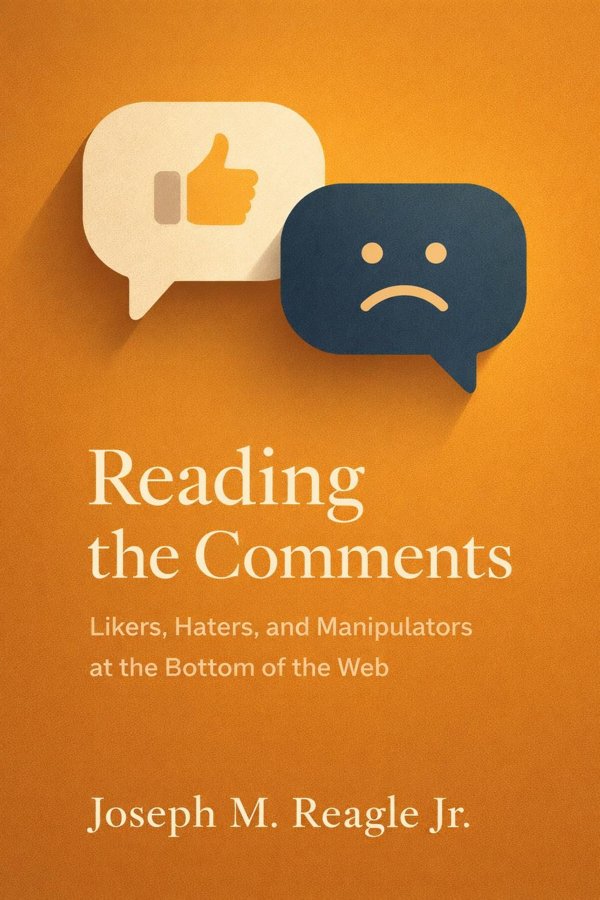
Reading the Comments: Likers, Haters, and Manipulators at the Bottom of the Web: Summary & Key Insights
 10 min8 chaptersAudio available
What Is Reading the Comments: Likers, Haters, and Manipulators at the Bottom of the Web About?
Reading the Comments: Likers, Haters, and Manipulators at the Bottom of the Web by Joseph M. Reagle Jr. is a digital_culture book spanning 8 pages. In 'Reading the Comments', Joseph M. Reagle Jr. explores the culture of online commenting, examining how people express themselves, argue, troll, and build communities in digital spaces. The book analyzes the social, psychological, and technological factors that shape online discourse, offering insights into civility, anonymity, and the dynamics of participation on the internet.
This FizzRead summary covers all 8 key chapters of Reading the Comments: Likers, Haters, and Manipulators at the Bottom of the Web in approximately 10 minutes, distilling the most important ideas, arguments, and takeaways from Joseph M. Reagle Jr.'s work. Also available as an audio summary and Key Quotes Podcast.
Reading the Comments: Likers, Haters, and Manipulators at the Bottom of the Web
In 'Reading the Comments', Joseph M. Reagle Jr. explores the culture of online commenting, examining how people express themselves, argue, troll, and build communities in digital spaces. The book analyzes the social, psychological, and technological factors that shape online discourse, offering insights into civility, anonymity, and the dynamics of participation on the internet.
Who Should Read Reading the Comments: Likers, Haters, and Manipulators at the Bottom of the Web?
This book is perfect for anyone interested in digital_culture and looking to gain actionable insights in a short read. Whether you're a student, professional, or lifelong learner, the key ideas from Reading the Comments: Likers, Haters, and Manipulators at the Bottom of the Web by Joseph M. Reagle Jr. will help you think differently.
- ✓Readers who enjoy digital_culture and want practical takeaways
- ✓Professionals looking to apply new ideas to their work and life
- ✓Anyone who wants the core insights of Reading the Comments: Likers, Haters, and Manipulators at the Bottom of the Web in just 10 minutes
Want the full summary?
Get instant access to this book summary and 100K+ more with Fizz Moment.
Get Free SummaryAvailable on App Store • Free to download
Key Chapters
To understand today’s cacophony of online voices, we must revisit the earliest digital landscapes. I trace the genealogy of comments back to bulletin board systems (BBS), Usenet, and early forums — spaces that were the laboratories of online culture. These were places where users gathered not just to share files or information, but to talk. Threaded discussions bound by shared interests gave rise to what we now recognize as community norms and internet etiquette.
Early commentators were often tech-savvy hobbyists or academics. The tone was collaborative and self-regulating; participants valued knowledge and the informal spirit of collective learning. But as the web expanded beyond these niche enclaves, new publics entered, bringing diverse motives and perspectives. The early optimism of networked conversation gradually encountered dilemmas of scale and civility.
Through this historical lens, commenting emerges as both a technological and sociological evolution: interfaces changed from simple text posts to rich multimedia replies; moderation shifted from manual oversight to algorithmic control. The very architecture of interaction evolved — the Like button, upvotes, and retweets reframed what participation meant. In documenting this, I hoped to show that our current debates over trolling, incivility, and self-promotion are not new — they are amplified echoes of patterns first seen decades ago.
The heart of comment culture lies in participation. People comment not merely to express opinions but to be seen, to belong, and to join the ongoing conversation. This participatory impulse fuels the democratization of expression online. Every comment, in its way, asserts that one’s voice matters. Yet, in this openness resides both beauty and chaos.
I draw upon theories of participatory culture articulated by scholars such as Henry Jenkins, exploring how online spaces turned passive audiences into active contributors. For many, commenting offers validation — the satisfaction of recognition within a vast network. Whether it’s agreement, disagreement, correction, or humor, the act is performative. We construct micro-identities through emojis, tone, and linguistic choices.
However, participation also carries ambivalence. The accessibility of commenting reduces barriers, but it also erases hierarchies that once safeguarded thoughtful discourse. Authority and expertise are diluted amidst emotional immediacy. In the modern web, engagement metrics — likes, shares, replies — often replace meaningful dialogue with quantifiable popularity.
Even so, I argue that participation remains one of the best manifestations of our digital aspirations. It reveals our desire to converse, challenge, and connect. It’s messy, but it’s human. And understanding that mess, instead of lamenting it, helps us reclaim civility and authenticity online.
+ 6 more chapters — available in the FizzRead app
All Chapters in Reading the Comments: Likers, Haters, and Manipulators at the Bottom of the Web
About the Author
Joseph M. Reagle Jr. is an Associate Professor of Communication Studies at Northeastern University. His research focuses on digital culture, online collaboration, and the social implications of technology. He has written extensively on Wikipedia, online communities, and the ethics of digital communication.
Get This Summary in Your Preferred Format
Read or listen to the Reading the Comments: Likers, Haters, and Manipulators at the Bottom of the Web summary by Joseph M. Reagle Jr. anytime, anywhere. FizzRead offers multiple formats so you can learn on your terms — all free.
Available formats: App · Audio · PDF · EPUB — All included free with FizzRead
Download Reading the Comments: Likers, Haters, and Manipulators at the Bottom of the Web PDF and EPUB Summary
Key Quotes from Reading the Comments: Likers, Haters, and Manipulators at the Bottom of the Web
“To understand today’s cacophony of online voices, we must revisit the earliest digital landscapes.”
“The heart of comment culture lies in participation.”
Frequently Asked Questions about Reading the Comments: Likers, Haters, and Manipulators at the Bottom of the Web
Reading the Comments: Likers, Haters, and Manipulators at the Bottom of the Web by Joseph M. Reagle Jr. is a digital_culture book that explores key ideas across 8 chapters. In 'Reading the Comments', Joseph M. Reagle Jr. explores the culture of online commenting, examining how people express themselves, argue, troll, and build communities in digital spaces. The book analyzes the social, psychological, and technological factors that shape online discourse, offering insights into civility, anonymity, and the dynamics of participation on the internet.
You Might Also Like
An Ugly Truth: Inside Facebook’s Battle for Domination
Sheera Frenkel, Cecilia Kang
10 min
Cyber Citizens
Ian Goodfellow
10 min
Digital Minimalism: Choosing a Focused Life in a Noisy World
Cal Newport
10 min
E‑Books & Beyond
Various Authors
10 min
The Future of Media
Various Authors
10 min
This Is Why We Can't Have Nice Things
Whitney Phillips
10 minBrowse by Category
Ready to read Reading the Comments: Likers, Haters, and Manipulators at the Bottom of the Web?
Get the full summary and 100K+ more books with Fizz Moment.