
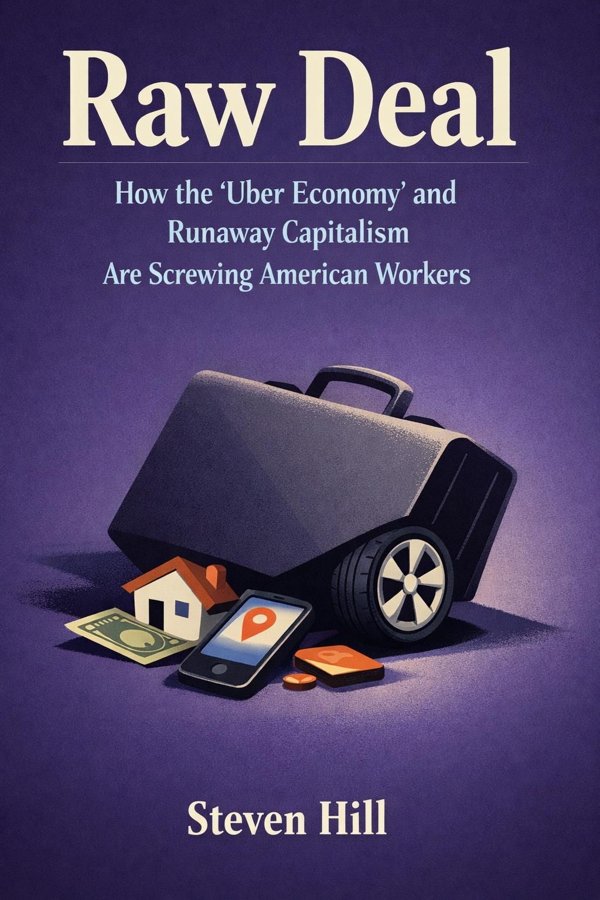
Raw Deal: How the 'Uber Economy' and Runaway Capitalism Are Screwing American Workers: Summary & Key Insights
by Steven Hill
 10 min6 chaptersAudio available
What Is Raw Deal: How the 'Uber Economy' and Runaway Capitalism Are Screwing American Workers About?
Raw Deal: How the 'Uber Economy' and Runaway Capitalism Are Screwing American Workers by Steven Hill is a economics book spanning 6 pages. Raw Deal es un análisis crítico del auge de la economía de plataformas y su impacto en los trabajadores estadounidenses. Steven Hill examina cómo empresas como Uber, Airbnb y TaskRabbit están transformando el trabajo, erosionando la seguridad laboral y debilitando las protecciones sociales. El libro propone reformas políticas y económicas para restaurar la equidad en la era digital.
This FizzRead summary covers all 6 key chapters of Raw Deal: How the 'Uber Economy' and Runaway Capitalism Are Screwing American Workers in approximately 10 minutes, distilling the most important ideas, arguments, and takeaways from Steven Hill's work. Also available as an audio summary and Key Quotes Podcast.
Raw Deal: How the 'Uber Economy' and Runaway Capitalism Are Screwing American Workers
Raw Deal es un análisis crítico del auge de la economía de plataformas y su impacto en los trabajadores estadounidenses. Steven Hill examina cómo empresas como Uber, Airbnb y TaskRabbit están transformando el trabajo, erosionando la seguridad laboral y debilitando las protecciones sociales. El libro propone reformas políticas y económicas para restaurar la equidad en la era digital.
Who Should Read Raw Deal: How the 'Uber Economy' and Runaway Capitalism Are Screwing American Workers?
This book is perfect for anyone interested in economics and looking to gain actionable insights in a short read. Whether you're a student, professional, or lifelong learner, the key ideas from Raw Deal: How the 'Uber Economy' and Runaway Capitalism Are Screwing American Workers by Steven Hill will help you think differently.
- ✓Readers who enjoy economics and want practical takeaways
- ✓Professionals looking to apply new ideas to their work and life
- ✓Anyone who wants the core insights of Raw Deal: How the 'Uber Economy' and Runaway Capitalism Are Screwing American Workers in just 10 minutes
Want the full summary?
Get instant access to this book summary and 100K+ more with Fizz Moment.
Get Free SummaryAvailable on App Store • Free to download
Key Chapters
For much of the twentieth century, American workers operated within a framework that balanced corporate profit with social responsibility. From Fordism to postwar prosperity, the prevailing model assumed that employees deserved stability: a steady paycheck, benefits, and the promise of advancement. The New Deal had woven a safety net—social security, unemployment insurance, union representation—that supported an expanding middle class. In that world, a job was more than a transaction; it was an identity and a foundation for a decent life.
Then came the wave of deregulation and globalization in the late twentieth century. Corporations began to shed responsibilities once considered essential. Outsourcing, automation, and financialization reshaped what work meant. The employment contract, which had once embedded social obligations, was gradually unbundled. The illusion of flexibility replaced the reality of security. Gig platforms entered this terrain as the logical endpoint of an ideology celebrating individualism and market freedom.
The so-called 'independent contractor revolution' didn’t start with Uber—it began when businesses discovered that labeling workers as contractors allowed them to evade labor law. Platforms like Uber and Airbnb took this loophole and scaled it globally. Workers became atomized, with no employer to bargain with and no institution to protect them. This historical descent—from collective bargaining to algorithmic management—is what sets the stage for the issues explored in later chapters.
When I began studying Uber, I saw a powerful metaphor for twenty-first century capitalism. It wasn’t just an app; it was a social experiment on a planetary scale. Uber’s founders reinvented transportation not through vehicles or drivers, but through software that allowed them to claim, astonishingly, that they owned none of the workforce actually moving the world. Airbnb followed a similar pattern—profiting from an inventory of homes it did not own, gathering massive global profits while sidestepping local housing regulations.
This model is seductive because it appears decentralized: anyone can participate. But beneath the surface lies deep concentration of wealth and control. A handful of companies hold data monopolies that decide prices, ratings, and working conditions. They use algorithms as gatekeepers, making opaque decisions that affect livelihoods while shielding themselves behind claims of neutrality. For these companies, workers are replaceable components, absorbed into the system when needed and discarded when not.
By examining Uber’s surge pricing, Airbnb’s impact on housing markets, and TaskRabbit’s race-to-the-bottom bidding model, I show how the gig economy shifts risk away from corporations and onto individuals. The platforms promise flexibility, but what they deliver is instability. Their real innovation lies in their ability to reframe exploitation as empowerment.
+ 4 more chapters — available in the FizzRead app
All Chapters in Raw Deal: How the 'Uber Economy' and Runaway Capitalism Are Screwing American Workers
About the Author
Steven Hill es un escritor y analista político estadounidense especializado en temas de democracia, economía y tecnología. Ha sido investigador en la New America Foundation y autor de varios libros sobre política comparada y economía digital.
Get This Summary in Your Preferred Format
Read or listen to the Raw Deal: How the 'Uber Economy' and Runaway Capitalism Are Screwing American Workers summary by Steven Hill anytime, anywhere. FizzRead offers multiple formats so you can learn on your terms — all free.
Available formats: App · Audio · PDF · EPUB — All included free with FizzRead
Download Raw Deal: How the 'Uber Economy' and Runaway Capitalism Are Screwing American Workers PDF and EPUB Summary
Key Quotes from Raw Deal: How the 'Uber Economy' and Runaway Capitalism Are Screwing American Workers
“For much of the twentieth century, American workers operated within a framework that balanced corporate profit with social responsibility.”
“When I began studying Uber, I saw a powerful metaphor for twenty-first century capitalism.”
Frequently Asked Questions about Raw Deal: How the 'Uber Economy' and Runaway Capitalism Are Screwing American Workers
Raw Deal: How the 'Uber Economy' and Runaway Capitalism Are Screwing American Workers by Steven Hill is a economics book that explores key ideas across 6 chapters. Raw Deal es un análisis crítico del auge de la economía de plataformas y su impacto en los trabajadores estadounidenses. Steven Hill examina cómo empresas como Uber, Airbnb y TaskRabbit están transformando el trabajo, erosionando la seguridad laboral y debilitando las protecciones sociales. El libro propone reformas políticas y económicas para restaurar la equidad en la era digital.
You Might Also Like
Business Adventures
John Brooks
10 min
Nudge
Richard H. Thaler, Cass R. Sunstein
10 min
The Hitchhiker"s Guide to the Galaxy
Douglas Adams
10 minThe Muqaddimah
Ibn Khaldun
10 minThe Outsiders
William N. Thorndike
10 min
A Little History of Economics
Niall Kishtainy
10 minBrowse by Category
Ready to read Raw Deal: How the 'Uber Economy' and Runaway Capitalism Are Screwing American Workers?
Get the full summary and 100K+ more books with Fizz Moment.