
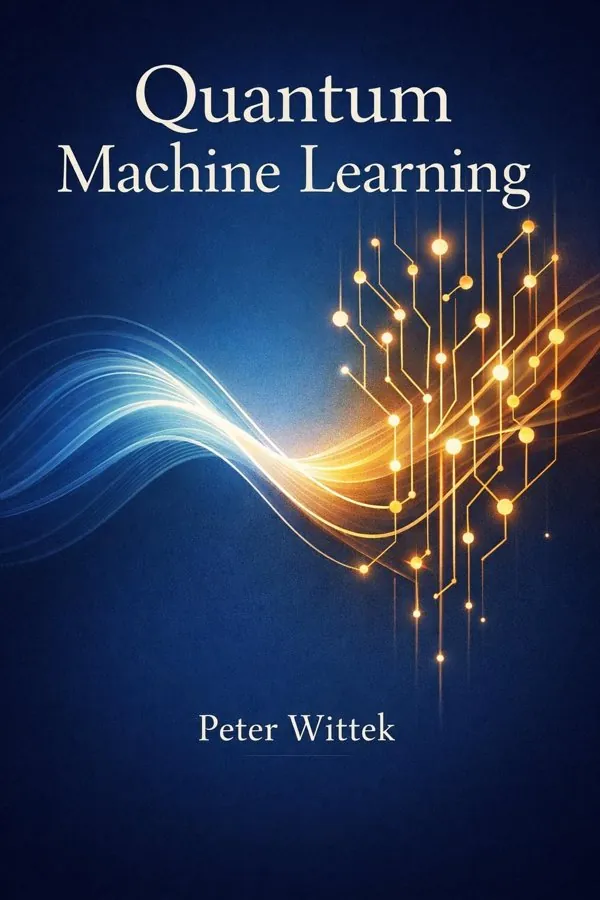
Quantum Machine Learning: What Quantum Computing Means to Data Mining: Summary & Key Insights
by Peter Wittek
 10 min5 chaptersAudio available
What Is Quantum Machine Learning: What Quantum Computing Means to Data Mining About?
Quantum Machine Learning: What Quantum Computing Means to Data Mining by Peter Wittek is a ai_ml book spanning 5 pages. Quantum Machine Learning introduces the intersection of quantum computing and machine learning, exploring how quantum algorithms can accelerate data analysis and pattern recognition. The book provides a rigorous yet accessible overview of quantum information theory, quantum algorithms, and their potential applications in artificial intelligence and data science.
This FizzRead summary covers all 5 key chapters of Quantum Machine Learning: What Quantum Computing Means to Data Mining in approximately 10 minutes, distilling the most important ideas, arguments, and takeaways from Peter Wittek's work. Also available as an audio summary and Key Quotes Podcast.
Quantum Machine Learning: What Quantum Computing Means to Data Mining
Quantum Machine Learning introduces the intersection of quantum computing and machine learning, exploring how quantum algorithms can accelerate data analysis and pattern recognition. The book provides a rigorous yet accessible overview of quantum information theory, quantum algorithms, and their potential applications in artificial intelligence and data science.
Who Should Read Quantum Machine Learning: What Quantum Computing Means to Data Mining?
This book is perfect for anyone interested in ai_ml and looking to gain actionable insights in a short read. Whether you're a student, professional, or lifelong learner, the key ideas from Quantum Machine Learning: What Quantum Computing Means to Data Mining by Peter Wittek will help you think differently.
- ✓Readers who enjoy ai_ml and want practical takeaways
- ✓Professionals looking to apply new ideas to their work and life
- ✓Anyone who wants the core insights of Quantum Machine Learning: What Quantum Computing Means to Data Mining in just 10 minutes
Want the full summary?
Get instant access to this book summary and 100K+ more with Fizz Moment.
Get Free SummaryAvailable on App Store • Free to download
Key Chapters
Before we can appreciate the quantum extensions, we must first internalize what machine learning really does in the classical context. Machine learning is built on the premise that data carries embedded structure—patterns, correlations, tendencies—and that by constructing algorithms that learn from examples rather than explicit programming, we can allow the computer to adapt and predict.
Supervised learning centers on labeled data. Here, the goal is to learn a mapping from inputs to outputs: regression models find continuous relationships, while classifiers draw decision boundaries in high-dimensional spaces. Unsupervised learning, in contrast, seeks to uncover hidden patterns without predefined labels—clustering algorithms like k-means partition data into groups, while principal component analysis extracts latent dimensions to simplify complex datasets. Reinforcement learning completes the triad, where agents interact dynamically with environments, learning strategies through reward signals.
Each of these paradigms reflects the computational tension between expressive power and efficiency. As data grows, linear algebra becomes the backbone: vector spaces, matrices, eigenvalues, and optimization form the grammar of learning. Techniques such as support vector machines and neural networks rely heavily on large-scale optimization, matrix multiplication, and inversion—operations that can scale poorly with dimensionality.
From here arises the fundamental question: what happens if we could perform these core operations exponentially faster? This question is not just about performance. It opens a philosophical doorway: can quantum phenomena enable forms of learning inaccessible to classical computation? Thus, classical machine learning becomes the lens through which we view quantum innovation. Understanding it in depth ensures that we do not lose sight of the underlying objectives when we transplant these ideas into the quantum realm.
Quantum information theory transforms the way we encode and manipulate data. Where classical bits take values of 0 or 1, a qubit exists in superposition: a combination of both states at once, represented mathematically by a point on the Bloch sphere. This seemingly abstract feature carries immense computational power, allowing quantum systems to process information in parallel through amplitudes rather than discrete probabilities.
Entanglement extends this idea by coupling qubits in ways that classical systems cannot replicate. Two entangled qubits share information instantaneously across any distance—an effect that underlies the speedup potential of quantum algorithms. Measurement, paradoxically, collapses the superposition to a definite state, but it also determines what we can extract as classical knowledge from a quantum computation. Understanding this measurement postulate is crucial for designing algorithms that navigate between continuous probability amplitudes and discrete decisions.
This framework allows us to treat data itself as a quantum state. Instead of vectors in classical space, we now deal with density matrices and state vectors that can represent statistical mixtures. Quantum gates—unitary transformations—become the computational operations replacing arithmetic and logic. In this language, computation is no longer a sequence of steps but an evolution of states under physical laws.
The implication for machine learning is profound. Superposition and entanglement introduce richer notions of correlation than classical covariance. They allow encoding high-dimensional relationships compactly, making operations on these structures potentially exponentially faster. The challenge—and excitement—lies in mapping classical data into such states effectively. Once achieved, every classical learning method gains a quantum analogue, extending its reach beyond the boundaries of classical complexity.
+ 3 more chapters — available in the FizzRead app
All Chapters in Quantum Machine Learning: What Quantum Computing Means to Data Mining
About the Author
Peter Wittek was a researcher and lecturer specializing in quantum information science and machine learning. He held positions at the University of Toronto and the Perimeter Institute for Theoretical Physics, contributing significantly to the emerging field of quantum machine learning before his passing in 2019.
Get This Summary in Your Preferred Format
Read or listen to the Quantum Machine Learning: What Quantum Computing Means to Data Mining summary by Peter Wittek anytime, anywhere. FizzRead offers multiple formats so you can learn on your terms — all free.
Available formats: App · Audio · PDF · EPUB — All included free with FizzRead
Download Quantum Machine Learning: What Quantum Computing Means to Data Mining PDF and EPUB Summary
Key Quotes from Quantum Machine Learning: What Quantum Computing Means to Data Mining
“Before we can appreciate the quantum extensions, we must first internalize what machine learning really does in the classical context.”
“Quantum information theory transforms the way we encode and manipulate data.”
Frequently Asked Questions about Quantum Machine Learning: What Quantum Computing Means to Data Mining
Quantum Machine Learning: What Quantum Computing Means to Data Mining by Peter Wittek is a ai_ml book that explores key ideas across 5 chapters. Quantum Machine Learning introduces the intersection of quantum computing and machine learning, exploring how quantum algorithms can accelerate data analysis and pattern recognition. The book provides a rigorous yet accessible overview of quantum information theory, quantum algorithms, and their potential applications in artificial intelligence and data science.
You Might Also Like
Life 3.0
Max Tegmark
10 min
Superintelligence
Nick Bostrom
10 min
TensorFlow in Action
Thushan Ganegedara
10 min
AI Made Simple: A Beginner’s Guide to Generative AI, ChatGPT, and the Future of Work
Rajeev Kapur
10 min
AI Snake Oil
Arvind Narayanan, Sayash Kapoor
10 min
AI Superpowers: China, Silicon Valley, and the New World Order
Kai-Fu Lee
10 minBrowse by Category
Ready to read Quantum Machine Learning: What Quantum Computing Means to Data Mining?
Get the full summary and 100K+ more books with Fizz Moment.