
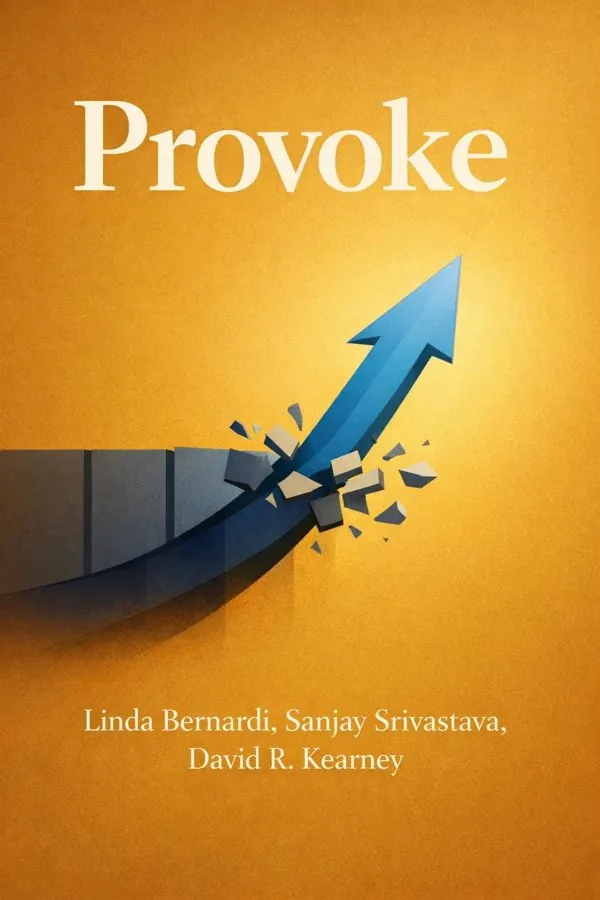
Provoke: How Leaders Shape the Future by Overcoming Fatal Human Flaws: Summary & Key Insights
by Linda Bernardi, Sanjay Srivastava, David R. Kearney
 10 min6 chaptersAudio available
What Is Provoke: How Leaders Shape the Future by Overcoming Fatal Human Flaws About?
Provoke: How Leaders Shape the Future by Overcoming Fatal Human Flaws by Linda Bernardi, Sanjay Srivastava, David R. Kearney is a leadership book spanning 6 pages. Provoke explores how leaders can drive innovation and transformation by challenging conventional thinking and embracing disruption. The authors argue that successful leadership in the modern era requires the courage to provoke change, anticipate future trends, and overcome human biases that hinder progress. Through case studies and strategic insights, the book provides a framework for proactive leadership in times of uncertainty.
This FizzRead summary covers all 6 key chapters of Provoke: How Leaders Shape the Future by Overcoming Fatal Human Flaws in approximately 10 minutes, distilling the most important ideas, arguments, and takeaways from Linda Bernardi, Sanjay Srivastava, David R. Kearney's work. Also available as an audio summary and Key Quotes Podcast.
Provoke: How Leaders Shape the Future by Overcoming Fatal Human Flaws
Provoke explores how leaders can drive innovation and transformation by challenging conventional thinking and embracing disruption. The authors argue that successful leadership in the modern era requires the courage to provoke change, anticipate future trends, and overcome human biases that hinder progress. Through case studies and strategic insights, the book provides a framework for proactive leadership in times of uncertainty.
Who Should Read Provoke: How Leaders Shape the Future by Overcoming Fatal Human Flaws?
This book is perfect for anyone interested in leadership and looking to gain actionable insights in a short read. Whether you're a student, professional, or lifelong learner, the key ideas from Provoke: How Leaders Shape the Future by Overcoming Fatal Human Flaws by Linda Bernardi, Sanjay Srivastava, David R. Kearney will help you think differently.
- ✓Readers who enjoy leadership and want practical takeaways
- ✓Professionals looking to apply new ideas to their work and life
- ✓Anyone who wants the core insights of Provoke: How Leaders Shape the Future by Overcoming Fatal Human Flaws in just 10 minutes
Want the full summary?
Get instant access to this book summary and 100K+ more with Fizz Moment.
Get Free SummaryAvailable on App Store • Free to download
Key Chapters
When we ask leaders why they didn’t see a disruption coming—why a startup blindsided them, or why a consumer behavior shift eroded their dominance—they often admit, in hindsight, that the signs were visible all along. Yet they didn’t act. That gap between recognition and action lies at the heart of our species’ biggest challenge when it comes to leadership: the fatal flaws built into human cognition.
The first of these is the illusion of control. Humans, especially those in leadership positions, overestimate their ability to predict and manage outcomes within complex systems. The more success we experience, the more we trust our current strategies, even when that very success breeds complacency. In boardrooms, this manifests as an overreliance on data that reassures rather than challenges.
Then comes confirmation bias—the tendency to seek information that validates our existing beliefs. We are creatures of pattern and comfort. Leaders fall into the trap of hearing what they want to hear, often from the same circle of advisors who share their worldview. Innovation, however, rarely comes from confirmation; it comes from contradiction.
Finally, there is the fear of failure. From the time we are educated to the time we ascend into executive ranks, we are conditioned to equate mistakes with weakness. But this is exactly what stifles experimentation and risk-taking. The fatal flaws, then, are not a lack of knowledge, but an emotional architecture that resists change.
Recognizing these flaws is the first step toward overcoming them. What we propose in *Provoke* is not merely a psychological adjustment, but a profound transformation in how leaders interpret their environment. The solution is to adopt provocation as a habitual discipline—a way to constantly test assumptions, invite dissent, and design organizations that reward truth over comfort.
Traditional leadership frameworks were built for linear times—periods when stability was prized, when growth could be mapped in predictable increments, and when competition was visible and measurable. In today’s exponential world, however, these frameworks collapse under the speed of change. Algorithms evolve faster than organizations. Consumer expectations shift within months. Entire markets materialize and vanish in the same business quarter. In such an environment, passivity is the new risk.
Provocative leadership is the antidote. A provocative leader doesn’t wait for futures to be validated; they engage in shaping those futures. They are deliberately uncomfortable, asking questions that unsettle the status quo. Instead of predicting the future from the vantage of the past, they co-create it with their teams, customers, and partners.
This kind of leadership is not simply visionary—it is systemic. It requires re-engineering how organizations think and act. Take, for instance, companies like Amazon or Tesla, whose strategies are grounded in continuous provocation of assumptions. Their leaders function less as managers of efficiency and more as architects of unpredictability, constantly birthing new possibilities.
Provocative leadership thus becomes a moral stance as well as a strategic one. To provoke is to challenge the inertia that keeps people and organizations stagnant. It is a commitment to curiosity over compliance, learning over legacy. In a world where waiting for data to confirm a hypothesis can mean missing an opportunity, provocation becomes the new discipline of leadership agility.
+ 4 more chapters — available in the FizzRead app
All Chapters in Provoke: How Leaders Shape the Future by Overcoming Fatal Human Flaws
About the Authors
Linda Bernardi is a technology entrepreneur and former IBM Chief Innovation Officer. Sanjay Srivastava is a digital transformation leader and CEO of Genpact. David R. Kearney is a business strategist and consultant specializing in organizational innovation.
Get This Summary in Your Preferred Format
Read or listen to the Provoke: How Leaders Shape the Future by Overcoming Fatal Human Flaws summary by Linda Bernardi, Sanjay Srivastava, David R. Kearney anytime, anywhere. FizzRead offers multiple formats so you can learn on your terms — all free.
Available formats: App · Audio · PDF · EPUB — All included free with FizzRead
Download Provoke: How Leaders Shape the Future by Overcoming Fatal Human Flaws PDF and EPUB Summary
Key Quotes from Provoke: How Leaders Shape the Future by Overcoming Fatal Human Flaws
“Traditional leadership frameworks were built for linear times—periods when stability was prized, when growth could be mapped in predictable increments, and when competition was visible and measurable.”
Frequently Asked Questions about Provoke: How Leaders Shape the Future by Overcoming Fatal Human Flaws
Provoke: How Leaders Shape the Future by Overcoming Fatal Human Flaws by Linda Bernardi, Sanjay Srivastava, David R. Kearney is a leadership book that explores key ideas across 6 chapters. Provoke explores how leaders can drive innovation and transformation by challenging conventional thinking and embracing disruption. The authors argue that successful leadership in the modern era requires the courage to provoke change, anticipate future trends, and overcome human biases that hinder progress. Through case studies and strategic insights, the book provides a framework for proactive leadership in times of uncertainty.
You Might Also Like

Extreme Ownership
Jocko Willink
10 min
Dare to Lead
Brene Brown
10 min
Leaders Eat Last
Simon Sinek
10 min
The 21 Irrefutable Laws of Leadership
John Maxwell
10 min
Start With Why
Simon Sinek
10 min
How to Lead When You're Not in Charge
Clay Scroggins
10 minBrowse by Category
Ready to read Provoke: How Leaders Shape the Future by Overcoming Fatal Human Flaws?
Get the full summary and 100K+ more books with Fizz Moment.