
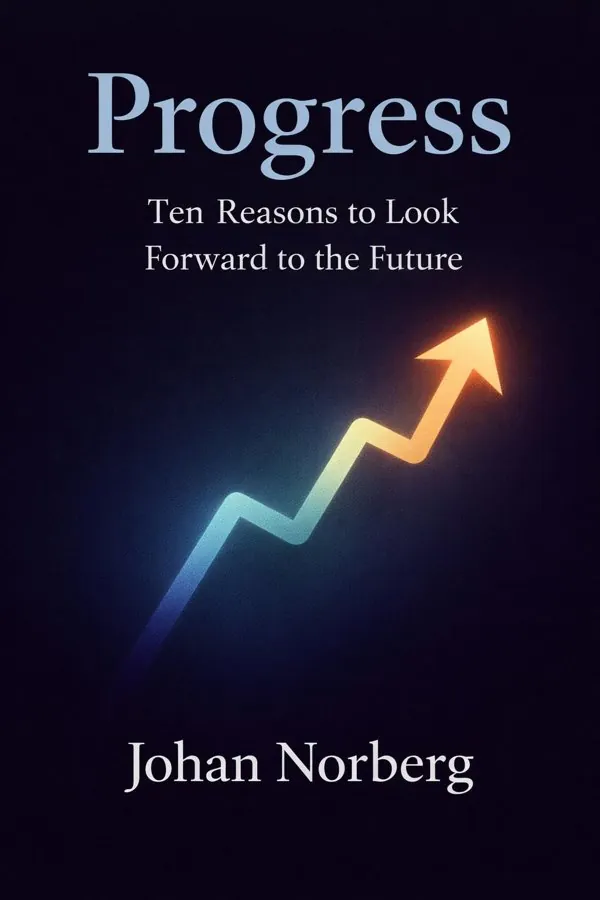
Progress: Ten Reasons to Look Forward to the Future: Summary & Key Insights
 10 min10 chaptersAudio available
What Is Progress: Ten Reasons to Look Forward to the Future About?
Progress: Ten Reasons to Look Forward to the Future by Johan Norberg is a economics book spanning 10 pages. In 'Progress: Ten Reasons to Look Forward to the Future', Swedish author and historian Johan Norberg presents a data-driven argument that the world is improving in nearly every measurable way. Drawing on global statistics, he explores advances in health, wealth, education, peace, and human rights, showing how innovation and cooperation have led to unprecedented progress despite widespread pessimism.
This FizzRead summary covers all 10 key chapters of Progress: Ten Reasons to Look Forward to the Future in approximately 10 minutes, distilling the most important ideas, arguments, and takeaways from Johan Norberg's work. Also available as an audio summary and Key Quotes Podcast.
Progress: Ten Reasons to Look Forward to the Future
In 'Progress: Ten Reasons to Look Forward to the Future', Swedish author and historian Johan Norberg presents a data-driven argument that the world is improving in nearly every measurable way. Drawing on global statistics, he explores advances in health, wealth, education, peace, and human rights, showing how innovation and cooperation have led to unprecedented progress despite widespread pessimism.
Who Should Read Progress: Ten Reasons to Look Forward to the Future?
This book is perfect for anyone interested in economics and looking to gain actionable insights in a short read. Whether you're a student, professional, or lifelong learner, the key ideas from Progress: Ten Reasons to Look Forward to the Future by Johan Norberg will help you think differently.
- ✓Readers who enjoy economics and want practical takeaways
- ✓Professionals looking to apply new ideas to their work and life
- ✓Anyone who wants the core insights of Progress: Ten Reasons to Look Forward to the Future in just 10 minutes
Want the full summary?
Get instant access to this book summary and 100K+ more with Fizz Moment.
Get Free SummaryAvailable on App Store • Free to download
Key Chapters
When I first examined global poverty data, I realized how little our intuitions align with reality. To most people, the world seems mired in inequality and deprivation. Yet the real story of poverty over the past two centuries is one of the most uplifting transformations imaginable. In 1820, more than 90 percent of humanity lived in what we now call extreme poverty—struggling each day merely to survive. Today, that figure has fallen to below 10 percent. This is not a miracle; it is the predictable outcome of expanding trade, innovation, and interconnected markets.
I trace this decline back to the Industrial Revolution, when the flow of knowledge and investment began freeing people from subsistence living. Nations that opened themselves to exchange and creative destruction—Britain in the nineteenth century, East Asia in the twentieth—rapidly transitioned from agrarian hardship to industrial prosperity. The same pattern continues today, as once-impoverished societies embrace global trade and technology. The essence of this progression is not charity but empowerment: when individuals gain access to markets, capital, and education, they can lift themselves and their communities.
Yet I also caution that this success is often misunderstood or ignored. Critics see the inequalities left behind and forget the scale of absolute improvement. Billions of people are no longer trapped in destitution. Rural villagers in Bangladesh or Kenya can now access mobile banking, invest in microenterprises, and participate in the global economy. The key driver here is human cooperation under conditions of freedom. Every act of trade is a small alliance against scarcity, and each innovation builds on countless prior ones. This is why I argue that the battle against poverty is a testament to our collective ingenuity—not just to numbers on a graph but to lives expanded with possibility.
Hunger used to be one of humanity’s defining curses. For tens of thousands of years, famine reappeared as a terrifying rhythm of existence. Today, famine is not only rarer—it is, in most regions, preventable. This transformation stems from technological ingenuity and the dissemination of knowledge, not from luck. When I explore agricultural statistics, what emerges is a quiet revolution beneath our feet. Since the 1960s, global food production has more than doubled even as population exploded—an achievement that would have been inconceivable before the Green Revolution.
The diffusion of high-yield crops, fertilizers, and modern irrigation allowed farmers across Asia and Latin America to feed entire regions that once starved. Logistics and refrigeration systems minimized spoilage, connecting distant markets and smoothing food supply. Even as climate pressures persist, hunger has receded into isolated political crises rather than systemic norm.
Yet acknowledging this progress does not blind me to the remaining challenges. Malnutrition and inequitable food distribution still exist, often as products of war or corrupt governance rather than of global capability. The important insight is that hunger is no longer inevitable—it is solvable when societies embrace openness, technology, and transparent institutions. The distance between the hungry past and the nourished present demonstrates the power of human problem-solving when science is applied with empathy.
+ 8 more chapters — available in the FizzRead app
All Chapters in Progress: Ten Reasons to Look Forward to the Future
About the Author
Johan Norberg is a Swedish author, lecturer, and historian of ideas known for his works on globalization, economics, and liberal values. He is a senior fellow at the Cato Institute and has written several books advocating for open societies and free markets.
Get This Summary in Your Preferred Format
Read or listen to the Progress: Ten Reasons to Look Forward to the Future summary by Johan Norberg anytime, anywhere. FizzRead offers multiple formats so you can learn on your terms — all free.
Available formats: App · Audio · PDF · EPUB — All included free with FizzRead
Download Progress: Ten Reasons to Look Forward to the Future PDF and EPUB Summary
Key Quotes from Progress: Ten Reasons to Look Forward to the Future
“When I first examined global poverty data, I realized how little our intuitions align with reality.”
“Hunger used to be one of humanity’s defining curses.”
Frequently Asked Questions about Progress: Ten Reasons to Look Forward to the Future
Progress: Ten Reasons to Look Forward to the Future by Johan Norberg is a economics book that explores key ideas across 10 chapters. In 'Progress: Ten Reasons to Look Forward to the Future', Swedish author and historian Johan Norberg presents a data-driven argument that the world is improving in nearly every measurable way. Drawing on global statistics, he explores advances in health, wealth, education, peace, and human rights, showing how innovation and cooperation have led to unprecedented progress despite widespread pessimism.
You Might Also Like
Business Adventures
John Brooks
10 min
Nudge
Richard H. Thaler, Cass R. Sunstein
10 min
The Hitchhiker"s Guide to the Galaxy
Douglas Adams
10 minThe Muqaddimah
Ibn Khaldun
10 minThe Outsiders
William N. Thorndike
10 min
A Little History of Economics
Niall Kishtainy
10 minBrowse by Category
Ready to read Progress: Ten Reasons to Look Forward to the Future?
Get the full summary and 100K+ more books with Fizz Moment.