
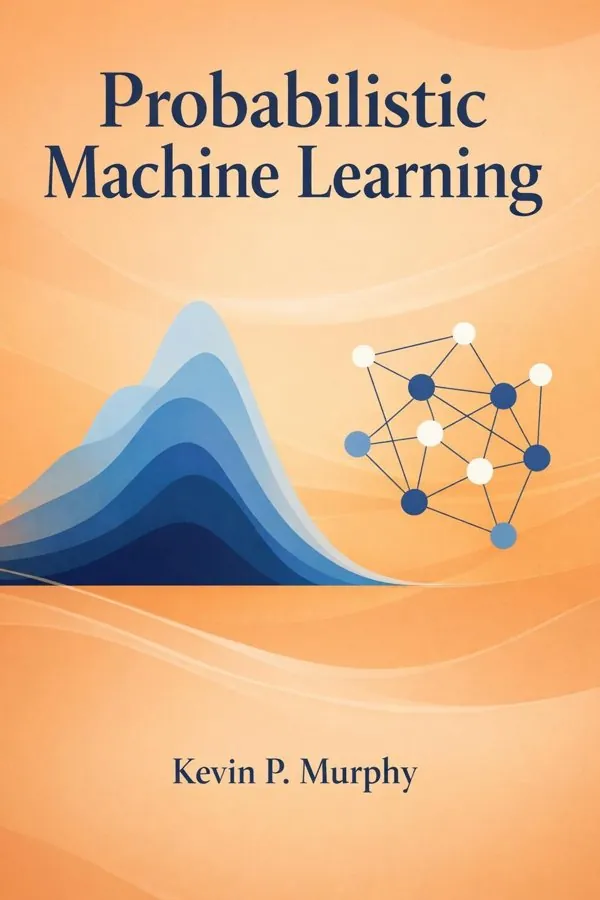
Probabilistic Machine Learning: An Introduction: Summary & Key Insights
 10 min8 chaptersAudio available
Key Takeaways from Probabilistic Machine Learning: An Introduction
Most mistakes in machine learning begin with overconfidence.
Learning is often described as pattern recognition, but Murphy frames it more precisely as belief revision.
Complex systems become understandable when we can see their dependencies.
A probabilistic model is only as useful as our ability to reason with it.
Prediction improves when models learn both the visible patterns in data and the hidden structure beneath them.
What Is Probabilistic Machine Learning: An Introduction About?
Probabilistic Machine Learning: An Introduction by Kevin P. Murphy is a ai_ml book spanning 6 pages. Machine learning becomes far more powerful when it stops pretending to be certain. In Probabilistic Machine Learning: An Introduction, Kevin P. Murphy shows that uncertainty is not a weakness in modeling but one of its greatest strengths. The book introduces the foundations of probabilistic thinking and explains how probability distributions, Bayesian inference, graphical models, latent variables, and modern neural methods can be used to learn from data in a principled way. Rather than treating predictions as fixed outputs, Murphy teaches readers to represent confidence, ambiguity, and noise directly in the model itself. What makes this book especially important is its breadth and clarity. It bridges classical statistics, modern machine learning, and deep learning within a single coherent framework, helping readers see connections that are often taught separately. Murphy is one of the most respected voices in the field, known for combining mathematical rigor with practical intuition. For students, researchers, and practitioners who want to understand not just how machine learning works but why probabilistic methods remain central to trustworthy AI, this book offers a deep and highly relevant guide.
This FizzRead summary covers all 8 key chapters of Probabilistic Machine Learning: An Introduction in approximately 10 minutes, distilling the most important ideas, arguments, and takeaways from Kevin P. Murphy's work. Also available as an audio summary and Key Quotes Podcast.
Probabilistic Machine Learning: An Introduction
Machine learning becomes far more powerful when it stops pretending to be certain. In Probabilistic Machine Learning: An Introduction, Kevin P. Murphy shows that uncertainty is not a weakness in modeling but one of its greatest strengths. The book introduces the foundations of probabilistic thinking and explains how probability distributions, Bayesian inference, graphical models, latent variables, and modern neural methods can be used to learn from data in a principled way. Rather than treating predictions as fixed outputs, Murphy teaches readers to represent confidence, ambiguity, and noise directly in the model itself.
What makes this book especially important is its breadth and clarity. It bridges classical statistics, modern machine learning, and deep learning within a single coherent framework, helping readers see connections that are often taught separately. Murphy is one of the most respected voices in the field, known for combining mathematical rigor with practical intuition. For students, researchers, and practitioners who want to understand not just how machine learning works but why probabilistic methods remain central to trustworthy AI, this book offers a deep and highly relevant guide.
Who Should Read Probabilistic Machine Learning: An Introduction?
This book is perfect for anyone interested in ai_ml and looking to gain actionable insights in a short read. Whether you're a student, professional, or lifelong learner, the key ideas from Probabilistic Machine Learning: An Introduction by Kevin P. Murphy will help you think differently.
- ✓Readers who enjoy ai_ml and want practical takeaways
- ✓Professionals looking to apply new ideas to their work and life
- ✓Anyone who wants the core insights of Probabilistic Machine Learning: An Introduction in just 10 minutes
Want the full summary?
Get instant access to this book summary and 100K+ more with Fizz Moment.
Get Free SummaryAvailable on App Store • Free to download
Key Chapters
Most mistakes in machine learning begin with overconfidence. Murphy’s starting point is that probability is not just a technical tool for gambling or statistics; it is a disciplined language for reasoning under uncertainty. In real-world learning problems, we rarely know the true state of the world. Sensors are noisy, labels are imperfect, future conditions shift, and data is incomplete. Probability provides a way to represent what we know, what we do not know, and how strongly we believe competing explanations.
The book introduces random variables, probability distributions, expectations, conditional probability, and independence as the core building blocks of this language. These ideas are not presented as isolated formulas but as the grammar behind intelligent systems. A spam filter, for example, does not need absolute certainty that an email is junk; it needs to estimate the likelihood that it belongs to the spam class given the observed words. A medical diagnostic model must weigh symptoms, test results, and prior disease prevalence to estimate risk rather than make brittle yes-or-no judgments.
Murphy also emphasizes that probabilistic thinking forces us to distinguish between data variability and model uncertainty. That distinction becomes essential when deploying models in high-stakes domains. A system that predicts loan default, machine failure, or disease progression must communicate confidence, not just output a label.
The practical lesson is simple but profound: before choosing a sophisticated algorithm, define the uncertainties in your problem. Ask what is random, what is observed, what is hidden, and what decisions depend on confidence. If you begin by framing your task probabilistically, your models will usually become more realistic, interpretable, and robust.
Learning is often described as pattern recognition, but Murphy frames it more precisely as belief revision. Bayesian inference lies at the center of this view. Bayes’ theorem tells us how to update prior beliefs after seeing new evidence, producing a posterior distribution that reflects both previous knowledge and observed data. This is the book’s conceptual heartbeat because it turns machine learning into a process of principled uncertainty management.
In practice, the prior can encode domain knowledge, assumptions, or regularization. The likelihood captures how probable the observed data would be under different parameter values or hypotheses. Their combination yields the posterior, which expresses what we now believe. This matters because many learning settings begin with limited data. If you are estimating click-through rates for a new advertisement, forecasting demand for a newly launched product, or fitting a medical model with a small patient sample, prior information can stabilize learning and prevent extreme conclusions.
Murphy also shows that Bayesian methods naturally support uncertainty quantification. Rather than giving a single best parameter estimate, they return a distribution over plausible values. That makes predictions more informative. For example, in weather forecasting or autonomous driving, knowing that the model is uncertain may be as important as the prediction itself.
The Bayesian view also helps clarify regularization in familiar models. Techniques that may appear ad hoc in standard optimization often have elegant probabilistic interpretations. This unifying perspective makes model design more coherent.
An actionable takeaway is to stop asking only, “What is the best parameter?” and start asking, “What remains plausible after seeing the data?” Whenever uncertainty matters, prefer methods that let you update beliefs rather than collapse them prematurely into point estimates.
Complex systems become understandable when we can see their dependencies. One of Murphy’s major contributions is showing how probabilistic graphical models turn tangled joint distributions into structured, interpretable representations. Bayesian networks and Markov random fields use graphs to express which variables influence each other directly and which are conditionally independent. That structure is more than visual convenience; it is computational leverage.
Without structure, modeling the full joint probability of many variables quickly becomes impossible. Graphical models factor large distributions into smaller local components, making both learning and inference more tractable. Consider a medical diagnosis system. Diseases, symptoms, test results, and risk factors interact in complicated ways, but not every variable depends on every other one. A graph can encode that fever and cough may depend on infection status, while age influences disease risk. This makes the model easier to build, explain, and update.
Murphy uses graphical models to unify many familiar tools: hidden Markov models for sequences, mixture models for clustering, latent variable models for representation learning, and topic models for text. The graph clarifies what is observed, what is hidden, and how information flows. That interpretability becomes especially valuable in scientific, industrial, and policy settings where stakeholders need to understand assumptions.
Graphical thinking also improves debugging. If a model performs poorly, a graph helps identify whether the issue lies in missing dependencies, incorrect conditional assumptions, or inadequate latent structure. Instead of treating the model as a black box, you can inspect its causal or statistical architecture.
A practical takeaway is to sketch your model before coding it. Draw nodes for observed data, hidden factors, and parameters, then connect only the relationships you truly believe exist. This simple step often reveals simplifications, independence assumptions, and opportunities for more efficient inference.
A probabilistic model is only as useful as our ability to reason with it. Murphy makes clear that once we define a rich model, exact inference is often impossible. Computing posteriors, marginals, or predictive distributions can become intractable in high-dimensional or structured settings. This is why inference algorithms are a central part of probabilistic machine learning rather than a technical afterthought.
The book introduces a range of approaches, especially sampling methods and variational inference. Sampling techniques such as Monte Carlo methods approximate difficult distributions by drawing representative samples. These are flexible and often asymptotically accurate, making them valuable when precision matters. Variational methods, by contrast, turn inference into optimization: choose a simpler family of distributions and find the member that best approximates the true posterior. This often scales better to large datasets and modern models.
Murphy’s treatment helps readers see the trade-offs. Sampling can be slower but more faithful; variational inference can be faster but may miss important aspects of uncertainty. In practice, these choices appear everywhere. Recommender systems may use approximate latent factor inference to scale to millions of users. Probabilistic topic models rely on variational methods to infer document themes efficiently. Bayesian neural networks may use stochastic variational techniques because exact posterior inference is impossible.
The broader lesson is that approximation is not failure; it is the price of modeling realism. The right question is not whether your inference is exact, but whether it is accurate enough, fast enough, and calibrated enough for the task.
Takeaway: when building a probabilistic model, plan the inference method at the same time. Match your approximation strategy to the scale, speed, and uncertainty requirements of the application rather than choosing it as an afterthought.
Prediction improves when models learn both the visible patterns in data and the hidden structure beneath them. Murphy explains that learning in probabilistic machine learning usually involves estimating parameters, latent variables, or both. Parameters govern the behavior of the model, while latent variables capture unobserved causes such as clusters, topics, states, or underlying traits. Together, they allow models to move beyond memorizing examples toward discovering generative structure.
The book distinguishes several learning paradigms: maximum likelihood estimation, maximum a posteriori estimation, and full Bayesian learning. Maximum likelihood seeks parameter values that make the observed data most probable. MAP estimation adds priors, making estimates more stable. Full Bayesian learning goes further by maintaining uncertainty over parameters instead of collapsing them to single values. These approaches differ in computational cost and philosophical commitment, but Murphy shows how they fit into one framework.
Latent variable models are especially powerful. A mixture model can discover customer segments from purchasing patterns. A hidden Markov model can infer underlying states in speech or biological sequences. Factor analysis can uncover hidden dimensions behind correlated measurements. In each case, the model explains observations through unseen structure, which can improve prediction, compression, and interpretation.
Murphy also highlights the expectation-maximization algorithm as a practical workhorse for problems with hidden variables. EM alternates between estimating latent structure and updating parameters, making difficult optimization problems manageable.
The actionable takeaway is to ask whether your data has hidden causes that should be modeled explicitly. If observations seem noisy, multimodal, or clustered, a latent variable approach may reveal the structure your predictive model is currently missing.
Modern deep learning is powerful, but power without calibrated uncertainty can be dangerous. Murphy extends probabilistic thinking into the deep learning era by showing how neural networks can be combined with probabilistic modeling to produce predictions that are not only accurate but also uncertainty-aware. This is one of the book’s most timely themes because many deployed AI systems now operate in settings where errors carry real cost.
Standard neural networks often output confident predictions even on unfamiliar or ambiguous inputs. Probabilistic deep learning addresses this by treating weights, outputs, latent representations, or noise processes probabilistically. Examples include Bayesian neural networks, variational autoencoders, deep generative models, and uncertainty-aware classifiers. These methods help answer questions like: How sure is the model? Is this input out of distribution? Should a human review this case?
Consider a self-driving car classifying objects under rain, darkness, or sensor degradation. A conventional network may still emit a high-confidence label, but a probabilistic version can indicate elevated uncertainty and trigger caution. In healthcare, an imaging model that flags uncertainty can help clinicians prioritize manual review. In forecasting demand or financial risk, predictive intervals are often more useful than single-point predictions.
Murphy’s broader point is that probabilistic methods and deep learning are not rivals. Deep models provide expressive function approximators, while probability theory gives them a framework for reasoning under uncertainty, handling missing data, and generating samples.
Takeaway: if your neural network will influence decisions rather than just rankings, add uncertainty estimation to the design criteria. Accuracy alone is not enough; trustworthy AI requires knowing when the model may be wrong.
Discriminating between classes is useful, but understanding how data is generated can be even more powerful. Murphy emphasizes generative modeling as a central idea in probabilistic machine learning. A generative model specifies a probabilistic process that could have produced the observed data, often including hidden variables, noise sources, and structural assumptions. This allows the model not only to classify or predict but also to simulate, complete missing values, detect anomalies, and reason about alternate scenarios.
The distinction between generative and discriminative approaches is practical. A discriminative model might estimate the probability of a label given an image. A generative model might describe how images of different classes are formed in the first place. This can help in low-data regimes, semi-supervised learning, and settings with incomplete observations. For example, in fraud detection, a generative model of normal behavior can identify unusual transactions even when labeled fraud examples are scarce. In language modeling, generative systems can predict the next word, create text, or assess the plausibility of a sentence.
Murphy shows that many widely used models are generative at heart: naive Bayes, Gaussian mixtures, hidden Markov models, latent Dirichlet allocation, and variational autoencoders. Their value lies not only in performance but in flexibility. Because they model the data distribution itself, they can be repurposed for tasks beyond the original training objective.
The actionable lesson is to think beyond classification accuracy. Ask whether you need your model to generate samples, fill in missing data, detect outliers, or adapt with limited labels. If so, a generative perspective may give you capabilities that purely discriminative models cannot easily match.
A prediction becomes useful only when it supports a decision. Murphy repeatedly reinforces that probabilistic machine learning is not just about fitting distributions; it is about making better choices under uncertainty. This shift from pure prediction to decision-making is crucial. In many applications, two models with similar accuracy can lead to very different outcomes if one is better calibrated or better aligned with downstream costs.
Calibration means that predicted probabilities correspond to real-world frequencies. If a model says an event has a 70 percent chance, that event should occur about 70 percent of the time over many similar cases. Poor calibration can be costly. In medicine, overconfident risk estimates can misguide treatment. In finance, underestimated uncertainty can amplify losses. In predictive maintenance, badly calibrated failure probabilities can lead either to unnecessary service or catastrophic downtime.
Murphy’s framework naturally connects probability to loss functions, utilities, and risk. Once a model produces a predictive distribution, we can choose actions by minimizing expected loss rather than blindly following the most likely class. For instance, a fraud system may choose a different threshold depending on the cost of false positives versus false negatives. A weather forecast should inform whether to carry an umbrella, evacuate a region, or hedge energy demand, not merely label tomorrow as rainy or clear.
The takeaway is practical: evaluate models not only on accuracy but on whether their probabilities are meaningful and decision-ready. If decisions matter, use calibration checks, predictive intervals, and cost-sensitive evaluation. A model that knows its uncertainty is often more valuable than one that only appears confident.
All Chapters in Probabilistic Machine Learning: An Introduction
About the Author
Kevin P. Murphy is a prominent computer scientist, machine learning researcher, and textbook author best known for his work on probabilistic modeling, Bayesian inference, and graphical models. He has contributed extensively to the theory and practice of machine learning and has held influential research roles in industry, including at Google Research. Murphy is widely respected for his ability to synthesize large areas of the field into clear, rigorous, and highly teachable frameworks. His earlier book, Machine Learning: A Probabilistic Perspective, became a standard reference for students and researchers seeking a mathematically grounded introduction to the subject. In Probabilistic Machine Learning: An Introduction, he continues that mission by presenting uncertainty as a central principle of modern AI, bridging classical methods and contemporary deep learning with exceptional clarity and authority.
Get This Summary in Your Preferred Format
Read or listen to the Probabilistic Machine Learning: An Introduction summary by Kevin P. Murphy anytime, anywhere. FizzRead offers multiple formats so you can learn on your terms — all free.
Available formats: App · Audio · PDF · EPUB — All included free with FizzRead
Download Probabilistic Machine Learning: An Introduction PDF and EPUB Summary
Key Quotes from Probabilistic Machine Learning: An Introduction
“Most mistakes in machine learning begin with overconfidence.”
“Learning is often described as pattern recognition, but Murphy frames it more precisely as belief revision.”
“Complex systems become understandable when we can see their dependencies.”
“A probabilistic model is only as useful as our ability to reason with it.”
“Prediction improves when models learn both the visible patterns in data and the hidden structure beneath them.”
Frequently Asked Questions about Probabilistic Machine Learning: An Introduction
Probabilistic Machine Learning: An Introduction by Kevin P. Murphy is a ai_ml book that explores key ideas across 8 chapters. Machine learning becomes far more powerful when it stops pretending to be certain. In Probabilistic Machine Learning: An Introduction, Kevin P. Murphy shows that uncertainty is not a weakness in modeling but one of its greatest strengths. The book introduces the foundations of probabilistic thinking and explains how probability distributions, Bayesian inference, graphical models, latent variables, and modern neural methods can be used to learn from data in a principled way. Rather than treating predictions as fixed outputs, Murphy teaches readers to represent confidence, ambiguity, and noise directly in the model itself. What makes this book especially important is its breadth and clarity. It bridges classical statistics, modern machine learning, and deep learning within a single coherent framework, helping readers see connections that are often taught separately. Murphy is one of the most respected voices in the field, known for combining mathematical rigor with practical intuition. For students, researchers, and practitioners who want to understand not just how machine learning works but why probabilistic methods remain central to trustworthy AI, this book offers a deep and highly relevant guide.
You Might Also Like

Life 3.0
Max Tegmark
10 min
Superintelligence
Nick Bostrom
10 min
TensorFlow in Action
Thushan Ganegedara
10 min
AI Made Simple: A Beginner’s Guide to Generative AI, ChatGPT, and the Future of Work
Rajeev Kapur
10 min
AI Snake Oil
Arvind Narayanan, Sayash Kapoor
10 min
AI Superpowers: China, Silicon Valley, and the New World Order
Kai-Fu Lee
10 minBrowse by Category
Ready to read Probabilistic Machine Learning: An Introduction?
Get the full summary and 100K+ more books with Fizz Moment.