
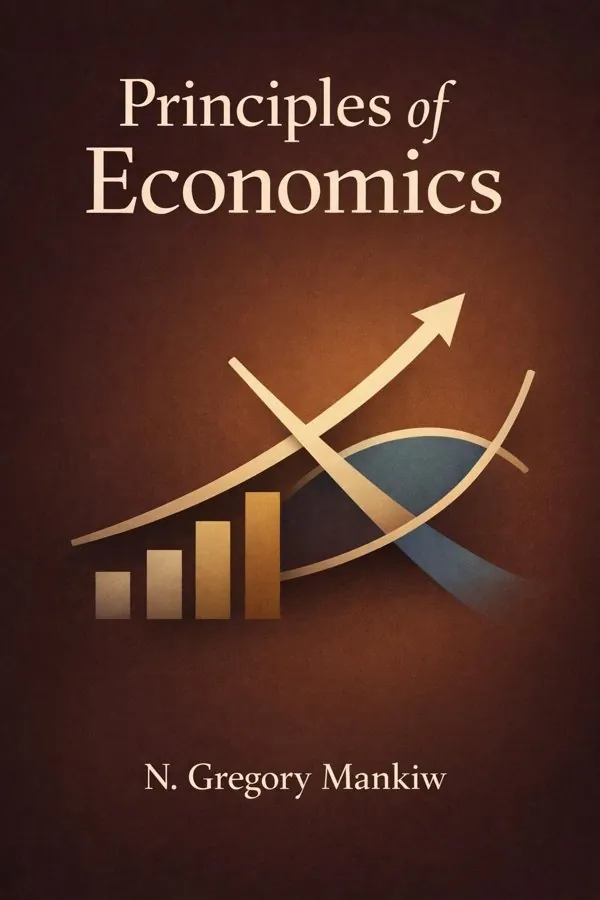
Principles of Economics: Summary & Key Insights
 10 min4 chaptersAudio available
What Is Principles of Economics About?
Principles of Economics by N. Gregory Mankiw is a economics book spanning 4 pages. Principles of Economics is a foundational textbook that introduces the core concepts of microeconomics and macroeconomics. It explains how markets function, how individuals and firms make decisions, and how government policies affect economic outcomes. The book is widely used in universities around the world for its clear explanations and real-world examples that make complex economic ideas accessible to beginners.
This FizzRead summary covers all 4 key chapters of Principles of Economics in approximately 10 minutes, distilling the most important ideas, arguments, and takeaways from N. Gregory Mankiw's work. Also available as an audio summary and Key Quotes Podcast.
Principles of Economics
Principles of Economics is a foundational textbook that introduces the core concepts of microeconomics and macroeconomics. It explains how markets function, how individuals and firms make decisions, and how government policies affect economic outcomes. The book is widely used in universities around the world for its clear explanations and real-world examples that make complex economic ideas accessible to beginners.
Who Should Read Principles of Economics?
This book is perfect for anyone interested in economics and looking to gain actionable insights in a short read. Whether you're a student, professional, or lifelong learner, the key ideas from Principles of Economics by N. Gregory Mankiw will help you think differently.
- ✓Readers who enjoy economics and want practical takeaways
- ✓Professionals looking to apply new ideas to their work and life
- ✓Anyone who wants the core insights of Principles of Economics in just 10 minutes
Want the full summary?
Get instant access to this book summary and 100K+ more with Fizz Moment.
Get Free SummaryAvailable on App Store • Free to download
Key Chapters
The first step in learning economics is to grasp ten fundamental principles that serve as the backbone of the entire discipline. These principles explain the logic behind individual decision-making, market behavior, and the broader functioning of an economy.
Every individual faces choices, and each choice comes at a cost. Scarcity forces us to decide, and every decision means giving up the next best alternative—this is the essence of opportunity cost. Rational decision-making is therefore about weighing options, not trying to have it all.
Second, people respond to incentives. When incentives change, behavior changes. This simple idea explains the reactions of markets and the effects of policy. For instance, when a government raises gas taxes, drivers don’t just drive less—they begin seeking fuel-efficient cars. Behind every policy lies a subtle restructuring of incentives.
Next comes the question of how markets coordinate individual actions. Although people act out of self-interest, their decisions often lead to efficient outcomes through the price mechanism. Adam Smith’s “invisible hand” operates through these exchanges, guiding resources toward their most valuable uses and bringing production and consumption into balance.
Yet markets are not perfect. Externalities and public goods can lead to inefficiency, making government intervention necessary. Well-designed taxes, subsidies, and regulations should aim to improve overall welfare, not merely serve short-term political goals.
Finally, the remaining principles turn to macroeconomic truths: a nation’s productivity determines its standard of living; the supply of money affects inflation; and, in the short run, policy can influence employment and output. These fundamentals reveal that economic activity is not random chaos but a system driven by logic, choice, and incentives.
The ten principles are not abstract theories—they are the keys to understanding every economic phenomenon. From personal finance to global trade, from welfare policy to technological innovation, they form a lens through which we can view the world’s economic patterns with clarity and insight.
Walk into any marketplace—whether a farmers’ market or a stock exchange—and you’ll find the same underlying mechanism at work: supply and demand. Together, they form the language of economics and explain how prices emerge and how resources are allocated.
Demand reflects consumers’ willingness to buy—lower prices increase demand, while higher prices reduce it. Supply expresses producers’ willingness to sell—higher prices encourage production, while lower prices discourage it. Where these two forces meet lies the market equilibrium, the price and quantity at which buyers and sellers are both satisfied.
If the market price climbs above equilibrium, there will be a surplus that pushes prices down; if it falls below, shortages will drive prices up. This constant adjustment demonstrates the market’s capacity for self-correction. Though this may sound theoretical, nearly all price movements—from agricultural goods to housing and labor—can be explained through supply and demand.
But the true power of markets lies in their ability to convey information. Prices tell us what goods are scarce and what behaviors are rewarded. Rising energy prices spur innovation in alternative fuels and encourage conservation. Prices act like a nervous system, transmitting signals across thousands of individual decisions that together animate the whole economy.
By mastering supply and demand, you learn to analyze the forces behind any market change. Price fluctuations are never random; they are the result of countless interacting choices. Seen through the economist’s lens, the market is not a cold mechanism but a sophisticated system coordinating human creativity and desire.
+ 2 more chapters — available in the FizzRead app
All Chapters in Principles of Economics
About the Author
N. Gregory Mankiw is an American economist and professor of economics at Harvard University. He has served as chairman of the Council of Economic Advisers and is known for his influential research in macroeconomics and public policy. Mankiw is also the author of several widely used economics textbooks.
Get This Summary in Your Preferred Format
Read or listen to the Principles of Economics summary by N. Gregory Mankiw anytime, anywhere. FizzRead offers multiple formats so you can learn on your terms — all free.
Available formats: App · Audio · PDF · EPUB — All included free with FizzRead
Download Principles of Economics PDF and EPUB Summary
Key Quotes from Principles of Economics
“The first step in learning economics is to grasp ten fundamental principles that serve as the backbone of the entire discipline.”
“Walk into any marketplace—whether a farmers’ market or a stock exchange—and you’ll find the same underlying mechanism at work: supply and demand.”
Frequently Asked Questions about Principles of Economics
Principles of Economics by N. Gregory Mankiw is a economics book that explores key ideas across 4 chapters. Principles of Economics is a foundational textbook that introduces the core concepts of microeconomics and macroeconomics. It explains how markets function, how individuals and firms make decisions, and how government policies affect economic outcomes. The book is widely used in universities around the world for its clear explanations and real-world examples that make complex economic ideas accessible to beginners.
You Might Also Like

Business Adventures
John Brooks
10 min
Nudge
Richard H. Thaler, Cass R. Sunstein
10 min
The Hitchhiker"s Guide to the Galaxy
Douglas Adams
10 minThe Muqaddimah
Ibn Khaldun
10 minThe Outsiders
William N. Thorndike
10 min
A Little History of Economics
Niall Kishtainy
10 minBrowse by Category
Ready to read Principles of Economics?
Get the full summary and 100K+ more books with Fizz Moment.