
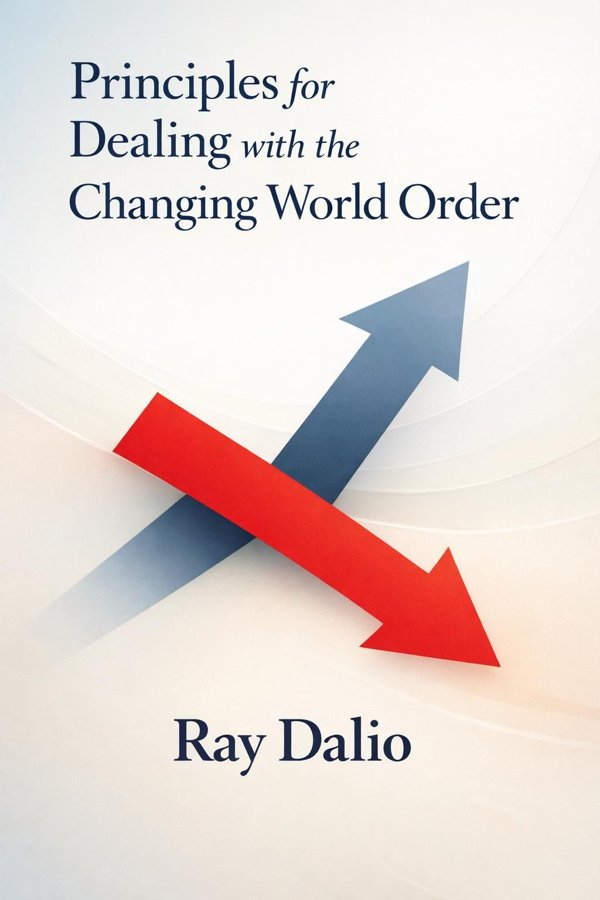
Principles for Dealing with the Changing World Order: Why Nations Succeed and Fail: Summary & Key Insights
by Ray Dalio
 10 min5 chaptersAudio available
What Is Principles for Dealing with the Changing World Order: Why Nations Succeed and Fail About?
Principles for Dealing with the Changing World Order: Why Nations Succeed and Fail by Ray Dalio is a economics book spanning 5 pages. In this book, Ray Dalio examines the patterns of history to understand how and why empires rise and fall. Drawing on extensive research into past global powers, Dalio identifies recurring cycles in economics, politics, and social structures that shape the world order. He applies these insights to analyze current global trends, particularly the shifting balance between the United States and China, offering a framework for anticipating future developments in the world economy and geopolitics.
This FizzRead summary covers all 5 key chapters of Principles for Dealing with the Changing World Order: Why Nations Succeed and Fail in approximately 10 minutes, distilling the most important ideas, arguments, and takeaways from Ray Dalio's work. Also available as an audio summary and Key Quotes Podcast.
Principles for Dealing with the Changing World Order: Why Nations Succeed and Fail
In this book, Ray Dalio examines the patterns of history to understand how and why empires rise and fall. Drawing on extensive research into past global powers, Dalio identifies recurring cycles in economics, politics, and social structures that shape the world order. He applies these insights to analyze current global trends, particularly the shifting balance between the United States and China, offering a framework for anticipating future developments in the world economy and geopolitics.
Who Should Read Principles for Dealing with the Changing World Order: Why Nations Succeed and Fail?
This book is perfect for anyone interested in economics and looking to gain actionable insights in a short read. Whether you're a student, professional, or lifelong learner, the key ideas from Principles for Dealing with the Changing World Order: Why Nations Succeed and Fail by Ray Dalio will help you think differently.
- ✓Readers who enjoy economics and want practical takeaways
- ✓Professionals looking to apply new ideas to their work and life
- ✓Anyone who wants the core insights of Principles for Dealing with the Changing World Order: Why Nations Succeed and Fail in just 10 minutes
Want the full summary?
Get instant access to this book summary and 100K+ more with Fizz Moment.
Get Free SummaryAvailable on App Store • Free to download
Key Chapters
When I studied the evolution of empires across hundreds of years, I realized that every great nation goes through a remarkably consistent pattern — what I call the Big Cycle. It begins with periods of peace and productive growth, driven by education, innovation, and increasing global competitiveness. Then comes a phase of prosperity, where the country leads in trade, technology, and military power. Over time, however, success breeds complacency. Debt levels rise, political divisions widen, productivity slows, and the empire begins to lose its global stature.
The Big Cycle is not a theory; it is an observation based on data. I analyzed centuries of economic and social indicators from major world powers — the Dutch, British, American, and Chinese among them — and found that every empire passes through similar stages. The combination of strong education systems, fiscal prudence, and social cohesion usually marks its ascent. Yet excessive debt, widening wealth gaps, and internal conflict often signal its decline.
One of the most telling patterns concerns the reserve currency. The Dutch guilder once dominated world trade, then the British pound, and finally the U.S. dollar. Each achieved global reserve status as its empire flourished, then lost dominance as debt mounted and confidence waned. The loss of reserve currency status doesn’t happen overnight; it’s a slow erosion of trust. But when it happens, it reshapes global economics dramatically — shifting wealth, investment flows, and geopolitical influence.
History provides our most reliable compass. When I examined the Dutch and British empires, I saw commonalities that reveal a deeper rhythm of human civilization. The Dutch pioneered international trade finance, building their empire on commerce and innovation. Their success eventually gave birth to the British financial and industrial era, which transformed the world through the Industrial Revolution. Later, the United States took over leadership through technological ingenuity, military strength, and democratic values.
Each transition was driven by new forms of innovation — whether ships, machinery, or digital technologies — and each was accompanied by periods of internal stress. The Dutch lost their edge as debt and military commitments grew beyond their means. The British followed a similar arc, facing social unrest and declining productivity as they overextended globally. The Americans rose from the ashes of World War II to become the world’s dominant force, with the dollar as the foundation of the international system.
These cases show that rising powers succeed through education, saving, and competitiveness, while declining powers suffer when privilege replaces meritocracy and when debt outpaces productivity. Studying these examples illuminates the present moment — and the emerging competition between the United States and China — with striking clarity.
+ 3 more chapters — available in the FizzRead app
All Chapters in Principles for Dealing with the Changing World Order: Why Nations Succeed and Fail
About the Author
Ray Dalio is an American investor, hedge fund manager, and philanthropist. He founded Bridgewater Associates, one of the world’s largest hedge funds, and is known for his principles-based approach to management and investing. Dalio has written several books on economics and life principles, including 'Principles: Life and Work' and 'Principles for Dealing with the Changing World Order'.
Get This Summary in Your Preferred Format
Read or listen to the Principles for Dealing with the Changing World Order: Why Nations Succeed and Fail summary by Ray Dalio anytime, anywhere. FizzRead offers multiple formats so you can learn on your terms — all free.
Available formats: App · Audio · PDF · EPUB — All included free with FizzRead
Download Principles for Dealing with the Changing World Order: Why Nations Succeed and Fail PDF and EPUB Summary
Key Quotes from Principles for Dealing with the Changing World Order: Why Nations Succeed and Fail
“When I studied the evolution of empires across hundreds of years, I realized that every great nation goes through a remarkably consistent pattern — what I call the Big Cycle.”
“History provides our most reliable compass.”
Frequently Asked Questions about Principles for Dealing with the Changing World Order: Why Nations Succeed and Fail
Principles for Dealing with the Changing World Order: Why Nations Succeed and Fail by Ray Dalio is a economics book that explores key ideas across 5 chapters. In this book, Ray Dalio examines the patterns of history to understand how and why empires rise and fall. Drawing on extensive research into past global powers, Dalio identifies recurring cycles in economics, politics, and social structures that shape the world order. He applies these insights to analyze current global trends, particularly the shifting balance between the United States and China, offering a framework for anticipating future developments in the world economy and geopolitics.
More by Ray Dalio


You Might Also Like

Business Adventures
John Brooks
10 min
Nudge
Richard H. Thaler, Cass R. Sunstein
10 min
The Hitchhiker"s Guide to the Galaxy
Douglas Adams
10 minThe Muqaddimah
Ibn Khaldun
10 minThe Outsiders
William N. Thorndike
10 min
A Little History of Economics
Niall Kishtainy
10 minBrowse by Category
Ready to read Principles for Dealing with the Changing World Order: Why Nations Succeed and Fail?
Get the full summary and 100K+ more books with Fizz Moment.