
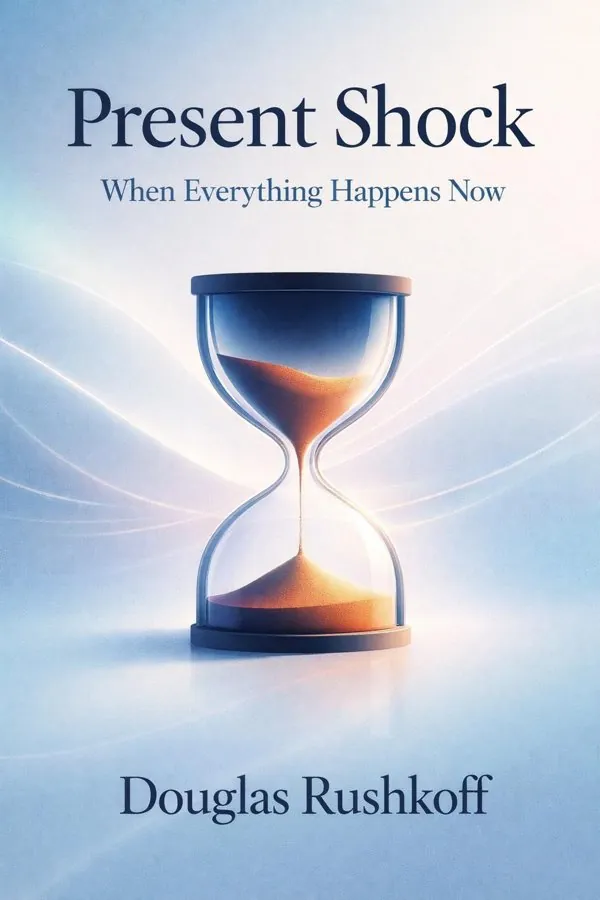
Present Shock: When Everything Happens Now: Summary & Key Insights
 10 min10 chaptersAudio available
Key Takeaways from Present Shock: When Everything Happens Now
A society without narrative loses more than stories—it loses direction.
The more places we exist at once, the less fully we arrive anywhere.
When the future arrives too early, the present becomes impossible to inhabit.
When information overwhelms us, we start seeing meaning everywhere.
A culture fixated on endings can lose the ability to build beginnings.
What Is Present Shock: When Everything Happens Now About?
Present Shock: When Everything Happens Now by Douglas Rushkoff is a digital_culture book spanning 10 pages. What happens when a culture stops moving toward the future and starts living inside an endless, urgent present? In Present Shock, media theorist Douglas Rushkoff argues that digital technology has not simply accelerated life—it has altered our experience of time itself. Constant connectivity, live feeds, endless updates, and immediate communication have weakened the stories, schedules, and expectations that once gave life structure. Instead of planning, reflecting, and progressing, we react. Instead of following narratives, we manage interruptions. Instead of imagining a shared future, we cope with whatever is flashing at us now. Rushkoff brings unusual authority to this subject. As one of the most influential thinkers on media and digital culture, he has spent decades studying how technologies reshape human attention, behavior, economics, and power. In this book, he names and explains the psychological, social, and political effects of an always-on world—from fractured attention and conspiracy thinking to financial short-termism and perpetual crisis. Present Shock matters because it helps readers understand a defining condition of modern life: why everything feels immediate, unfinished, and exhausting—and what we can do to reclaim perspective, meaning, and time.
This FizzRead summary covers all 10 key chapters of Present Shock: When Everything Happens Now in approximately 10 minutes, distilling the most important ideas, arguments, and takeaways from Douglas Rushkoff's work. Also available as an audio summary and Key Quotes Podcast.
Present Shock: When Everything Happens Now
What happens when a culture stops moving toward the future and starts living inside an endless, urgent present? In Present Shock, media theorist Douglas Rushkoff argues that digital technology has not simply accelerated life—it has altered our experience of time itself. Constant connectivity, live feeds, endless updates, and immediate communication have weakened the stories, schedules, and expectations that once gave life structure. Instead of planning, reflecting, and progressing, we react. Instead of following narratives, we manage interruptions. Instead of imagining a shared future, we cope with whatever is flashing at us now.
Rushkoff brings unusual authority to this subject. As one of the most influential thinkers on media and digital culture, he has spent decades studying how technologies reshape human attention, behavior, economics, and power. In this book, he names and explains the psychological, social, and political effects of an always-on world—from fractured attention and conspiracy thinking to financial short-termism and perpetual crisis. Present Shock matters because it helps readers understand a defining condition of modern life: why everything feels immediate, unfinished, and exhausting—and what we can do to reclaim perspective, meaning, and time.
Who Should Read Present Shock: When Everything Happens Now?
This book is perfect for anyone interested in digital_culture and looking to gain actionable insights in a short read. Whether you're a student, professional, or lifelong learner, the key ideas from Present Shock: When Everything Happens Now by Douglas Rushkoff will help you think differently.
- ✓Readers who enjoy digital_culture and want practical takeaways
- ✓Professionals looking to apply new ideas to their work and life
- ✓Anyone who wants the core insights of Present Shock: When Everything Happens Now in just 10 minutes
Want the full summary?
Get instant access to this book summary and 100K+ more with Fizz Moment.
Get Free SummaryAvailable on App Store • Free to download
Key Chapters
A society without narrative loses more than stories—it loses direction. One of Rushkoff’s central claims is that digital culture has weakened the linear narratives that once helped people make sense of experience. In earlier eras, individuals and institutions relied on arcs: childhood to adulthood, school to career, campaign to policy, problem to resolution. News unfolded in daily cycles. Television episodes had beginnings, middles, and endings. Even national identity often rested on a shared historical storyline. But digital media fragments these arcs into an ongoing stream of updates, reactions, clips, and interruptions.
The result is what Rushkoff calls narrative collapse. We no longer move through coherent sequences as easily; instead, we jump from alert to alert, post to post, crisis to crisis. Social media rewards immediacy over development. Online discourse favors moments over meaning. A political issue becomes a trending topic, then disappears before its causes or consequences are understood. Personal identity also becomes episodic: we perform ourselves in real time rather than developing ourselves through reflection.
This does not mean storytelling disappears. Rather, it is replaced by fragmented, simultaneous mini-narratives competing for attention. That change affects how we think. Without longer arcs, it becomes harder to delay gratification, imagine consequences, or commit to goals that do not produce instant feedback.
You can see this in everyday life when a person struggles to read a long book, follow a complex argument, or stay with a difficult project without checking for stimulation. The practical response is to reintroduce narrative deliberately: keep journals, pursue long-form reading, structure projects in phases, and ask not just what is happening now, but where it is leading. Actionable takeaway: build at least one daily practice that restores sequence—such as reading for 30 uninterrupted minutes or writing the story of your week instead of merely reacting to each day.
The more places we exist at once, the less fully we arrive anywhere. Rushkoff uses the term digiphrenia to describe the psychological strain of living multiple digital identities simultaneously. A person may be in a meeting physically, in a family chat emotionally, in a work platform professionally, and on social media performatively—all at the same time. The self becomes distributed across platforms, each demanding a different tone, speed, and role.
This fragmentation creates a subtle but persistent disorientation. Instead of inhabiting a single moment, we are constantly context-switching. One notification pulls us into workplace urgency; another reminds us of a social obligation; a third triggers anxiety about global events. The brain must repeatedly reset. Over time, this produces fatigue, reduced presence, and a feeling that one’s life is happening in pieces rather than as a whole.
Digiphrenia also changes identity. Online, we curate versions of ourselves for audiences. We become managers of multiple selves rather than inhabitants of one coherent personhood. A freelancer, for example, may maintain a polished LinkedIn persona, a witty X account, an intimate text life, and a stressed private self. The tension among these can be exhausting.
Rushkoff’s insight is not that digital multiplicity is always bad. It can expand connection and opportunity. But without boundaries, it erodes psychological continuity. Practical examples include turning off nonessential notifications, separating channels by purpose, and resisting the pressure to respond instantly in every sphere. Even simple rituals—closing work apps after hours or taking a walk without a phone—help reunify attention.
Actionable takeaway: identify the three digital environments that most fragment your day and create a boundary rule for each, such as no work chat during meals, no social media before focused work, or no messaging during face-to-face conversations.
When the future arrives too early, the present becomes impossible to inhabit. Rushkoff’s idea of overwinding describes a culture that is constantly preloaded with expectations, forecasts, and speculative scenarios. Digital systems encourage us to anticipate everything: market moves, brand launches, election outcomes, shipping updates, message replies, and social reactions. We are always leaning forward, bracing for what comes next.
This produces a strange temporal distortion. Instead of planning sensibly for the future, we feel pressured to live in a state of permanent preemption. Businesses chase quarterly projections before building durable value. Entertainment franchises promote sequels before audiences have absorbed the original. Individuals obsess over future opportunities while neglecting present experience. Parents schedule children years in advance. Workers check emails at night to get ahead of tomorrow. We are not calmly preparing; we are nervously over-wound.
Overwinding often shows up as anxiety disguised as productivity. The mind loops through hypothetical outcomes, trying to reduce uncertainty through constant vigilance. But because the digital environment generates endless new variables, vigilance never ends. The reward system becomes tied to preparedness rather than presence.
Rushkoff suggests that a healthier relationship to time requires distinguishing meaningful foresight from compulsive anticipation. Strategic planning is useful; endless preloading is not. In practice, this might mean reviewing finances monthly instead of hourly, checking package updates once a day instead of ten times, or developing projects in stages rather than trying to predict every reaction in advance.
A manager, for example, may improve team performance by replacing around-the-clock status pings with one structured planning meeting and one review. A student may reduce stress by creating a study schedule instead of mentally rehearsing every possible exam scenario.
Actionable takeaway: choose one area where you are over-monitoring the future and reduce the checking cycle dramatically. Replace reactive anticipation with a scheduled planning window.
When information overwhelms us, we start seeing meaning everywhere. Rushkoff calls this tendency fractalnoia: the compulsion to detect hidden patterns, connections, and designs in the chaos of networked life. In a data-saturated environment, events no longer seem isolated. Everything appears linked—to algorithms, secret motives, market forces, media manipulations, or cosmic significance. Sometimes these connections are real; often they are exaggerated or imagined.
Fractalnoia arises because the digital world presents us with endless fragments without sufficient context. We receive headlines without histories, graphs without methodologies, clips without full conversations. The mind naturally tries to complete the pattern. Social media intensifies this by rewarding dramatic interpretations. A coincidence becomes a theory. A cluster of events becomes proof of a hidden system. Recommendation algorithms then reinforce whichever pattern a user begins to believe.
This concept helps explain not only conspiracy thinking but also subtler forms of cognitive distortion. Investors infer huge narratives from small market changes. Employees assume every management decision signals an unseen plan. Consumers read personal meaning into algorithmic feeds. In all these cases, uncertainty becomes psychologically uncomfortable, so pattern-making rushes in.
Rushkoff is not arguing that systems are simple or that institutions are transparent. Rather, he warns against the mental trap of converting complexity into overly coherent stories. The antidote is disciplined skepticism: asking what evidence is missing, what alternative explanations exist, and whether a pattern has predictive value or merely emotional appeal.
Practically, this means slowing down before sharing alarming content, reading primary sources when possible, and resisting the urge to turn every signal into a grand theory. In organizations, leaders can reduce fractalnoia by communicating clearly instead of leaving people to infer motives from scattered clues.
Actionable takeaway: the next time a story or event feels like proof that “everything is connected,” pause and list two mundane explanations before accepting the most dramatic one.
A culture fixated on endings can lose the ability to build beginnings. Rushkoff uses apocalypto to describe the recurring sense that we are living at the edge of collapse—economic, ecological, political, technological, or spiritual. In digital culture, this feeling becomes constant because crises are streamed to us in real time, amplified, personalized, and refreshed without pause. The end is always near, and always being updated.
Unlike traditional apocalyptic thinking, which imagines a final rupture followed by revelation or renewal, present shock traps us in an ongoing pre-apocalypse. We brace for breakdown but continue scrolling. We consume disaster forecasts as content. Catastrophe becomes both frightening and strangely addictive because it provides intensity, clarity, and a temporary storyline. If everything is ending, at least events make sense.
This mindset shapes behavior in harmful ways. People may withdraw from civic action because they assume systems are already doomed. Companies may exploit fear to sell security, certainty, or urgency. Media outlets may overemphasize dramatic scenarios because dread captures attention. Individuals may alternate between panic and numbness, unable to sustain practical engagement.
Rushkoff’s insight is that permanent crisis consciousness narrows time. If the future looks only like disaster, long-term stewardship becomes harder. Yet many genuine threats do require attention. The challenge is to respond without surrendering to fatalism.
Practical applications include limiting doomscrolling, distinguishing acute emergencies from chronic structural problems, and focusing on concrete domains of agency. Someone concerned about climate, for example, may be better served by joining a local initiative, changing consumption patterns, and supporting policy efforts than by endlessly consuming catastrophic media.
Actionable takeaway: convert one fear-based concern into one recurring constructive action, such as donating monthly, volunteering locally, or setting a weekly time to engage deeply rather than anxiously with an issue.
When everything happens live, reflection starts to feel like falling behind. Rushkoff argues that digital media has created a real-time culture in which events are not merely reported after they occur but experienced, interpreted, and contested in the instant of their unfolding. News breaks on social media before facts are verified. Brands respond to trends within minutes. Individuals are expected to comment immediately on events they barely understand.
Real-time culture changes the value system of communication. Speed becomes more important than accuracy, reaction more important than interpretation, visibility more important than wisdom. This affects journalism, politics, business, and ordinary relationships. A person who waits to think may lose the chance to be seen. An institution that pauses to verify may appear slow or disconnected.
The danger is not simply misinformation; it is the erosion of intervals. Human understanding often depends on delay—time to compare sources, absorb emotion, examine consequences, and form judgment. Without such intervals, we become highly responsive but less discerning. Organizations may make reputational decisions based on online pressure rather than principle. Individuals may post emotionally charged responses they later regret.
Examples are everywhere: live-tweeted controversies, instant outrage cycles, pressure on public figures to issue immediate statements, and workplaces where every message implies urgency. Real-time dashboards can improve coordination in some contexts, such as logistics or emergency response, but using the same tempo for all domains creates chronic stress.
To counter this, Rushkoff implicitly advocates restoring delayed modes where they matter. Teams can establish response expectations by channel. Families can create phone-free spaces. Media consumers can wait for second-day reporting before drawing conclusions.
Actionable takeaway: create a personal “reflection lag” for nonemergency matters—such as waiting one hour before responding to provocative messages and one day before forming strong opinions on breaking news.
An economy obsessed with the present cannot invest well in the future. Rushkoff shows how present shock is not only psychological or cultural; it is built into financial and commercial systems. Digital technologies enable markets, analytics, pricing, advertising, and investor behavior to operate in increasingly real time. That sounds efficient, but it also creates incentives for short-term extraction over long-term value.
Public companies chase quarterly earnings. Traders respond in milliseconds. Platforms optimize for immediate engagement rather than lasting trust. Consumers are nudged toward instant purchase, instant delivery, instant gratification. In such an environment, patience looks uncompetitive. The future is discounted not only financially but morally.
This temporal compression affects work too. Employees are managed through live metrics and continuous performance signals. Creative processes are accelerated to feed content pipelines. Businesses launch minimum viable products quickly, then rely on constant iteration. Some of this agility is useful. The problem arises when every decision is governed by immediacy. Infrastructure, relationships, craftsmanship, and resilience all require time horizons longer than the current dashboard.
Rushkoff’s critique helps explain why many organizations feel busy but brittle. They respond rapidly yet struggle to endure. A newsroom chasing clicks may undermine credibility. A company cutting training to improve short-term margins may weaken long-term capability. A consumer living on buy-now-pay-later habits may gain convenience but lose stability.
The practical lesson is to build longer feedback loops where possible. Leaders can balance real-time metrics with multi-year goals. Investors can ask whether a company creates durable value. Individuals can evaluate purchases and career decisions by long-term return rather than immediate stimulation.
Actionable takeaway: review one recurring financial or work decision through a longer lens. Ask, “Will this still seem wise in a year?” and use the answer to override at least one short-term impulse.
Democracy struggles when public life becomes one endless emergency. Rushkoff argues that politics in the age of present shock is increasingly reactive, theatrical, and incapable of sustained governance. Digital media rewards candidates and commentators who can dominate the current cycle, not necessarily those who can build long-term policy. Politicians become performers in a permanent now, forced to respond instantly to scandals, trends, polls, and outrage waves.
This environment favors slogans over strategy. Complex issues like healthcare, housing, education, or climate require long time horizons and patient coalition-building. But real-time politics punishes delay and nuance. Leaders are pushed to signal responsiveness rather than solve problems. Citizens, meanwhile, are bombarded by alerts that frame every development as unprecedented. Attention becomes fragmented across countless mini-crises, weakening democratic memory and accountability.
There is also a governance problem. Institutions designed for deliberation—courts, legislatures, regulatory bodies—move more slowly than digital discourse. That gap creates frustration and distrust. People may interpret procedural delay as corruption or indifference, even when careful process is necessary. At the same time, bad actors can exploit acceleration by spreading manipulated content faster than institutions can respond.
Rushkoff’s analysis suggests that preserving democracy requires protecting slower civic rhythms. Public deliberation, investigative reporting, local organizing, and institutional checks all depend on time. Citizens need not only information but continuity and context.
Practical applications include consuming less horse-race coverage and more explanatory reporting, engaging in local politics where outcomes unfold over time, and supporting institutions that value record-keeping and process. A voter who follows legislation rather than just campaign messaging becomes less vulnerable to present-shock manipulation.
Actionable takeaway: choose one public issue you care about and track it beyond the headline cycle for three months, focusing on policy movement rather than online reaction.
What we attend to becomes the shape of our lives. Beneath Rushkoff’s cultural diagnosis lies a deeply human concern: present shock erodes not only focus but meaning. If attention is continually hijacked by alerts, feeds, and demands for instant response, then our inner life becomes organized by external triggers. We stop choosing significance and start inheriting it from whatever is most urgent, novel, or emotionally charged.
Meaning usually emerges over time. It grows through memory, commitment, repetition, and interpretation. Friendships deepen through shared history. Skills develop through practice. Purpose forms when actions connect to values across months and years. But the always-on environment privileges interruption over continuity. It offers stimulation without development, contact without intimacy, expression without reflection.
This is why many people feel both hyperconnected and strangely empty. They are busy all day but uncertain what mattered. Their attention has been consumed, yet little has been integrated. Rushkoff pushes readers to recognize that this condition is not merely a personal weakness. It is a structural outcome of media systems engineered to capture and monetize attention.
Reclaiming agency begins with choosing temporal depth. That might involve long conversations, analog hobbies, spiritual practices, creative work, or device-free time in nature. It also means asking a harder question than “What requires my response?”—namely, “What deserves my life?” A student may discover more meaning by studying one subject deeply than by skimming endless educational content. A parent may strengthen family culture through regular rituals rather than constant coordination by text.
Actionable takeaway: identify one activity each week that creates depth rather than stimulation—reading, cooking, walking, praying, building, practicing—and protect it as noninterruptible time.
The cure for present shock is not abandoning technology but redesigning our relationship with it. Rushkoff does not offer a nostalgic fantasy of returning to a pre-digital world. Instead, he suggests that people and institutions can choose temporal structures that preserve humanity inside networked life. The key is intentionality: if we do not design our time, platforms and systems will do it for us.
Reclaiming time starts with recognizing that not every process should be real time. Some activities benefit from immediacy—navigation, emergency coordination, live collaboration. Others require slowness—learning, grieving, strategizing, creating, governing, and loving. Wisdom lies in matching the tempo to the task. This means setting expectations, boundaries, and rituals that reintroduce rhythm.
At the personal level, that may include scheduled communication windows, single-task work sessions, Sabbath-like tech breaks, and physical environments free of screens. At the family level, it can mean shared meals without devices, weekly planning instead of constant rescheduling, and traditions that anchor memory. In organizations, leaders can reduce false urgency by clarifying response times, protecting deep work, and evaluating people on outcomes rather than perpetual availability.
Rushkoff’s broader invitation is cultural. We must become active participants in shaping the temporal norms of digital society. Schools can teach attention literacy. Companies can reward durability over instant metrics. Communities can create spaces for gathering that are not mediated by feeds.
Present shock is powerful because it feels inevitable. Rushkoff argues it is not. Time can be structured differently. Human beings can reclaim sequence, patience, and presence.
Actionable takeaway: redesign one recurring part of your week—work, family, media consumption, or rest—around deliberate rhythms instead of constant responsiveness, and keep that structure for a month.
All Chapters in Present Shock: When Everything Happens Now
About the Author
Douglas Rushkoff is an American media theorist, author, and professor whose work focuses on the social effects of technology, media, and digital culture. He first gained prominence in the 1990s for his writing on cyberculture and has since become one of the most recognizable critics of how technological systems shape human behavior, economics, politics, and identity. Rushkoff has written numerous influential books, including works on media literacy, the digital economy, and contemporary capitalism. Known for coining memorable concepts and translating complex cultural shifts into accessible language, he has taught at several universities and spoken widely on technology’s impact on society. His writing consistently challenges readers to question the assumptions built into digital life and to imagine more human-centered alternatives.
Get This Summary in Your Preferred Format
Read or listen to the Present Shock: When Everything Happens Now summary by Douglas Rushkoff anytime, anywhere. FizzRead offers multiple formats so you can learn on your terms — all free.
Available formats: App · Audio · PDF · EPUB — All included free with FizzRead
Download Present Shock: When Everything Happens Now PDF and EPUB Summary
Key Quotes from Present Shock: When Everything Happens Now
“A society without narrative loses more than stories—it loses direction.”
“The more places we exist at once, the less fully we arrive anywhere.”
“When the future arrives too early, the present becomes impossible to inhabit.”
“When information overwhelms us, we start seeing meaning everywhere.”
“A culture fixated on endings can lose the ability to build beginnings.”
Frequently Asked Questions about Present Shock: When Everything Happens Now
Present Shock: When Everything Happens Now by Douglas Rushkoff is a digital_culture book that explores key ideas across 10 chapters. What happens when a culture stops moving toward the future and starts living inside an endless, urgent present? In Present Shock, media theorist Douglas Rushkoff argues that digital technology has not simply accelerated life—it has altered our experience of time itself. Constant connectivity, live feeds, endless updates, and immediate communication have weakened the stories, schedules, and expectations that once gave life structure. Instead of planning, reflecting, and progressing, we react. Instead of following narratives, we manage interruptions. Instead of imagining a shared future, we cope with whatever is flashing at us now. Rushkoff brings unusual authority to this subject. As one of the most influential thinkers on media and digital culture, he has spent decades studying how technologies reshape human attention, behavior, economics, and power. In this book, he names and explains the psychological, social, and political effects of an always-on world—from fractured attention and conspiracy thinking to financial short-termism and perpetual crisis. Present Shock matters because it helps readers understand a defining condition of modern life: why everything feels immediate, unfinished, and exhausting—and what we can do to reclaim perspective, meaning, and time.
More by Douglas Rushkoff

You Might Also Like
An Ugly Truth: Inside Facebook’s Battle for Domination
Sheera Frenkel, Cecilia Kang
10 min
Cyber Citizens
Ian Goodfellow
10 min
Digital Minimalism: Choosing a Focused Life in a Noisy World
Cal Newport
10 min
E‑Books & Beyond
Various Authors
10 min
The Future of Media
Various Authors
10 min
This Is Why We Can't Have Nice Things
Whitney Phillips
10 minBrowse by Category
Ready to read Present Shock: When Everything Happens Now?
Get the full summary and 100K+ more books with Fizz Moment.