
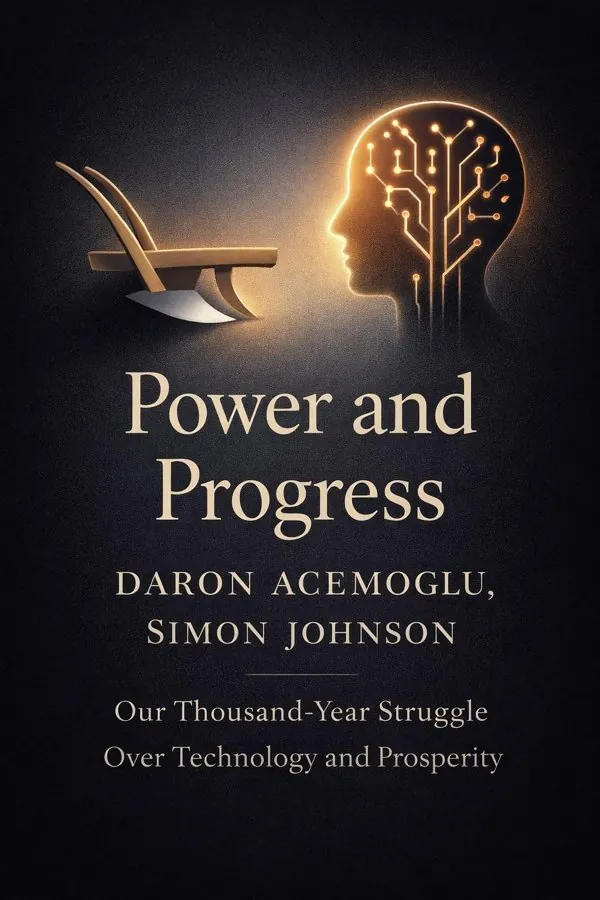
Power and Progress: Our Thousand-Year Struggle Over Technology and Prosperity: Summary & Key Insights
by Daron Acemoglu, Simon Johnson
 10 min12 chaptersAudio available
What Is Power and Progress: Our Thousand-Year Struggle Over Technology and Prosperity About?
Power and Progress: Our Thousand-Year Struggle Over Technology and Prosperity by Daron Acemoglu, Simon Johnson is a economics book spanning 12 pages. In this sweeping historical and economic analysis, Daron Acemoglu and Simon Johnson explore how technological progress has shaped societies over the past millennium. They argue that while innovation has the potential to improve human welfare, it often benefits elites unless guided by inclusive institutions and policies. The authors trace examples from the medieval plow to artificial intelligence, showing how societies can steer technology toward shared prosperity rather than inequality.
This FizzRead summary covers all 12 key chapters of Power and Progress: Our Thousand-Year Struggle Over Technology and Prosperity in approximately 10 minutes, distilling the most important ideas, arguments, and takeaways from Daron Acemoglu, Simon Johnson's work. Also available as an audio summary and Key Quotes Podcast.
Power and Progress: Our Thousand-Year Struggle Over Technology and Prosperity
In this sweeping historical and economic analysis, Daron Acemoglu and Simon Johnson explore how technological progress has shaped societies over the past millennium. They argue that while innovation has the potential to improve human welfare, it often benefits elites unless guided by inclusive institutions and policies. The authors trace examples from the medieval plow to artificial intelligence, showing how societies can steer technology toward shared prosperity rather than inequality.
Who Should Read Power and Progress: Our Thousand-Year Struggle Over Technology and Prosperity?
This book is perfect for anyone interested in economics and looking to gain actionable insights in a short read. Whether you're a student, professional, or lifelong learner, the key ideas from Power and Progress: Our Thousand-Year Struggle Over Technology and Prosperity by Daron Acemoglu, Simon Johnson will help you think differently.
- ✓Readers who enjoy economics and want practical takeaways
- ✓Professionals looking to apply new ideas to their work and life
- ✓Anyone who wants the core insights of Power and Progress: Our Thousand-Year Struggle Over Technology and Prosperity in just 10 minutes
Want the full summary?
Get instant access to this book summary and 100K+ more with Fizz Moment.
Get Free SummaryAvailable on App Store • Free to download
Key Chapters
Our journey begins in medieval Europe, where technology first altered the organization of society. Watermills and windmills in the Middle Ages boosted productivity, transforming agriculture and craftwork. Yet these innovations did not necessarily uplift peasants or artisans. Instead, they often reinforced feudal hierarchies. Lords who controlled the lands and mills profited most, while workers remained bound by obligation. Even early banking and trade systems tended to widen inequality. The medieval record shows how technological solutions, when monopolized by elites, increase their power over production and information. This pattern repeats across history. Technological change opens possibilities, but whether these possibilities serve many or few depends on institutional design. This early period teaches a sobering lesson: when technology emerges within concentrated power systems, it is used to entrench that concentration.
The Industrial Revolution is often hailed as the dawn of modern prosperity, but our analysis reveals a more complex story. The arrival of mechanized factories in Britain created unparalleled wealth for a small elite. Steam engines, spinning jennies, and power looms transformed labor but also marginalized it. As productivity soared, wages stagnated. Factory owners, backed by property laws and political influence, captured the gains, while workers endured long hours under harsh conditions. The machine was hailed as liberating, yet it often enslaved. However, the Industrial Revolution also sparked resistance—workers organized and demanded rights, reforms began to restrict exploitation, and governments slowly recognized the need for public investment in health and education. The industrial age thus illustrates our broader thesis: technological progress without inclusive institutions magnifies inequality, but when collective voices demand fairness, technology can be redirected toward shared advancement.
+ 10 more chapters — available in the FizzRead app
All Chapters in Power and Progress: Our Thousand-Year Struggle Over Technology and Prosperity
About the Authors
Daron Acemoglu is an Institute Professor of Economics at the Massachusetts Institute of Technology, known for his research on political economy and economic growth. Simon Johnson is the Ronald A. Kurtz Professor of Entrepreneurship at MIT Sloan School of Management and a former chief economist at the International Monetary Fund. Together, they have coauthored influential works on institutions and economic development.
Get This Summary in Your Preferred Format
Read or listen to the Power and Progress: Our Thousand-Year Struggle Over Technology and Prosperity summary by Daron Acemoglu, Simon Johnson anytime, anywhere. FizzRead offers multiple formats so you can learn on your terms — all free.
Available formats: App · Audio · PDF · EPUB — All included free with FizzRead
Download Power and Progress: Our Thousand-Year Struggle Over Technology and Prosperity PDF and EPUB Summary
Key Quotes from Power and Progress: Our Thousand-Year Struggle Over Technology and Prosperity
“Our journey begins in medieval Europe, where technology first altered the organization of society.”
“The Industrial Revolution is often hailed as the dawn of modern prosperity, but our analysis reveals a more complex story.”
Frequently Asked Questions about Power and Progress: Our Thousand-Year Struggle Over Technology and Prosperity
Power and Progress: Our Thousand-Year Struggle Over Technology and Prosperity by Daron Acemoglu, Simon Johnson is a economics book that explores key ideas across 12 chapters. In this sweeping historical and economic analysis, Daron Acemoglu and Simon Johnson explore how technological progress has shaped societies over the past millennium. They argue that while innovation has the potential to improve human welfare, it often benefits elites unless guided by inclusive institutions and policies. The authors trace examples from the medieval plow to artificial intelligence, showing how societies can steer technology toward shared prosperity rather than inequality.
You Might Also Like
Business Adventures
John Brooks
10 min
Nudge
Richard H. Thaler, Cass R. Sunstein
10 min
The Hitchhiker"s Guide to the Galaxy
Douglas Adams
10 minThe Muqaddimah
Ibn Khaldun
10 minThe Outsiders
William N. Thorndike
10 min
A Little History of Economics
Niall Kishtainy
10 minBrowse by Category
Ready to read Power and Progress: Our Thousand-Year Struggle Over Technology and Prosperity?
Get the full summary and 100K+ more books with Fizz Moment.