
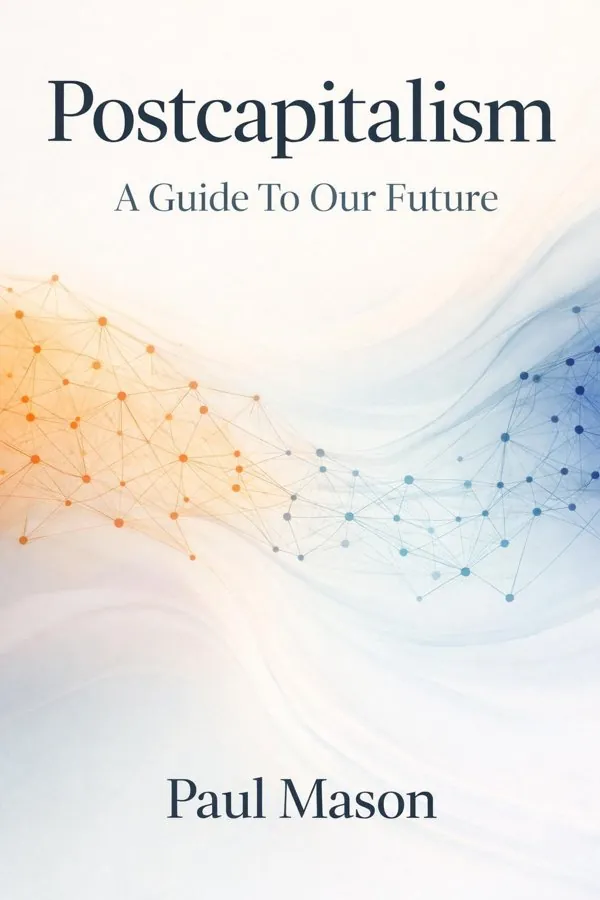
Postcapitalism: A Guide To Our Future: Summary & Key Insights
by Paul Mason
 10 min11 chaptersAudio available
What Is Postcapitalism: A Guide To Our Future About?
Postcapitalism: A Guide To Our Future by Paul Mason is a economics book spanning 11 pages. PostCapitalism: A Guide to Our Future is a nonfiction work by British journalist and economist Paul Mason. The book explores how technological change, automation, and information networks are transforming the global economy and potentially leading to a post-capitalist society. Mason argues that capitalism is reaching its limits due to declining profitability, environmental constraints, and the rise of collaborative, non-market forms of production enabled by digital technology.
This FizzRead summary covers all 11 key chapters of Postcapitalism: A Guide To Our Future in approximately 10 minutes, distilling the most important ideas, arguments, and takeaways from Paul Mason's work. Also available as an audio summary and Key Quotes Podcast.
Postcapitalism: A Guide To Our Future
PostCapitalism: A Guide to Our Future is a nonfiction work by British journalist and economist Paul Mason. The book explores how technological change, automation, and information networks are transforming the global economy and potentially leading to a post-capitalist society. Mason argues that capitalism is reaching its limits due to declining profitability, environmental constraints, and the rise of collaborative, non-market forms of production enabled by digital technology.
Who Should Read Postcapitalism: A Guide To Our Future?
This book is perfect for anyone interested in economics and looking to gain actionable insights in a short read. Whether you're a student, professional, or lifelong learner, the key ideas from Postcapitalism: A Guide To Our Future by Paul Mason will help you think differently.
- ✓Readers who enjoy economics and want practical takeaways
- ✓Professionals looking to apply new ideas to their work and life
- ✓Anyone who wants the core insights of Postcapitalism: A Guide To Our Future in just 10 minutes
Want the full summary?
Get instant access to this book summary and 100K+ more with Fizz Moment.
Get Free SummaryAvailable on App Store • Free to download
Key Chapters
Capitalism did not descend upon humanity fully formed; it evolved through centuries of experimentation, crisis, and reinvention. I begin the story with mercantilism, that strange hybrid of empire and trade through which European powers amassed wealth and colonized vast territories. This was capitalism in embryo, driven by monopolies, state privilege, and the extraction of resources. Industrialization brought its coming of age, as steam power and mechanization liberated production from the rhythms of nature and birthed the modern factory. The social consequences were immense: urbanization, wage labor, and the emergence of industrial classes.
Throughout this evolution, capitalism demonstrated resilience, adapting to revolutions and wars by transforming its mode of accumulation. The nineteenth century’s laissez-faire gave way to the twentieth’s regulated capitalism—Keynesian policies, welfare states, and organized labor. Yet each phase relied on finding new frontiers: raw materials, markets, and technologies capable of unlocking growth.
By the 1970s, as profit rates declined and the Fordist model stalled, neoliberal globalization emerged as the next mutation. Free markets, deregulation, and financialization promised renewed dynamism. Global supply chains linked the planet’s economies; debt replaced wages as sustenance for consumption. However, the neoliberal wave also deepened instability, amplifying inequality and ecological strain. This transformation sets the stage for postcapitalism: the moment when capitalism’s adaptive mechanisms reach their limits because technological progress now erodes the very logic of markets themselves.
Drawing on Nikolai Kondratiev’s theory of long waves, I argue that capitalism moves through fifty- to sixty-year cycles, each driven by clusters of revolutionary technologies and modes of organization. Steam powered the first wave; electricity and the internal combustion engine the second; information and communication technologies the current one. Each wave follows a pattern: rapid expansion, saturation, and decline, followed by social upheaval and renewal.
These cycles are not mere mechanical sequences—they reflect deep interactions between technology, culture, and institutions. The current informational wave, however, differs in one decisive respect: it tends toward zero-cost reproduction. When information is free to copy, store, and circulate infinitely, the system based on scarcity begins to malfunction. Profit becomes harder to secure; intellectual property must be protected by increasingly rigid laws; and monopolies replace open markets as capital seeks stability.
Understanding these waves allows us to see capitalism’s mortality as structural, not episodic. Each transition reshapes consciousness: from the disciplined factory worker to the flexible, networked individual. The long waves theory thus offers both a map and a warning—when the technological basis of society no longer sustains capitalist value creation, a new mode of production inevitably emerges.
+ 9 more chapters — available in the FizzRead app
All Chapters in Postcapitalism: A Guide To Our Future
About the Author
Paul Mason is a British journalist, broadcaster, and author known for his work on economics, social change, and technology. He has served as economics editor for BBC Newsnight and Channel 4 News and has written several books analyzing the global economy and the future of capitalism.
Get This Summary in Your Preferred Format
Read or listen to the Postcapitalism: A Guide To Our Future summary by Paul Mason anytime, anywhere. FizzRead offers multiple formats so you can learn on your terms — all free.
Available formats: App · Audio · PDF · EPUB — All included free with FizzRead
Download Postcapitalism: A Guide To Our Future PDF and EPUB Summary
Key Quotes from Postcapitalism: A Guide To Our Future
“Capitalism did not descend upon humanity fully formed; it evolved through centuries of experimentation, crisis, and reinvention.”
“Steam powered the first wave; electricity and the internal combustion engine the second; information and communication technologies the current one.”
Frequently Asked Questions about Postcapitalism: A Guide To Our Future
Postcapitalism: A Guide To Our Future by Paul Mason is a economics book that explores key ideas across 11 chapters. PostCapitalism: A Guide to Our Future is a nonfiction work by British journalist and economist Paul Mason. The book explores how technological change, automation, and information networks are transforming the global economy and potentially leading to a post-capitalist society. Mason argues that capitalism is reaching its limits due to declining profitability, environmental constraints, and the rise of collaborative, non-market forms of production enabled by digital technology.
You Might Also Like
Business Adventures
John Brooks
10 min
Nudge
Richard H. Thaler, Cass R. Sunstein
10 min
The Hitchhiker"s Guide to the Galaxy
Douglas Adams
10 minThe Muqaddimah
Ibn Khaldun
10 minThe Outsiders
William N. Thorndike
10 min
A Little History of Economics
Niall Kishtainy
10 minBrowse by Category
Ready to read Postcapitalism: A Guide To Our Future?
Get the full summary and 100K+ more books with Fizz Moment.