
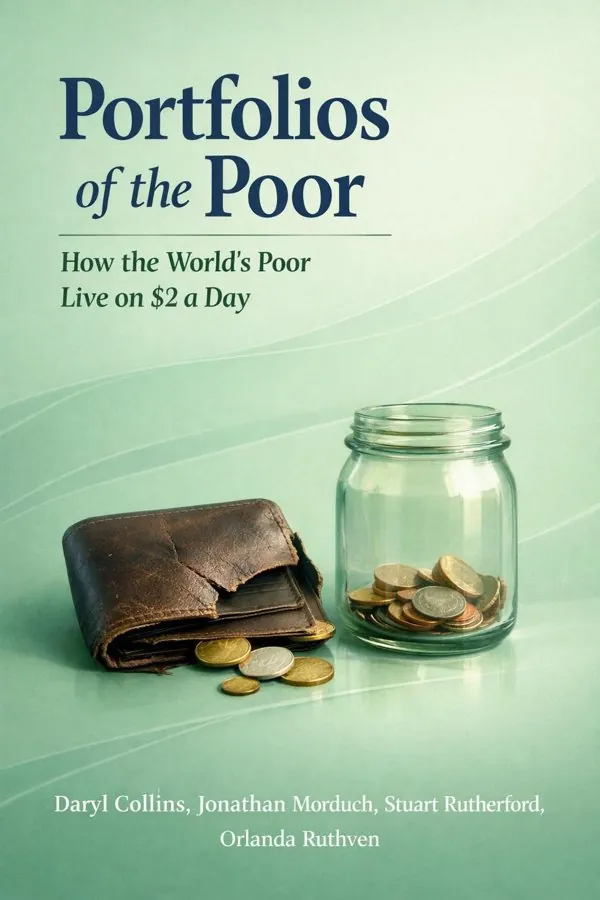
Portfolios of the Poor: How the World's Poor Live on $2 a Day: Summary & Key Insights
by Daryl Collins, Jonathan Morduch, Stuart Rutherford, Orlanda Ruthven
 10 min11 chaptersAudio available
What Is Portfolios of the Poor: How the World's Poor Live on $2 a Day About?
Portfolios of the Poor: How the World's Poor Live on $2 a Day by Daryl Collins, Jonathan Morduch, Stuart Rutherford, Orlanda Ruthven is a economics book spanning 11 pages. This book presents a groundbreaking study of how low-income households in Bangladesh, India, and South Africa manage their financial lives. Drawing on detailed financial diaries collected over a year, the authors reveal the complex strategies the poor use to survive and improve their circumstances, challenging conventional assumptions about poverty and microfinance.
This FizzRead summary covers all 11 key chapters of Portfolios of the Poor: How the World's Poor Live on $2 a Day in approximately 10 minutes, distilling the most important ideas, arguments, and takeaways from Daryl Collins, Jonathan Morduch, Stuart Rutherford, Orlanda Ruthven's work. Also available as an audio summary and Key Quotes Podcast.
Portfolios of the Poor: How the World's Poor Live on $2 a Day
This book presents a groundbreaking study of how low-income households in Bangladesh, India, and South Africa manage their financial lives. Drawing on detailed financial diaries collected over a year, the authors reveal the complex strategies the poor use to survive and improve their circumstances, challenging conventional assumptions about poverty and microfinance.
Who Should Read Portfolios of the Poor: How the World's Poor Live on $2 a Day?
This book is perfect for anyone interested in economics and looking to gain actionable insights in a short read. Whether you're a student, professional, or lifelong learner, the key ideas from Portfolios of the Poor: How the World's Poor Live on $2 a Day by Daryl Collins, Jonathan Morduch, Stuart Rutherford, Orlanda Ruthven will help you think differently.
- ✓Readers who enjoy economics and want practical takeaways
- ✓Professionals looking to apply new ideas to their work and life
- ✓Anyone who wants the core insights of Portfolios of the Poor: How the World's Poor Live on $2 a Day in just 10 minutes
Want the full summary?
Get instant access to this book summary and 100K+ more with Fizz Moment.
Get Free SummaryAvailable on App Store • Free to download
Key Chapters
Our approach revolved around a deceptively simple yet powerful idea: create financial diaries that record every inflow and outflow of cash in poor households. Beginning in Bangladesh and later extending to India and South Africa, we followed families and individuals over an entire year, visiting them weekly to record details of their economic transactions. Each household became a living ledger of adaptation and survival.
Unlike large-scale surveys that often freeze households into a snapshot, the diaries allowed us to capture financial life as a motion picture. Income among the poor is notoriously irregular—wages come sporadically, remittances unpredictably, and expenses suddenly. We wanted to know how people smooth such unevenness day to day. To get there, we sat in their homes, documented debts borrowed and repaid, and tracked every form of saving—from coins in a box to deposits in microfinance accounts.
The trust we built with participants was crucial. They opened their most private spheres, not just economically but emotionally. These diaries unveiled partnerships, friendships, and obligations that constituted what we came to see as a finely tuned system of informal finance. The methodology’s rigor lay in its intimacy. By entering the texture of everyday financial behavior, we could see patterns invisible in national data sets.
Our core sample spanned different contexts: the impoverished urban and rural regions of Bangladesh, the slums and small towns of India, and the township economy of South Africa. Each site reflected distinct histories and institutions, yet the underlying logic of financial management among the poor—the effort to turn small, uncertain flows into reliable resources—was a unifying thread.
The common image of the poor as living hand-to-mouth is both wrong and misleading. The diaries revealed that most poor households engage in numerous financial transactions every week. Even with limited income, their portfolios are surprisingly diverse: they save small sums, borrow from several sources, and participate in reciprocal exchanges.
Consider a Bangladesh housewife who keeps part of her savings in a ROSCA, part with a deposit collector who visits daily, and part secretly in a tin box. She also lends small amounts to relatives and occasionally borrows from a neighbor. Her household doesn’t have steady income, but it constantly manages complex liquidity demands. Similar stories abound across the study: Indian wage laborers who juggle small loans against festival expenses, South African pensioners who sustain extended families by coordinating multiple remittance flows.
Through these portraits, we realized that the poor construct miniature financial systems around themselves. They balance long- and short-term needs using whatever instruments are available. Their ingenuity challenges the idea that poor people lack financial acumen; rather, what they lack are reliable, affordable tools. Financial service exclusion, not financial incapacity, is the defining constraint.
+ 9 more chapters — available in the FizzRead app
All Chapters in Portfolios of the Poor: How the World's Poor Live on $2 a Day
About the Authors
Daryl Collins is a development economist specializing in financial inclusion. Jonathan Morduch is a professor of public policy and economics at New York University. Stuart Rutherford is a microfinance practitioner and founder of SafeSave in Bangladesh. Orlanda Ruthven is a researcher focused on labor and livelihoods in South Asia.
Get This Summary in Your Preferred Format
Read or listen to the Portfolios of the Poor: How the World's Poor Live on $2 a Day summary by Daryl Collins, Jonathan Morduch, Stuart Rutherford, Orlanda Ruthven anytime, anywhere. FizzRead offers multiple formats so you can learn on your terms — all free.
Available formats: App · Audio · PDF · EPUB — All included free with FizzRead
Download Portfolios of the Poor: How the World's Poor Live on $2 a Day PDF and EPUB Summary
Key Quotes from Portfolios of the Poor: How the World's Poor Live on $2 a Day
“Our approach revolved around a deceptively simple yet powerful idea: create financial diaries that record every inflow and outflow of cash in poor households.”
“The common image of the poor as living hand-to-mouth is both wrong and misleading.”
Frequently Asked Questions about Portfolios of the Poor: How the World's Poor Live on $2 a Day
Portfolios of the Poor: How the World's Poor Live on $2 a Day by Daryl Collins, Jonathan Morduch, Stuart Rutherford, Orlanda Ruthven is a economics book that explores key ideas across 11 chapters. This book presents a groundbreaking study of how low-income households in Bangladesh, India, and South Africa manage their financial lives. Drawing on detailed financial diaries collected over a year, the authors reveal the complex strategies the poor use to survive and improve their circumstances, challenging conventional assumptions about poverty and microfinance.
You Might Also Like
Business Adventures
John Brooks
10 min
Nudge
Richard H. Thaler, Cass R. Sunstein
10 min
The Hitchhiker"s Guide to the Galaxy
Douglas Adams
10 minThe Muqaddimah
Ibn Khaldun
10 minThe Outsiders
William N. Thorndike
10 min
A Little History of Economics
Niall Kishtainy
10 minBrowse by Category
Ready to read Portfolios of the Poor: How the World's Poor Live on $2 a Day?
Get the full summary and 100K+ more books with Fizz Moment.