
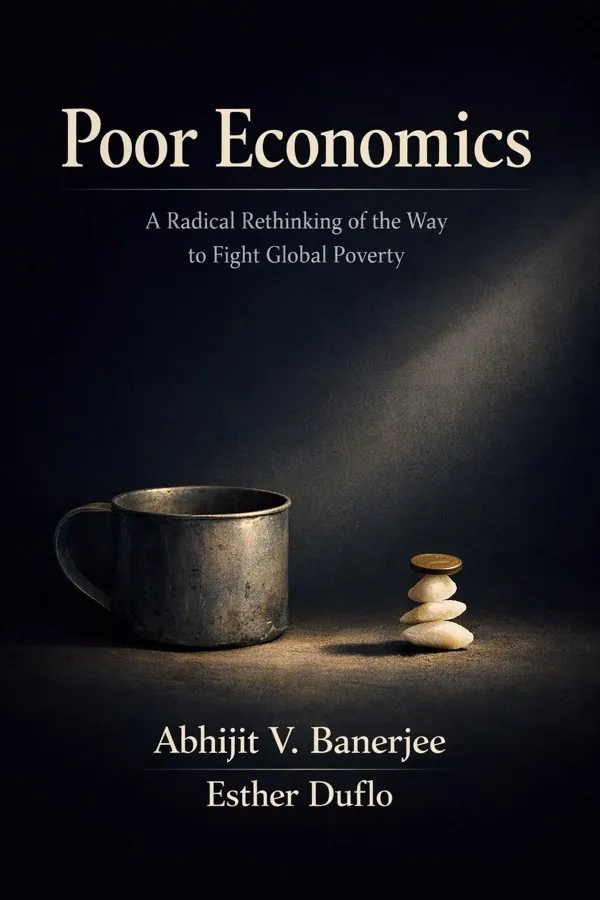
Poor Economics: A Radical Rethinking of the Way to Fight Global Poverty: Summary & Key Insights
by Abhijit V. Banerjee, Esther Duflo
 10 min9 chaptersAudio available
What Is Poor Economics: A Radical Rethinking of the Way to Fight Global Poverty About?
Poor Economics: A Radical Rethinking of the Way to Fight Global Poverty by Abhijit V. Banerjee, Esther Duflo is a economics book spanning 9 pages. This book explores the economic lives of the poor and challenges conventional wisdom about global poverty. Drawing on years of field research and randomized controlled trials, the authors reveal how the poor make decisions and how small changes in policy can lead to significant improvements in living standards.
This FizzRead summary covers all 9 key chapters of Poor Economics: A Radical Rethinking of the Way to Fight Global Poverty in approximately 10 minutes, distilling the most important ideas, arguments, and takeaways from Abhijit V. Banerjee, Esther Duflo's work. Also available as an audio summary and Key Quotes Podcast.
Poor Economics: A Radical Rethinking of the Way to Fight Global Poverty
This book explores the economic lives of the poor and challenges conventional wisdom about global poverty. Drawing on years of field research and randomized controlled trials, the authors reveal how the poor make decisions and how small changes in policy can lead to significant improvements in living standards.
Who Should Read Poor Economics: A Radical Rethinking of the Way to Fight Global Poverty?
This book is perfect for anyone interested in economics and looking to gain actionable insights in a short read. Whether you're a student, professional, or lifelong learner, the key ideas from Poor Economics: A Radical Rethinking of the Way to Fight Global Poverty by Abhijit V. Banerjee, Esther Duflo will help you think differently.
- ✓Readers who enjoy economics and want practical takeaways
- ✓Professionals looking to apply new ideas to their work and life
- ✓Anyone who wants the core insights of Poor Economics: A Radical Rethinking of the Way to Fight Global Poverty in just 10 minutes
Want the full summary?
Get instant access to this book summary and 100K+ more with Fizz Moment.
Get Free SummaryAvailable on App Store • Free to download
Key Chapters
We began our inquiry by simply asking: what does daily economic life look like for someone surviving on less than two dollars a day? It’s a vivid picture of resilience and complexity. The poor may not have bank accounts, but they engage in intricate financial management, borrowing and lending from relatives or neighbors, participating in informal credit groups, and diversifying income streams to manage risk. What surprised us most was that poverty does not stem from a lack of economic activity—it thrives amidst a dizzying web of transactions.
One of the first lessons drawn from field studies in India and Africa was how the poor allocate their limited resources. Food dominates the budget, of course, yet not always in the most nutritionally efficient way. Pleasure or aspiration often guides spending too: a television might seem extravagant, but for a family isolated from the world, it serves as connection and dignity. The poor are not robots of utility maximization—they pursue the same mixture of necessity and joy that defines every human life.
However, scarcity imposes a psychological tax. Choices become myopic under the stress of limited options. Without reliable savings, emergencies—whether illness, crop failure, or job loss—can undo years of progress. Thus, cycles of poverty persist not because of irrationality but because every rational decision reinforces vulnerability. Understanding these choices is our first step toward designing effective interventions that reduce risk and expand opportunity.
It might seem obvious that spending on health and nutrition is vital. Yet, in many poor communities, people routinely underinvest in preventive care and healthy diets. Why? The answer lies in perception and experience. The poor often distrust the health system: clinics may be far away, doctors may not show up, and promises of free medicine frequently go unfulfilled. Moreover, the benefits of prevention—vaccines, clean water, micronutrients—aren’t immediately visible. When every coin must be justified, the invisible is easily neglected.
Our experiments revealed fascinating truths. For example, when families were offered mosquito nets for free, usage shot up—but when nets were priced even modestly, demand dropped dramatically. This challenged a widespread belief that people value what they pay for. In the context of poverty, the opposite can be true: small fees often act as barriers, not motivators. Similarly, nutrition programs sometimes fail because they assume that information alone will change behavior. In reality, the poor already know malnutrition hurts, but good food may not fit their cultural preferences or local availability.
Understanding the economics of health among the poor means accepting that patience, trust, and immediate feedback matter more than distant promises. Programs that make healthy choices easy—default rather than optional—succeed better than those that require persuasion alone.
+ 7 more chapters — available in the FizzRead app
All Chapters in Poor Economics: A Radical Rethinking of the Way to Fight Global Poverty
About the Authors
Abhijit V. Banerjee is an Indian-American economist and professor at MIT, known for his work on development economics and poverty alleviation. Esther Duflo is a French-American economist and professor at MIT, co-founder of the Abdul Latif Jameel Poverty Action Lab (J-PAL), and a Nobel laureate in Economics.
Get This Summary in Your Preferred Format
Read or listen to the Poor Economics: A Radical Rethinking of the Way to Fight Global Poverty summary by Abhijit V. Banerjee, Esther Duflo anytime, anywhere. FizzRead offers multiple formats so you can learn on your terms — all free.
Available formats: App · Audio · PDF · EPUB — All included free with FizzRead
Download Poor Economics: A Radical Rethinking of the Way to Fight Global Poverty PDF and EPUB Summary
Key Quotes from Poor Economics: A Radical Rethinking of the Way to Fight Global Poverty
“We began our inquiry by simply asking: what does daily economic life look like for someone surviving on less than two dollars a day?”
“It might seem obvious that spending on health and nutrition is vital.”
Frequently Asked Questions about Poor Economics: A Radical Rethinking of the Way to Fight Global Poverty
Poor Economics: A Radical Rethinking of the Way to Fight Global Poverty by Abhijit V. Banerjee, Esther Duflo is a economics book that explores key ideas across 9 chapters. This book explores the economic lives of the poor and challenges conventional wisdom about global poverty. Drawing on years of field research and randomized controlled trials, the authors reveal how the poor make decisions and how small changes in policy can lead to significant improvements in living standards.
You Might Also Like

Business Adventures
John Brooks
10 min
Nudge
Richard H. Thaler, Cass R. Sunstein
10 min
The Hitchhiker"s Guide to the Galaxy
Douglas Adams
10 minThe Muqaddimah
Ibn Khaldun
10 minThe Outsiders
William N. Thorndike
10 min
A Little History of Economics
Niall Kishtainy
10 minBrowse by Category
Ready to read Poor Economics: A Radical Rethinking of the Way to Fight Global Poverty?
Get the full summary and 100K+ more books with Fizz Moment.