
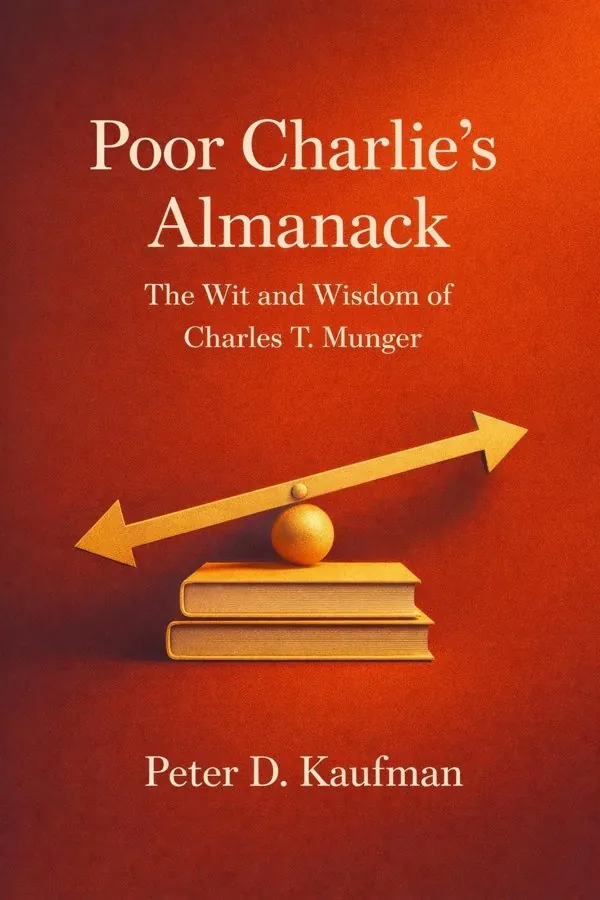
Poor Charlie's Almanack: The Wit and Wisdom of Charles T. Munger: Summary & Key Insights
 10 min4 chaptersAudio available
What Is Poor Charlie's Almanack: The Wit and Wisdom of Charles T. Munger About?
Poor Charlie's Almanack: The Wit and Wisdom of Charles T. Munger by Peter D. Kaufman is a finance book spanning 4 pages. A comprehensive collection of speeches, essays, and commentary capturing the investment philosophy, life lessons, and humor of Charles T. Munger, vice chairman of Berkshire Hathaway. The book presents Munger’s multidisciplinary approach to decision-making, his emphasis on rational thinking, and his insights into business, investing, and human behavior.
This FizzRead summary covers all 4 key chapters of Poor Charlie's Almanack: The Wit and Wisdom of Charles T. Munger in approximately 10 minutes, distilling the most important ideas, arguments, and takeaways from Peter D. Kaufman's work. Also available as an audio summary and Key Quotes Podcast.
Poor Charlie's Almanack: The Wit and Wisdom of Charles T. Munger
A comprehensive collection of speeches, essays, and commentary capturing the investment philosophy, life lessons, and humor of Charles T. Munger, vice chairman of Berkshire Hathaway. The book presents Munger’s multidisciplinary approach to decision-making, his emphasis on rational thinking, and his insights into business, investing, and human behavior.
Who Should Read Poor Charlie's Almanack: The Wit and Wisdom of Charles T. Munger?
This book is perfect for anyone interested in finance and looking to gain actionable insights in a short read. Whether you're a student, professional, or lifelong learner, the key ideas from Poor Charlie's Almanack: The Wit and Wisdom of Charles T. Munger by Peter D. Kaufman will help you think differently.
- ✓Readers who enjoy finance and want practical takeaways
- ✓Professionals looking to apply new ideas to their work and life
- ✓Anyone who wants the core insights of Poor Charlie's Almanack: The Wit and Wisdom of Charles T. Munger in just 10 minutes
Want the full summary?
Get instant access to this book summary and 100K+ more with Fizz Moment.
Get Free SummaryAvailable on App Store • Free to download
Key Chapters
When I gave my talk on ‘The Psychology of Human Misjudgment,’ my purpose was simple: to make intelligent people aware of how easily their minds mislead them. After years of observation, I realized that even the sharpest investors and executives repeatedly stumble over basic psychological tendencies. Human evolution prepared us for survival, not rational finance; our brains are hardwired for bias, and we distort reality in predictable ways.
Never underestimate the power of incentives. 'Show me the incentive, and I’ll show you the outcome.' Overprescribing doctors, overpromising brokers, and overreporting managers—all are products of their reward systems. Add to that the ‘liking and disliking bias’—our instinct to agree with those we favor and reject those we don’t—and systemic errors are inevitable.
Then there’s the ‘social proof effect,’ or herd behavior. People follow the crowd because it feels safe, even when the cliff edge lies ahead. The dot-com bubble and housing mania are prime examples of social validation crushing reason. Combined with ‘association bias’ and ‘availability bias,’ our minds link ideas automatically and remember vivid things over true ones.
I’ve spent my life building a kind of cognitive vaccine against these tendencies. Biases can’t be eradicated, but through awareness and cross-disciplinary thinking, they can be corrected. Psychology reveals the roots of our failures, and understanding that means you’ve already won half the battle. When you study incentives alongside cognition, the world becomes clearer—you stop blaming luck and start repairing your own reasoning flaws.
A person with only one lens can see only one world, but those with many lenses can glimpse reality itself. That’s why I preach the idea of ‘mental models.’ No single field can explain the full complexity of life; only a lattice of ideas drawn from multiple disciplines provides the tools to decode reality properly.
Economics teaches scarcity, incentives, and competition, but it can’t capture feedback loops or nonlinearity—for that, you turn to biology or physics. Psychology offers insight into emotion, while history reveals how civilizations rise and fall under stress. Combined, these models allow us to navigate complexity as sailors once used constellations to chart their course.
At Berkshire Hathaway, every decision is guided by this framework. When evaluating an investment, we don’t rely solely on formulas—we ask: Does the business obey Newtonian laws of motion and inertia? Are the incentives aligned with human nature? Is the market behaving sanely or irrationally? Each additional model sharpens perception, and the accumulation of clarity becomes wisdom itself.
Modern education’s tragedy is its devotion to narrow expertise. Engineers ignore finance; financiers neglect thermodynamics; and errors multiply. I urge everyone to become ‘collectors of models,’ building mental scaffolding from which knowledge interconnects. When ideas compound, understanding compounds—and that is the finest form of interest you can ever earn: the interest on your own intellect.
+ 2 more chapters — available in the FizzRead app
All Chapters in Poor Charlie's Almanack: The Wit and Wisdom of Charles T. Munger
About the Author
Peter D. Kaufman is an American businessman, author, and editor known for compiling and editing 'Poor Charlie’s Almanack'. He is the CEO of Glenair, Inc. and a close associate of Charles T. Munger, recognized for his work in distilling Munger’s wisdom into accessible form.
Get This Summary in Your Preferred Format
Read or listen to the Poor Charlie's Almanack: The Wit and Wisdom of Charles T. Munger summary by Peter D. Kaufman anytime, anywhere. FizzRead offers multiple formats so you can learn on your terms — all free.
Available formats: App · Audio · PDF · EPUB — All included free with FizzRead
Download Poor Charlie's Almanack: The Wit and Wisdom of Charles T. Munger PDF and EPUB Summary
Key Quotes from Poor Charlie's Almanack: The Wit and Wisdom of Charles T. Munger
“When I gave my talk on ‘The Psychology of Human Misjudgment,’ my purpose was simple: to make intelligent people aware of how easily their minds mislead them.”
“A person with only one lens can see only one world, but those with many lenses can glimpse reality itself.”
Frequently Asked Questions about Poor Charlie's Almanack: The Wit and Wisdom of Charles T. Munger
Poor Charlie's Almanack: The Wit and Wisdom of Charles T. Munger by Peter D. Kaufman is a finance book that explores key ideas across 4 chapters. A comprehensive collection of speeches, essays, and commentary capturing the investment philosophy, life lessons, and humor of Charles T. Munger, vice chairman of Berkshire Hathaway. The book presents Munger’s multidisciplinary approach to decision-making, his emphasis on rational thinking, and his insights into business, investing, and human behavior.
You Might Also Like



Browse by Category
Ready to read Poor Charlie's Almanack: The Wit and Wisdom of Charles T. Munger?
Get the full summary and 100K+ more books with Fizz Moment.