
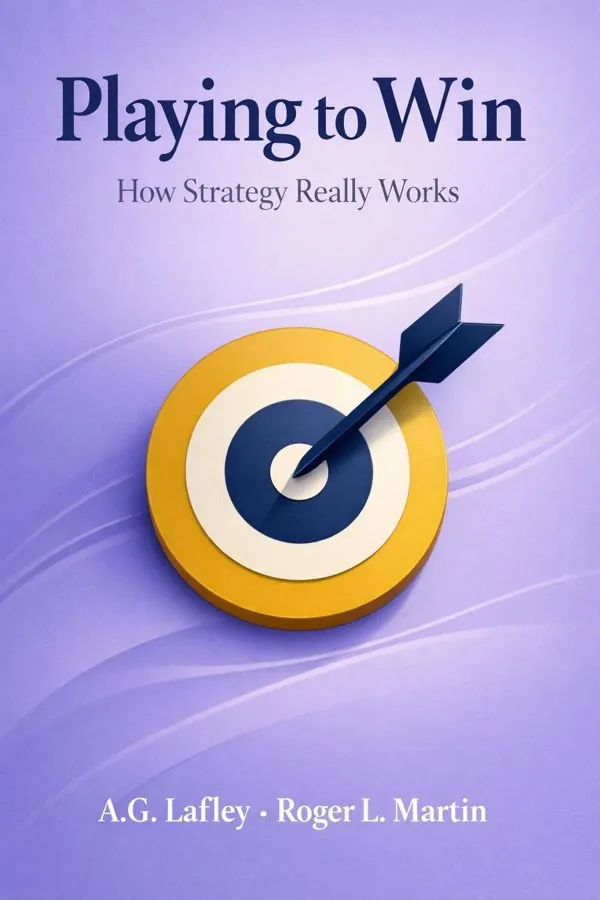
Playing to Win: Summary & Key Insights
by A.G. Lafley
 10 min4 chaptersAudio available
What Is Playing to Win About?
Playing to Win by A.G. Lafley is a business book published in 2013 spanning 4 pages. Playing to Win: How Strategy Really Works es un libro de gestión empresarial que presenta un enfoque práctico para desarrollar estrategias competitivas efectivas. Los autores, A.G. Lafley, ex CEO de Procter & Gamble, y Roger L. Martin, decano de la Rotman School of Management, explican cómo las empresas pueden definir dónde jugar y cómo ganar, utilizando ejemplos reales de P&G y otras organizaciones líderes. El libro ofrece un marco claro para la toma de decisiones estratégicas y la ejecución exitosa en entornos empresariales complejos.
This FizzRead summary covers all 4 key chapters of Playing to Win in approximately 10 minutes, distilling the most important ideas, arguments, and takeaways from A.G. Lafley's work. Also available as an audio summary and Key Quotes Podcast.
Playing to Win: How Strategy Really Works
Playing to Win: How Strategy Really Works es un libro de gestión empresarial que presenta un enfoque práctico para desarrollar estrategias competitivas efectivas. Los autores, A.G. Lafley, ex CEO de Procter & Gamble, y Roger L. Martin, decano de la Rotman School of Management, explican cómo las empresas pueden definir dónde jugar y cómo ganar, utilizando ejemplos reales de P&G y otras organizaciones líderes. El libro ofrece un marco claro para la toma de decisiones estratégicas y la ejecución exitosa en entornos empresariales complejos.
Who Should Read Playing to Win?
This book is perfect for anyone interested in business and looking to gain actionable insights in a short read. Whether you're a student, professional, or lifelong learner, the key ideas from Playing to Win by A.G. Lafley will help you think differently.
- ✓Readers who enjoy business and want practical takeaways
- ✓Professionals looking to apply new ideas to their work and life
- ✓Anyone who wants the core insights of Playing to Win in just 10 minutes
Want the full summary?
Get instant access to this book summary and 100K+ more with Fizz Moment.
Get Free SummaryAvailable on App Store • Free to download
Key Chapters
Strategy is not a slogan, nor a plan dressed as ambition. It is not an exercise in optimization or a checklist of best practices. Throughout my tenure at P&G, I saw organizations confuse activity for strategy—thinking that more initiatives, more analysis, or more brainstorming equated to direction. But activity without choice is motion without progress. Strategy is coherence in choices.
Roger and I emphasize this distinction right from the outset. A vision describes the desired future, but strategy builds the path to get there. A plan often lists steps, but strategy defines the principles that decide which steps matter. Optimization makes things better within an existing model, but strategy changes the game itself. The purpose of strategy, then, is to position the organization to win—not simply to operate efficiently, but to create advantage that others cannot easily imitate.
To think strategically means to accept trade-offs. You can’t choose everywhere, you can’t please everyone, and you certainly can’t win by copying your competitors. Good strategy demands exclusion: by choosing one path, we say no to many others. That’s uncomfortable for leaders who crave comprehensive solutions, but in truth, it’s the only way clarity emerges.
At P&G, this lesson became brutally clear when we examined dozens of underperforming businesses that had diffuse market focus and no sharp winning aspiration. They had plans, yes—but no real choices. Once we shifted the perspective from "how do we grow?" to "where can we win and why?", energy concentrated, innovation exploded, and performance changed. This is the heart of strategic discipline: seeing that success flows not from doing more, but from doing the right things deliberately and consistently.
That realization shaped the backbone of the entire framework in this book—the five interlocking choices that define real strategy. Every company must make these decisions consciously and cohesively, or risk wandering without direction. Strategy is a craft of choice-making, not chance-taking, and that truth anchors every idea we explore hereafter.
Every winning strategy builds upon five pivotal questions. Each one functions as both a lens and a lever, shaping the organization’s ambition and actions. Together, they form an integrated framework that guides every strategic decision.
The first question is, *What is our winning aspiration?* Every organization exists for a reason—but not every reason leads to winning. Your aspiration defines success on your own terms; it frames what victory looks like for your brand, your team, your organization. For P&G, this meant not merely selling products but improving consumers’ lives—an aspiration that elevated our purpose beyond transactions.
The second question follows naturally—*Where will we play?* This choice defines the competitive battlefield: categories, geographies, channels, and consumer segments. Trying to be everywhere dilutes strength; choosing where to play focuses it. When we sharpened focus on categories like beauty and grooming, P&G did more with less, concentrating innovation on markets where we had the clearest path to leadership.
The third question asks, *How will we win?* This involves securing competitive advantage—unique value propositions and distinctive capabilities that deliver superiority. At Olay, for instance, our winning approach revolved around delivering premium beauty science at accessible prices—a balance of technology and emotional connection that competitors struggled to match.
Once the direction and method of victory are clear, the next choice is *What capabilities must be in place?* Capabilities are the muscles of strategy; they determine whether aspirational choices translate into action. These include areas like brand building, consumer understanding, and innovation management—core competencies that can’t be outsourced or improvised.
Finally, *What management systems are required?* Systems ensure continuity: they embed strategic thinking into processes, performance metrics, and organizational design. Without these, strategy fades into slogans. Management systems translate strategic intentions into daily practice, aligning behavior across levels.
These five questions are not sequential checkboxes—they are interdependent elements of a living framework. Change one, and the rest must adapt. Iteration is constant: as markets evolve, the answers to these questions evolve too. The beauty of this framework lies in its flexibility and rigor—it helps leaders steer the organization through uncertainty while maintaining coherence. Strategy, as defined here, is not static; it is a disciplined conversation among these five choices—a conversation that keeps the organization honest and focused on winning.
+ 2 more chapters — available in the FizzRead app
All Chapters in Playing to Win
About the Author
A.G. Lafley fue presidente y director ejecutivo de Procter & Gamble, donde lideró una transformación estratégica que duplicó las ventas y aumentó significativamente el valor de mercado de la empresa. Roger L. Martin es un reconocido académico y consultor de estrategia, ex decano de la Rotman School of Management de la Universidad de Toronto, y autor de varios libros sobre pensamiento estratégico y gestión empresarial.
Get This Summary in Your Preferred Format
Read or listen to the Playing to Win summary by A.G. Lafley anytime, anywhere. FizzRead offers multiple formats so you can learn on your terms — all free.
Available formats: App · Audio · PDF · EPUB — All included free with FizzRead
Download Playing to Win PDF and EPUB Summary
Key Quotes from Playing to Win
“Strategy is not a slogan, nor a plan dressed as ambition.”
“Every winning strategy builds upon five pivotal questions.”
Frequently Asked Questions about Playing to Win
Playing to Win by A.G. Lafley is a business book that explores key ideas across 4 chapters. Playing to Win: How Strategy Really Works es un libro de gestión empresarial que presenta un enfoque práctico para desarrollar estrategias competitivas efectivas. Los autores, A.G. Lafley, ex CEO de Procter & Gamble, y Roger L. Martin, decano de la Rotman School of Management, explican cómo las empresas pueden definir dónde jugar y cómo ganar, utilizando ejemplos reales de P&G y otras organizaciones líderes. El libro ofrece un marco claro para la toma de decisiones estratégicas y la ejecución exitosa en entornos empresariales complejos.
You Might Also Like



Browse by Category
Ready to read Playing to Win?
Get the full summary and 100K+ more books with Fizz Moment.