
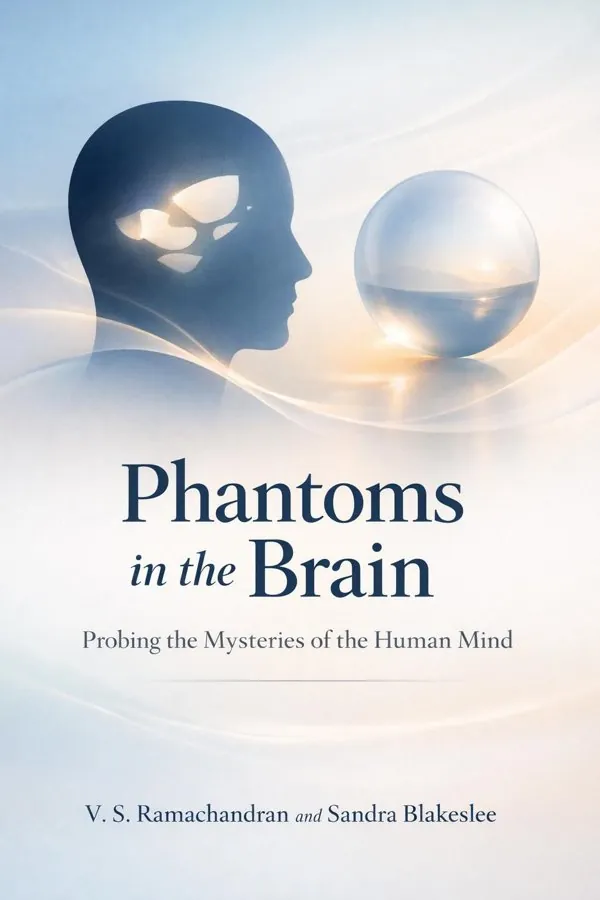
Phantoms in the Brain: Probing the Mysteries of the Human Mind: Summary & Key Insights
by V. S. Ramachandran, Sandra Blakeslee
 10 min10 chaptersAudio available
What Is Phantoms in the Brain: Probing the Mysteries of the Human Mind About?
Phantoms in the Brain: Probing the Mysteries of the Human Mind by V. S. Ramachandran and Sandra Blakeslee is a neuroscience book spanning 10 pages. In this groundbreaking work, neuroscientist V. S. Ramachandran explores the mysteries of the human brain through fascinating case studies of patients with neurological disorders. From phantom limbs to out-of-body experiences, the book reveals how the brain constructs reality and what happens when that process goes awry. Blending scientific insight with engaging storytelling, it offers a profound look into the nature of consciousness and self-awareness.
This FizzRead summary covers all 10 key chapters of Phantoms in the Brain: Probing the Mysteries of the Human Mind in approximately 10 minutes, distilling the most important ideas, arguments, and takeaways from V. S. Ramachandran and Sandra Blakeslee's work. Also available as an audio summary and Key Quotes Podcast.
Phantoms in the Brain: Probing the Mysteries of the Human Mind
In this groundbreaking work, neuroscientist V. S. Ramachandran explores the mysteries of the human brain through fascinating case studies of patients with neurological disorders. From phantom limbs to out-of-body experiences, the book reveals how the brain constructs reality and what happens when that process goes awry. Blending scientific insight with engaging storytelling, it offers a profound look into the nature of consciousness and self-awareness.
Who Should Read Phantoms in the Brain: Probing the Mysteries of the Human Mind?
This book is perfect for anyone interested in neuroscience and looking to gain actionable insights in a short read. Whether you're a student, professional, or lifelong learner, the key ideas from Phantoms in the Brain: Probing the Mysteries of the Human Mind by V. S. Ramachandran and Sandra Blakeslee will help you think differently.
- ✓Readers who enjoy neuroscience and want practical takeaways
- ✓Professionals looking to apply new ideas to their work and life
- ✓Anyone who wants the core insights of Phantoms in the Brain: Probing the Mysteries of the Human Mind in just 10 minutes
Want the full summary?
Get instant access to this book summary and 100K+ more with Fizz Moment.
Get Free SummaryAvailable on App Store • Free to download
Key Chapters
Among my most famous cases were those involving phantom limbs—patients who still felt arms or legs long after amputation. At first glance this phenomenon seems bizarre, almost supernatural. But to a neuroscientist, it offers direct evidence that the brain contains an internal map of the body, a somatotopic representation in the parietal cortex. That map does not depend on the physical presence of the limb; it’s a model, a set of neural expectations about what the body should be.
One of my patients, whom I’ll call Tom, lost his arm in an accident but continued to feel his fingers curl painfully. He could swear the missing arm still existed, clenched in torment. Initially, doctors thought this was psychological, but imaging and mapping studies revealed something remarkable: when Tom’s face was touched, he felt sensations in the phantom hand. Neurons that once represented the hand had been invaded by adjacent facial neurons. In other words, the map had reorganized itself—the brain adapting to injury with astonishing plasticity.
This finding reshaped our understanding of how the brain constructs body ownership. It told us that the sense of ‘self’ extends beyond muscle and bone; it lives in cortical networks. When that network misfires, the ghost of the body lingers. These patients reminded me that perception is not about seeing what’s out there—it’s about the brain’s predictions of what should be there. The phantom limb is the perfect metaphor for consciousness itself: a vivid creation that feels wholly real but is ultimately a construct.
Tom’s suffering led me to design a simple yet surprisingly effective treatment—a box with two mirrors. The mirror reflected his intact arm in place of the missing one, creating an illusion that both limbs moved together. When he opened and closed the existing hand while watching the reflection, his brain received visual feedback that the phantom was also moving. Sometimes, after several sessions, his painful clenching would stop.
To me, this was a revelation. The therapy was rudimentary, but it demonstrated that vision could substitute for proprioception. The brain seeks coherence across its sensory inputs; give it a believable illusion, and it will accept it as truth. This insight has since inspired countless rehabilitation approaches—not just for amputees, but for stroke victims and those suffering from chronic pain.
The mirror box taught me the power of sensory reconciliation. The mind is not trapped inside the head; it negotiates reality through a dynamic dialogue among senses. When that dialogue is restored, even by illusion, the brain heals itself. Healing, in many cases, is an act of perceptual reeducation.
+ 8 more chapters — available in the FizzRead app
All Chapters in Phantoms in the Brain: Probing the Mysteries of the Human Mind
About the Authors
Vilayanur S. Ramachandran is a renowned neuroscientist and professor at the University of California, San Diego, known for his pioneering research on visual perception and phantom limb phenomena. Sandra Blakeslee is a science writer for The New York Times specializing in neuroscience and psychology.
Get This Summary in Your Preferred Format
Read or listen to the Phantoms in the Brain: Probing the Mysteries of the Human Mind summary by V. S. Ramachandran and Sandra Blakeslee anytime, anywhere. FizzRead offers multiple formats so you can learn on your terms — all free.
Available formats: App · Audio · PDF · EPUB — All included free with FizzRead
Download Phantoms in the Brain: Probing the Mysteries of the Human Mind PDF and EPUB Summary
Key Quotes from Phantoms in the Brain: Probing the Mysteries of the Human Mind
“Among my most famous cases were those involving phantom limbs—patients who still felt arms or legs long after amputation.”
“Tom’s suffering led me to design a simple yet surprisingly effective treatment—a box with two mirrors.”
Frequently Asked Questions about Phantoms in the Brain: Probing the Mysteries of the Human Mind
Phantoms in the Brain: Probing the Mysteries of the Human Mind by V. S. Ramachandran and Sandra Blakeslee is a neuroscience book that explores key ideas across 10 chapters. In this groundbreaking work, neuroscientist V. S. Ramachandran explores the mysteries of the human brain through fascinating case studies of patients with neurological disorders. From phantom limbs to out-of-body experiences, the book reveals how the brain constructs reality and what happens when that process goes awry. Blending scientific insight with engaging storytelling, it offers a profound look into the nature of consciousness and self-awareness.
You Might Also Like
Anxious
Joseph LeDoux
10 min
Hallucinations
Oliver Sacks
10 min
The Biological Mind: How Brain, Body, and Environment Collaborate to Make Us Who We Are
Alan Jasanoff
10 min
The Feeling of Life Itself: Why Consciousness Is Widespread but Can't Be Computed
Christof Koch
10 min
The No-Nonsense Meditation Book
Steven Laureys
10 min
A General Theory of Love
Thomas Lewis, Fari Amini, Richard Lannon
10 minBrowse by Category
Ready to read Phantoms in the Brain: Probing the Mysteries of the Human Mind?
Get the full summary and 100K+ more books with Fizz Moment.