
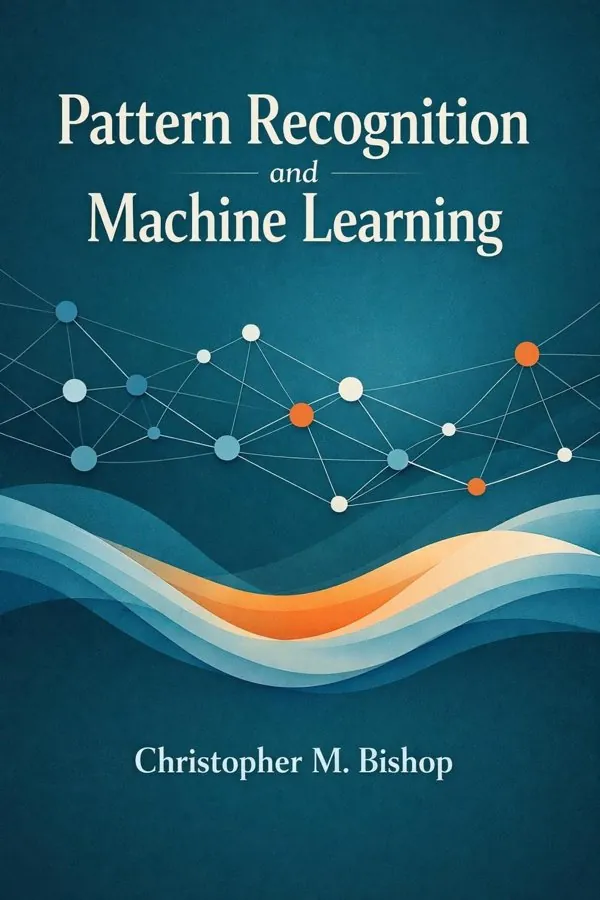
Pattern Recognition and Machine Learning: Summary & Key Insights
 10 min7 chaptersAudio available
What Is Pattern Recognition and Machine Learning About?
Pattern Recognition and Machine Learning by Christopher M. Bishop is a ai_ml book spanning 7 pages. This comprehensive textbook provides an introduction to the fields of pattern recognition and machine learning. It covers a wide range of probabilistic models and inference techniques, including Bayesian networks, graphical models, kernel methods, and neural networks. The book emphasizes a unified treatment of machine learning methods from a probabilistic perspective, making it suitable for advanced undergraduates, graduate students, and researchers in computer science, engineering, and related disciplines.
This FizzRead summary covers all 7 key chapters of Pattern Recognition and Machine Learning in approximately 10 minutes, distilling the most important ideas, arguments, and takeaways from Christopher M. Bishop's work. Also available as an audio summary and Key Quotes Podcast.
Pattern Recognition and Machine Learning
This comprehensive textbook provides an introduction to the fields of pattern recognition and machine learning. It covers a wide range of probabilistic models and inference techniques, including Bayesian networks, graphical models, kernel methods, and neural networks. The book emphasizes a unified treatment of machine learning methods from a probabilistic perspective, making it suitable for advanced undergraduates, graduate students, and researchers in computer science, engineering, and related disciplines.
Who Should Read Pattern Recognition and Machine Learning?
This book is perfect for anyone interested in ai_ml and looking to gain actionable insights in a short read. Whether you're a student, professional, or lifelong learner, the key ideas from Pattern Recognition and Machine Learning by Christopher M. Bishop will help you think differently.
- ✓Readers who enjoy ai_ml and want practical takeaways
- ✓Professionals looking to apply new ideas to their work and life
- ✓Anyone who wants the core insights of Pattern Recognition and Machine Learning in just 10 minutes
Want the full summary?
Get instant access to this book summary and 100K+ more with Fizz Moment.
Get Free SummaryAvailable on App Store • Free to download
Key Chapters
Every sound model begins with probability—the art of quantifying uncertainty. In the early chapters, we revisit the fundamentals: random variables, probability distributions, and the rules of inference. Bayes’ theorem is not just a formula; it is the principle that ties prior beliefs to data-driven evidence. Once we have that lens, we can reinterpret regression as inference rather than mere curve-fitting.
In a traditional approach, linear regression seeks to minimize squared error—a mechanical optimization. In the Bayesian view, however, regression embodies uncertainty both in the parameters and in the predictions. Instead of single parameter estimates, we derive posterior distributions. This simple shift transforms how we approach model design. We can now express beliefs about the parameters before observing data and update these beliefs afterward.
Bayesian linear regression, therefore, provides predictive distributions, capturing both the central tendency of the fit and the confidence we have in each prediction. The resulting framework allows natural extensions: we can regularize automatically through priors, compare models using marginal likelihoods, and build hierarchical structures that adapt complexity to data volume. By grasping these foundations, you step into a world where learning is not deterministic but nuanced, probabilistic, and adaptive.
Regression predicts continuous outcomes; classification separates categories. Yet the principles remain probabilistic. Logistic regression and discriminant analysis are the key players. Logistic regression maps linear combinations of inputs through a sigmoid to yield probabilities—a smooth transition from ignorance to certainty. Discriminant analysis, on the other hand, treats each class as a Gaussian distribution and constructs boundaries where their posteriors meet.
These models illuminate a recurring theme: under the Bayesian lens, decisions stem from probability, not arbitrary thresholds. Regularization and priors become tools to control complexity, preventing overfitting while preserving expressiveness. Through this understanding, you begin to see the geometry of learning—the way data shape decision surfaces, how uncertainty curves those surfaces, and how priors nudge them toward sensible configurations.
Classification is where the practical meets the philosophical: every predicted label is a statement about uncertainty. A well-trained probabilistic classifier never insists—it expresses belief. That humility, embedded in probability, is the essence of robust machine learning.
+ 5 more chapters — available in the FizzRead app
All Chapters in Pattern Recognition and Machine Learning
About the Author
Christopher M. Bishop is a British computer scientist and researcher known for his contributions to machine learning and artificial intelligence. He is a Professor of Computer Science at the University of Edinburgh and a Microsoft Technical Fellow, leading research in AI and machine learning. Bishop is also the author of the earlier textbook 'Neural Networks for Pattern Recognition'.
Get This Summary in Your Preferred Format
Read or listen to the Pattern Recognition and Machine Learning summary by Christopher M. Bishop anytime, anywhere. FizzRead offers multiple formats so you can learn on your terms — all free.
Available formats: App · Audio · PDF · EPUB — All included free with FizzRead
Download Pattern Recognition and Machine Learning PDF and EPUB Summary
Key Quotes from Pattern Recognition and Machine Learning
“Every sound model begins with probability—the art of quantifying uncertainty.”
“Regression predicts continuous outcomes; classification separates categories.”
Frequently Asked Questions about Pattern Recognition and Machine Learning
Pattern Recognition and Machine Learning by Christopher M. Bishop is a ai_ml book that explores key ideas across 7 chapters. This comprehensive textbook provides an introduction to the fields of pattern recognition and machine learning. It covers a wide range of probabilistic models and inference techniques, including Bayesian networks, graphical models, kernel methods, and neural networks. The book emphasizes a unified treatment of machine learning methods from a probabilistic perspective, making it suitable for advanced undergraduates, graduate students, and researchers in computer science, engineering, and related disciplines.
You Might Also Like
Life 3.0
Max Tegmark
10 min
Superintelligence
Nick Bostrom
10 min
TensorFlow in Action
Thushan Ganegedara
10 min
AI Made Simple: A Beginner’s Guide to Generative AI, ChatGPT, and the Future of Work
Rajeev Kapur
10 min
AI Snake Oil
Arvind Narayanan, Sayash Kapoor
10 min
AI Superpowers: China, Silicon Valley, and the New World Order
Kai-Fu Lee
10 minBrowse by Category
Ready to read Pattern Recognition and Machine Learning?
Get the full summary and 100K+ more books with Fizz Moment.