
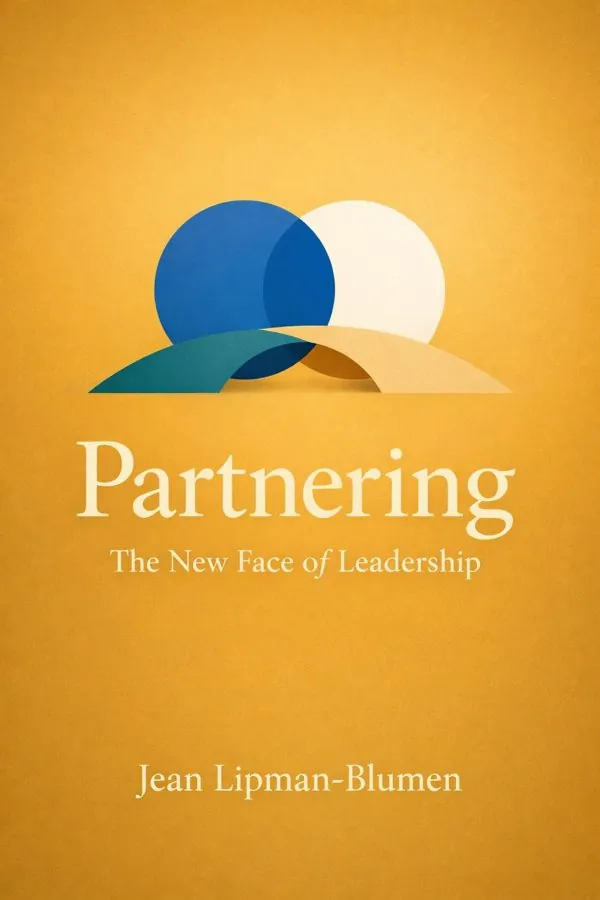
Partnering: The New Face of Leadership: Summary & Key Insights
 10 min12 chaptersAudio available
What Is Partnering: The New Face of Leadership About?
Partnering: The New Face of Leadership by Jean Lipman-Blumen is a leadership book spanning 12 pages. In 'Partnering: The New Face of Leadership', Jean Lipman-Blumen explores a transformative model of leadership based on collaboration, mutual respect, and shared purpose. Moving away from traditional hierarchical structures, the book argues that effective leadership in the modern world depends on building partnerships that transcend organizational and cultural boundaries. Lipman-Blumen draws on research and real-world examples to show how leaders can foster trust, inclusivity, and innovation through genuine partnership.
This FizzRead summary covers all 12 key chapters of Partnering: The New Face of Leadership in approximately 10 minutes, distilling the most important ideas, arguments, and takeaways from Jean Lipman-Blumen's work. Also available as an audio summary and Key Quotes Podcast.
Partnering: The New Face of Leadership
In 'Partnering: The New Face of Leadership', Jean Lipman-Blumen explores a transformative model of leadership based on collaboration, mutual respect, and shared purpose. Moving away from traditional hierarchical structures, the book argues that effective leadership in the modern world depends on building partnerships that transcend organizational and cultural boundaries. Lipman-Blumen draws on research and real-world examples to show how leaders can foster trust, inclusivity, and innovation through genuine partnership.
Who Should Read Partnering: The New Face of Leadership?
This book is perfect for anyone interested in leadership and looking to gain actionable insights in a short read. Whether you're a student, professional, or lifelong learner, the key ideas from Partnering: The New Face of Leadership by Jean Lipman-Blumen will help you think differently.
- ✓Readers who enjoy leadership and want practical takeaways
- ✓Professionals looking to apply new ideas to their work and life
- ✓Anyone who wants the core insights of Partnering: The New Face of Leadership in just 10 minutes
Want the full summary?
Get instant access to this book summary and 100K+ more with Fizz Moment.
Get Free SummaryAvailable on App Store • Free to download
Key Chapters
For much of human history, leadership has been modeled after the chain of command: a vertical structure that simplifies decision-making but suppresses creativity. In the industrial age, this system served us well; efficiency mattered most, and organizations thrived on discipline and standardization. But today, those same structures survive like fossils, beautiful in their design but brittle under the weight of modern complexity.
Traditional leaders rely on authority. They speak, and others obey. The result is predictability — but predictability kills innovation. Fear of error, fear of judgment, and fear of exclusion all reduce our capacity to see beyond the familiar. True collaboration demands freedom, and freedom cannot flourish under control.
In my research at Claremont Graduate University and through conversations with leaders across sectors, I have seen the exhaustion that hierarchical culture breeds. The top feels isolated; the bottom feels voiceless. Hierarchies create silos within organizations, dividing rather than connecting departments, discouraging initiative, and weakening the sense of shared purpose. The partnering model arises in direct opposition to that isolation. It asks leaders to trade dominance for connection, to reach out to colleagues not as subordinates but as equals in pursuit of something greater.
When we begin to dismantle hierarchy, we discover an unexpected vitality. Innovation blooms from conversation, creativity arises from difference, and resilience grows from trust. But this transition is painful and radical — it requires courage from those who have long benefited from authority and humility from those who have long felt powerless. This book does not promise an easy passage from one model to the next; it offers a compass, pointing us toward partnership as the only leadership principle suited to our interdependent era.
+ 10 more chapters — available in the FizzRead app
All Chapters in Partnering: The New Face of Leadership
About the Author
Jean Lipman-Blumen is an American organizational sociologist and leadership scholar, known for her work on connective leadership and gender in organizations. She is a professor at Claremont Graduate University and co-founder of the Connective Leadership Institute. Her research focuses on leadership, collaboration, and the social psychology of organizations.
Get This Summary in Your Preferred Format
Read or listen to the Partnering: The New Face of Leadership summary by Jean Lipman-Blumen anytime, anywhere. FizzRead offers multiple formats so you can learn on your terms — all free.
Available formats: App · Audio · PDF · EPUB — All included free with FizzRead
Download Partnering: The New Face of Leadership PDF and EPUB Summary
Key Quotes from Partnering: The New Face of Leadership
“For much of human history, leadership has been modeled after the chain of command: a vertical structure that simplifies decision-making but suppresses creativity.”
“It is a deep, sustained, and authentic relationship built upon mutual respect, shared goals, and interdependence.”
Frequently Asked Questions about Partnering: The New Face of Leadership
Partnering: The New Face of Leadership by Jean Lipman-Blumen is a leadership book that explores key ideas across 12 chapters. In 'Partnering: The New Face of Leadership', Jean Lipman-Blumen explores a transformative model of leadership based on collaboration, mutual respect, and shared purpose. Moving away from traditional hierarchical structures, the book argues that effective leadership in the modern world depends on building partnerships that transcend organizational and cultural boundaries. Lipman-Blumen draws on research and real-world examples to show how leaders can foster trust, inclusivity, and innovation through genuine partnership.
You Might Also Like

Extreme Ownership
Jocko Willink
10 min
Dare to Lead
Brene Brown
10 min
Leaders Eat Last
Simon Sinek
10 min
The 21 Irrefutable Laws of Leadership
John Maxwell
10 min
Start With Why
Simon Sinek
10 min
How to Lead When You're Not in Charge
Clay Scroggins
10 minBrowse by Category
Ready to read Partnering: The New Face of Leadership?
Get the full summary and 100K+ more books with Fizz Moment.