
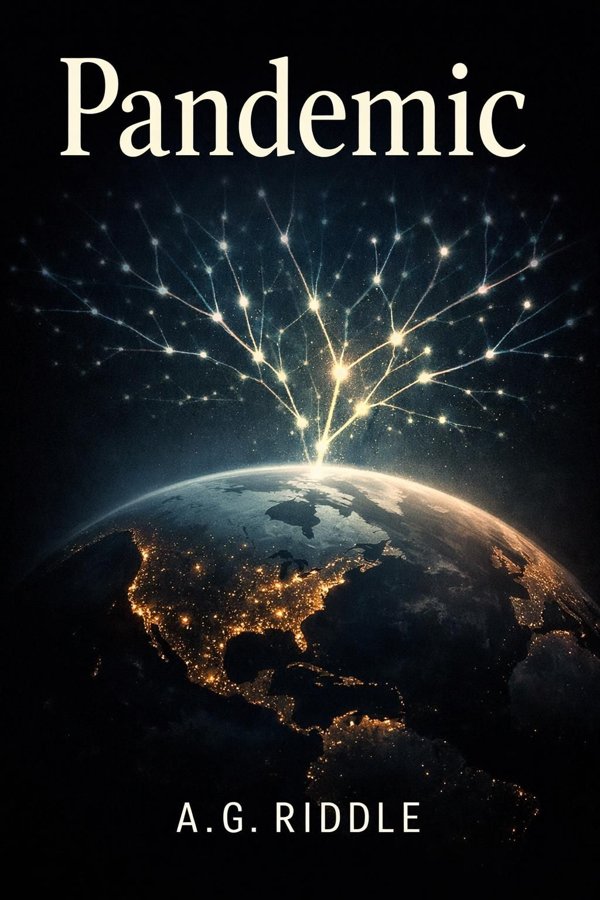
Pandemic: Summary & Key Insights
by A. G. Riddle
 10 min8 chaptersAudio available
Key Takeaways from Pandemic
Every civilization feels permanent—until a microscopic threat proves otherwise.
The most dangerous discoveries are often the ones that prove disaster is not random.
The future becomes far more unsettling when it is buried in the past.
In a crisis, facts are valuable—but timing determines whether they matter.
A pathogen attacks the body, but panic attacks the social fabric.
What Is Pandemic About?
Pandemic by A. G. Riddle is a bestsellers book spanning 4 pages. Pandemic by A. G. Riddle is a fast-moving science thriller that turns one of humanity’s deepest fears into a gripping global mystery: what happens when a deadly outbreak is not just a biological accident, but part of a much larger secret tied to human origins, hidden research, and the future of our species. The novel follows Dr. Peyton Shaw, a CDC epidemiologist drawn into an escalating crisis after a strange, devastating illness erupts in Africa and begins spreading across borders with terrifying speed. As bodies pile up and governments scramble, Shaw discovers that the pathogen may be engineered—and that its purpose reaches far beyond mass death. What makes Pandemic compelling is not only its pace, but its scope. Riddle combines outbreak realism, geopolitical tension, advanced genetics, and speculative science into a story that asks urgent questions about scientific responsibility, evolution, secrecy, and survival. Known for blending high-concept ideas with thriller momentum, A. G. Riddle writes with the confidence of an author who understands how to make complex science accessible and cinematic. Pandemic matters because it transforms a familiar disaster scenario into a provocative exploration of what humanity might become under extreme pressure.
This FizzRead summary covers all 8 key chapters of Pandemic in approximately 10 minutes, distilling the most important ideas, arguments, and takeaways from A. G. Riddle's work. Also available as an audio summary and Key Quotes Podcast.
Pandemic
Pandemic by A. G. Riddle is a fast-moving science thriller that turns one of humanity’s deepest fears into a gripping global mystery: what happens when a deadly outbreak is not just a biological accident, but part of a much larger secret tied to human origins, hidden research, and the future of our species. The novel follows Dr. Peyton Shaw, a CDC epidemiologist drawn into an escalating crisis after a strange, devastating illness erupts in Africa and begins spreading across borders with terrifying speed. As bodies pile up and governments scramble, Shaw discovers that the pathogen may be engineered—and that its purpose reaches far beyond mass death.
What makes Pandemic compelling is not only its pace, but its scope. Riddle combines outbreak realism, geopolitical tension, advanced genetics, and speculative science into a story that asks urgent questions about scientific responsibility, evolution, secrecy, and survival. Known for blending high-concept ideas with thriller momentum, A. G. Riddle writes with the confidence of an author who understands how to make complex science accessible and cinematic. Pandemic matters because it transforms a familiar disaster scenario into a provocative exploration of what humanity might become under extreme pressure.
Who Should Read Pandemic?
This book is perfect for anyone interested in bestsellers and looking to gain actionable insights in a short read. Whether you're a student, professional, or lifelong learner, the key ideas from Pandemic by A. G. Riddle will help you think differently.
- ✓Readers who enjoy bestsellers and want practical takeaways
- ✓Professionals looking to apply new ideas to their work and life
- ✓Anyone who wants the core insights of Pandemic in just 10 minutes
Want the full summary?
Get instant access to this book summary and 100K+ more with Fizz Moment.
Get Free SummaryAvailable on App Store • Free to download
Key Chapters
Every civilization feels permanent—until a microscopic threat proves otherwise. Pandemic opens in Kenya, where a baffling illness erupts with shocking speed and brutality. What begins as an isolated medical emergency quickly reveals itself as something far more dangerous: a lethal outbreak that spreads faster than institutions can respond. Victims suffer extreme symptoms, collapse rapidly, and die in numbers too high to dismiss as a local anomaly. Riddle uses these opening scenes to show how fragile modern systems really are. Borders, hospitals, public messaging, and emergency protocols all depend on time, and a fast-moving pathogen steals that time first.
The power of this section lies in its realism. Outbreaks rarely begin with clarity. They begin with confusion, incomplete data, delayed communication, and human reluctance to believe the worst. Local doctors struggle to identify what they are seeing. Officials hesitate. Rumors spread faster than verified information. By the time the world recognizes the pattern, the disease has already outrun containment. The crisis in Kenya is not just a plot trigger; it is a lesson in how modern disasters emerge—from denial, fragmentation, and the mismatch between local events and global consequences.
This idea has practical resonance far beyond fiction. Organizations, governments, and even households often ignore weak signals until a problem becomes unmanageable. Whether the threat is biological, financial, or technological, the earliest warnings matter most. Preparedness is rarely dramatic, but delay is often catastrophic.
Actionable takeaway: Pay close attention to early warning signs in any system you depend on, because the cost of responding late is almost always greater than the cost of preparing early.
The most dangerous discoveries are often the ones that prove disaster is not random. As Dr. Peyton Shaw examines samples from the outbreak, she finds genetic anomalies that should not exist in a naturally evolved pathogen. The viral structure carries signs of manipulation—markers that suggest design rather than accident. This changes everything. A public-health emergency becomes a criminal, political, and moral crisis. If someone built this virus, then the outbreak is not merely a tragedy of nature; it is a human act with intent, strategy, and consequences no one can fully control.
Riddle uses this revelation to explore the double edge of advanced science. The same tools that allow researchers to cure disease, edit genes, and understand life at its most fundamental level can also be used to weaponize biology. The lab becomes both a place of rescue and a source of dread. Shaw’s investigation shows that technical expertise is not enough. Scientific knowledge without ethical boundaries can create threats as profound as any war. The novel also reminds readers that data rarely speaks for itself. It must be interpreted, trusted, and acted upon in environments full of bureaucracy, fear, and competing agendas.
In practical terms, this key idea speaks to our own age of biotechnology, artificial intelligence, and powerful research platforms. Innovation is not automatically benevolent. Oversight, transparency, and accountability are not obstacles to progress; they are what make progress survivable.
Actionable takeaway: Whenever you encounter a powerful new technology, ask not only what it can do, but who controls it, what safeguards exist, and what happens if those safeguards fail.
The future becomes far more unsettling when it is buried in the past. One of Pandemic’s most intriguing ideas is that the outbreak may be connected to hidden genetic material and a long-concealed truth about human evolution. As the investigation deepens, the story moves beyond epidemiology into a larger speculative question: what if ancient DNA contains a blueprint for a transformation in humanity itself? In Riddle’s hands, this is not just a clever twist. It expands the novel from medical thriller into existential science fiction.
This concept matters because it reframes disease. The pathogen may not simply be killing; it may be selecting, activating, or triggering changes tied to dormant biological potential. That possibility introduces profound ethical tension. If a virus can alter the course of human evolution, who gets to decide whether that change is a catastrophe, a cure, or an upgrade? Characters are forced to think beyond immediate survival and ask whether preserving humanity means preserving it exactly as it is. The hidden blueprint becomes a metaphor for all latent human possibility—our strengths, mutations, adaptations, and the dangerous temptation to engineer our own destiny.
Readers can connect this idea to contemporary debates around gene editing, inherited disease prevention, enhancement technologies, and transhumanism. The question is no longer whether humans can intervene in evolution, but how far they should go and who bears the risk when they do.
Actionable takeaway: Treat claims about biological improvement with caution—before embracing any promised human upgrade, examine the ethical tradeoffs, unintended consequences, and who benefits from the change.
In a crisis, facts are valuable—but timing determines whether they matter. As the outbreak spreads, Peyton Shaw’s search for answers collides with political secrecy, personal history, and a widening global emergency. The novel gains emotional force here because the race is no longer simply to identify a pathogen. It is to understand the truth quickly enough to stop irreversible damage. Each revelation comes with a cost: new enemies, deeper uncertainty, and the realization that those closest to the mystery may also be entangled in it.
Riddle builds tension by making knowledge unstable. Information arrives in fragments. Institutions conceal what they know. Individuals carry conflicting loyalties. Even identity becomes complicated as personal connections intersect with scientific secrets. This structure reflects a hard truth about real-world crises: the people trying to solve the problem rarely have the luxury of perfect clarity. They must act amid incomplete evidence, moral ambiguity, and immense pressure. Shaw’s determination becomes the novel’s anchor. She is not powerful because she has total control; she is compelling because she persists despite confusion and fear.
This idea applies far beyond thrillers. In medicine, business, public policy, and personal life, delayed truth compounds harm. Waiting for ideal certainty can become its own dangerous form of inaction. At the same time, urgency without rigor creates panic. Pandemic dramatizes the difficult middle ground: move fast, but keep testing what you think you know.
Actionable takeaway: In high-stakes situations, build the habit of making the best possible decision with the evidence available while staying ready to revise that decision as new facts emerge.
A pathogen attacks the body, but panic attacks the social fabric. One of the novel’s strongest underlying observations is that outbreaks are never purely biological events. As news of the disease spreads, fear multiplies through media, rumor, political reaction, and public distrust. People do not just respond to the virus itself; they respond to uncertainty. That uncertainty produces hoarding, scapegoating, institutional paralysis, and rash decision-making. In this sense, Pandemic is also a story about information contagion.
Riddle captures how societies become unstable when people lose confidence in the systems meant to protect them. Hospitals can be overwhelmed not only by patients, but by confusion. Governments may conceal facts to preserve order, only to make distrust worse. Citizens fill gaps in knowledge with conspiracy, suspicion, and emotional reaction. This dynamic makes the outbreak harder to control because public cooperation is one of the most important tools in any emergency. When trust breaks down, even good policies fail.
This idea has practical value for readers living in a hyperconnected world. Crises now unfold in real time across phones and screens, where dramatic claims often outrun verified evidence. Emotional content spreads because it is alarming, not because it is accurate. Learning how to evaluate information calmly is part of modern resilience.
A useful everyday application is to create a personal crisis-information filter: rely on credible primary sources, avoid impulsive sharing, and notice when anxiety is distorting judgment. Calm is not passivity; it is a strategic advantage.
Actionable takeaway: During any crisis, manage your information intake as carefully as your physical safety—trust verified sources, pause before reacting, and do not help fear spread faster than facts.
The greatest moral tests rarely arrive in comfortable conditions. Pandemic places its characters in situations where survival pressures threaten to override ethics. Should dangerous research be hidden if exposing it could trigger chaos? Should a cure be pursued at any cost? Is it acceptable to sacrifice a few to save many when the numbers become catastrophic? Riddle does not offer easy answers. Instead, he shows that extreme conditions reveal the principles people truly live by.
This is one of the novel’s most valuable themes. Scientific capability can create the illusion that technical solutions are enough, but the real question is always moral: what should be done? The story repeatedly emphasizes that intelligence without conscience becomes perilous. Researchers, officials, and power brokers may justify secrecy or experimentation in the name of progress or necessity, yet those justifications often hide ambition, fear, or arrogance. Peyton Shaw stands out because she is guided not only by expertise, but by a commitment to human consequences. She seeks truth because people are dying, not because the mystery is intellectually interesting.
In ordinary life, ethical drift usually happens gradually. People rationalize small compromises, then find themselves defending larger ones. Crisis accelerates that pattern. The novel reminds readers that values must be clarified before pressure arrives. Teams, institutions, and individuals all need principles that survive stress.
A practical application is to decide in advance what lines you will not cross, whether in leadership, research, medicine, or business. Pre-committed ethics reduce the risk of self-serving decisions when urgency clouds judgment.
Actionable takeaway: Define your non-negotiable moral boundaries before a crisis begins, because it is far harder to invent integrity in the middle of chaos.
We like to think of humanity as a fixed category, but Pandemic challenges that assumption at its core. As the novel explores genetic manipulation, evolutionary possibility, and hidden biological inheritance, it raises a disturbing question: if our biology can be altered, activated, or redirected, what does it actually mean to be human? This is not merely a scientific issue in the book; it is emotional, philosophical, and political. Identity becomes unstable when the body itself is open to revision.
Riddle’s speculative framework gives this theme unusual force. The threat is not only extinction; it is transformation. Some characters fear change as a violation of human nature. Others see it as destiny. Still others are willing to exploit it. The conflict reveals how deeply identity is tied to continuity. People can endure hardship more easily than they can endure uncertainty about what they are becoming. In this way, the novel taps into a broad modern anxiety surrounding biotechnology, enhancement, and the blurred line between healing and redesign.
This idea has direct relevance to contemporary debates about reproductive technologies, genetic screening, cognitive enhancement, and life extension. Societies will increasingly face decisions about which forms of intervention count as care, which count as improvement, and which may create new inequalities or definitions of worth. Pandemic dramatizes these issues through suspense, but the underlying concerns are real.
A practical way to engage this theme is to ask better questions whenever “better humans” are proposed: better according to whom, measured how, and at what cost to dignity, diversity, and consent?
Actionable takeaway: When discussing human enhancement, do not focus only on capability—also protect the values that make human life meaningful, including autonomy, dignity, and shared moral worth.
No one survives a global catastrophe alone, no matter how brilliant they are. Beneath its conspiracies and scientific twists, Pandemic is also a story about resilience built through teamwork, trust, and the refusal to surrender under overwhelming pressure. Peyton Shaw may be the central investigator, but progress depends on networks of doctors, scientists, field workers, intelligence sources, and ordinary people making difficult choices. The novel rejects the fantasy of the solitary savior. In a real emergency, survival is collective.
This matters because disaster fiction often highlights collapse more than adaptation. Riddle certainly shows systems failing, but he also shows people improvising, sharing expertise, and continuing to act even when the situation appears hopeless. Courage in this context is not dramatic fearlessness. It is disciplined persistence: continuing to test samples, gather evidence, protect others, and make responsible decisions while the world destabilizes. Cooperation becomes a form of resistance against both the disease and the secrecy surrounding it.
There is a strong real-world lesson here. Resilience is often misunderstood as individual toughness, when in practice it depends on relationships, institutions, communication, and mutual trust. Communities that coordinate recover better than communities that fragment. The same principle applies in workplaces, families, and public systems.
A practical application is to build resilience before it is needed. Know who you can rely on, what resources are available, and how information will flow in a crisis. Prepared networks outperform heroic improvisation.
Actionable takeaway: Strengthen your support systems now—personal, professional, and civic—because resilience is rarely a solo achievement and cooperation is one of the most effective forms of preparedness.
All Chapters in Pandemic
About the Author
A. G. Riddle is an American bestselling author known for science-driven thrillers that blend speculative ideas with commercial suspense. He first gained major attention with The Atlantis Gene, launching a career built on high-concept fiction that often explores genetics, pandemics, ancient mysteries, space, and the long-term future of humanity. His novels are recognized for their cinematic pacing, accessible scientific framing, and willingness to ask large philosophical questions inside page-turning plots. Before becoming a full-time writer, Riddle worked in business and technology, an experience that helped shape his interest in systems, innovation, and the unintended consequences of human advancement. His books have sold millions of copies worldwide, been translated into multiple languages, and attracted a broad international readership among fans of techno-thrillers and speculative fiction.
Get This Summary in Your Preferred Format
Read or listen to the Pandemic summary by A. G. Riddle anytime, anywhere. FizzRead offers multiple formats so you can learn on your terms — all free.
Available formats: App · Audio · PDF · EPUB — All included free with FizzRead
Download Pandemic PDF and EPUB Summary
Key Quotes from Pandemic
“Every civilization feels permanent—until a microscopic threat proves otherwise.”
“The most dangerous discoveries are often the ones that prove disaster is not random.”
“The future becomes far more unsettling when it is buried in the past.”
“In a crisis, facts are valuable—but timing determines whether they matter.”
“A pathogen attacks the body, but panic attacks the social fabric.”
Frequently Asked Questions about Pandemic
Pandemic by A. G. Riddle is a bestsellers book that explores key ideas across 8 chapters. Pandemic by A. G. Riddle is a fast-moving science thriller that turns one of humanity’s deepest fears into a gripping global mystery: what happens when a deadly outbreak is not just a biological accident, but part of a much larger secret tied to human origins, hidden research, and the future of our species. The novel follows Dr. Peyton Shaw, a CDC epidemiologist drawn into an escalating crisis after a strange, devastating illness erupts in Africa and begins spreading across borders with terrifying speed. As bodies pile up and governments scramble, Shaw discovers that the pathogen may be engineered—and that its purpose reaches far beyond mass death. What makes Pandemic compelling is not only its pace, but its scope. Riddle combines outbreak realism, geopolitical tension, advanced genetics, and speculative science into a story that asks urgent questions about scientific responsibility, evolution, secrecy, and survival. Known for blending high-concept ideas with thriller momentum, A. G. Riddle writes with the confidence of an author who understands how to make complex science accessible and cinematic. Pandemic matters because it transforms a familiar disaster scenario into a provocative exploration of what humanity might become under extreme pressure.
You Might Also Like

The Godfather
Mario Puzo
10 min
The Handmaid's Tale
Margaret Atwood
10 min
The Hunger Games
Suzanne Collins
10 min
The Nightingale
Kristin Hannah
10 min
The Seven Husbands of Evelyn Hugo
Taylor Jenkins Reid
10 min
Backwater Justice
Fern Michaels
10 minBrowse by Category
Ready to read Pandemic?
Get the full summary and 100K+ more books with Fizz Moment.