
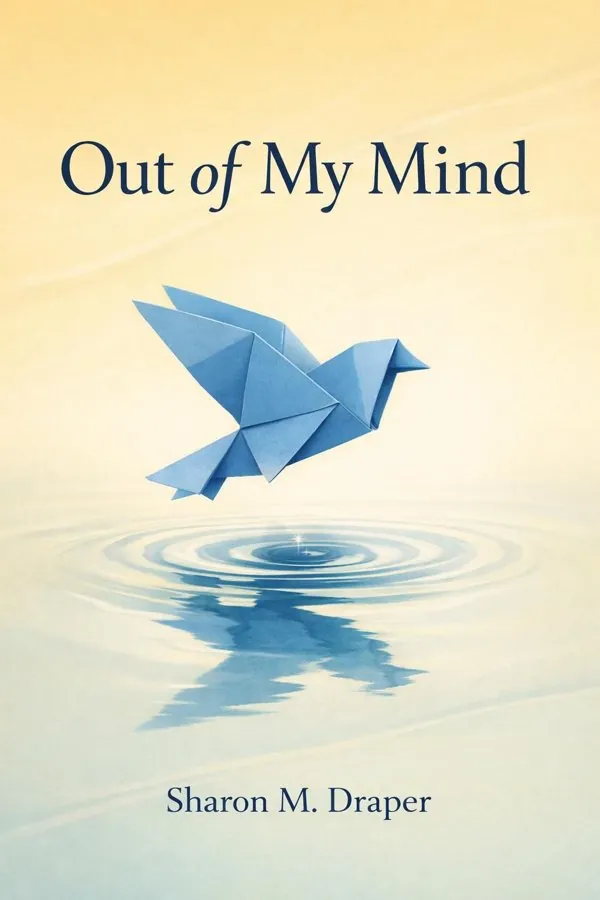
Out of My Mind: Summary & Key Insights
 10 min9 chaptersAudio available
Key Takeaways from Out of My Mind
One of the novel’s most unsettling truths is that people often confuse the inability to speak with the inability to think.
Few experiences are more isolating than knowing exactly who you are while everyone else sees a reduced version of you.
Every child needs at least one person who sees possibility before results appear.
One of the novel’s most hopeful insights is that communication is not limited to speech.
A person can be in the room and still be excluded from the real life of the group.
What Is Out of My Mind About?
Out of My Mind by Sharon M. Draper is a bestsellers book spanning 6 pages. Out of My Mind is Sharon M. Draper’s powerful 2010 novel about Melody Brooks, an eleven-year-old girl with cerebral palsy whose body limits her movement and speech, but whose mind is dazzlingly quick, observant, and full of life. Melody has a photographic memory, a hunger to learn, and a deep frustration with a world that assumes silence means emptiness. When assistive technology finally gives her a way to communicate, the people around her are forced to confront how badly they have underestimated her. What follows is both uplifting and painful: a story of breakthrough, friendship, exclusion, and the stubborn courage it takes to keep showing the world who you are. The novel matters because it challenges readers to rethink intelligence, disability, and belonging. Draper writes with emotional clarity and unusual empathy, drawing on her extensive experience as an award-winning educator who has spent decades working with young people from different backgrounds and abilities. More than a middle-grade bestseller, Out of My Mind is a call to listen more carefully, judge less quickly, and recognize the rich inner lives that often go unseen.
This FizzRead summary covers all 9 key chapters of Out of My Mind in approximately 10 minutes, distilling the most important ideas, arguments, and takeaways from Sharon M. Draper's work. Also available as an audio summary and Key Quotes Podcast.
Out of My Mind
Out of My Mind is Sharon M. Draper’s powerful 2010 novel about Melody Brooks, an eleven-year-old girl with cerebral palsy whose body limits her movement and speech, but whose mind is dazzlingly quick, observant, and full of life. Melody has a photographic memory, a hunger to learn, and a deep frustration with a world that assumes silence means emptiness. When assistive technology finally gives her a way to communicate, the people around her are forced to confront how badly they have underestimated her. What follows is both uplifting and painful: a story of breakthrough, friendship, exclusion, and the stubborn courage it takes to keep showing the world who you are.
The novel matters because it challenges readers to rethink intelligence, disability, and belonging. Draper writes with emotional clarity and unusual empathy, drawing on her extensive experience as an award-winning educator who has spent decades working with young people from different backgrounds and abilities. More than a middle-grade bestseller, Out of My Mind is a call to listen more carefully, judge less quickly, and recognize the rich inner lives that often go unseen.
Who Should Read Out of My Mind?
This book is perfect for anyone interested in bestsellers and looking to gain actionable insights in a short read. Whether you're a student, professional, or lifelong learner, the key ideas from Out of My Mind by Sharon M. Draper will help you think differently.
- ✓Readers who enjoy bestsellers and want practical takeaways
- ✓Professionals looking to apply new ideas to their work and life
- ✓Anyone who wants the core insights of Out of My Mind in just 10 minutes
Want the full summary?
Get instant access to this book summary and 100K+ more with Fizz Moment.
Get Free SummaryAvailable on App Store • Free to download
Key Chapters
One of the novel’s most unsettling truths is that people often confuse the inability to speak with the inability to think. Sharon M. Draper dismantles that assumption from the opening pages by placing readers directly inside Melody Brooks’s mind. Melody cannot walk independently or form words with her mouth because of cerebral palsy, yet her inner voice is sharp, funny, observant, and emotionally sophisticated. She remembers everything she sees and hears, notices patterns others miss, and feels the humiliation of being underestimated every day.
This contrast between Melody’s rich mental life and the world’s low expectations creates the emotional engine of the book. Her teachers often simplify material, classmates talk around her rather than to her, and strangers treat her as if she is much younger than she is. By showing readers what Melody knows but cannot express, Draper forces us to see how many judgments are based on surface-level impressions.
This idea matters far beyond the novel. In schools, workplaces, and families, people are routinely misjudged because they communicate differently, process information differently, or move through the world in atypical ways. Out of My Mind asks readers to pause before labeling someone by what they cannot do.
A practical lesson from Melody’s experience is to widen the ways we recognize intelligence. Instead of relying only on fluent speech, quick responses, or conventional behavior, we can pay attention to memory, creativity, problem-solving, persistence, and emotional insight.
Actionable takeaway: The next time someone seems quiet, slow, or difficult to understand, replace assumption with curiosity and ask what abilities might be hidden beneath the surface.
Few experiences are more isolating than knowing exactly who you are while everyone else sees a reduced version of you. Melody lives inside that painful gap. She is constantly aware that she is smarter than many people realize, yet she cannot easily correct their assumptions. That mismatch creates not just frustration but loneliness. She hears adults use babyish tones, watches classmates dismiss her, and feels the crushing indignity of being present but not fully included.
Draper uses Melody’s perspective to show that misunderstanding is not a minor inconvenience; it can shape a person’s confidence, relationships, and opportunities. Melody is not only denied respect, she is denied complexity. People see the wheelchair, the involuntary movements, the inability to speak, and stop looking. The novel reveals how damaging this can be, especially for children who are still forming a sense of self.
At the same time, the book suggests that misunderstanding often comes from habit and ignorance rather than deliberate cruelty. Many people simply have no framework for recognizing intelligence when it appears in unfamiliar form. That does not excuse their behavior, but it does point toward change through education, patience, and exposure.
In everyday life, this idea applies to anyone who has felt stereotyped: children with disabilities, language learners, introverts, students who learn differently, or anyone whose external presentation hides their internal depth. Real inclusion begins when we stop talking over people and start creating ways for them to be known.
Actionable takeaway: Notice when you are making quick judgments about someone’s abilities, and consciously give them more time, more dignity, and more ways to show who they are.
Every child needs at least one person who sees possibility before results appear. For Melody, that person is Mrs. V, her energetic next-door neighbor. Mrs. V does more than help Melody with practical skills; she treats her as a whole person with intelligence, humor, and potential. In a world full of lowered expectations, that kind of belief becomes transformational.
Mrs. V’s role highlights an important truth: support is most powerful when it combines care with challenge. She does not pity Melody or speak to her as if she is fragile. Instead, she encourages her to learn, explore, and push beyond what others assume is possible. She also supports Melody’s family, showing that inclusion often depends on networks of care rather than individual effort alone.
The novel makes clear that mentorship is not just about solving problems; it is about naming strengths that others overlook. Mrs. V sees Melody’s intelligence and helps create conditions in which it can emerge. She becomes an advocate, translator, encourager, and witness. For many readers, she represents the teacher, neighbor, coach, or relative who can alter the course of a young person’s life simply by refusing to accept limiting narratives.
This idea has broad application. A mentor can help a child gain confidence, try new tools, enter unfamiliar spaces, and keep going after setbacks. In inclusive education especially, one adult’s high expectations can dramatically change outcomes.
Actionable takeaway: Be the person who notices untapped ability in someone else and backs that belief with concrete support, encouragement, and opportunities.
One of the novel’s most hopeful insights is that communication is not limited to speech. Melody has always had thoughts, opinions, memories, and jokes, but without a reliable way to express them, those inner resources remain trapped. When she gains access to a speech-generating communication device, everything begins to change. The device does not create her intelligence; it reveals it.
Draper uses this turning point to show how transformative assistive technology can be. Melody is suddenly able to answer questions, participate more fully in school, express preferences, and connect with others in ways that were previously impossible. The shift is emotional as well as practical. Being heard affirms her humanity. Her device becomes not just a tool, but a bridge between her inner world and the social world.
Importantly, the novel also reminds readers that tools alone are not enough. Technology works best when people are willing to listen, adapt, and respect the person using it. A communication device can open a door, but others still have to stop, pay attention, and treat the speaker as real.
In modern classrooms and communities, this lesson remains urgent. Whether the tool is text-to-speech software, captioning, AAC devices, visual supports, or flexible interfaces, accessibility is not an extra feature. It is a way of making participation possible.
Actionable takeaway: When someone uses a tool to communicate or learn differently, treat that tool as an extension of their voice and make space for them to use it fully and without stigma.
A person can be in the room and still be excluded from the real life of the group. Out of My Mind exposes this distinction with painful clarity. Melody attends school, sits in classrooms, and is technically present among peers, but presence alone does not equal belonging. She is often separated, simplified, ignored, or treated as symbolic rather than genuinely included.
This becomes especially significant when Melody begins to demonstrate her academic abilities. Some adults and students are surprised to discover what she knows, which reveals how shallow their version of inclusion has been. They accepted her physical presence without revising their expectations, relationships, or systems. Draper’s novel argues that true inclusion means access to challenge, participation, friendship, dignity, and recognition.
The book is particularly useful for readers who think kindness alone is enough. Kindness matters, but inclusion also requires structure: adaptive tools, patient communication, high expectations, collaborative teaching, and social norms that invite participation rather than tokenism. Melody does not want to be merely accommodated; she wants to belong as a full member of her classroom community.
This lesson applies in schools, workplaces, and public life. Organizations often celebrate diversity while failing to redesign environments so that different kinds of people can meaningfully contribute. Inclusion asks harder questions: Who gets heard? Who gets challenged? Who gets left out when systems stay unchanged?
Actionable takeaway: Evaluate whether your idea of inclusion is only about letting someone be present, or whether it truly gives them access, voice, challenge, and belonging.
Love is not the absence of strain; often, it is what survives strain. Melody’s family cares deeply for her, but Draper portrays that love honestly rather than sentimentally. Her parents juggle advocacy, exhaustion, worry, and daily logistics. They want the best for Melody, yet they are not flawless. They make mistakes, feel overwhelmed, and struggle to balance Melody’s needs with the needs of the whole family.
This emotional realism becomes especially significant during moments of crisis. Events involving Melody’s younger sister intensify the family’s fear and guilt, revealing how vulnerable every household can become when care, stress, and unpredictability collide. Rather than presenting disability as an individual issue, the novel shows how it shapes family dynamics, routines, anxieties, and forms of tenderness.
What makes this portrayal effective is its refusal to reduce anyone to a role. Melody is not merely a burden or an inspiration; she is a daughter and sister. Her parents are not saints or failures; they are loving people doing difficult work under pressure. This nuance helps readers understand caregiving as emotionally complex and deeply human.
The broader lesson is that empathy should extend to family systems, not just individuals. Support for a disabled child often depends on respite, community help, flexible institutions, and emotional understanding. Families need room to be tired without being judged and hopeful without pretending everything is easy.
Actionable takeaway: If someone you know is caring for a family member with significant needs, offer practical help and compassionate understanding rather than assumptions about what their daily life must be like.
Resilience is often praised so casually that it becomes a way of ignoring injustice. Out of My Mind avoids that trap. Melody is unquestionably resilient: she endures misunderstanding, isolation, embarrassment, and disappointment while continuing to learn, hope, and push forward. But Draper never suggests that these hardships are good for her or that suffering is somehow noble. Melody’s strength is admirable precisely because her obstacles are real and unnecessary.
This distinction matters. Many stories about disability lean too heavily on inspiration, asking readers to admire perseverance without examining the social failures that make perseverance necessary. Draper gives readers a more honest framework. Melody is brave, but the goal should not be to celebrate how much she can tolerate. The goal should be to build a world in which she does not have to fight so hard to be seen and included.
That makes Melody’s resilience more grounded and more useful. It is not magical positivity. It is persistence mixed with anger, humor, longing, and determination. She keeps going not because everything happens for a reason, but because she knows her mind has value.
Readers can apply this lesson by changing the way they talk about adversity. Instead of praising people only for enduring exclusion, we can ask what systems need to change. We can admire courage while also addressing the barriers that require it.
Actionable takeaway: When you encounter someone’s resilience, honor their strength—but also ask what unfair conditions they have had to survive and what you can do to help remove those conditions.
The deepest message of the novel is that empathy requires more than feeling sorry for someone; it requires learning how to hear them. Out of My Mind invites readers into Melody’s perspective so intimately that they cannot remain satisfied with stereotypes. By the end of the book, the central moral challenge is not simply to care about Melody, but to change the habits of perception that prevented others from understanding her in the first place.
Draper achieves this by making the reader experience the gap between thought and expression. We know Melody’s jokes, fears, intelligence, and disappointments even when the characters around her do not. This narrative design turns reading itself into an exercise in perspective-taking. We come to see how often society values speed, conventional speech, and physical control over patience, attention, and depth.
The broader significance is profound. Empathy grows when we stop assuming that other people experience the world as we do. It grows when we ask how communication might look from another person’s body, limitations, tools, and social context. In classrooms, friendships, and families, listening differently may mean waiting longer, using alternative formats, reducing distractions, or simply refusing to speak for someone too quickly.
This is why the novel remains so widely taught and discussed. It does not just inform readers about disability; it trains them to notice hidden inner lives. That is a skill with moral consequences.
Actionable takeaway: Practice a wider form of listening by slowing down, giving people more than one way to express themselves, and remembering that a person’s voice may not sound like your expectation of one.
All Chapters in Out of My Mind
About the Author
Sharon M. Draper is an award-winning American author, educator, and literacy advocate best known for her novels for children and young adults. Before gaining national recognition as a writer, she spent many years as a classroom teacher and was named National Teacher of the Year, an honor that reflects her deep understanding of students and learning. Draper’s books often explore empathy, identity, injustice, family, and resilience, and she is widely praised for creating authentic young voices. Her work has received numerous distinctions, including multiple Coretta Scott King Awards. In Out of My Mind, Draper brings together her gifts as both storyteller and educator, crafting a novel that is emotionally powerful, socially meaningful, and enduringly relevant for readers of all ages.
Get This Summary in Your Preferred Format
Read or listen to the Out of My Mind summary by Sharon M. Draper anytime, anywhere. FizzRead offers multiple formats so you can learn on your terms — all free.
Available formats: App · Audio · PDF · EPUB — All included free with FizzRead
Download Out of My Mind PDF and EPUB Summary
Key Quotes from Out of My Mind
“One of the novel’s most unsettling truths is that people often confuse the inability to speak with the inability to think.”
“Few experiences are more isolating than knowing exactly who you are while everyone else sees a reduced version of you.”
“Every child needs at least one person who sees possibility before results appear.”
“One of the novel’s most hopeful insights is that communication is not limited to speech.”
“A person can be in the room and still be excluded from the real life of the group.”
Frequently Asked Questions about Out of My Mind
Out of My Mind by Sharon M. Draper is a bestsellers book that explores key ideas across 9 chapters. Out of My Mind is Sharon M. Draper’s powerful 2010 novel about Melody Brooks, an eleven-year-old girl with cerebral palsy whose body limits her movement and speech, but whose mind is dazzlingly quick, observant, and full of life. Melody has a photographic memory, a hunger to learn, and a deep frustration with a world that assumes silence means emptiness. When assistive technology finally gives her a way to communicate, the people around her are forced to confront how badly they have underestimated her. What follows is both uplifting and painful: a story of breakthrough, friendship, exclusion, and the stubborn courage it takes to keep showing the world who you are. The novel matters because it challenges readers to rethink intelligence, disability, and belonging. Draper writes with emotional clarity and unusual empathy, drawing on her extensive experience as an award-winning educator who has spent decades working with young people from different backgrounds and abilities. More than a middle-grade bestseller, Out of My Mind is a call to listen more carefully, judge less quickly, and recognize the rich inner lives that often go unseen.
You Might Also Like

The Godfather
Mario Puzo
10 min
The Handmaid's Tale
Margaret Atwood
10 min
The Hunger Games
Suzanne Collins
10 min
The Nightingale
Kristin Hannah
10 min
The Seven Husbands of Evelyn Hugo
Taylor Jenkins Reid
10 min
Backwater Justice
Fern Michaels
10 minBrowse by Category
Ready to read Out of My Mind?
Get the full summary and 100K+ more books with Fizz Moment.