
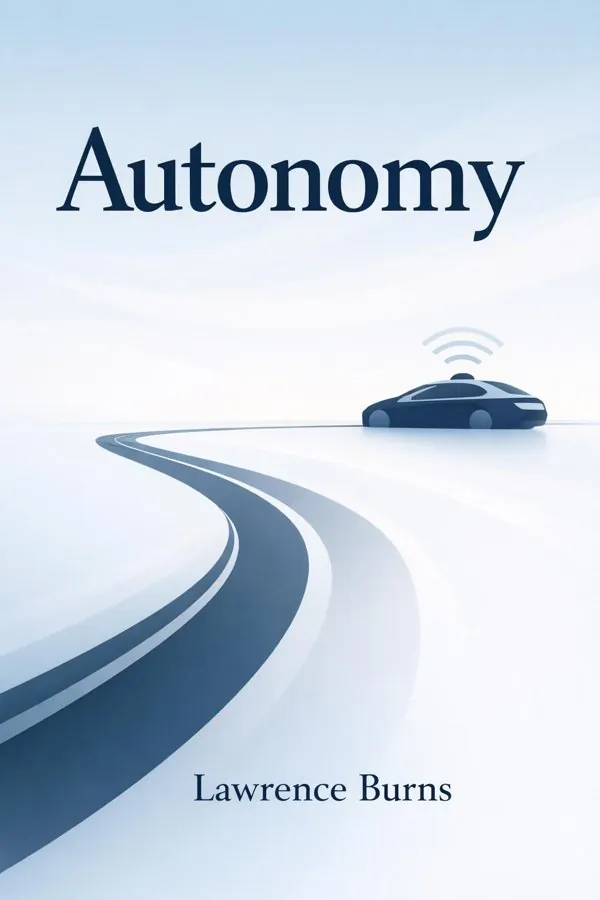
Autonomy: Summary & Key Insights
 10 min5 chaptersAudio available
What Is Autonomy About?
Autonomy by Lawrence Burns is a emerging_tech book spanning 5 pages. Autonomy: The Quest to Build the Driverless Car—and How It Will Reshape Our World is a nonfiction book by Lawrence D. Burns with Christopher Shulgan. It explores the development of autonomous vehicle technology, the history of automotive innovation, and the societal implications of self-driving cars. The book provides insider perspectives from Burns, a former General Motors executive, on the technological, ethical, and economic challenges of creating driverless transportation.
This FizzRead summary covers all 5 key chapters of Autonomy in approximately 10 minutes, distilling the most important ideas, arguments, and takeaways from Lawrence Burns's work. Also available as an audio summary and Key Quotes Podcast.
Autonomy
Autonomy: The Quest to Build the Driverless Car—and How It Will Reshape Our World is a nonfiction book by Lawrence D. Burns with Christopher Shulgan. It explores the development of autonomous vehicle technology, the history of automotive innovation, and the societal implications of self-driving cars. The book provides insider perspectives from Burns, a former General Motors executive, on the technological, ethical, and economic challenges of creating driverless transportation.
Who Should Read Autonomy?
This book is perfect for anyone interested in emerging_tech and looking to gain actionable insights in a short read. Whether you're a student, professional, or lifelong learner, the key ideas from Autonomy by Lawrence Burns will help you think differently.
- ✓Readers who enjoy emerging_tech and want practical takeaways
- ✓Professionals looking to apply new ideas to their work and life
- ✓Anyone who wants the core insights of Autonomy in just 10 minutes
Want the full summary?
Get instant access to this book summary and 100K+ more with Fizz Moment.
Get Free SummaryAvailable on App Store • Free to download
Key Chapters
To understand where autonomy began, one must go back to the roots of mobility itself. The automobile industry was born out of a relentless human desire to move faster and farther. The early twentieth century turned that desire into an economy—and a culture—centered around personal ownership of cars. Henry Ford’s assembly line did not just revolutionize production; it created a social expectation that freedom was tied to possession of a steering wheel. For decades, advances came incrementally—better engines, smoother transmissions, safer structures. Yet, despite all this progress, the essential act of driving remained a human task, susceptible to fatigue, distraction, and error.
During my years at General Motors, I began wrestling with a question that seems obvious now but was radical then: what if humans didn’t have to drive at all? Could we reimagine the automobile as a system that made decisions, perceived environments, and acted preemptively to protect passengers? This line of thinking ran parallel with the early research in machine perception taking place at institutions like Carnegie Mellon and Stanford in the 1980s and 1990s. Those academic experiments—prototype vehicles covered in sensors and processors—might have appeared primitive, but they were seeds of something transformative.
The story of modern autonomy truly accelerated with the 2004 DARPA Grand Challenge, a government-funded competition that dared teams to build vehicles that could navigate desert terrain without human intervention. The sight of those machines attempting to complete a 150-mile route was more than spectacle; it was a proof of concept. Though few finished the first race, by the 2007 Urban Challenge, the technology had matured to the point that cars were handling city traffic, intersections, and other vehicles. For those of us watching closely from the automotive industry, it was clear: the future of driving had just changed course.
When I left General Motors, I joined the movement from a front-row seat in the nascent world of autonomous startups. Google’s entry into the field was particularly disruptive. Unlike traditional automakers, Google approached the problem not as a car company but as a data and software organization. Led by Sebastian Thrun and later Chris Urmson, the Google Self-Driving Car Project brought together top talent from robotics, computer vision, and machine learning. Their achievement wasn’t simply in building a car that could move automatically—it was in designing a system that could interpret its surroundings with astonishing accuracy.
By 2010, the prototypes were quietly navigating California roads, absorbing petabytes of real-world data. That learning loop—testing, analyzing, and refining—became the true differentiator between Silicon Valley’s approach and Detroit’s tradition. Meanwhile, legacy manufacturers, still focused on gradual automation, found themselves struggling to adapt to a pace of innovation measured not in model years but in gigabytes.
I witnessed a profound cultural contrast between these worlds. In Detroit, change was methodical and risk-averse, governed by regulatory compliance and legacy cost. In Mountain View, experimentation ruled. Failures weren’t punished; they were fuel. Out of that crucible emerged not just Waymo but a new playbook for innovation in mobility: treat transportation as an information problem rather than an assembly problem. That shift—recognizing vehicles as intelligent networks—was the philosophical breakthrough that would propel the entire field forward.
+ 3 more chapters — available in the FizzRead app
All Chapters in Autonomy
About the Author
Lawrence D. Burns is an American engineer and business executive known for his work in automotive innovation and sustainable mobility. He served as Vice President of Research and Development at General Motors and has been a leading advocate for autonomous and electric vehicle technologies.
Get This Summary in Your Preferred Format
Read or listen to the Autonomy summary by Lawrence Burns anytime, anywhere. FizzRead offers multiple formats so you can learn on your terms — all free.
Available formats: App · Audio · PDF · EPUB — All included free with FizzRead
Download Autonomy PDF and EPUB Summary
Key Quotes from Autonomy
“To understand where autonomy began, one must go back to the roots of mobility itself.”
“When I left General Motors, I joined the movement from a front-row seat in the nascent world of autonomous startups.”
Frequently Asked Questions about Autonomy
Autonomy by Lawrence Burns is a emerging_tech book that explores key ideas across 5 chapters. Autonomy: The Quest to Build the Driverless Car—and How It Will Reshape Our World is a nonfiction book by Lawrence D. Burns with Christopher Shulgan. It explores the development of autonomous vehicle technology, the history of automotive innovation, and the societal implications of self-driving cars. The book provides insider perspectives from Burns, a former General Motors executive, on the technological, ethical, and economic challenges of creating driverless transportation.
You Might Also Like

Blockchain Technology Guide (Chinese Edition)
Li Qilei
10 min
21st Century Technologies Revisited: What is Happening and What is Next
Organisation for Economic Co-operation and Development (OECD)
10 min
Autonomous Vehicles: Opportunities, Strategies, and Challenges
Various Authors
10 min
Blockchain Basics: A Non-Technical Introduction in 25 Steps
Daniel Drescher
10 min
Blockchain Revolution: How the Technology Behind Bitcoin and Other Cryptocurrencies Is Changing the World
Don Tapscott & Alex Tapscott
10 min
Blockchain and Energy: A Holistic Guide to Blockchain in Energy Markets
Alexander Freier
10 minBrowse by Category
Ready to read Autonomy?
Get the full summary and 100K+ more books with Fizz Moment.