
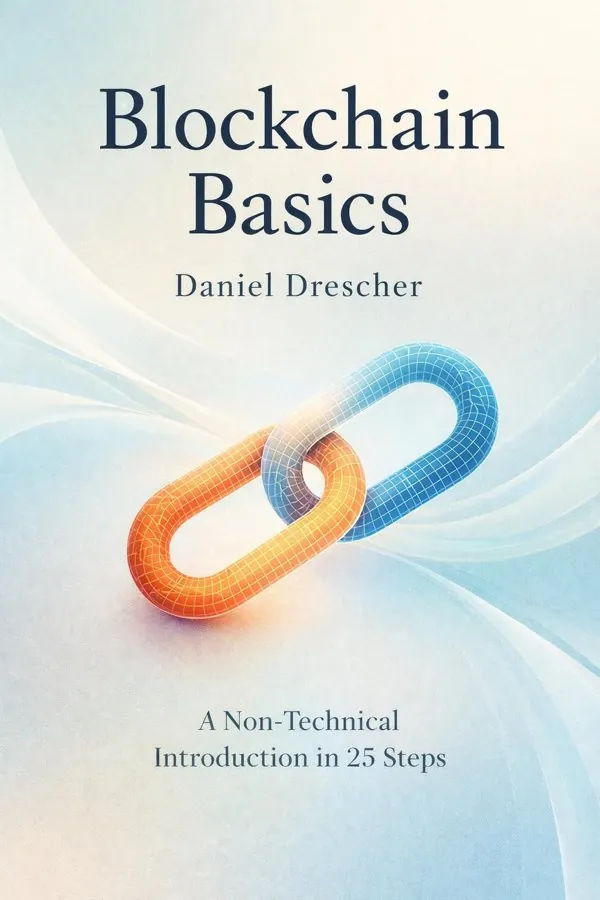
Blockchain Basics: A Non-Technical Introduction in 25 Steps: Summary & Key Insights
 10 min10 chaptersAudio available
Key Takeaways from Blockchain Basics: A Non-Technical Introduction in 25 Steps
Every blockchain discussion begins in the wrong place if it starts with code.
Most people rarely think about ledgers, yet ledgers quietly organize modern society.
The most radical promise of blockchain is not speed or novelty, but the possibility of coordinating trust without a central authority.
In everyday life, disagreement is expensive.
Trust is strongest when it does not depend on good intentions alone.
What Is Blockchain Basics: A Non-Technical Introduction in 25 Steps About?
Blockchain Basics: A Non-Technical Introduction in 25 Steps by Daniel Drescher is a emerging_tech book spanning 11 pages. Blockchain is often discussed as if it were either a miracle technology or an impossibly technical puzzle. Daniel Drescher’s Blockchain Basics: A Non-Technical Introduction in 25 Steps cuts through both extremes. The book is designed for readers who want to understand what blockchain actually is, why it works, and where it fits in the modern economy—without needing a background in computer science, cryptography, or finance. In a sequence of short, carefully structured steps, Drescher builds the subject from the ground up: transactions, ledgers, distributed records, consensus, cryptographic security, smart contracts, and real-world use cases. What makes the book valuable is not just its simplicity, but its discipline. Rather than rely on hype, Drescher explains the logic behind blockchain and shows how trust can be created through rules, transparency, and mathematics instead of centralized intermediaries. Drawing on his experience in banking, capital markets technology, and digital innovation, he offers a practical, business-aware perspective. The result is an accessible guide for professionals, students, and curious readers who want to understand one of the defining technologies of the digital age.
This FizzRead summary covers all 10 key chapters of Blockchain Basics: A Non-Technical Introduction in 25 Steps in approximately 10 minutes, distilling the most important ideas, arguments, and takeaways from Daniel Drescher's work. Also available as an audio summary and Key Quotes Podcast.
Blockchain Basics: A Non-Technical Introduction in 25 Steps
Blockchain is often discussed as if it were either a miracle technology or an impossibly technical puzzle. Daniel Drescher’s Blockchain Basics: A Non-Technical Introduction in 25 Steps cuts through both extremes. The book is designed for readers who want to understand what blockchain actually is, why it works, and where it fits in the modern economy—without needing a background in computer science, cryptography, or finance. In a sequence of short, carefully structured steps, Drescher builds the subject from the ground up: transactions, ledgers, distributed records, consensus, cryptographic security, smart contracts, and real-world use cases. What makes the book valuable is not just its simplicity, but its discipline. Rather than rely on hype, Drescher explains the logic behind blockchain and shows how trust can be created through rules, transparency, and mathematics instead of centralized intermediaries. Drawing on his experience in banking, capital markets technology, and digital innovation, he offers a practical, business-aware perspective. The result is an accessible guide for professionals, students, and curious readers who want to understand one of the defining technologies of the digital age.
Who Should Read Blockchain Basics: A Non-Technical Introduction in 25 Steps?
This book is perfect for anyone interested in emerging_tech and looking to gain actionable insights in a short read. Whether you're a student, professional, or lifelong learner, the key ideas from Blockchain Basics: A Non-Technical Introduction in 25 Steps by Daniel Drescher will help you think differently.
- ✓Readers who enjoy emerging_tech and want practical takeaways
- ✓Professionals looking to apply new ideas to their work and life
- ✓Anyone who wants the core insights of Blockchain Basics: A Non-Technical Introduction in 25 Steps in just 10 minutes
Want the full summary?
Get instant access to this book summary and 100K+ more with Fizz Moment.
Get Free SummaryAvailable on App Store • Free to download
Key Chapters
Every blockchain discussion begins in the wrong place if it starts with code. Drescher begins somewhere much more intuitive: the transaction. A transaction is simply an exchange of value or information between parties. That could be money sent from one account to another, a property title transferred to a buyer, or a health record updated by a doctor. By starting here, the book shows that blockchain is not primarily about computers—it is about recording and coordinating exchanges in a trustworthy way.
In traditional settings, transactions rely on institutions to verify, authorize, and document what happened. Banks keep payment records. Governments store land registries. Platforms manage digital ownership. These systems work, but they also create dependencies. If the institution makes an error, is hacked, changes rules, or excludes certain participants, the transaction system becomes fragile. Drescher’s first insight is that blockchain should be understood as a new way of managing these exchanges, not as a mysterious digital object.
He also helps readers see that information itself can be transacted. Ownership, permissions, certifications, and contractual commitments all involve updates to shared records. Once you understand transactions broadly, blockchain becomes easier to grasp because it appears as a structured method for storing and validating those changes.
A practical example is an international payment. Today, moving funds across borders may involve several intermediaries, settlement delays, and multiple records. A blockchain-based system aims to create one shared record that all authorized participants can trust. The immediate takeaway: before asking whether blockchain matters, ask what kinds of transactions in your industry depend on trust, coordination, and record-keeping.
Most people rarely think about ledgers, yet ledgers quietly organize modern society. A ledger is simply a record of transactions, but its design determines who is trusted, who can participate, and how disputes are resolved. Drescher explains that traditional ledgers are usually centralized: one organization controls the master copy, updates it, and decides who can see or change it. This model is familiar and efficient in many contexts, but it also creates concentration of power.
The book’s great strength is showing how blockchain reimagines the ledger itself. Instead of one institution maintaining the official record, multiple participants hold synchronized copies. This makes the ledger distributed rather than centralized. The significance is profound. If everyone in a network can verify the same history of transactions, then trust shifts away from a single gatekeeper and toward a system of shared rules.
Think of supply chains. A manufacturer, shipping company, customs authority, distributor, and retailer often maintain separate records. Reconciling these records is time-consuming and error-prone. A distributed ledger could give all parties access to the same updated chain of events, reducing delays and disputes. The same logic applies to trade finance, insurance claims, and identity verification.
Drescher does not claim distributed ledgers are automatically better in every situation. Instead, he helps readers evaluate when shared record-keeping solves a real coordination problem. If a single trusted authority already performs well, blockchain may be unnecessary. But when multiple parties need a common source of truth without surrendering control to one participant, distributed ledgers become compelling. Actionable takeaway: examine where your organization spends time reconciling records across parties—that is often where blockchain’s ledger model becomes relevant.
The most radical promise of blockchain is not speed or novelty, but the possibility of coordinating trust without a central authority. Drescher carefully explains what that means. In conventional systems, an intermediary validates transactions and enforces rules. We depend on banks to prevent double spending, registries to confirm ownership, and platforms to authorize activity. Blockchain asks whether those same functions can be performed by a network governed by protocol rather than by a single institution.
This does not mean institutions disappear. Rather, their role changes. Instead of being the sole keeper of truth, they may become participants in a shared system. That distinction matters because decentralization is often misunderstood as chaos. In Drescher’s treatment, decentralization is rule-based coordination across many nodes, each following the same logic and verifying the same data.
A useful example is digital asset transfer. In a centralized platform, the operator updates balances in its own database. Users trust the operator not to alter records unfairly. In a decentralized system, the network collectively validates the transfer according to predefined rules. No single actor can quietly rewrite the record. This reduces reliance on a dominant intermediary, though it may introduce trade-offs in speed, governance, or scalability.
Drescher also reminds readers that eliminating a central authority does not eliminate the need for trust altogether. It changes the object of trust—from institutions and people to protocols, incentives, and transparent processes. That is a crucial conceptual leap for non-technical readers. Actionable takeaway: when evaluating blockchain, identify exactly which central authority it aims to replace or reduce, and ask whether that authority is truly a bottleneck, risk, or source of inefficiency.
Trust is strongest when it does not depend on good intentions alone. Drescher shows how cryptography gives blockchain that property. While the book stays non-technical, it explains enough to make the role of cryptography intuitive. Digital signatures help prove that a transaction was authorized by the rightful party. Hash functions help detect whether data has been altered. Together, these tools allow participants to verify integrity and authenticity without personally knowing one another.
This is one of blockchain’s most important breakthroughs. In traditional business relationships, trust often depends on reputation, regulation, or contracts enforced after the fact. Blockchain systems shift part of that trust into technical guarantees. If a transaction is digitally signed, others can verify it. If a block has been tampered with, the cryptographic links reveal the inconsistency.
A practical illustration is document verification. A university could issue a digital certificate and register its proof on a blockchain. An employer checking the credential would not need to call the registrar’s office or rely entirely on a PDF copy. Instead, the employer could verify that the certificate matches an authenticated record. Similar logic applies to product provenance, intellectual property claims, and audit trails.
Drescher is careful not to exaggerate. Cryptography secures data and process, but it cannot guarantee that false information was not entered in the first place. Blockchain can preserve truthfulness in records only after valid input is established. That distinction is crucial in real-world use. Actionable takeaway: whenever you hear that blockchain is “trustless,” translate it into more precise language—cryptography reduces the need to trust people blindly by making verification stronger and tampering harder.
Information matters, but ordered information matters more. Drescher explains that blockchain is not just a database of entries; it is a structured history. Transactions are grouped into blocks, and blocks are linked to earlier blocks, forming a chain. This design means each new addition carries a traceable relationship to what came before. The result is a ledger where history is difficult to rewrite without detection.
That feature is what gives blockchain its reputation for immutability. In practical terms, immutability does not mean data can never be changed in any philosophical sense. It means the network is designed so that altering past records is extremely difficult, visible, or economically impractical. This is valuable wherever historical integrity matters.
Take food safety. If contamination is discovered, tracing products through farms, processors, shippers, and retailers can be slow because records are fragmented. A blockchain-based chain of custody could preserve a clearer, tamper-evident history of each handoff. Or consider financial auditing. Rather than reconstructing events from disconnected systems, auditors could examine a time-ordered ledger where changes are easier to follow.
The chaining of blocks also reinforces accountability. Once a record is accepted into the chain, participants gain confidence that it will remain part of the shared history unless extraordinary effort overturns it. That reduces ambiguity and opportunistic revision.
Drescher’s deeper point is that blockchain is valuable not only because it stores data, but because it stores sequence, linkage, and proof of consistency over time. Actionable takeaway: in any proposed blockchain use case, ask whether preserving an auditable and tamper-evident history is central to the problem. If not, a simpler database may be enough.
Technology alone does not sustain a blockchain network. People and organizations must run nodes, validate transactions, follow rules, and accept changes to the system over time. Drescher highlights that a blockchain is both a technical architecture and a social arrangement. This is where many oversimplified explanations fall short: they describe the software but ignore the governance and incentives that keep the software meaningful.
Participants in a blockchain network need reasons to behave honestly and mechanisms to handle disagreement. Depending on the design, incentives may come from fees, rewards, reputational benefits, or strategic alignment among consortium members. Governance may involve open communities, formal voting, or agreements among selected institutions. No matter the model, the network must answer practical questions: Who can participate? Who can validate? Who updates the rules? What happens when conflicts arise?
For example, a public blockchain open to anyone faces different governance challenges than a private blockchain used by banks. The public system must design economic incentives to resist manipulation at scale. The private system must determine who has permission, how legal accountability works, and how competing institutions share control.
Drescher’s explanation helps readers see that “decentralized” does not mean “ungoverned.” In fact, good governance becomes even more important when no single authority is in charge. Trust emerges from transparent rules, aligned interests, and predictable procedures. Actionable takeaway: never evaluate blockchain only by its technical features. Ask how the network is governed, how participants are motivated, and how the system resolves disputes—because weak governance can undermine even elegant technology.
Many institutions ask for trust without offering full visibility. Blockchain changes that balance by making verification more transparent and rule-based. Drescher emphasizes that confidence in blockchain systems comes not from marketing claims, but from the ability of participants to inspect, verify, and mathematically test what the system is doing. This is one reason blockchain attracts attention in environments where opacity creates friction.
Transparency can take several forms. Participants may be able to see the transaction history, verify that the rules were followed, and confirm that records match agreed procedures. Combined with cryptographic protections and consensus rules, this creates a framework where trust is not just asserted—it is examined. In many cases, the value is not that everyone sees everything, but that relevant actors can independently confirm the integrity of the process.
A good example is charitable donations or public spending. If funds move through a traceable blockchain-based system, stakeholders can verify where money was allocated and when. In corporate settings, transparency can improve internal accountability and reduce reconciliation costs across departments or partner organizations. In regulated industries, it can simplify auditing by providing a more consistent record trail.
Drescher also notes the tension between transparency and privacy. Not every transaction should be fully visible to every party. This means blockchain design must balance openness with confidentiality. Still, the central contribution remains: blockchain offers a way to replace blind faith with observable evidence.
Actionable takeaway: when considering blockchain, identify where greater transparency and independent verification would lower risk, reduce dispute resolution costs, or improve stakeholder confidence.
A contract is useful only if its terms lead to action. Drescher introduces smart contracts as one of blockchain’s most intriguing extensions: self-executing code that runs when predefined conditions are met. The key idea is not that legal agreements disappear, but that certain rules and actions can be automated on top of blockchain infrastructure. This reduces manual intervention and can speed up execution in multiparty processes.
Imagine crop insurance triggered by weather data. Instead of farmers filing claims and insurers manually reviewing them, a smart contract could release payment automatically when trusted data shows rainfall fell below a certain threshold. Or consider royalty distribution in media. When content is purchased or streamed, a smart contract could divide payments according to predetermined percentages and transfer funds instantly to the relevant parties.
Drescher keeps the explanation practical. Smart contracts are powerful because they can make transactions more predictable, transparent, and efficient. But they are not magical. Poorly written logic, flawed data inputs, or ambiguous real-world conditions can still create problems. A smart contract can execute exactly as coded even when the code reflects a bad assumption. Automation increases efficiency only when the underlying rules are clear and the data feeding the contract is trustworthy.
The broader significance is that blockchain can do more than store records; it can trigger behavior. That opens possibilities in finance, logistics, legal operations, and digital marketplaces. Actionable takeaway: look for business processes that rely on repetitive verification and rule-based execution—those are the best candidates for smart contract experimentation, provided the rules can be clearly defined.
Not every problem needs blockchain, and Drescher’s refusal to oversell the technology is one of the book’s greatest strengths. After explaining the mechanics, he turns to applications and future implications with a balanced mindset. Blockchain can be transformative where multiple parties need a shared, tamper-evident record and do not fully trust one another. It can be useful in supply chains, trade finance, identity systems, asset registries, healthcare data sharing, and automated business workflows. But outside those contexts, it may be unnecessary or inefficient.
This practical lens helps readers separate true opportunities from hype. For example, a land registry in a region with fragmented records and weak institutional trust may benefit from blockchain’s auditability and shared access. A company managing a simple internal database with one trusted administrator may not. Likewise, a consortium of firms trying to reduce reconciliation costs across organizations may find real value, while a solo startup might not need a decentralized ledger at all.
Drescher’s final message is forward-looking without becoming speculative. Blockchain’s long-term importance lies in how it challenges established assumptions about trust, coordination, and digital ownership. It encourages us to imagine systems where verification is built in, where records are jointly maintained, and where execution can be automated across organizational boundaries.
The most useful reading of the book is therefore strategic rather than ideological. Blockchain is neither a cure-all nor a fad to dismiss automatically. Actionable takeaway: use blockchain as a diagnostic question—if your process involves many actors, low mutual trust, frequent reconciliation, and high need for auditability, then the technology deserves serious consideration.
All Chapters in Blockchain Basics: A Non-Technical Introduction in 25 Steps
About the Author
Daniel Drescher is a technology professional with deep experience in banking, capital markets, and financial systems innovation. Over the course of his career, he has worked at the intersection of business and technology, focusing on areas such as automation, machine learning, enterprise architecture, and distributed systems. That blend of practical industry knowledge and technical fluency gives his writing unusual clarity, especially for readers trying to understand complex technologies without a programming background. In Blockchain Basics, Drescher draws on this experience to explain how blockchain works in terms that business professionals, students, and non-specialists can actually use. He is particularly valued for his balanced approach: insightful about blockchain’s potential, but careful to separate genuine use cases from exaggerated claims.
Get This Summary in Your Preferred Format
Read or listen to the Blockchain Basics: A Non-Technical Introduction in 25 Steps summary by Daniel Drescher anytime, anywhere. FizzRead offers multiple formats so you can learn on your terms — all free.
Available formats: App · Audio · PDF · EPUB — All included free with FizzRead
Download Blockchain Basics: A Non-Technical Introduction in 25 Steps PDF and EPUB Summary
Key Quotes from Blockchain Basics: A Non-Technical Introduction in 25 Steps
“Every blockchain discussion begins in the wrong place if it starts with code.”
“Most people rarely think about ledgers, yet ledgers quietly organize modern society.”
“The most radical promise of blockchain is not speed or novelty, but the possibility of coordinating trust without a central authority.”
“In everyday life, disagreement is expensive.”
“Trust is strongest when it does not depend on good intentions alone.”
Frequently Asked Questions about Blockchain Basics: A Non-Technical Introduction in 25 Steps
Blockchain Basics: A Non-Technical Introduction in 25 Steps by Daniel Drescher is a emerging_tech book that explores key ideas across 10 chapters. Blockchain is often discussed as if it were either a miracle technology or an impossibly technical puzzle. Daniel Drescher’s Blockchain Basics: A Non-Technical Introduction in 25 Steps cuts through both extremes. The book is designed for readers who want to understand what blockchain actually is, why it works, and where it fits in the modern economy—without needing a background in computer science, cryptography, or finance. In a sequence of short, carefully structured steps, Drescher builds the subject from the ground up: transactions, ledgers, distributed records, consensus, cryptographic security, smart contracts, and real-world use cases. What makes the book valuable is not just its simplicity, but its discipline. Rather than rely on hype, Drescher explains the logic behind blockchain and shows how trust can be created through rules, transparency, and mathematics instead of centralized intermediaries. Drawing on his experience in banking, capital markets technology, and digital innovation, he offers a practical, business-aware perspective. The result is an accessible guide for professionals, students, and curious readers who want to understand one of the defining technologies of the digital age.
You Might Also Like
Blockchain Technology Guide (Chinese Edition)
Li Qilei
10 min
21st Century Technologies Revisited: What is Happening and What is Next
Organisation for Economic Co-operation and Development (OECD)
10 min
Autonomous Vehicles: Opportunities, Strategies, and Challenges
Various Authors
10 min
Autonomy
Lawrence Burns
10 min
Blockchain Revolution: How the Technology Behind Bitcoin and Other Cryptocurrencies Is Changing the World
Don Tapscott & Alex Tapscott
10 min
Blockchain and Energy: A Holistic Guide to Blockchain in Energy Markets
Alexander Freier
10 minBrowse by Category
Ready to read Blockchain Basics: A Non-Technical Introduction in 25 Steps?
Get the full summary and 100K+ more books with Fizz Moment.