
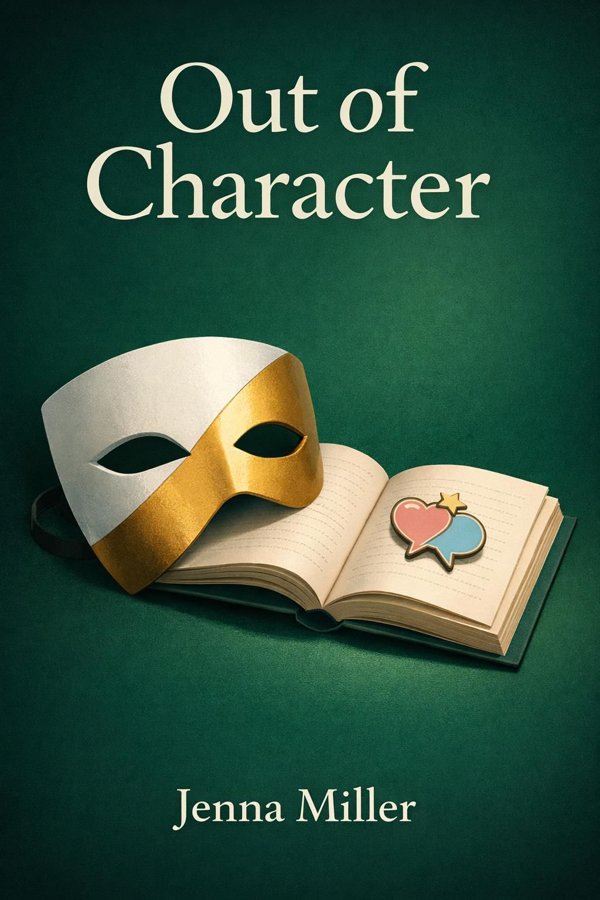
Out of Character: Summary & Key Insights
by Jenna Miller
 10 min8 chaptersAudio available
Key Takeaways from Out of Character
A double life rarely collapses all at once; it usually frays at the edges until every performance becomes impossible to sustain.
Sometimes the people who knew us best before we started performing are the ones who can most clearly see what we have become.
Growth often begins when our own narrative stops being the only one we trust.
Authenticity is often romanticized as a sudden, fearless act, but in reality it usually looks messy, partial, and vulnerable.
The communities we are told are trivial often become the places where we first learn we are not alone.
What Is Out of Character About?
Out of Character by Jenna Miller is a bestsellers book spanning 4 pages. Out of Character by Jenna Miller is a contemporary young adult novel about the exhausting gap between who we are and who we think we have to be in order to belong. At the center of the story is Cass, a teen who has learned to split herself in two: one version fits neatly into the social rules of high school, while the other loves fandom, conventions, online friendships, and the parts of herself she fears will make her seem uncool. When that carefully managed balance begins to collapse, Cass is forced to confront the cost of performance, the fragility of popularity, and the possibility that being known might be better than being approved of. What makes the novel resonate is its emotional precision. Miller writes with deep understanding about adolescence, identity, queer self-discovery, and the complicated politics of friendship in both digital and offline spaces. More than a coming-of-age story, Out of Character is a sharp and compassionate exploration of authenticity, shame, and the courage it takes to stop editing yourself for other people’s comfort.
This FizzRead summary covers all 8 key chapters of Out of Character in approximately 10 minutes, distilling the most important ideas, arguments, and takeaways from Jenna Miller's work. Also available as an audio summary and Key Quotes Podcast.
Out of Character
Out of Character by Jenna Miller is a contemporary young adult novel about the exhausting gap between who we are and who we think we have to be in order to belong. At the center of the story is Cass, a teen who has learned to split herself in two: one version fits neatly into the social rules of high school, while the other loves fandom, conventions, online friendships, and the parts of herself she fears will make her seem uncool. When that carefully managed balance begins to collapse, Cass is forced to confront the cost of performance, the fragility of popularity, and the possibility that being known might be better than being approved of. What makes the novel resonate is its emotional precision. Miller writes with deep understanding about adolescence, identity, queer self-discovery, and the complicated politics of friendship in both digital and offline spaces. More than a coming-of-age story, Out of Character is a sharp and compassionate exploration of authenticity, shame, and the courage it takes to stop editing yourself for other people’s comfort.
Who Should Read Out of Character?
This book is perfect for anyone interested in bestsellers and looking to gain actionable insights in a short read. Whether you're a student, professional, or lifelong learner, the key ideas from Out of Character by Jenna Miller will help you think differently.
- ✓Readers who enjoy bestsellers and want practical takeaways
- ✓Professionals looking to apply new ideas to their work and life
- ✓Anyone who wants the core insights of Out of Character in just 10 minutes
Want the full summary?
Get instant access to this book summary and 100K+ more with Fizz Moment.
Get Free SummaryAvailable on App Store • Free to download
Key Chapters
Sometimes the people who knew us best before we started performing are the ones who can most clearly see what we have become. After her social world begins to crack, Cass unexpectedly reconnects with Maddie, her former best friend. Their history matters because it represents a version of Cass that was less filtered and more sincere. The friendship did not simply fade with time; it was damaged by Cass’s pursuit of popularity and her willingness to distance herself from what once brought her joy. That makes their renewed connection emotionally rich and morally complicated.
Miller does not present reconciliation as easy nostalgia. Cass cannot simply step back into the friendship and expect everything to be repaired. There is hurt, mistrust, and the lingering memory of abandonment. Maddie becomes important not because she conveniently forgives, but because her presence forces Cass to confront the choices she made in the name of belonging. In that sense, the reunion is not just about recovering a friend; it is about recovering integrity.
The book suggests that growth often requires returning to relationships we left unfinished. This does not mean all broken friendships should be restored, nor that apology guarantees closeness. Rather, it means our past connections can reveal patterns we would rather ignore: whom we sidelined, what values we traded away, and how fear shaped our behavior. Cass’s movement toward Maddie shows that rebuilding trust starts with accountability, not self-justification.
In real life, this theme resonates with anyone who has drifted from old friends while trying to reinvent themselves. Looking back can be painful, but it can also be clarifying. The past is not only where we made mistakes; it is also where we can locate the selves we abandoned too quickly.
Actionable takeaway: Reach out to one person connected to an earlier, more authentic version of you, and begin with honesty rather than excuses.
Growth often begins when our own narrative stops being the only one we trust. A major strength of Out of Character is the way it pushes Cass beyond her self-protective assumptions and asks her to see other people as full, complicated individuals rather than background characters in her social survival story. As she reconnects with people she has misjudged or neglected, she starts learning that everyone is navigating vulnerabilities, expectations, and private fears of their own.
This shift in perspective matters because Cass initially interprets much of the world through anxiety and image management. She is highly attuned to how she appears, which means she often fails to understand how her choices affect others. By encountering different viewpoints—through friendships, fandom interactions, and emotional conflict—she begins to recognize the limits of her own defensiveness. The people around her are not simply sources of approval or rejection. They have histories, wounds, and motivations that demand empathy.
Miller uses this expanding awareness to show that maturity is not just self-acceptance; it is also relational intelligence. Cass grows when she learns to listen, to question first impressions, and to sit with discomfort instead of rushing to control outcomes. This is especially relevant for young readers in digitally mediated environments, where misunderstandings can escalate quickly and identities are often flattened into labels. The novel quietly argues that perspective-taking is a discipline, one that deepens connection and reduces shame.
Applied practically, this idea is useful in friendships, family life, and school communities. Before assuming someone is judging you, ask what else might be true. Before deciding a friendship is over, consider what pain or pressure the other person may be carrying. Perspective does not erase harm, but it creates the conditions for better responses.
Actionable takeaway: In your next conflict, pause before defending yourself and name one valid feeling or concern the other person might have.
Authenticity is often romanticized as a sudden, fearless act, but in reality it usually looks messy, partial, and vulnerable. Out of Character resists the simplistic idea that Cass only needs to “be herself” and everything will improve. Instead, the novel shows that authenticity is a practice of telling the truth more consistently, even when that truth disrupts the image you have carefully built. Cass does not become brave overnight. She stumbles, hesitates, and sometimes continues to conceal herself. That makes her growth believable.
What the story captures especially well is that authenticity is not the opposite of insecurity. You can still be afraid and choose honesty anyway. Cass’s love of fandom, her emotional attachments, and her evolving sense of identity all become sites where she must decide whether she wants admiration or real connection. Miller presents these choices with compassion, acknowledging that teenagers often learn to hide for good reasons. Social rejection can feel devastating. But the book also insists that chronic self-erasure carries its own cost.
This idea has practical relevance far beyond adolescence. Many people think they must become fully confident before showing their true interests, values, or desires. The novel suggests the reverse: confidence often grows after we risk being known. Authenticity is not a polished final state; it is built through repeated acts of openness, apology, boundary-setting, and self-recognition.
Cass’s journey also reminds readers that honesty does not require total public disclosure. Being authentic means aligning your actions with your values, not performing your innermost self for everyone. The key is choosing relationships where your real self does not have to be disguised to be tolerated.
Actionable takeaway: Identify one place where your public behavior conflicts with your private values, and make one small change toward alignment this week.
The communities we are told are trivial often become the places where we first learn we are not alone. One of the most meaningful elements in Out of Character is its portrayal of fandom not as a quirky backdrop, but as a legitimate emotional ecosystem. Conventions, online spaces, shared obsessions, and fan-created communities offer Cass something school often cannot: recognition without immediate conformity. In fandom, enthusiasm becomes connection, and identity can be explored through stories, characters, and collective joy.
Miller treats this world with respect. Rather than mocking passionate interest, the novel recognizes fandom as a site of creativity, friendship, and self-discovery. For many readers, especially queer teens or socially anxious teens, fandom can function as a bridge between isolation and belonging. It offers language, rituals, and people who understand why fictional worlds matter. For Cass, this space is deeply personal, which is exactly why she feels pressure to hide it from peers who might dismiss it.
The book also captures an important tension: communities that feel safe can still become complicated when real-life identity, reputation, and conflict enter the picture. Fandom does not solve every problem, but it gives Cass a context in which authenticity feels more possible. That matters. Belonging is not only about being accepted in mainstream spaces; sometimes it is about finding or building spaces where your excitement is not treated as embarrassment.
In everyday life, this theme encourages readers to reconsider the value of interest-based communities. Whether through books, games, art, music, sports, or online forums, shared passion can create meaningful support networks. The challenge is to honor those communities instead of minimizing them to appear more acceptable elsewhere.
Actionable takeaway: Invest more openly in one community built around something you genuinely love, and treat that enthusiasm as a strength rather than a liability.
Wanting forgiveness is natural; earning trust is harder. One of the most grounded lessons in Out of Character is that emotional repair depends on accountability, not simply good intentions. As Cass faces the consequences of her choices, she cannot undo the hurt by explaining that she was scared or confused. Fear may explain behavior, but it does not erase impact. Miller handles this tension well, allowing Cass room to grow without excusing the damage she has caused.
This makes the novel especially valuable for readers who are used to stories where conflict is resolved through a single dramatic apology. Here, repair is more gradual. It requires honesty, changed behavior, and the humility to accept that some people may remain cautious even after you mean well. Cass has to learn that accountability includes listening to criticism without centering her own discomfort. That is a difficult lesson at any age.
The broader application is clear. In friendships and family relationships, people often rush toward closure because guilt is uncomfortable. But real repair asks different questions: Have I named what I did clearly? Have I made space for the other person’s experience? Am I behaving differently now, or do I only want relief from shame? The novel suggests that trust returns through consistency, not performance.
Importantly, accountability also reconnects with self-respect. When Cass stops defending every mistake and starts owning her choices, she becomes more emotionally solid. She no longer needs to protect a perfect image because she is learning how to be imperfect without being dishonest. That is one of the story’s most mature contributions.
Actionable takeaway: If you owe someone repair, make your next apology specific, avoid self-justifying language, and pair your words with one concrete behavioral change.
Sometimes the hardest truth to admit is not what others will think of us, but what acknowledging ourselves might change. Out of Character weaves queer identity into its emotional core with sensitivity, showing that self-recognition can unfold gradually through friendship, longing, discomfort, and comparison between the life one performs and the life one wants. Cass’s internal journey is not presented as a neat revelation. Instead, it emerges through confusion, attraction, and the slow realization that suppressing parts of herself has affected more than her hobbies or friendships.
Jenna Miller’s handling of this theme is particularly strong because it links queer questioning to the broader problem of authenticity. Cass is not only hiding interests; she is also navigating feelings that complicate the version of herself she has tried to maintain. That overlap makes the story feel true to many readers’ experiences. Identity exploration rarely happens in isolation. It is entangled with social pressure, fear of rejection, and the desire to remain legible to the people around us.
The novel’s value lies in its gentleness. It does not force certainty before Cass is ready, and it does not treat queerness as a dramatic twist. Instead, it frames self-understanding as an act of attention: noticing what feels real, what feels performative, and where emotional energy naturally flows. For readers who are questioning their own identities, this can be deeply affirming.
In practical terms, the theme encourages patience and self-trust. You do not need to have every label figured out immediately. What matters is creating enough internal and external space to explore honestly. The story reminds us that confusion is not failure; it is often the beginning of clarity.
Actionable takeaway: Give yourself permission to explore identity through reflection, conversation, or journaling without demanding immediate certainty or a final label.
All Chapters in Out of Character
About the Author
Jenna Miller is an American author of young adult fiction whose work focuses on identity, belonging, relationships, and queer representation. She is known for creating emotionally authentic characters who feel caught between the expectations of the world around them and the truth of who they are. Her writing often explores the vulnerability of adolescence with warmth, humor, and psychological insight, making her especially appealing to readers who enjoy character-driven contemporary YA. In Out of Character, Miller brings together themes of fandom, friendship, self-discovery, and social pressure in a story that feels both modern and deeply relatable. Her work stands out for its compassion toward messy growth and its belief that honesty, though difficult, is essential to real connection.
Get This Summary in Your Preferred Format
Read or listen to the Out of Character summary by Jenna Miller anytime, anywhere. FizzRead offers multiple formats so you can learn on your terms — all free.
Available formats: App · Audio · PDF · EPUB — All included free with FizzRead
Download Out of Character PDF and EPUB Summary
Key Quotes from Out of Character
“A double life rarely collapses all at once; it usually frays at the edges until every performance becomes impossible to sustain.”
“Sometimes the people who knew us best before we started performing are the ones who can most clearly see what we have become.”
“Growth often begins when our own narrative stops being the only one we trust.”
“Authenticity is often romanticized as a sudden, fearless act, but in reality it usually looks messy, partial, and vulnerable.”
“The communities we are told are trivial often become the places where we first learn we are not alone.”
Frequently Asked Questions about Out of Character
Out of Character by Jenna Miller is a bestsellers book that explores key ideas across 8 chapters. Out of Character by Jenna Miller is a contemporary young adult novel about the exhausting gap between who we are and who we think we have to be in order to belong. At the center of the story is Cass, a teen who has learned to split herself in two: one version fits neatly into the social rules of high school, while the other loves fandom, conventions, online friendships, and the parts of herself she fears will make her seem uncool. When that carefully managed balance begins to collapse, Cass is forced to confront the cost of performance, the fragility of popularity, and the possibility that being known might be better than being approved of. What makes the novel resonate is its emotional precision. Miller writes with deep understanding about adolescence, identity, queer self-discovery, and the complicated politics of friendship in both digital and offline spaces. More than a coming-of-age story, Out of Character is a sharp and compassionate exploration of authenticity, shame, and the courage it takes to stop editing yourself for other people’s comfort.
You Might Also Like

The Godfather
Mario Puzo
10 min
The Handmaid's Tale
Margaret Atwood
10 min
The Hunger Games
Suzanne Collins
10 min
The Nightingale
Kristin Hannah
10 min
The Seven Husbands of Evelyn Hugo
Taylor Jenkins Reid
10 min
Backwater Justice
Fern Michaels
10 minBrowse by Category
Ready to read Out of Character?
Get the full summary and 100K+ more books with Fizz Moment.