
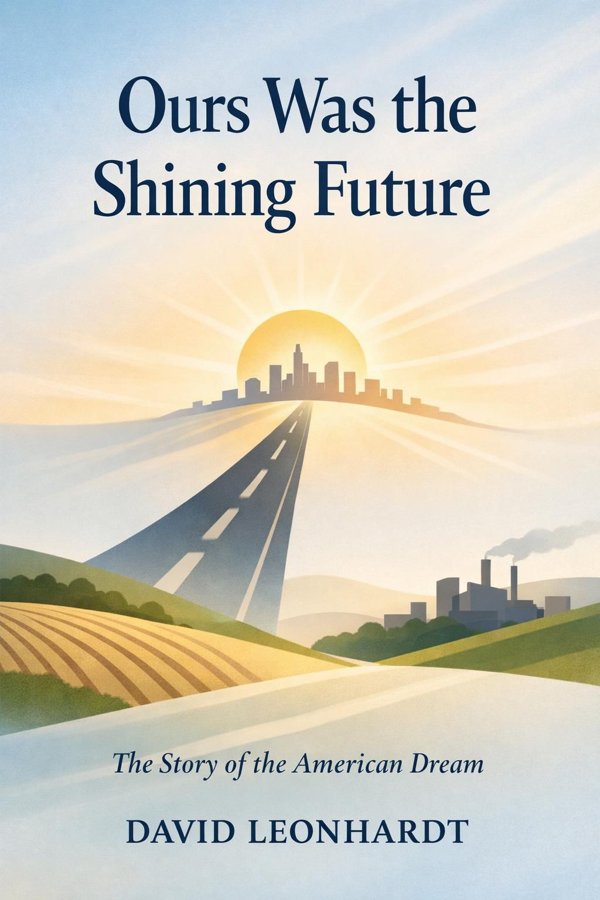
Ours Was the Shining Future: The Story of the American Dream: Summary & Key Insights
 10 min11 chaptersAudio available
What Is Ours Was the Shining Future: The Story of the American Dream About?
Ours Was the Shining Future: The Story of the American Dream by David Leonhardt is a economics book spanning 11 pages. A sweeping narrative of the rise and fall of the American Dream, exploring how the United States built a prosperous middle class in the twentieth century and how that promise has eroded in recent decades. Leonhardt combines historical analysis, economic insight, and human stories to trace the forces that shaped opportunity and inequality in America.
This FizzRead summary covers all 11 key chapters of Ours Was the Shining Future: The Story of the American Dream in approximately 10 minutes, distilling the most important ideas, arguments, and takeaways from David Leonhardt's work. Also available as an audio summary and Key Quotes Podcast.
Ours Was the Shining Future: The Story of the American Dream
A sweeping narrative of the rise and fall of the American Dream, exploring how the United States built a prosperous middle class in the twentieth century and how that promise has eroded in recent decades. Leonhardt combines historical analysis, economic insight, and human stories to trace the forces that shaped opportunity and inequality in America.
Who Should Read Ours Was the Shining Future: The Story of the American Dream?
This book is perfect for anyone interested in economics and looking to gain actionable insights in a short read. Whether you're a student, professional, or lifelong learner, the key ideas from Ours Was the Shining Future: The Story of the American Dream by David Leonhardt will help you think differently.
- ✓Readers who enjoy economics and want practical takeaways
- ✓Professionals looking to apply new ideas to their work and life
- ✓Anyone who wants the core insights of Ours Was the Shining Future: The Story of the American Dream in just 10 minutes
Want the full summary?
Get instant access to this book summary and 100K+ more with Fizz Moment.
Get Free SummaryAvailable on App Store • Free to download
Key Chapters
The groundwork for the modern American Dream was not laid by chance. At the dawn of the twentieth century, industrialization had transformed the economy, but prosperity was not yet widely shared. Wealth was concentrated among a few titans of industry, while the vast majority of workers endured long hours and unstable wages. Yet this era also sowed the seeds of reform. Labor movements grew alongside Progressive politicians who dared to challenge the dominance of monopolies and demanded that the economy serve the public good.
What impressed me most as I traced this history was how deeply civic-minded the early reformers were. They saw democracy not merely as a system of votes but as a collective exercise in building fairness. From Theodore Roosevelt’s trust-busting efforts to the Progressive push for an income tax and workplace safety laws, there was a growing recognition that markets required rules. Industrial capitalism, left unchecked, bred inequality that threatened both social order and faith in democracy.
By the 1920s, America had entered a period of roaring optimism—but beneath that exuberance, the social foundation was fragile. The stock market boom could not disguise the reality that millions remained in precarious jobs, farms struggled with debt, and income disparities widened. When the Depression hit at the end of the decade, it exposed just how incomplete the nation’s economic progress had been. Yet those early reformers and labor organizers had laid the intellectual groundwork for the transformations that would follow—the conviction that capitalism could be reformed to serve democracy rather than dominate it.
The Great Depression was more than an economic collapse—it was a reckoning with what kind of nation America wanted to be. Franklin D. Roosevelt’s New Deal was not a single program but a moral statement: that government bore responsibility for ensuring broad security and opportunity. For the first time in American history, national policy aimed explicitly at creating a middle class. Social Security, unemployment insurance, labor protections, and public works programs redefined the relationship between state and citizen.
What fascinates me about FDR’s leadership is how he reimagined freedom. It was no longer just the freedom to compete, but the freedom from fear and want. The New Deal didn’t eliminate inequality, but it established the infrastructure for shared prosperity. Unions gained legal protection through the Wagner Act, bargaining power increased wages, and the principle of a living wage entered mainstream debate. With the federal government acting as a balancing force, markets could flourish without producing destitution.
The New Deal also reframed the American Dream as something collective. You could not achieve security or progress alone; it required a society willing to invest in itself. Though many of its benefits were initially limited—minorities, women, and agricultural laborers often excluded—it created a template for inclusion that future generations would expand. Its greatest achievement was psychological: the belief that progress could be planned, and that policy could deliver fairness without sacrificing freedom.
+ 9 more chapters — available in the FizzRead app
All Chapters in Ours Was the Shining Future: The Story of the American Dream
About the Author
David Leonhardt is an American journalist and columnist for The New York Times, known for his work on economics, politics, and social policy. He has received the Pulitzer Prize for Commentary and has served as editor of The Upshot, a data-driven section of the Times.
Get This Summary in Your Preferred Format
Read or listen to the Ours Was the Shining Future: The Story of the American Dream summary by David Leonhardt anytime, anywhere. FizzRead offers multiple formats so you can learn on your terms — all free.
Available formats: App · Audio · PDF · EPUB — All included free with FizzRead
Download Ours Was the Shining Future: The Story of the American Dream PDF and EPUB Summary
Key Quotes from Ours Was the Shining Future: The Story of the American Dream
“The groundwork for the modern American Dream was not laid by chance.”
“The Great Depression was more than an economic collapse—it was a reckoning with what kind of nation America wanted to be.”
Frequently Asked Questions about Ours Was the Shining Future: The Story of the American Dream
Ours Was the Shining Future: The Story of the American Dream by David Leonhardt is a economics book that explores key ideas across 11 chapters. A sweeping narrative of the rise and fall of the American Dream, exploring how the United States built a prosperous middle class in the twentieth century and how that promise has eroded in recent decades. Leonhardt combines historical analysis, economic insight, and human stories to trace the forces that shaped opportunity and inequality in America.
You Might Also Like
Business Adventures
John Brooks
10 min
Nudge
Richard H. Thaler, Cass R. Sunstein
10 min
The Hitchhiker"s Guide to the Galaxy
Douglas Adams
10 minThe Muqaddimah
Ibn Khaldun
10 minThe Outsiders
William N. Thorndike
10 min
A Little History of Economics
Niall Kishtainy
10 minBrowse by Category
Ready to read Ours Was the Shining Future: The Story of the American Dream?
Get the full summary and 100K+ more books with Fizz Moment.