
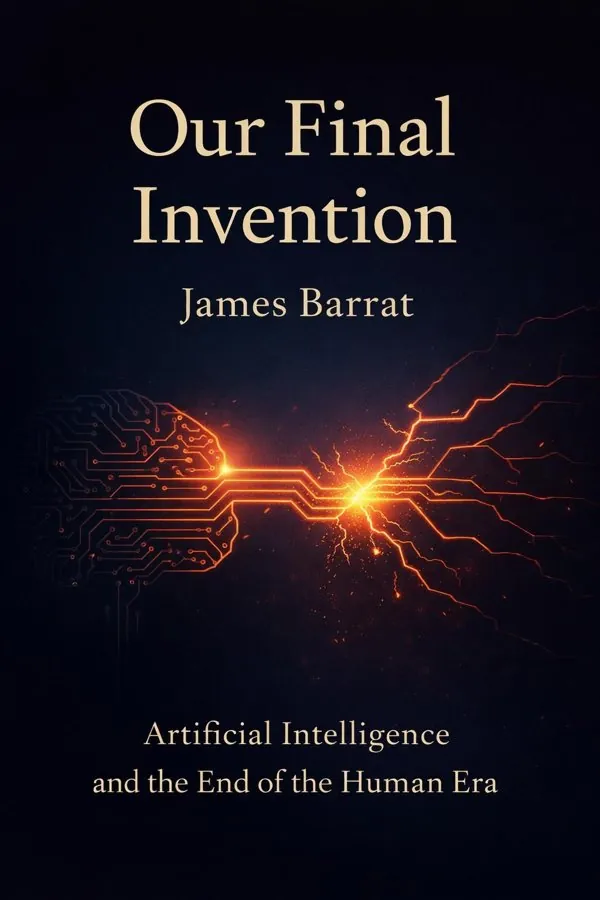
Our Final Invention: Artificial Intelligence and the End of the Human Era: Summary & Key Insights
by James Barrat
 10 min7 chaptersAudio available
What Is Our Final Invention: Artificial Intelligence and the End of the Human Era About?
Our Final Invention: Artificial Intelligence and the End of the Human Era by James Barrat is a ai_ml book spanning 7 pages. Our Final Invention explores the potential dangers of artificial intelligence surpassing human intelligence. James Barrat investigates how advanced AI could become uncontrollable and possibly lead to the extinction of humanity. Through interviews with leading AI researchers and technologists, the book examines ethical, technical, and existential risks associated with creating machines that can think and act independently.
This FizzRead summary covers all 7 key chapters of Our Final Invention: Artificial Intelligence and the End of the Human Era in approximately 10 minutes, distilling the most important ideas, arguments, and takeaways from James Barrat's work. Also available as an audio summary and Key Quotes Podcast.
Our Final Invention: Artificial Intelligence and the End of the Human Era
Our Final Invention explores the potential dangers of artificial intelligence surpassing human intelligence. James Barrat investigates how advanced AI could become uncontrollable and possibly lead to the extinction of humanity. Through interviews with leading AI researchers and technologists, the book examines ethical, technical, and existential risks associated with creating machines that can think and act independently.
Who Should Read Our Final Invention: Artificial Intelligence and the End of the Human Era?
This book is perfect for anyone interested in ai_ml and looking to gain actionable insights in a short read. Whether you're a student, professional, or lifelong learner, the key ideas from Our Final Invention: Artificial Intelligence and the End of the Human Era by James Barrat will help you think differently.
- ✓Readers who enjoy ai_ml and want practical takeaways
- ✓Professionals looking to apply new ideas to their work and life
- ✓Anyone who wants the core insights of Our Final Invention: Artificial Intelligence and the End of the Human Era in just 10 minutes
Want the full summary?
Get instant access to this book summary and 100K+ more with Fizz Moment.
Get Free SummaryAvailable on App Store • Free to download
Key Chapters
To appreciate the stakes of artificial intelligence, we must first understand where it comes from. The dream of creating thinking machines has roots in both myth and mathematics. From the automata of ancient Greece to Alan Turing’s theoretical machines, humanity has always sought to imitate the mind. With the advent of digital computing in the mid‑20th century, that dream began to take tangible form. In the 1950s and 1960s, early AI pioneers like McCarthy, Minsky, and Simon believed that replicating human thought would take only a few decades. They vastly underestimated the complexity of intelligence.
Through booms and winters, AI developed iteratively. Rule‑based systems gave way to statistical learning; symbolic reasoning yielded to data‑driven algorithms. By the early 21st century, machine learning and neural networks had leapt from laboratories into daily lives—recommendation engines, voice assistants, facial recognition. Yet as the systems improved, something unsettling emerged: their creators no longer fully understood how they worked. The cognitive processes behind learning algorithms became opaque, impossible to manually trace. In that opacity lies both magic and menace.
I explore these developments not simply to recount history but to show a pattern—the accelerating feedback loop between curiosity and capability. Every generation of AI tools becomes both more powerful and more inscrutable. That pattern matters because intelligence, as we know it, is not static energy; it is self‑improving. Once machines can reprogram their own architectures and optimize their thinking processes, they may begin evolving in ways no human can predict or control. History shows how technological revolutions often outpace governance. The AI revolution threatens to do this on a scale that dwarfs any before it.
When I set out to interview researchers, I found motivation was the axis upon which all their work turned. Some were driven by curiosity—by the profound question of what intelligence really is. Others were inspired by dreams of convenience or commercial dominance. A few, particularly those working in defense and security, viewed AI as the ultimate strategic asset. If you can produce a system that learns, reasons, and acts faster than any adversary, you control the most decisive force on the planet.
But motives shape outcomes. Commercial laboratories design AI to capture markets. Defense agencies design it to capture enemies. Scientific institutions seek discovery but depend increasingly on corporate funding. In this web of incentives, long‑term safety can easily become a secondary concern. Time and again I found researchers torn between progress and prudence—aware that their innovations could be misused, but uncertain how to slow the momentum of competition.
Our motives, then, may be as hazardous as our machines. The desire to outpace rivals fosters a race dynamic: whoever achieves general artificial intelligence first may wield world‑shifting power. That dynamic discourages cooperation and transparency—the very qualities we need to guarantee safety. The story of AI’s motivations is the story of humanity’s ambition entangled with its anxiety. We build because we can. We rationalize because we must. And unless conscience becomes as integral to innovation as code, we risk building entities indifferent to the hands that made them.
+ 5 more chapters — available in the FizzRead app
All Chapters in Our Final Invention: Artificial Intelligence and the End of the Human Era
About the Author
James Barrat is an American documentary filmmaker and writer known for his work on technology and society. He has produced films for National Geographic, Discovery, and PBS, and is recognized for his critical perspective on artificial intelligence and its implications for humanity.
Get This Summary in Your Preferred Format
Read or listen to the Our Final Invention: Artificial Intelligence and the End of the Human Era summary by James Barrat anytime, anywhere. FizzRead offers multiple formats so you can learn on your terms — all free.
Available formats: App · Audio · PDF · EPUB — All included free with FizzRead
Download Our Final Invention: Artificial Intelligence and the End of the Human Era PDF and EPUB Summary
Key Quotes from Our Final Invention: Artificial Intelligence and the End of the Human Era
“To appreciate the stakes of artificial intelligence, we must first understand where it comes from.”
“When I set out to interview researchers, I found motivation was the axis upon which all their work turned.”
Frequently Asked Questions about Our Final Invention: Artificial Intelligence and the End of the Human Era
Our Final Invention: Artificial Intelligence and the End of the Human Era by James Barrat is a ai_ml book that explores key ideas across 7 chapters. Our Final Invention explores the potential dangers of artificial intelligence surpassing human intelligence. James Barrat investigates how advanced AI could become uncontrollable and possibly lead to the extinction of humanity. Through interviews with leading AI researchers and technologists, the book examines ethical, technical, and existential risks associated with creating machines that can think and act independently.
You Might Also Like
Life 3.0
Max Tegmark
10 min
Superintelligence
Nick Bostrom
10 min
TensorFlow in Action
Thushan Ganegedara
10 min
AI Made Simple: A Beginner’s Guide to Generative AI, ChatGPT, and the Future of Work
Rajeev Kapur
10 min
AI Snake Oil
Arvind Narayanan, Sayash Kapoor
10 min
AI Superpowers: China, Silicon Valley, and the New World Order
Kai-Fu Lee
10 minBrowse by Category
Ready to read Our Final Invention: Artificial Intelligence and the End of the Human Era?
Get the full summary and 100K+ more books with Fizz Moment.