
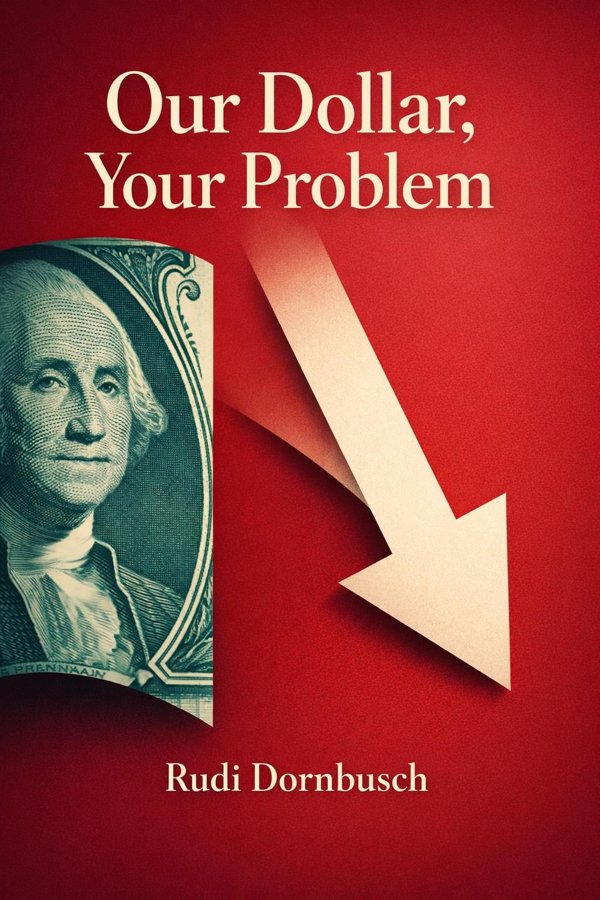
Our Dollar, Your Problem: Summary & Key Insights
 10 min10 chaptersAudio available
What Is Our Dollar, Your Problem About?
Our Dollar, Your Problem by Rudi Dornbusch is a economics book spanning 10 pages. This book analyzes the global economic influence of the United States dollar, exploring how U.S. monetary policy affects international trade, inflation, and financial stability. Dornbusch discusses the mechanisms through which the dollar became the dominant reserve currency and the implications for other economies.
This FizzRead summary covers all 10 key chapters of Our Dollar, Your Problem in approximately 10 minutes, distilling the most important ideas, arguments, and takeaways from Rudi Dornbusch's work. Also available as an audio summary and Key Quotes Podcast.
Our Dollar, Your Problem
This book analyzes the global economic influence of the United States dollar, exploring how U.S. monetary policy affects international trade, inflation, and financial stability. Dornbusch discusses the mechanisms through which the dollar became the dominant reserve currency and the implications for other economies.
Who Should Read Our Dollar, Your Problem?
This book is perfect for anyone interested in economics and looking to gain actionable insights in a short read. Whether you're a student, professional, or lifelong learner, the key ideas from Our Dollar, Your Problem by Rudi Dornbusch will help you think differently.
- ✓Readers who enjoy economics and want practical takeaways
- ✓Professionals looking to apply new ideas to their work and life
- ✓Anyone who wants the core insights of Our Dollar, Your Problem in just 10 minutes
Want the full summary?
Get instant access to this book summary and 100K+ more with Fizz Moment.
Get Free SummaryAvailable on App Store • Free to download
Key Chapters
The postwar monetary system began with a promise: the Bretton Woods Agreement of 1944 sought to create a stable global order anchored by fixed exchange rates, reconstruction, and global liquidity. The United States, already the dominant industrial and financial power, assumed the central role. The dollar was directly convertible into gold, while all other currencies were tied to it. In practice, this meant that the United States would provide the liquidity needed for global growth by running balance-of-payments deficits financed in its own currency.
For the early decades after the war, this arrangement worked surprisingly well. The world needed dollars—to rebuild, trade, and hold reserves—and the United States could supply them. Europe and Japan recovered under this umbrella, depending on access to dollar financing. Yet the system contained the seeds of its own unraveling. As other nations became wealthier and more competitive, U.S. deficits grew, confidence in gold convertibility weakened, and inflation pressures mounted. The Triffin dilemma—the insight that the issuer of a reserve currency must run deficits to provide liquidity, but in doing so undermines confidence in that very currency—became painfully evident.
By the early 1970s, the contradictions became untenable. The United States suspended gold convertibility in 1971, ending the Bretton Woods system. What followed was a new era of floating exchange rates. Yet the dollar did not disappear as the world’s standard. On the contrary, it persisted as the primary reserve, invoicing, and intervention currency. This endurance, even absent gold, reflected not only inertia but also the sheer depth and credibility of U.S. financial markets. The dollar standard had transformed—from a gold-backed anchor to a paper-based but deeply integrated financial web linking banks, firms, and governments across continents.
To understand why the dollar retained its dominance, one must look beyond formal arrangements to the substance of financial and trade behavior. The United States provides markets that are deep, liquid, and trusted—features unmatched by any other economy. International investors, seeking safety and flexibility, gravitate to U.S. Treasury securities. Central banks hold the dollar because it is not only stable in political terms but also because it provides access to the world’s largest asset market.
Trade invoicing reinforces this dominance. A significant portion of global commerce—whether involving the United States directly or not—is denominated in dollars. Oil, commodities, and high-tech goods are priced in the American unit, which means that even countries with no formal link to U.S. markets use the dollar as a vehicle for exchange. This creates a self-sustaining cycle: because goods are priced in dollars, businesses demand them for transactions; because businesses demand them, financial institutions provide services and credit in dollars; and because of this network, alternative currencies struggle to gain traction.
Reserve holdings tell a similar story. Central banks accumulate dollars not only to intervene in exchange markets but also to signal credibility to investors and rating agencies. Even when the dollar weakens, there is no clear alternative. The yen and the Deutsche mark (later, the euro) have at times seemed contenders, but the scale and openness of the U.S. market maintain its supremacy. These forces make the dollar system remarkably resilient, though not without vulnerabilities. For all its strength, dependence on a single country’s currency leaves the world exposed to one nation’s political and monetary cycles.
+ 8 more chapters — available in the FizzRead app
All Chapters in Our Dollar, Your Problem
About the Author
Rudi Dornbusch (1942–2002) was a German-born American economist known for his work on international economics and macroeconomic theory. He taught at MIT and contributed significantly to understanding exchange rate dynamics and open economy macroeconomics.
Get This Summary in Your Preferred Format
Read or listen to the Our Dollar, Your Problem summary by Rudi Dornbusch anytime, anywhere. FizzRead offers multiple formats so you can learn on your terms — all free.
Available formats: App · Audio · PDF · EPUB — All included free with FizzRead
Download Our Dollar, Your Problem PDF and EPUB Summary
Key Quotes from Our Dollar, Your Problem
“The postwar monetary system began with a promise: the Bretton Woods Agreement of 1944 sought to create a stable global order anchored by fixed exchange rates, reconstruction, and global liquidity.”
“To understand why the dollar retained its dominance, one must look beyond formal arrangements to the substance of financial and trade behavior.”
Frequently Asked Questions about Our Dollar, Your Problem
Our Dollar, Your Problem by Rudi Dornbusch is a economics book that explores key ideas across 10 chapters. This book analyzes the global economic influence of the United States dollar, exploring how U.S. monetary policy affects international trade, inflation, and financial stability. Dornbusch discusses the mechanisms through which the dollar became the dominant reserve currency and the implications for other economies.
You Might Also Like

Business Adventures
John Brooks
10 min
Nudge
Richard H. Thaler, Cass R. Sunstein
10 min
The Hitchhiker"s Guide to the Galaxy
Douglas Adams
10 minThe Muqaddimah
Ibn Khaldun
10 minThe Outsiders
William N. Thorndike
10 min
A Little History of Economics
Niall Kishtainy
10 minBrowse by Category
Ready to read Our Dollar, Your Problem?
Get the full summary and 100K+ more books with Fizz Moment.