
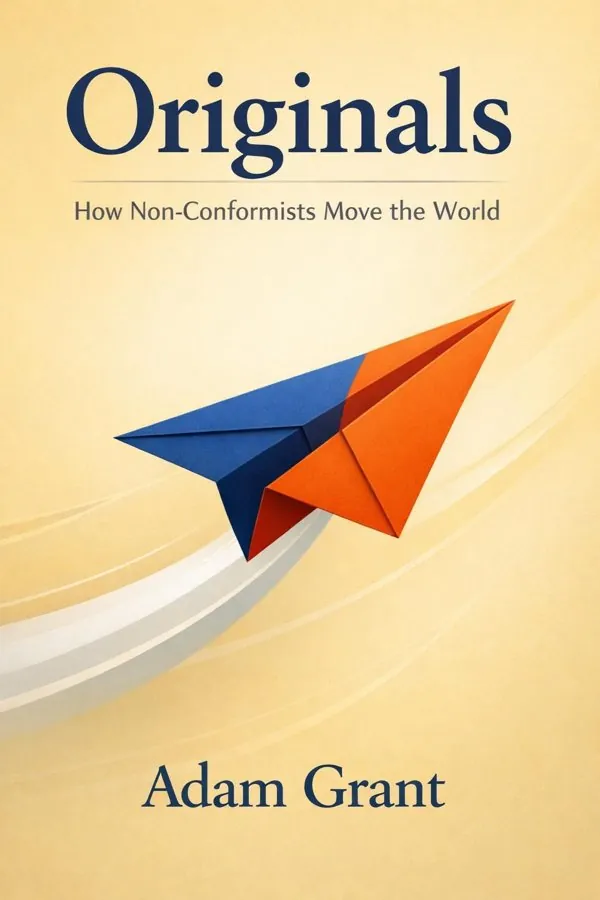
Originals: Summary & Key Insights
by Adam Grant
 10 min9 chaptersAudio available
Key Takeaways from Originals
Most people accept the world as it is; original thinkers ask why it has to stay that way.
The people with the best ideas are rarely the ones with only a few ideas; they are usually the ones with the most ideas overall.
Originals are not fearless gamblers; they are often skilled risk managers.
Delaying action is usually treated as a flaw, but Grant shows that some forms of procrastination can improve originality.
A great idea can fail if it is presented in the wrong way.
What Is Originals About?
Originals by Adam Grant is a general book. What makes someone challenge the default, question accepted wisdom, and push a new idea into the world when everyone else seems content to follow the script? In Originals, organizational psychologist Adam Grant explores exactly that question. Rather than treating creativity as a mysterious gift reserved for a few rare geniuses, Grant shows that originality is a set of behaviors, decisions, and habits that ordinary people can develop. The book examines how original thinkers spot opportunities for change, manage fear and risk, persuade skeptical audiences, and build cultures that welcome fresh thinking instead of punishing it. What makes the book especially valuable is its evidence-based approach. Grant draws on research in psychology, sociology, business, and history, while also using memorable stories from entrepreneurs, activists, executives, and artists. He argues that originality is not about reckless boldness or constant rebellion. It is about improving the status quo in intelligent, strategic ways. As one of the most influential organizational psychologists of his generation, Adam Grant brings both academic rigor and practical insight to the topic. Originals matters because in a world shaped by conformity, progress depends on people willing to think differently and act on it.
This FizzRead summary covers all 9 key chapters of Originals in approximately 10 minutes, distilling the most important ideas, arguments, and takeaways from Adam Grant's work. Also available as an audio summary and Key Quotes Podcast.
Originals
What makes someone challenge the default, question accepted wisdom, and push a new idea into the world when everyone else seems content to follow the script? In Originals, organizational psychologist Adam Grant explores exactly that question. Rather than treating creativity as a mysterious gift reserved for a few rare geniuses, Grant shows that originality is a set of behaviors, decisions, and habits that ordinary people can develop. The book examines how original thinkers spot opportunities for change, manage fear and risk, persuade skeptical audiences, and build cultures that welcome fresh thinking instead of punishing it.
What makes the book especially valuable is its evidence-based approach. Grant draws on research in psychology, sociology, business, and history, while also using memorable stories from entrepreneurs, activists, executives, and artists. He argues that originality is not about reckless boldness or constant rebellion. It is about improving the status quo in intelligent, strategic ways. As one of the most influential organizational psychologists of his generation, Adam Grant brings both academic rigor and practical insight to the topic. Originals matters because in a world shaped by conformity, progress depends on people willing to think differently and act on it.
Who Should Read Originals?
This book is perfect for anyone interested in general and looking to gain actionable insights in a short read. Whether you're a student, professional, or lifelong learner, the key ideas from Originals by Adam Grant will help you think differently.
- ✓Readers who enjoy general and want practical takeaways
- ✓Professionals looking to apply new ideas to their work and life
- ✓Anyone who wants the core insights of Originals in just 10 minutes
Want the full summary?
Get instant access to this book summary and 100K+ more with Fizz Moment.
Get Free SummaryAvailable on App Store • Free to download
Key Chapters
Most people accept the world as it is; original thinkers ask why it has to stay that way. That simple difference is at the heart of Originals. Adam Grant argues that originality does not begin with a lightning bolt of genius. It begins with doubt directed at convention. Originals notice rules, routines, and assumptions that others treat as natural, and they ask whether those patterns still serve a purpose. This mindset opens the door to innovation because every norm is, in some sense, a decision made by someone at some point in the past.
Grant makes an important distinction here: being original is not the same as being contrarian for its own sake. Rejecting every common practice is no wiser than blindly following them. The real skill is selective nonconformity: challenging defaults when there is a better path available. That might mean redesigning a hiring process, rethinking an outdated business model, or speaking up when a team keeps repeating the same flawed strategy. In everyday life, it can be as small as questioning a meeting format that wastes everyone’s time or a classroom habit that discourages participation.
This idea matters because conformity often feels safe. People assume that if many others are doing something, it must be right. But social proof can keep ineffective systems alive long after they stop working. Originals train themselves to notice those invisible pressures. They become students of assumptions: Why is this done this way? What would happen if we tried the opposite? Who benefits from the current system, and who is left out?
A practical way to apply this is to regularly identify one “default” in your work or life and examine it. Ask what problem it originally solved, whether that problem still exists, and what alternatives might work better. Actionable takeaway: build a habit of questioning one routine assumption each week, because originality starts when you stop treating the familiar as inevitable.
The people with the best ideas are rarely the ones with only a few ideas; they are usually the ones with the most ideas overall. One of Grant’s most liberating insights is that originality is a numbers game. We often imagine successful creators as people who consistently produce brilliant work, but research suggests something more realistic: highly original people generate large volumes of ideas, many of which are mediocre, impractical, or wrong. Their advantage is not perfect judgment from the start. It is willingness to produce enough possibilities that a few exceptional ones emerge.
This matters because fear of being wrong stops many people before they begin. They assume that if an idea is not immediately strong, it proves they are not creative. Grant challenges that myth. Quantity can be a path to quality because experimentation increases the odds of discovering something valuable. Writers draft multiple versions. Entrepreneurs test several models. Designers sketch dozens of options before selecting one. The breakthrough often appears after the obvious ideas have been exhausted.
There is also an organizational lesson here. Teams that reward only polished, fully formed proposals can unintentionally suppress creativity. A better culture allows rough ideas to surface early, where they can be refined, combined, or discarded without shame. Brainstorming works best not when people chase perfection, but when they separate idea generation from idea evaluation.
In practice, this means creating more output before narrowing down. If you are solving a problem, aim for ten possible solutions instead of two. If you are planning a project, list multiple approaches before choosing one. If you lead a team, encourage a wider first draft of thinking.
Actionable takeaway: set a target for idea volume, not just idea quality, because producing more possibilities is one of the most reliable ways to increase originality.
Originals are not fearless gamblers; they are often skilled risk managers. One of the most surprising arguments in the book is that many successful original thinkers are more cautious than they appear. They do not necessarily bet everything on one dramatic leap. Instead, they often reduce downside risk while pursuing upside potential. This challenges the popular image of the visionary who quits everything, ignores all warnings, and boldly jumps into the unknown.
Grant uses examples of entrepreneurs who kept stable jobs while building new ventures on the side. Their caution did not make them less original. In many cases, it made them more effective. Financial security preserved mental bandwidth, reduced desperation, and gave them time to improve their ideas before relying on them for survival. The same principle applies beyond entrepreneurship. A professional can test a new offering before switching careers. A manager can pilot a process change with one team before rolling it out company-wide. A creator can validate audience interest before investing heavily.
This idea is powerful because people often overestimate the cost of trying something new and underestimate the cost of standing still. Sticking with the status quo may feel safe, but it can carry hidden risks: missed opportunities, fading relevance, or dependence on outdated systems. The question is not whether risk exists. It is how to structure it intelligently.
To apply this, separate reckless risk from strategic experimentation. Ask: What is the smallest credible test of this idea? What can I do to preserve stability while learning quickly? Where can I create optionality instead of forcing an all-or-nothing decision?
Actionable takeaway: pursue originality by managing risk in stages—run experiments, build side options, and protect your downside so you can keep moving toward bold ideas without unnecessary self-destruction.
Delaying action is usually treated as a flaw, but Grant shows that some forms of procrastination can improve originality. This is not an argument for laziness or avoidance. It is an argument for strategic delay: giving ideas time to incubate so that they can evolve, combine, and mature. When people rush to closure, they often settle for the most obvious solution. When they allow room for unfinished thinking, they increase the chance of discovering a more original answer.
Creative work often benefits from this process because the mind keeps working in the background. A writer who steps away from a draft may return with sharper phrasing. A product team that sits with a concept for a few days may spot hidden weaknesses and new opportunities. A student who revisits a question after reflection may connect material in a deeper way. Grant highlights that many original creators start early but finish late—they begin thinking in advance, then revisit and refine rather than forcing immediate completion.
The important distinction is between active procrastination and passive avoidance. Passive avoidance means endlessly delaying because the task feels uncomfortable. Active procrastination means intentionally creating space while remaining engaged. You gather more information, explore alternatives, and let the problem breathe. That mental distance can reduce fixation and produce fresher combinations.
This can be applied in practical ways. Start important projects early enough that you can step back and return. Build review gaps into your calendar. When stuck, switch tasks temporarily instead of forcing low-quality output. Keep a place to capture new thoughts that appear while your subconscious keeps processing.
Actionable takeaway: for creative and strategic work, stop equating speed with quality—begin early, pause deliberately, and use incubation time to improve the originality of your final decision.
A great idea can fail if it is presented in the wrong way. Grant emphasizes that originality is not only about generating novel ideas; it is also about convincing others to support them. In organizations and communities, even strong ideas face resistance because people are attached to familiar practices, wary of uncertainty, and concerned about status. That means original thinkers must become effective advocates, not just inventors.
One of the book’s key persuasion insights is that timing, framing, and audience matter. A proposal is more likely to gain traction when it is connected to values people already care about. Instead of attacking the existing system head-on, original thinkers can show how a change solves a shared problem or advances a collective goal. Grant also notes that moderate confidence can be more persuasive than extreme certainty. People may trust advocates who acknowledge obstacles and demonstrate realism.
Another useful tactic is letting others contribute to the idea. When people feel a sense of ownership, they become more willing to support change. This is especially relevant for leaders. Rather than announcing a finished vision and demanding alignment, they can invite dissent, collect feedback, and improve the idea publicly. That approach not only strengthens the final plan but also increases buy-in.
In day-to-day life, smart advocacy might mean preparing evidence before challenging a policy, choosing the right moment to raise a concern, or tailoring your message for different stakeholders. A data-focused executive may need numbers. A mission-driven team may respond better to purpose. A skeptical colleague may need a low-risk pilot.
Actionable takeaway: when advancing an original idea, spend as much energy on persuasion strategy as on idea creation—frame it around shared interests, invite participation, and present change as credible rather than merely exciting.
Harmony is often overrated. One of the strongest themes in Originals is that healthy disagreement makes people and organizations better. Grant argues that cultures of unquestioned consensus may feel pleasant in the short term, but they often produce weak thinking, blind spots, and preventable mistakes. Originality thrives where dissent is permitted, respected, and productively used.
This does not mean encouraging constant conflict or negativity. The goal is not personal friction; it is intellectual friction. Teams improve when members challenge assumptions, test evidence, and raise concerns before decisions become irreversible. Grant highlights the value of “task conflict” over “relationship conflict.” In other words, debate the idea without attacking the person. When people feel psychologically safe enough to disagree, leaders gain access to better information and lower the risk of groupthink.
This principle applies in families, classrooms, businesses, and creative collaborations. A manager who invites criticism of a strategy may uncover an execution flaw that saves months of work. Parents who allow children to question rules can raise more independent thinkers. A startup that encourages honest disagreement may avoid expensive self-delusion. The opposite environment—where everyone nods along to preserve harmony—can quietly punish originality and reward silence.
Building a culture of constructive dissent requires deliberate habits. Leaders can ask for the strongest argument against a proposal, assign someone to play devil’s advocate, or reward people who identify risks early. On a personal level, you can seek out thoughtful critics instead of surrounding yourself with constant supporters.
Actionable takeaway: create spaces where disagreement is safe and useful—invite critique, separate ideas from identities, and treat dissent as a resource that sharpens judgment rather than a threat to unity.
Original people do not necessarily feel less fear than everyone else; they often learn how to act despite it. Grant’s discussion of fear is especially valuable because it corrects a common misconception: courage is not the absence of anxiety. In many cases, people avoid original action because they imagine that bold thinkers simply possess extraordinary confidence. But confidence can be unstable, and waiting for perfect certainty usually means waiting forever.
What matters more is learning to manage the emotional experience of risk. Grant points to the role of reappraisal—interpreting tension, uncertainty, and nervous energy in a more useful way. Instead of seeing anxiety as proof that you should stop, you can view it as a sign that the situation matters. This shift can help people move from paralysis to action. Original thinkers also reduce fear by preparing well, creating backup plans, and breaking large moves into smaller steps.
Another key insight is that social support can make courageous action more likely. People are better able to challenge norms when they know they are not alone. A supportive mentor, collaborator, or peer group can provide perspective, encouragement, and accountability. That support does not eliminate risk, but it makes risk more manageable.
In practical terms, this might mean rehearsing a difficult conversation before having it, gathering data before proposing a change, or naming your fear clearly instead of letting it remain vague and overwhelming. It can also mean asking what you will regret more: trying and failing, or never trying at all.
Actionable takeaway: stop waiting to feel fearless—prepare, reframe your anxiety, lean on supportive allies, and take the next manageable step, because originality grows when you act with fear instead of surrendering to it.
Originality is not just an individual trait; it is shaped by environments. Grant shows that families, schools, and workplaces can either encourage independent thinking or quietly suppress it. This makes Originals especially useful for parents, teachers, and leaders who want to develop people rather than just manage them. The central lesson is that originality grows when people learn to think for themselves, not merely obey instructions.
One way to cultivate this is by emphasizing values over rigid rules. Grant notes that when children understand the reasons behind expectations, they are more likely to internalize principles and make thoughtful decisions in new situations. The same logic applies at work. Employees who are trusted to use judgment, challenge inefficiency, and suggest improvements become more engaged and more innovative than those trained only to comply.
Role modeling also matters. Leaders who admit mistakes, invite feedback, and revise their views demonstrate that questioning is acceptable. Parents who encourage respectful debate teach children that authority is not infallible. Teachers who reward originality, not just correct answers, help students develop intellectual courage. Over time, these signals create a culture where people are more willing to experiment and speak up.
At the same time, freedom without structure is not enough. Originality benefits from boundaries that create accountability and focus. The best environments combine high standards with openness. They say, in effect: think independently, but support your thinking with effort and evidence.
Actionable takeaway: if you want to raise or lead more original people, explain the why behind expectations, invite thoughtful questioning, and reward principled independence rather than mere obedience.
A strong idea is not enough; when and how persistently you pursue it can determine whether it succeeds. Grant stresses that originality is often less about instant recognition and more about staying in the game long enough to find the right moment. Many original ideas initially face skepticism because they ask people to change habits, identities, or assumptions. That means early rejection is not always a verdict on quality. Sometimes it is simply a sign that the audience, market, or culture is not ready yet.
This insight helps explain why original thinkers need both patience and adaptability. Persistence does not mean stubbornly repeating the same pitch forever. It means continuing to refine, reposition, and relaunch an idea in response to what you learn. A founder may discover that the product is good but the target user is wrong. An activist may realize that the message needs reframing. An internal innovator may wait for a leadership change or a business shift that makes a previously ignored proposal suddenly relevant.
Timing also matters at the micro level. A difficult conversation lands differently depending on whether people are under pressure, distracted, or already open to change. A new concept can gain momentum if introduced when dissatisfaction with the current system is visible. Original thinkers therefore pay attention not only to the strength of the idea itself, but to context, readiness, and sequence.
You can use this by asking two questions whenever an idea struggles: Is the idea flawed, or is the timing off? Then decide whether to revise, wait, gather more evidence, or present it to a different audience.
Actionable takeaway: treat rejection as information, not final destiny—improve the idea, watch for the right window, and persist strategically until originality meets readiness.
All Chapters in Originals
About the Author
Adam Grant is an American organizational psychologist, professor, and bestselling author known for his work on motivation, generosity, creativity, and workplace culture. He has taught at the Wharton School of the University of Pennsylvania, where he became one of its highest-rated professors. Grant is widely recognized for turning rigorous academic research into clear, practical ideas that help individuals and organizations think and perform better. His books, including Give and Take, Originals, Think Again, and Hidden Potential, have reached a broad global audience. Beyond academia, he is a popular speaker and podcast host whose work explores how people can challenge assumptions, improve collaboration, and build more thoughtful careers and cultures. His writing combines evidence, storytelling, and actionable insight.
Get This Summary in Your Preferred Format
Read or listen to the Originals summary by Adam Grant anytime, anywhere. FizzRead offers multiple formats so you can learn on your terms — all free.
Available formats: App · Audio · PDF · EPUB — All included free with FizzRead
Download Originals PDF and EPUB Summary
Key Quotes from Originals
“Most people accept the world as it is; original thinkers ask why it has to stay that way.”
“The people with the best ideas are rarely the ones with only a few ideas; they are usually the ones with the most ideas overall.”
“Originals are not fearless gamblers; they are often skilled risk managers.”
“Delaying action is usually treated as a flaw, but Grant shows that some forms of procrastination can improve originality.”
“A great idea can fail if it is presented in the wrong way.”
Frequently Asked Questions about Originals
Originals by Adam Grant is a general book that explores key ideas across 9 chapters. What makes someone challenge the default, question accepted wisdom, and push a new idea into the world when everyone else seems content to follow the script? In Originals, organizational psychologist Adam Grant explores exactly that question. Rather than treating creativity as a mysterious gift reserved for a few rare geniuses, Grant shows that originality is a set of behaviors, decisions, and habits that ordinary people can develop. The book examines how original thinkers spot opportunities for change, manage fear and risk, persuade skeptical audiences, and build cultures that welcome fresh thinking instead of punishing it. What makes the book especially valuable is its evidence-based approach. Grant draws on research in psychology, sociology, business, and history, while also using memorable stories from entrepreneurs, activists, executives, and artists. He argues that originality is not about reckless boldness or constant rebellion. It is about improving the status quo in intelligent, strategic ways. As one of the most influential organizational psychologists of his generation, Adam Grant brings both academic rigor and practical insight to the topic. Originals matters because in a world shaped by conformity, progress depends on people willing to think differently and act on it.
More by Adam Grant

You Might Also Like
Duct Tape Marketing: The World's Most Practical Small Business Marketing Guide
John Jantsch
10 minDusk, Night, Dawn: On Revival and Courage
Anne Lamott
10 minFinish Big: How Great Entrepreneurs Exit Their Companies on Top
Bo Burlingham
10 minFirst As Tragedy, Then As Farce
Slavoj Zizek
10 minFirst Principles: What America's Founders Learned from the Greeks and Romans and How That Shaped Our Country
Thomas E. Ricks
10 minGood Habits, Bad Habits: The Science of Making Positive Changes That Stick
Wendy Wood
10 minFeatured In
Browse by Category
Ready to read Originals?
Get the full summary and 100K+ more books with Fizz Moment.