
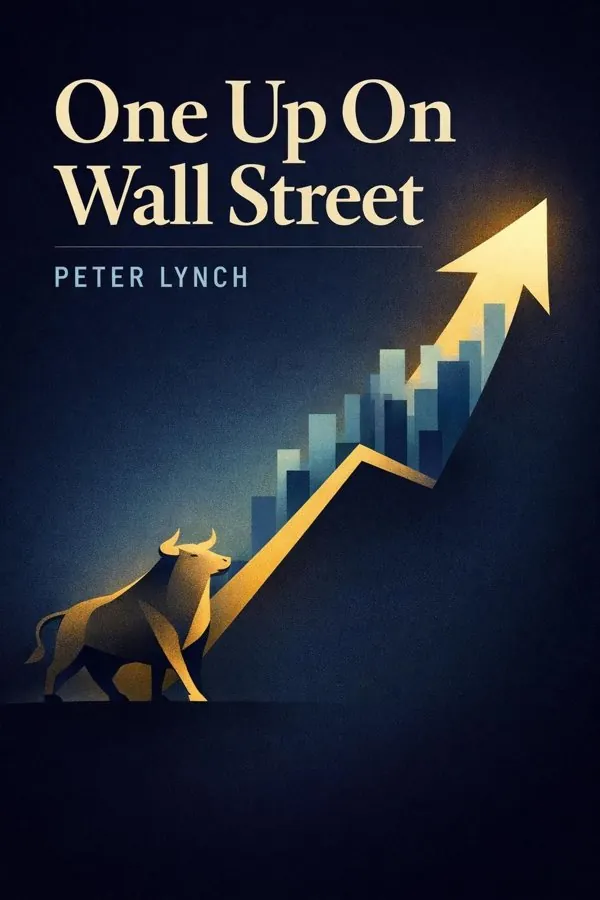
One Up On Wall Street: How To Use What You Already Know To Make Money In The Market: Summary & Key Insights
by Peter Lynch
 10 min10 chaptersAudio available
Key Takeaways from One Up On Wall Street: How To Use What You Already Know To Make Money In The Market
The biggest misconception in investing is that power belongs to whoever has the most screens, data, and credentials.
Spectacular results do not always come from spectacular complexity.
Before a stock becomes a Wall Street favorite, it often becomes a real-world favorite.
Not every stock should be judged by the same standard.
A compelling story can attract attention, but only the numbers determine whether a business deserves your money.
What Is One Up On Wall Street: How To Use What You Already Know To Make Money In The Market About?
One Up On Wall Street: How To Use What You Already Know To Make Money In The Market by Peter Lynch is a finance book spanning 10 pages. Peter Lynch’s One Up On Wall Street is one of the most influential investing books ever written because it overturns a deeply rooted belief: that ordinary people are doomed to trail professional investors. Lynch argues the opposite. In many cases, individuals have a real advantage because they encounter useful clues in daily life long before those clues appear in analyst reports or financial headlines. As the legendary manager of Fidelity’s Magellan Fund, Lynch produced extraordinary returns not by predicting the economy, but by finding understandable businesses with strong growth prospects and buying them at sensible prices. In this book, he explains how investors can spot opportunities in stores, workplaces, neighborhoods, and personal habits, then verify those insights through disciplined research. The result is a practical guide to investing that feels refreshingly grounded. Rather than relying on abstract theory, Lynch teaches readers how to think clearly, avoid common mistakes, categorize stocks, evaluate company fundamentals, and stay rational in volatile markets. For anyone who wants a smarter, more confident, and more realistic approach to stock picking, this book remains a timeless masterclass.
This FizzRead summary covers all 10 key chapters of One Up On Wall Street: How To Use What You Already Know To Make Money In The Market in approximately 10 minutes, distilling the most important ideas, arguments, and takeaways from Peter Lynch's work. Also available as an audio summary and Key Quotes Podcast.
One Up On Wall Street: How To Use What You Already Know To Make Money In The Market
Peter Lynch’s One Up On Wall Street is one of the most influential investing books ever written because it overturns a deeply rooted belief: that ordinary people are doomed to trail professional investors. Lynch argues the opposite. In many cases, individuals have a real advantage because they encounter useful clues in daily life long before those clues appear in analyst reports or financial headlines. As the legendary manager of Fidelity’s Magellan Fund, Lynch produced extraordinary returns not by predicting the economy, but by finding understandable businesses with strong growth prospects and buying them at sensible prices. In this book, he explains how investors can spot opportunities in stores, workplaces, neighborhoods, and personal habits, then verify those insights through disciplined research. The result is a practical guide to investing that feels refreshingly grounded. Rather than relying on abstract theory, Lynch teaches readers how to think clearly, avoid common mistakes, categorize stocks, evaluate company fundamentals, and stay rational in volatile markets. For anyone who wants a smarter, more confident, and more realistic approach to stock picking, this book remains a timeless masterclass.
Who Should Read One Up On Wall Street: How To Use What You Already Know To Make Money In The Market?
This book is perfect for anyone interested in finance and looking to gain actionable insights in a short read. Whether you're a student, professional, or lifelong learner, the key ideas from One Up On Wall Street: How To Use What You Already Know To Make Money In The Market by Peter Lynch will help you think differently.
- ✓Readers who enjoy finance and want practical takeaways
- ✓Professionals looking to apply new ideas to their work and life
- ✓Anyone who wants the core insights of One Up On Wall Street: How To Use What You Already Know To Make Money In The Market in just 10 minutes
Want the full summary?
Get instant access to this book summary and 100K+ more with Fizz Moment.
Get Free SummaryAvailable on App Store • Free to download
Key Chapters
Spectacular results do not always come from spectacular complexity. Lynch uses the growth of the Fidelity Magellan Fund to show that long-term success can come from understandable businesses, steady observation, and relentless research. When he took over the fund in 1977, it was tiny. By the time he stepped down, it had become one of the most famous mutual funds in history. His achievement was not based on market timing, macroeconomic forecasting, or chasing fashionable theories. It came from finding good companies before the crowd fully appreciated them.
A major lesson from Lynch’s experience is that there is no single “perfect” stock profile. He bought many kinds of companies, from fast growers to turnarounds to cyclical businesses. What mattered was matching the story to the numbers. If a company had room to expand, strong unit economics, and honest management, it deserved attention. If the stock price offered a reasonable entry point relative to future earnings, it became compelling.
Lynch’s record also demonstrates the value of breadth. He did not rely on a handful of dramatic bets. He researched constantly and owned many stocks, knowing that a few exceptional winners could drive overall performance. This mindset reduces the pressure to be right every time. Investing is not about perfection; it is about finding enough asymmetrical opportunities.
For everyday investors, the Magellan story is encouraging because it suggests that discipline beats brilliance. You do not need to predict interest rates or election outcomes. You need to identify companies with favorable prospects and avoid overpaying.
Actionable takeaway: Focus less on forecasting the economy and more on understanding individual businesses. Build your process around research, patience, and a willingness to hold several well-reasoned positions rather than hunt for one magical stock.
Before a stock becomes a Wall Street favorite, it often becomes a real-world favorite. Lynch emphasizes that some of the best investing ideas emerge from ordinary experiences: shopping, commuting, working, dining out, or talking with friends. These situations reveal changing consumer preferences and business momentum far earlier than most formal analysis. If a chain store is packed, a software tool is spreading quickly through offices, or a product keeps disappearing from shelves, something economically meaningful may be happening.
This idea is powerful because it gives investors a practical scouting method. Instead of waiting for a broker to suggest ideas, you can collect evidence from daily life. Teachers may notice education products gaining adoption. Contractors may spot building suppliers winning repeat business. Pharmacists may see demand shift toward a particular manufacturer. The stock market often lags these grassroots signals, especially in smaller or less glamorous companies.
Still, Lynch insists on moving from anecdote to analysis. A popular product can be attached to a weak business. A great company can still be a terrible investment if the stock is overpriced. The key is to use real-world experience as an entry point into deeper investigation. You ask: Is same-store sales growth accelerating? Are profits rising? Is the company opening new locations successfully? Are competitors struggling to keep up?
This process turns observation into informed conviction. It also makes investing more understandable. Rather than buying vague stories, you invest in businesses whose strengths you have seen firsthand.
Actionable takeaway: Start an “idea journal” based on businesses you personally encounter. Each time you notice unusual customer enthusiasm, repeat usage, or market share gains, record it and follow up with a basic financial review before considering the stock.
Not every stock should be judged by the same standard. One of Lynch’s most useful contributions is his framework for classifying companies into six broad categories: slow growers, stalwarts, fast growers, cyclicals, turnarounds, and asset plays. This matters because investors often make mistakes when they expect one kind of stock to behave like another. A fast-growing retailer should not be analyzed the same way as a mature utility, and a cyclical automaker should not be valued as though demand were stable year-round.
Slow growers are mature companies with limited expansion prospects, often paying dividends. Stalwarts are larger, dependable businesses that can deliver steady, moderate growth. Fast growers are smaller firms expanding rapidly and often offer the most dramatic upside, but also more risk. Cyclicals rise and fall with economic conditions, so timing and industry awareness matter. Turnarounds are troubled companies that may recover if conditions improve or management executes well. Asset plays are companies whose hidden assets, such as real estate or subsidiaries, may be worth more than the market recognizes.
This framework helps investors ask better questions. If you own a stalwart, are you expecting too much growth? If you buy a cyclical at peak earnings, are you misreading temporary strength as permanence? If you buy a turnaround, do you have evidence that the turnaround is actually happening?
For example, a regional bank with steady profits and dividends may be a stalwart, while a rapidly expanding restaurant chain may be a fast grower. Each demands different expectations and selling rules.
Actionable takeaway: Before buying any stock, classify it. Then evaluate it using the right lens: growth runway for fast growers, cycle awareness for cyclicals, balance-sheet repair for turnarounds, and income stability for slow growers or stalwarts.
A compelling story can attract attention, but only the numbers determine whether a business deserves your money. Lynch repeatedly stresses that investors must study fundamentals, because excitement without evidence is speculation. The good news is that you do not need an advanced finance degree to analyze a company. You need to understand a few key indicators and connect them to the business story.
He encourages investors to look at earnings growth, debt levels, cash generation, profit margins, inventory trends, and valuation. If a retailer claims to be booming but inventory is rising faster than sales, trouble may be building. If a manufacturer is expanding but taking on dangerous amounts of debt, the risk profile changes. If a company’s earnings are growing but the stock price already assumes unrealistic perfection, future returns may disappoint.
Lynch is especially interested in the relationship between price and growth. A great company can be a poor investment if purchased at an absurd valuation. Conversely, a good business with moderate growth may offer strong returns if bought at a sensible price. He often uses the price/earnings ratio as a practical reference point, comparing it against the company’s growth rate, historical range, and industry context.
This chapter of the book teaches investors to move from vague optimism to evidence-based judgment. You are not trying to predict every quarter. You are trying to assess whether the business is improving, durable, and reasonably priced.
Actionable takeaway: Build a simple stock checklist. Review revenue growth, earnings growth, debt, margins, cash flow, and valuation before every purchase. If you cannot explain the business and its numbers in plain language, do not buy the stock.
Patience is often treated as a personality trait, but in investing it is a strategic advantage. Lynch argues that once you have identified a strong company and bought it at a reasonable price, one of the smartest things you can do is give the thesis time to play out. The stock market constantly tempts people into activity, yet many of the best returns come from holding winners through years of business growth rather than trading around short-term noise.
This does not mean blind loyalty. Lynch is not advocating passive neglect. He believes in owning stocks for specific reasons and revisiting those reasons periodically. If the original thesis remains intact and the company continues to execute, temporary price weakness may not matter. In fact, it may offer a chance to add. Many investors sabotage themselves by selling too early after modest gains, only to miss the long compounding phase that follows.
Consider a fast-growing consumer brand expanding from 200 stores to 2,000. The real payoff may come not in the first 20 percent rise, but over years of successful expansion. Selling because the stock “has already gone up” can be a costly mistake if the business opportunity is still in its early innings.
Lynch also emphasizes that your conviction should come from research, not from stubbornness. A stock deserves patience when the business keeps improving. If sales flatten, debt balloons, or the competitive edge disappears, patience becomes complacency.
Actionable takeaway: Write down exactly why you own each stock. Review that thesis every quarter. Hold patiently when the business is progressing as expected, but be willing to act if the core facts change.
Buying well matters, but selling well protects returns and prevents avoidable mistakes. Lynch offers a practical answer to one of investing’s hardest questions: when should you sell? His answer is not based on market forecasts or emotional reactions. You sell when the original reason for owning the stock no longer holds, when the valuation becomes excessive relative to realistic prospects, or when a better use of capital appears.
The right selling decision depends on the stock type. If a fast grower begins maturing and its expansion runway shrinks, future upside may be lower than before. If a turnaround succeeds and the recovery is fully reflected in the price, much of the opportunity may be gone. If a cyclical reaches peak conditions and profits look temporarily inflated, investors should be careful not to mistake peak earnings for normal earnings.
Lynch also warns against the worst reason to sell: price movement alone. A falling stock is not automatically a sell, just as a rising one is not automatically a hold. What matters is whether the business fundamentals support the investment case. If the company is still strengthening, a decline may simply reflect market volatility. If the company is deteriorating while the price remains elevated, that can be a more urgent warning.
Selling, in other words, should be tied to evidence. Did management lose discipline? Did competition intensify? Did debt become dangerous? Did growth expectations become unrealistic? These questions bring clarity where emotion creates confusion.
Actionable takeaway: Establish exit triggers before buying. Decide what business changes, valuation extremes, or strategic opportunities would justify a sale, so your future decisions are guided by logic rather than fear or greed.
The market’s daily drama creates the illusion that every price move carries deep meaning. Lynch rejects that mindset. He sees volatility as normal, unavoidable, and often useful. Prices fluctuate for countless reasons unrelated to long-term business value, including macro fears, investor mood swings, and institutional repositioning. For the prepared investor, this instability is not merely a threat. It is a source of opportunity.
A key lesson from the book is that psychology often matters more than intelligence. Investors lose money not only because they choose bad stocks, but because they panic during declines, chase excitement during rallies, or anchor their decisions to headlines. Lynch reminds readers that owning stocks means owning pieces of businesses, not lottery tickets. If the business remains healthy, a lower stock price may make it more attractive, not less.
For example, suppose a solid company reports one disappointing quarter due to a temporary supply issue, and the stock falls sharply. If the long-term thesis remains intact and the balance sheet is strong, the market’s reaction may be exaggerated. Prepared investors with cash and conviction can take advantage of that gap between price and value.
Lynch is not dismissing risk. He is arguing that emotional overreaction magnifies it. The investor who understands what they own has a better chance of using downturns productively. The investor who buys vague stories is likely to be shaken out at the worst moment.
Actionable takeaway: Expect volatility in advance and plan your response. Keep a watchlist of quality companies you would like to own at lower prices, so market sell-offs become opportunities to evaluate rather than reasons to panic.
Many investing mistakes begin when people forget that stocks represent businesses. Lynch’s broader philosophy is that successful investing is often less about advanced theory and more about disciplined common sense. He urges readers to avoid flashy narratives, macro predictions, and the pressure to always be doing something. Instead, he recommends understanding what a company actually does, why customers choose it, how it makes money, and whether its future is better than the market assumes.
This principle has several practical implications. First, avoid businesses you cannot explain. Complexity can hide risk. Second, do not confuse a good company with a good stock; valuation matters. Third, be skeptical of popular stories that everyone already loves, because expectations may already be too high. Fourth, stay humble. Even skilled investors are wrong often, so risk management and diversification remain essential.
Lynch’s style is especially refreshing because it democratizes investing. He does not tell readers they need to outsmart the market every day. He shows them how to observe carefully, think independently, and act only when they have a clear edge. This approach is calmer, more realistic, and more repeatable than trying to guess the next economic headline.
A practical example is choosing between a hyped tech stock with no profits and an underfollowed local chain that is expanding successfully with strong cash flow. Wall Street may celebrate the glamorous story, but common sense may point toward the sturdier business.
Actionable takeaway: Before buying any stock, answer in one paragraph: what the company does, why it wins, what could go wrong, and why the current price is reasonable. If you cannot do that clearly, keep looking.
Lynch’s enduring appeal comes from how practical his advice is. He does not ask readers to become full-time analysts. He asks them to become more observant, more skeptical, and more disciplined. Throughout the book, he offers a set of habits that ordinary investors can use to improve results: do your own homework, ignore market noise, diversify sensibly, be patient, and never invest in something you do not understand.
One important lesson is that investing should fit your life and temperament. Someone with limited time may focus on a smaller number of understandable companies and hold them longer. Someone with deeper industry knowledge may explore opportunities within that circle of competence. What matters is not copying a professional portfolio, but building a process you can actually sustain.
Lynch also teaches readers to resist urgency. You do not need to own a stock today simply because it is being discussed everywhere. Good opportunities recur. Missing one idea is less harmful than buying a bad one out of fear of being left behind. He encourages investors to prepare, wait, and act when facts and price align.
Finally, he reminds readers that outcomes improve when expectations are realistic. Not every pick will be a ten-bagger. Some will be mediocre, and some will fail. But a portfolio of thoughtfully selected companies can still perform well if a few major winners are allowed to compound.
Actionable takeaway: Create a personal investing routine: maintain a watchlist, read company reports regularly, review your holdings quarterly, and limit purchases to businesses you genuinely understand. A simple, repeatable process is often more powerful than a complicated strategy.
All Chapters in One Up On Wall Street: How To Use What You Already Know To Make Money In The Market
About the Author
Peter Lynch is an American investor, mutual fund manager, and author best known for leading Fidelity’s Magellan Fund from 1977 to 1990. During his tenure, the fund achieved extraordinary performance and grew from a relatively small fund into one of the largest and most celebrated mutual funds in the world. Lynch became famous for his belief that individual investors can discover great companies through everyday observation and straightforward research. His investing philosophy emphasizes understanding the business, paying attention to fundamentals, and buying growth at a reasonable price. After retiring from day-to-day fund management, he wrote influential books that helped demystify stock investing for a broad audience, including One Up On Wall Street and Beating the Street. He remains one of the most admired voices in practical, long-term investing.
Get This Summary in Your Preferred Format
Read or listen to the One Up On Wall Street: How To Use What You Already Know To Make Money In The Market summary by Peter Lynch anytime, anywhere. FizzRead offers multiple formats so you can learn on your terms — all free.
Available formats: App · Audio · PDF · EPUB — All included free with FizzRead
Download One Up On Wall Street: How To Use What You Already Know To Make Money In The Market PDF and EPUB Summary
Key Quotes from One Up On Wall Street: How To Use What You Already Know To Make Money In The Market
“The biggest misconception in investing is that power belongs to whoever has the most screens, data, and credentials.”
“Spectacular results do not always come from spectacular complexity.”
“Before a stock becomes a Wall Street favorite, it often becomes a real-world favorite.”
“Not every stock should be judged by the same standard.”
“A compelling story can attract attention, but only the numbers determine whether a business deserves your money.”
Frequently Asked Questions about One Up On Wall Street: How To Use What You Already Know To Make Money In The Market
One Up On Wall Street: How To Use What You Already Know To Make Money In The Market by Peter Lynch is a finance book that explores key ideas across 10 chapters. Peter Lynch’s One Up On Wall Street is one of the most influential investing books ever written because it overturns a deeply rooted belief: that ordinary people are doomed to trail professional investors. Lynch argues the opposite. In many cases, individuals have a real advantage because they encounter useful clues in daily life long before those clues appear in analyst reports or financial headlines. As the legendary manager of Fidelity’s Magellan Fund, Lynch produced extraordinary returns not by predicting the economy, but by finding understandable businesses with strong growth prospects and buying them at sensible prices. In this book, he explains how investors can spot opportunities in stores, workplaces, neighborhoods, and personal habits, then verify those insights through disciplined research. The result is a practical guide to investing that feels refreshingly grounded. Rather than relying on abstract theory, Lynch teaches readers how to think clearly, avoid common mistakes, categorize stocks, evaluate company fundamentals, and stay rational in volatile markets. For anyone who wants a smarter, more confident, and more realistic approach to stock picking, this book remains a timeless masterclass.
More by Peter Lynch
You Might Also Like



Browse by Category
Ready to read One Up On Wall Street: How To Use What You Already Know To Make Money In The Market?
Get the full summary and 100K+ more books with Fizz Moment.