
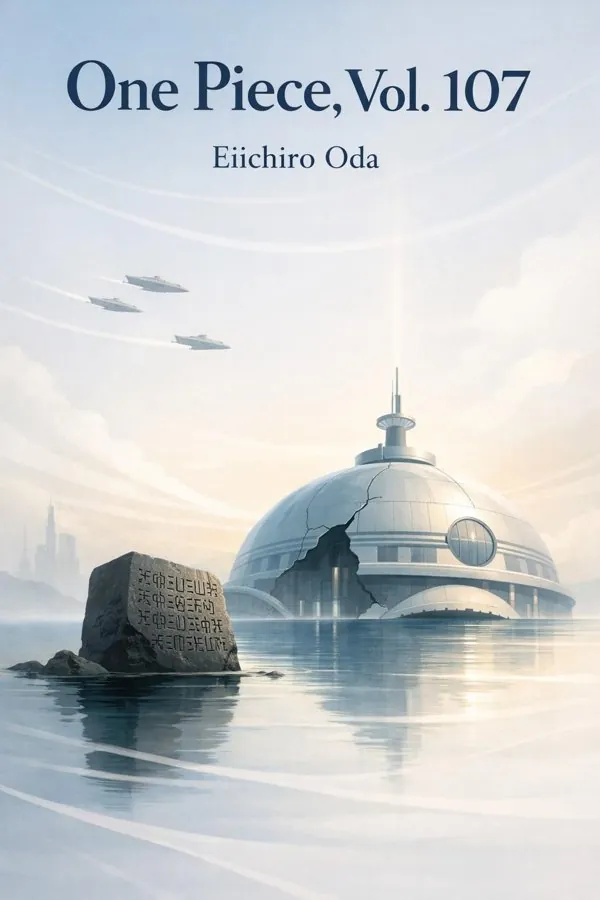
One Piece, Vol. 107: Summary & Key Insights
by Eiichiro Oda
 10 min8 chaptersAudio available
Key Takeaways from One Piece, Vol. 107
A new setting in One Piece is never just scenery; it is a thesis about how the world works.
The most dangerous knowledge is often not falsehood, but truth revealed too clearly.
Conflict becomes sharper when force is sent to silence questions rather than answer them.
Epic stories stay meaningful when they remember that history wounds individuals before it reshapes nations.
Sometimes the present only becomes legible when the past is finally allowed to speak.
What Is One Piece, Vol. 107 About?
One Piece, Vol. 107 by Eiichiro Oda is a bestsellers book spanning 5 pages. Some stories expand their world by adding new places. One Piece, Vol. 107 expands its world by changing what readers think the world means. Set during the explosive Egghead Arc, this volume brings the Straw Hat Pirates into direct contact with Dr. Vegapunk, the legendary scientist whose inventions have shaped the age of pirates, warfare, and political control. What begins as an adventure on the dazzling “Island of the Future” quickly turns into a collision between science, memory, and state power. Through Bonney’s search for the truth about Kuma, the looming threat of CP0, and the increasing danger surrounding forbidden knowledge, Oda pushes the series into some of its most revealing territory yet. This volume matters because it is not merely transitional; it is transformative. Egghead ties personal pain to global history, linking intimate character drama with the deepest mysteries of the One Piece world. Eiichiro Oda is uniquely qualified to deliver a story of this scale. Over decades, he has built one of fiction’s richest universes, balancing slapstick comedy, emotional tragedy, and mythic long-form storytelling with remarkable confidence. Vol. 107 is a vivid example of that mastery at work.
This FizzRead summary covers all 8 key chapters of One Piece, Vol. 107 in approximately 10 minutes, distilling the most important ideas, arguments, and takeaways from Eiichiro Oda's work. Also available as an audio summary and Key Quotes Podcast.
One Piece, Vol. 107
Some stories expand their world by adding new places. One Piece, Vol. 107 expands its world by changing what readers think the world means. Set during the explosive Egghead Arc, this volume brings the Straw Hat Pirates into direct contact with Dr. Vegapunk, the legendary scientist whose inventions have shaped the age of pirates, warfare, and political control. What begins as an adventure on the dazzling “Island of the Future” quickly turns into a collision between science, memory, and state power. Through Bonney’s search for the truth about Kuma, the looming threat of CP0, and the increasing danger surrounding forbidden knowledge, Oda pushes the series into some of its most revealing territory yet.
This volume matters because it is not merely transitional; it is transformative. Egghead ties personal pain to global history, linking intimate character drama with the deepest mysteries of the One Piece world. Eiichiro Oda is uniquely qualified to deliver a story of this scale. Over decades, he has built one of fiction’s richest universes, balancing slapstick comedy, emotional tragedy, and mythic long-form storytelling with remarkable confidence. Vol. 107 is a vivid example of that mastery at work.
Who Should Read One Piece, Vol. 107?
This book is perfect for anyone interested in bestsellers and looking to gain actionable insights in a short read. Whether you're a student, professional, or lifelong learner, the key ideas from One Piece, Vol. 107 by Eiichiro Oda will help you think differently.
- ✓Readers who enjoy bestsellers and want practical takeaways
- ✓Professionals looking to apply new ideas to their work and life
- ✓Anyone who wants the core insights of One Piece, Vol. 107 in just 10 minutes
Want the full summary?
Get instant access to this book summary and 100K+ more with Fizz Moment.
Get Free SummaryAvailable on App Store • Free to download
Key Chapters
A new setting in One Piece is never just scenery; it is a thesis about how the world works. Egghead Island arrives as a dazzling symbol of possibility, a place where technology appears to have leapt centuries ahead of the rest of the seas. Floating systems, automated inventions, futuristic clothing, and impossible machines give the island an energy unlike anything the Straw Hats have seen before. But Oda does not present Egghead as simple spectacle. He uses it to ask a deeper question: what happens when innovation grows inside a world still ruled by fear, censorship, and violence?
The island’s brilliance immediately reframes the series. For years, One Piece has explored pirate freedom, inherited will, and political oppression through kingdoms, oceans, and ancient ruins. Egghead introduces another force into that equation: scientific progress. The future is no longer abstract. It has a shape, a laboratory, and a creator. Yet this future feels unstable from the moment the crew arrives. The wonders of Egghead are matched by surveillance, secrecy, and looming threat, suggesting that progress alone does not create justice.
Readers can connect this idea to real life. New technology often promises liberation, efficiency, and connection, but it can also intensify inequality or become a tool of control. Egghead captures that tension brilliantly. It invites awe while warning against naïve optimism. The Straw Hats respond in characteristically human ways—curiosity, humor, confusion, excitement—which makes the island feel both fantastical and emotionally grounded.
The actionable takeaway is simple: when you encounter something impressive, do not only ask how advanced it is. Ask who controls it, who benefits from it, and what truths it may be hiding.
The most dangerous knowledge is often not falsehood, but truth revealed too clearly. In Vol. 107, Dr. Vegapunk’s presence turns Egghead from a technological wonderland into a political fault line. He is not only the world’s greatest scientist; he is also a figure standing dangerously close to the buried truths of history. His research hints at connections to the Void Century, that erased era the World Government has tried to keep hidden at all costs.
What makes this idea compelling is that Oda frames knowledge itself as a battlefield. The issue is not simply that Vegapunk knows too much. It is that knowledge can redistribute power. If history has been deliberately erased, then recovering it becomes an act of rebellion. The World Government understands this, which is why scientific inquiry and historical excavation are treated as threats rather than achievements. Egghead, then, becomes a place where invention and archaeology intersect. Machines point forward, but truth points backward.
Vegapunk also complicates the moral landscape. He is not presented as a simple rebel or saint. He is a genius whose work has served institutions of power even as his curiosity pulls him toward dangerous truths. That ambiguity makes him believable. Many brilliant people work inside flawed systems, benefiting from them while also challenging them. Oda’s writing recognizes that contradiction without flattening it.
In practical terms, this idea applies to any society in which records are controlled, narratives are curated, or inconvenient facts are buried. Whether in history, media, or personal relationships, selective memory protects power.
The actionable takeaway: treat curiosity as a responsibility. When you sense that a story has been edited for your comfort, ask what has been removed—and why.
Conflict becomes sharper when force is sent to silence questions rather than answer them. The arrival and actions of CP0 transform Egghead from a mysterious exploration story into an unfolding siege. Their presence makes one thing unmistakable: the World Government does not fear chaos nearly as much as it fears disclosure. Assassination, suppression, and strategic violence become the chosen tools for restoring order.
This key idea matters because CP0 represents institutional ruthlessness stripped of pretense. They do not exist to persuade or understand. They exist to enforce. By bringing them into the narrative at this moment, Oda highlights the chain reaction that follows when truth threatens authority. The Straw Hats are no longer just visiting a strange island; they are standing inside a confrontation between state power and intellectual freedom.
The clash also raises the stakes for every character. Vegapunk is no longer just eccentric or mysterious. Bonney’s search becomes more urgent. The crew’s protective instincts kick in. Even the island itself feels more fragile once military force begins circling it. Oda is especially effective here because he balances large-scale tension with immediate emotional stakes. Readers understand the geopolitical implications, but they also care about the people who may be crushed by those implications.
There is a useful lesson in this escalation. In organizations, families, and governments, suppression often reveals what leaders value most. When questions trigger disproportionate retaliation, it is a sign that the underlying issue is real and significant. Resistance can become a diagnostic tool.
The actionable takeaway: pay attention to what systems punish most aggressively. Their fiercest reactions often point directly to the truths they are least able to survive.
Epic stories stay meaningful when they remember that history wounds individuals before it reshapes nations. Jewelry Bonney’s role in Vol. 107 gives Egghead emotional gravity by tying abstract mysteries to deeply personal pain. Her connection to Bartholomew Kuma is not treated as a side note or a convenient subplot. It becomes one of the volume’s emotional anchors, reminding readers that the secrets of the world are never merely intellectual puzzles. They live inside bodies, memories, and broken families.
Bonney’s search reframes everything around her. The questions about Kuma are not academic. Why did he become what he became? What was taken from him? What choices were forced upon him? These questions make the arc feel less like a treasure hunt for lore and more like an inquiry into suffering, identity, and exploitation. Oda excels at this move. He often embeds large revelations inside personal stories so that the reader feels truth before fully understanding it.
This dynamic also deepens Bonney herself. She is not simply reacting to events; she is demanding ownership over a story others have controlled. That insistence gives her strength, vulnerability, and narrative importance. Readers who may have seen her as a compelling but secondary character are asked to view her with new seriousness.
In everyday life, people often discuss systems—governments, institutions, histories—in abstract language. Bonney’s story reminds us to ask who pays the human cost. Data and policy can obscure lived experience. Emotion restores clarity.
The actionable takeaway: when confronting any large issue, look for the personal story at its center. Understanding one person’s pain can reveal more truth than mastering a hundred detached facts.
Sometimes the present only becomes legible when the past is finally allowed to speak. Vol. 107 intensifies the mystery around Kuma by suggesting that his history is inseparable from the moral architecture of the entire arc. Kuma has long existed in One Piece as an enigmatic figure: terrifying, loyal, passive, mechanical, tragic. This volume pushes readers to reconsider him not as a puzzle piece but as a person whose transformation carries enormous thematic weight.
The brilliance of Oda’s handling lies in delayed revelation. Rather than offering simple exposition, he lets Kuma’s past emerge through emotion, implication, and the perspectives of those who loved or used him. That method creates a feeling of moral excavation. Readers are not merely told what happened; they feel the cost of what happened. The result is a stronger understanding of how power dehumanizes. If Kuma has been turned into a weapon, then his story becomes one of stolen agency, and the institutions responsible become more monstrous.
This idea extends beyond one character. It reinforces a recurring One Piece theme: people labeled as tools, threats, or symbols always possess a buried human story. Revisiting that story can overturn our assumptions. In real life, too, labels often replace understanding. A public role, diagnosis, reputation, or status can eclipse the complex path that produced it.
As a practical application, consider how quickly people are reduced to outcomes: a failure, a success, a criminal, a machine, an asset. Kuma’s arc invites a more humane approach. Before judging what someone has become, ask what was demanded of them, taken from them, or endured by them.
The actionable takeaway: revisit fixed impressions. The truth about someone’s past may completely change how you understand their present.
The most effective turning points in long-form storytelling arrive before the explosion, in the dense quiet of inevitability. Vol. 107 is filled with that feeling. Oda structures the volume so that readers sense a large-scale confrontation forming even before all combat lines are drawn. Forces are moving, alliances are unstable, truths are surfacing, and no side can retreat without consequence. The result is a powerful atmosphere of gathering war.
This escalation works because Oda understands momentum. He does not treat conflict as a sudden event but as an accumulation of unresolved pressures: political secrecy, personal grief, military response, scientific ambition, and pirate intervention. Egghead becomes the convergence point for multiple story currents, and each chapter adds another degree of pressure. By the time the volume closes, the reader understands that the arc is no longer confined to one island’s drama. It is becoming a hinge for the wider world.
What makes this especially satisfying is that the threat of war is not only physical. It is ideological. Who should control knowledge? What does progress serve? Can people escape the roles imposed by empires? These questions ensure that future battles will matter beyond spectacle.
There is a practical insight here for readers outside fiction. Major crises rarely appear from nowhere. They build through ignored warnings, concentrated power, and unresolved contradictions. Learning to recognize buildup is often more useful than reacting once things explode.
The actionable takeaway: train yourself to notice pressure before collapse. Whether in a project, a relationship, or a society, early signals of conflict are often visible long before open battle begins.
Innovation is never morally neutral once it enters a political world. One Piece, Vol. 107 uses Egghead and Vegapunk to explore the uneasy relationship between discovery and responsibility. The volume does not reject science; in fact, it delights in scientific imagination. But it refuses to romanticize progress detached from ethics. Every invention on Egghead raises a larger question: does this technology serve people, or does it make them easier to monitor, weaponize, or replace?
That tension gives the volume unusual depth. Vegapunk’s genius has clearly advanced civilization in remarkable ways, yet many of those advancements exist alongside militarization and state control. This creates a morally complex landscape where invention cannot be judged by brilliance alone. Oda is effectively asking what kind of future emerges when the smartest mind in the world works under the shadow of authoritarian power.
This issue is immediately relevant to modern readers. Artificial intelligence, surveillance systems, genetic engineering, and automation all inspire excitement and anxiety for similar reasons. A breakthrough can improve life while also expanding institutional dominance. The same tool that heals can be used to control. Egghead dramatizes this ambiguity through adventure rather than lecture, which makes the theme more memorable.
The Straw Hats provide a useful contrast because they relate to technology through instinctive ethics. They respond first to whether people are being protected, harmed, manipulated, or liberated. Their moral clarity cuts through technical complexity.
The actionable takeaway: do not evaluate innovation only by what it can do. Evaluate it by who governs it, what incentives shape it, and whether it preserves human dignity.
In a world crowded with secrets, empires, and systems, the Straw Hats remain important because they keep the story loyal to freedom at a human scale. Vol. 107 surrounds them with advanced technology, global stakes, and historical revelation, yet they do not disappear into the machinery of the plot. Instead, they anchor the reader emotionally. Their curiosity, protectiveness, humor, and refusal to accept imposed authority turn Egghead from a lore-heavy arc into a lived adventure.
This role matters more than it may first appear. The Straw Hats are not scholars of the Void Century or architects of world policy. They are people who instinctively side with the oppressed and challenge structures that deny dignity. That moral reflex is central to why One Piece works. Oda can build incredibly complex settings, but the series never loses its heart because the crew responds to complexity with unmistakably human values.
Vol. 107 highlights that strength. Whether facing strange inventions, protecting allies, or confronting government aggression, the crew functions as a moving standard of chosen family and ethical action. Their presence reassures readers that revelation alone is not enough; truth matters because someone must act on it. This is where the series blends adventure with principle.
In practical life, large systems often feel too complicated to confront. The Straw Hats model a simpler beginning point: start with loyalty, protect the vulnerable, and refuse narratives that justify cruelty as necessity. You do not need total information to take a moral stand.
The actionable takeaway: when facing overwhelming complexity, return to first principles. Ask who needs help, what freedom is being denied, and what action aligns with your values right now.
All Chapters in One Piece, Vol. 107
About the Author
Eiichiro Oda is a Japanese manga artist best known as the creator of One Piece, one of the bestselling and most influential manga series of all time. Born in Kumamoto Prefecture in 1975, Oda showed an early interest in drawing and storytelling, and he later entered the manga industry at a young age. In 1997, One Piece began serialization in Weekly Shonen Jump and quickly grew into a global phenomenon. Oda is widely admired for his unmatched world-building, inventive character design, comedic timing, and ability to sustain emotional and narrative momentum across decades of storytelling. His work combines adventure, action, satire, and heartfelt themes about freedom, loyalty, sacrifice, and inherited dreams. Through One Piece, Oda has shaped modern manga culture and earned a reputation as one of the most ambitious long-form storytellers in contemporary fiction.
Get This Summary in Your Preferred Format
Read or listen to the One Piece, Vol. 107 summary by Eiichiro Oda anytime, anywhere. FizzRead offers multiple formats so you can learn on your terms — all free.
Available formats: App · Audio · PDF · EPUB — All included free with FizzRead
Download One Piece, Vol. 107 PDF and EPUB Summary
Key Quotes from One Piece, Vol. 107
“A new setting in One Piece is never just scenery; it is a thesis about how the world works.”
“The most dangerous knowledge is often not falsehood, but truth revealed too clearly.”
“Conflict becomes sharper when force is sent to silence questions rather than answer them.”
“Epic stories stay meaningful when they remember that history wounds individuals before it reshapes nations.”
“Sometimes the present only becomes legible when the past is finally allowed to speak.”
Frequently Asked Questions about One Piece, Vol. 107
One Piece, Vol. 107 by Eiichiro Oda is a bestsellers book that explores key ideas across 8 chapters. Some stories expand their world by adding new places. One Piece, Vol. 107 expands its world by changing what readers think the world means. Set during the explosive Egghead Arc, this volume brings the Straw Hat Pirates into direct contact with Dr. Vegapunk, the legendary scientist whose inventions have shaped the age of pirates, warfare, and political control. What begins as an adventure on the dazzling “Island of the Future” quickly turns into a collision between science, memory, and state power. Through Bonney’s search for the truth about Kuma, the looming threat of CP0, and the increasing danger surrounding forbidden knowledge, Oda pushes the series into some of its most revealing territory yet. This volume matters because it is not merely transitional; it is transformative. Egghead ties personal pain to global history, linking intimate character drama with the deepest mysteries of the One Piece world. Eiichiro Oda is uniquely qualified to deliver a story of this scale. Over decades, he has built one of fiction’s richest universes, balancing slapstick comedy, emotional tragedy, and mythic long-form storytelling with remarkable confidence. Vol. 107 is a vivid example of that mastery at work.
You Might Also Like
The Godfather
Mario Puzo
10 min
The Handmaid's Tale
Margaret Atwood
10 min
The Hunger Games
Suzanne Collins
10 min
The Nightingale
Kristin Hannah
10 min
The Seven Husbands of Evelyn Hugo
Taylor Jenkins Reid
10 min
Backwater Justice
Fern Michaels
10 minBrowse by Category
Ready to read One Piece, Vol. 107?
Get the full summary and 100K+ more books with Fizz Moment.