
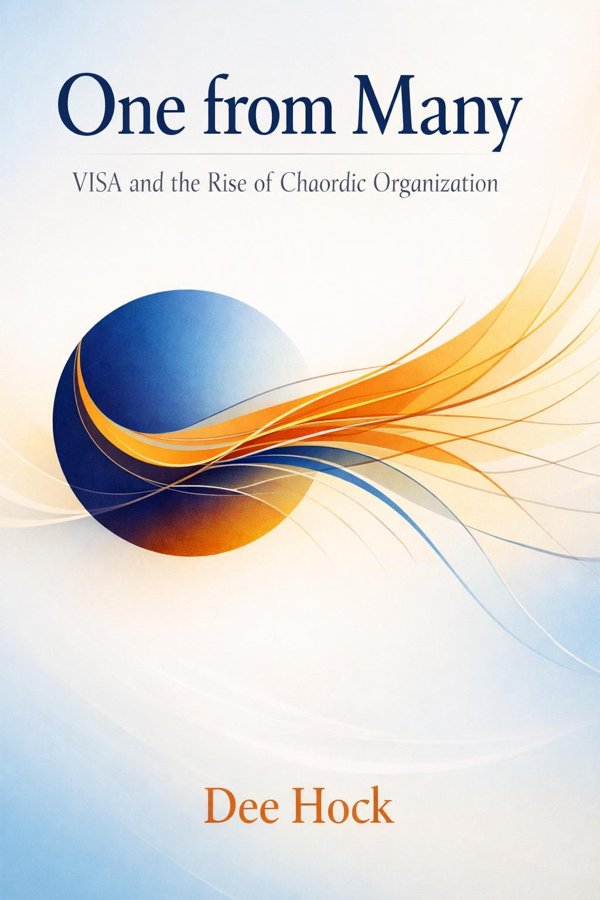
One from Many: VISA and the Rise of Chaordic Organization: Summary & Key Insights
by Dee Hock
 10 min5 chaptersAudio available
What Is One from Many: VISA and the Rise of Chaordic Organization About?
One from Many: VISA and the Rise of Chaordic Organization by Dee Hock is a leadership book spanning 5 pages. In this groundbreaking work, Dee Hock, the founder and former CEO of VISA, recounts the creation of one of the world’s most innovative and successful organizations. He introduces the concept of the 'chaordic organization'—a system that blends chaos and order to foster creativity, adaptability, and collaboration. Through personal narrative and organizational insight, Hock explores how VISA’s decentralized structure became a model for self-organizing systems in business and beyond.
This FizzRead summary covers all 5 key chapters of One from Many: VISA and the Rise of Chaordic Organization in approximately 10 minutes, distilling the most important ideas, arguments, and takeaways from Dee Hock's work. Also available as an audio summary and Key Quotes Podcast.
One from Many: VISA and the Rise of Chaordic Organization
In this groundbreaking work, Dee Hock, the founder and former CEO of VISA, recounts the creation of one of the world’s most innovative and successful organizations. He introduces the concept of the 'chaordic organization'—a system that blends chaos and order to foster creativity, adaptability, and collaboration. Through personal narrative and organizational insight, Hock explores how VISA’s decentralized structure became a model for self-organizing systems in business and beyond.
Who Should Read One from Many: VISA and the Rise of Chaordic Organization?
This book is perfect for anyone interested in leadership and looking to gain actionable insights in a short read. Whether you're a student, professional, or lifelong learner, the key ideas from One from Many: VISA and the Rise of Chaordic Organization by Dee Hock will help you think differently.
- ✓Readers who enjoy leadership and want practical takeaways
- ✓Professionals looking to apply new ideas to their work and life
- ✓Anyone who wants the core insights of One from Many: VISA and the Rise of Chaordic Organization in just 10 minutes
Want the full summary?
Get instant access to this book summary and 100K+ more with Fizz Moment.
Get Free SummaryAvailable on App Store • Free to download
Key Chapters
In the early 1960s, I was an ordinary banker caught in the grind of a system that seemed determined to stifle innovation. Credit cards were still a fledgling concept, plagued by fraud, confusion, and administrative chaos. BankAmericard, the precursor to VISA, was struggling to unify thousands of independent banks into a coherent operational network. Every institution wanted control, yet no one trusted anyone else. The traditional banking hierarchy simply couldn’t cope with the complexity of this new financial ecosystem.
As I watched the system unravel, I realized that the problem wasn’t technical — it was conceptual. We were trying to impose rigid hierarchies on problems that demanded collaboration, adaptability, and distributed intelligence. We were living in an era of accelerating change, but our organizations were designed for stability. The more the world sped up, the more our systems froze.
In those chaotic circumstances, I began to search for a better way. I asked questions that few dared to ask at that time: Can we build an organization that doesn’t rely on central command? Can order arise naturally from shared purpose? At first, such ideas seemed heretical. Yet, as the failures of BankAmericard multiplied, the urgency for a new approach became undeniable. The crisis was the catalyst that forced imagination to awaken.
These years taught me that disruption fuels discovery. When you stop trying to impose perfect control and begin listening for patterns within the chaos, something magnificent happens. Order begins to emerge from within. I began to see the possibility of a living organization that could balance autonomy and cohesion — one that behaved more like an ecosystem than an engineered machine. That realization was the seed from which the chaordic idea would grow.
When the opportunity came to reorganize the failing credit card association, I knew we couldn’t follow the conventional corporate model. We needed a structure that was neither centralized nor fragmented — one that would unite thousands of competing institutions without smothering their individual freedoms. The model I envisioned was a cooperative network governed by shared principles and mutual trust. Together, the participating banks and I began drafting what amounted to a constitution for a new kind of organization.
Instead of command hierarchies, we designed a framework that distributed authority and decision-making. Each member institution would have both autonomy and accountability, operating within a system bound by purpose and common standards. VISA was not owned by any one bank; it was owned collectively by its members. Its governance processes were shaped to ensure equitable participation — a democratic network embedded within a complex financial world.
This was not merely administrative innovation; it was a cultural transformation. It required banks to think beyond competition toward cooperation, to recognize that collective value creation was possible even in a fiercely individualistic industry. The results were astonishing. The VISA system scaled exponentially, operating globally while maintaining agility at the local level. It adapted to technological change and regional diversity with a grace that no centralized corporation could match.
Underlying this success was the chaordic principle — the idea that true stability is found not in rigidity but in dynamic balance. VISA demonstrated that order and chaos are not enemies; they are complementary forces. When properly designed, an organization can contain both — freedom to innovate and discipline to sustain continuity. That balance became the foundation for everything that followed in my understanding of leadership and organization.
+ 3 more chapters — available in the FizzRead app
All Chapters in One from Many: VISA and the Rise of Chaordic Organization
About the Author
Dee Hock (1929–2022) was an American businessman best known as the founder and CEO emeritus of VISA. He was a pioneer in organizational theory, coining the term 'chaordic' to describe systems that harmoniously combine chaos and order. Hock’s ideas have influenced management thinking, leadership, and the design of complex adaptive organizations worldwide.
Get This Summary in Your Preferred Format
Read or listen to the One from Many: VISA and the Rise of Chaordic Organization summary by Dee Hock anytime, anywhere. FizzRead offers multiple formats so you can learn on your terms — all free.
Available formats: App · Audio · PDF · EPUB — All included free with FizzRead
Download One from Many: VISA and the Rise of Chaordic Organization PDF and EPUB Summary
Key Quotes from One from Many: VISA and the Rise of Chaordic Organization
“In the early 1960s, I was an ordinary banker caught in the grind of a system that seemed determined to stifle innovation.”
“When the opportunity came to reorganize the failing credit card association, I knew we couldn’t follow the conventional corporate model.”
Frequently Asked Questions about One from Many: VISA and the Rise of Chaordic Organization
One from Many: VISA and the Rise of Chaordic Organization by Dee Hock is a leadership book that explores key ideas across 5 chapters. In this groundbreaking work, Dee Hock, the founder and former CEO of VISA, recounts the creation of one of the world’s most innovative and successful organizations. He introduces the concept of the 'chaordic organization'—a system that blends chaos and order to foster creativity, adaptability, and collaboration. Through personal narrative and organizational insight, Hock explores how VISA’s decentralized structure became a model for self-organizing systems in business and beyond.
You Might Also Like

Extreme Ownership
Jocko Willink
10 min
Dare to Lead
Brene Brown
10 min
Leaders Eat Last
Simon Sinek
10 min
The 21 Irrefutable Laws of Leadership
John Maxwell
10 min
Start With Why
Simon Sinek
10 min
How to Lead When You're Not in Charge
Clay Scroggins
10 minBrowse by Category
Ready to read One from Many: VISA and the Rise of Chaordic Organization?
Get the full summary and 100K+ more books with Fizz Moment.